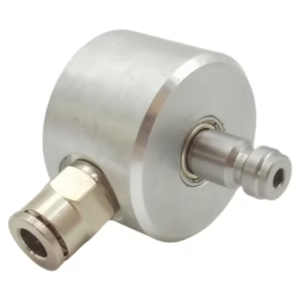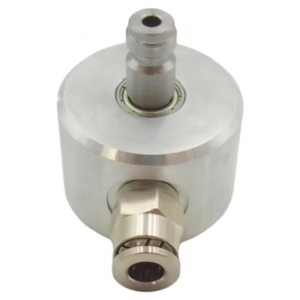
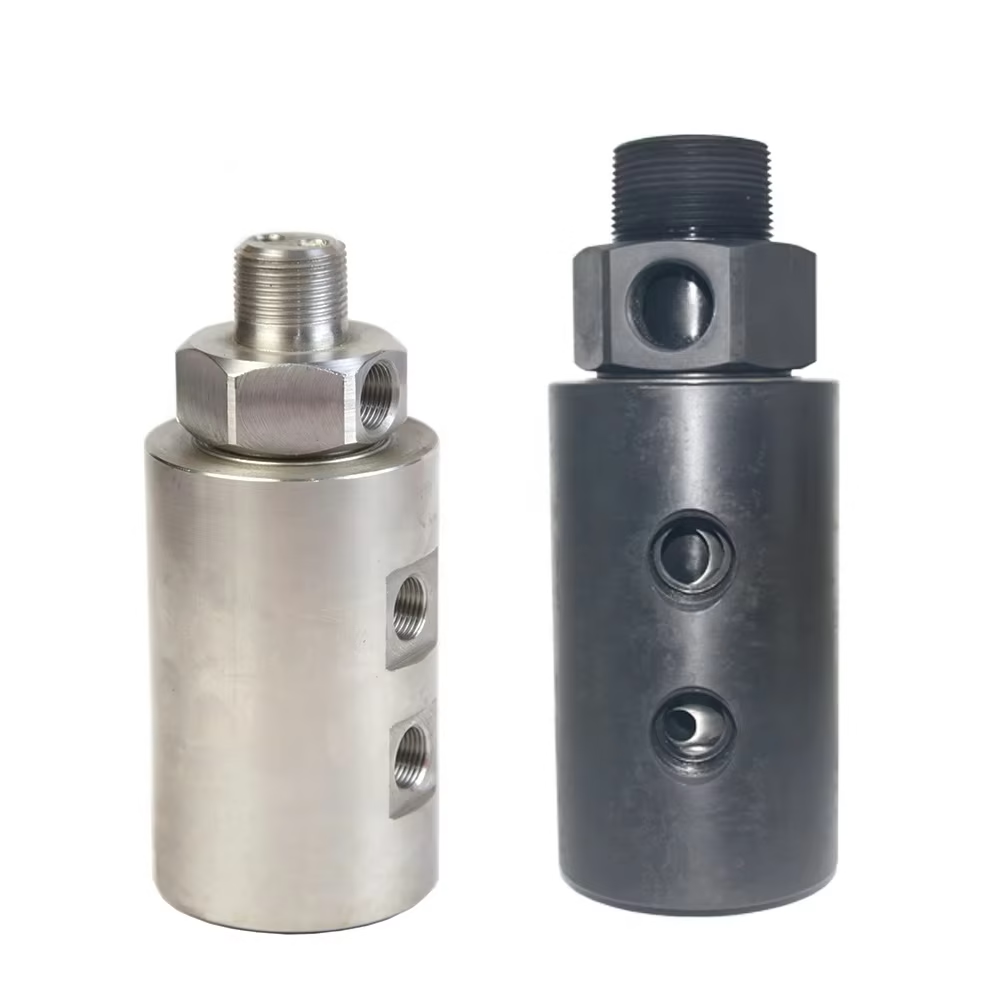
High Pressure Hydraulic Dual Channel Rotary Joint – Precision Fluid Transfer for Demanding Applications
Original price was: $120.00.$110.00Current price is: $110.00.
- Product name:</strong>Dual Channel Rotary Joint
- Connection:Male
- Thread:BSPP BSPT NPT
- Surface treatment:machining
- Medium:Water Compressed Air Hydraulic Oil
- Maximum pressure: 30MPa
- Maximum speed: 150RPM
- Tolerable temperature:120℃
Description
A Dual Channel Rotary Joint is designed to transfer two independent media simultaneously between stationary pipelines and rotating equipment while maintaining complete separation between both flow passages. Compared with installing two individual rotary unions, a dual-channel design provides a more compact structure, fewer potential leakage points, simplified piping, and lower maintenance costs.
At Dann Hydraulic, we manufacture high-performance dual channel rotary joints for demanding industrial applications including CNC machining centers, rotary indexing tables, steel processing equipment, injection molding machines, robotics, packaging machinery, textile production lines, and automated manufacturing systems.
As a professional Chinese rotary union manufacturer, we specialize in producing cost-effective alternatives to leading international brands, including compatible replacement models for many Deublin dual-passage rotary unions. Every rotary joint is manufactured using precision CNC machining, high-quality sealing materials, and rigorous quality inspection procedures to ensure reliable performance under continuous operation.
Whether your equipment transfers coolant and compressed air, hydraulic oil and water, vacuum and air, or two independent cooling circuits, our dual channel rotary joints provide stable fluid transmission with long service life and minimal maintenance requirements.
Why Engineers Prefer Dual Channel Rotary Joints Instead of Two Separate Rotary Unions
Many machine builders originally install two individual rotary unions to transfer two different media. While this solution works, it introduces additional piping complexity, requires more installation space, and increases the number of potential leakage points.
A dual channel rotary joint integrates both media passages into one compact assembly, providing several practical advantages.
Reduced Installation Space
One integrated rotary joint occupies significantly less space than two separate units, making it ideal for compact machine designs where available installation space is limited.
Simplified Piping Layout
A single housing reduces the number of external hoses, fittings, and support brackets, resulting in cleaner machine layouts and easier maintenance.
Lower Leakage Risk
Every threaded fitting or pipe connection represents a potential leak point. By reducing the total number of connections, a dual channel rotary joint improves system reliability.
Improved Machine Reliability
Fewer components mean fewer wear points and a lower probability of unexpected failures, helping manufacturers reduce unplanned downtime.
Lower Total Cost of Ownership
Although a dual channel rotary joint performs the work of two individual rotary unions, it often lowers the overall ownership cost by reducing installation time, maintenance labor, spare parts inventory, and downtime.
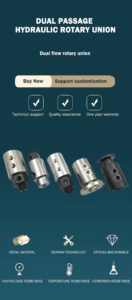

Key Features
High Pressure Resistance
- Supports hydraulic systems up to 250 bar (or customized higher)
- Stable sealing under pressure fluctuations
- Ideal for heavy-duty industrial environments
Dual Passage Independent Flow Design
- Two fully isolated channels
- Eliminates cross-contamination
- Optimized internal flow paths for minimal pressure loss
Advanced Mechanical Sealing System
- Carbon graphite/silicon carbide seal faces
- Balanced seal design reduces wear
- Leak-free operation under high speed and pressure
High-Speed Stability
- Precision-balanced rotor design
- Reduced vibration and thermal expansion
- Suitable for continuous operation
Durable Construction Materials
- Hardened alloy steel shaft
- Stainless steel or brass housing options
- Corrosion-resistant for harsh environments
Long Service Life & Low Maintenance
- Reduced friction design
- Extended seal life
- Lower downtime and maintenance cost
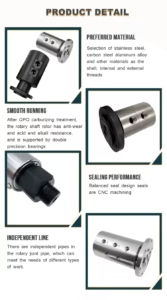
Product Advantages
Choosing the right rotary joint directly affects machine reliability, maintenance costs, and production efficiency. Our dual channel rotary joints are engineered to deliver long-term performance in harsh industrial environments.
Independent Dual Passage Design
The two internal flow passages remain completely separated throughout operation.
This allows equipment to simultaneously transfer combinations such as:
- Cooling water + compressed air
- Hydraulic oil + coolant
- Vacuum + compressed air
- Hot oil + cooling water
- Two independent coolant circuits
without internal leakage or pressure interference.
Precision Mechanical Seal Technology
The sealing system is one of the most important components of every rotary joint.
We use carefully selected sealing materials combined with precision-machined sealing faces to achieve:
- Low friction
- Stable sealing force
- Reduced wear
- Excellent leak resistance
- Longer maintenance intervals
Our optimized seal balance design also minimizes heat generation during continuous operation.
High Precision Bearing Support
Bearing performance directly influences seal life.
Our rotary joints utilize precision bearings capable of supporting both radial and axial loads while maintaining accurate shaft alignment.
Benefits include:
- Reduced vibration
- Improved rotational stability
- Lower operating torque
- Longer bearing life
- Increased sealing reliability
Excellent Machining Accuracy
Every housing, shaft, and sealing component is produced using CNC machining centers to maintain tight dimensional tolerances.
Precision machining provides:
- Better concentricity
- Improved sealing performance
- Stable rotation
- Consistent product quality
- Easier installation
Dimensional consistency also makes our products suitable as replacement rotary unions for many internationally recognized brands.
Durable Material Selection
Different industries require different material combinations.
Depending on operating conditions, we manufacture rotary joints using:
- Stainless steel
- Carbon steel
- Hardened alloy steel
- Brass
- Aluminum alloys
Seal materials are selected according to media compatibility, temperature, and operating pressure.
Easy Installation
Our compact design allows convenient installation on both new equipment and existing production lines.
Connection options include:
- BSP threads
- NPT threads
- Metric threads
- SAE connections
- Flange mounting
- Custom interfaces
This flexibility simplifies machine integration and replacement projects.

Technical Highlights
Our dual channel rotary joints are designed for demanding industrial environments where stable performance and long service life are essential.
Standard Features
- Dual independent media passages
- Precision mechanical sealing system
- Heavy-duty bearing support
- Optimized internal flow channels
- Low friction operation
- Compact housing design
- Excellent sealing reliability
- High machining accuracy
- Corrosion-resistant material options
- Long maintenance intervals
- OEM and custom manufacturing available
- Compatible replacement solutions for many international rotary union brands

Typical Applications of Our Dual Channel Rotary Joint
A dual channel rotary joint is more than a fluid transfer component—it is a critical interface between stationary pipelines and rotating equipment. In many industries, one passage delivers the working medium while the second passage returns the medium or supplies a different fluid or gas. This integrated design improves machine efficiency, reduces installation complexity, and supports continuous production.
Below are some of the most common industrial applications where our dual channel rotary joints deliver reliable long-term performance.
CNC Machining Centers
Modern CNC machining centers require a continuous supply of coolant and compressed air to rotating spindles. A dual channel rotary joint enables both media to pass through the spindle simultaneously without hose twisting.
Typical applications include:
- Through-spindle coolant systems
- High-speed milling machines
- Drilling centers
- Multi-axis machining centers
- Automatic tool changing systems
Customer Benefits
- Improved cooling efficiency
- Better chip evacuation
- Increased machining accuracy
- Reduced spindle downtime
- Longer spindle service life
Rotary Indexing Tables
Rotary indexing tables continuously rotate while supplying hydraulic oil, coolant, or compressed air to workholding fixtures.
Our rotary joints provide reliable media transfer during repetitive indexing operations.
Typical equipment includes:
- Rotary assembly tables
- Welding automation systems
- Robotic positioning systems
- Automated inspection stations
Advantages include:
- Stable media supply during rotation
- Reduced hose entanglement
- Compact installation
- Increased automation reliability
Plastic Injection Molding Machines
Injection molding equipment frequently requires two separate media circuits.
One passage supplies mold cooling water while the second provides compressed air for core pulling or part ejection systems.
Applications include:
- Multi-cavity molds
- Rotary molding tables
- Two-color injection molding
- High-speed molding equipment
Benefits:
- Improved mold temperature control
- Faster production cycles
- Consistent product quality
- Reduced maintenance
Steel and Metal Processing Equipment
Steel mills operate under harsh conditions involving heat, dust, vibration, and continuous operation.
Dual channel rotary joints are commonly installed on:
- Coil processing lines
- Decoilers
- Recoilers
- Rotary drums
- Rolling mills
- Tension reels
Typical transferred media include:
- Cooling water
- Hydraulic oil
- Lubricating oil
Reliable sealing helps prevent costly production interruptions caused by fluid leakage.
Packaging Machinery
High-speed packaging equipment often combines vacuum systems with compressed air to handle products efficiently.
Our rotary joints support:
- Rotary filling machines
- Bottle packaging systems
- Pharmaceutical packaging
- Food packaging equipment
- Labeling systems
Benefits include:
- Stable vacuum transmission
- Reliable pneumatic control
- Continuous high-speed production
- Reduced maintenance downtime
Printing Industry
Printing presses require stable cooling to maintain print quality while simultaneously operating pneumatic control systems.
Typical applications include:
- Flexographic printing
- Offset printing
- Gravure printing
- Digital printing equipment
Our dual channel rotary joints ensure continuous cooling and air transfer without interrupting machine operation.
Textile Machinery
Modern textile equipment operates continuously at high rotational speeds.
Rotary joints support:
- Yarn winding machines
- Dyeing equipment
- Fabric finishing lines
- Textile rollers
Advantages:
- Stable temperature control
- Improved production consistency
- Longer equipment life
- Reduced maintenance frequency
Tire and Rubber Manufacturing
Rubber processing equipment often combines cooling water with compressed air or hydraulic systems.
Applications include:
- Tire building machines
- Rubber calenders
- Mixing equipment
- Rotary curing presses
Reliable fluid transfer helps maintain precise temperature control throughout production.
Robotics and Industrial Automation
Industrial robots increasingly require rotating joints capable of transmitting multiple media.
Typical media combinations include:
- Air + vacuum
- Air + coolant
- Hydraulic oil + compressed air
Applications include:
- Robotic welding cells
- Material handling systems
- Automated assembly lines
- Pick-and-place robots
A compact dual channel rotary joint reduces cable and hose management issues while improving system flexibility.
Food and Beverage Equipment
Many food processing machines require hygienic fluid transfer for rotating equipment.
Typical applications include:
- Mixing equipment
- Filling systems
- Rotary washing machines
- Bottle handling equipment
Optional stainless steel construction improves corrosion resistance and supports demanding operating environments.

Common Problems Solved by Our Dual Channel Rotary Joint
Many equipment failures originate from an improperly selected rotary union rather than the machine itself. Our engineering team frequently helps customers solve the following issues.
Problem 1 – Media Leakage During Rotation
Common Causes
- Worn seals
- Poor machining accuracy
- Incorrect installation
- Excessive vibration
Our Solution
We use precision-machined sealing surfaces, optimized seal balance, and high-quality sealing materials to maintain reliable sealing performance throughout continuous operation.
Result:
- Lower leakage rates
- Cleaner production environment
- Reduced maintenance costs
Problem 2 – Cross Leakage Between Two Channels
When transferring two different media, internal leakage can contaminate the process.
For example:
- Water enters compressed air lines.
- Hydraulic oil mixes with coolant.
- Vacuum performance decreases.
Our Solution
Independent sealing structures completely separate both flow passages.
Each media channel maintains its own sealing system, significantly reducing the risk of cross-contamination.
Problem 3 – Premature Seal Failure
High friction and poor shaft alignment often shorten seal life.
Our Solution
Our engineers optimize:
- Seal face geometry
- Bearing support
- Rotating balance
- Surface finish
These improvements reduce friction and extend seal service life.
Problem 4 – Bearing Damage
Bearings often fail because of vibration, misalignment, or contamination.
Our Solution
Every rotary joint incorporates precision bearings designed for continuous industrial operation.
Additional protective features help reduce contamination and improve long-term stability.
Benefits include:
- Lower vibration
- Better shaft alignment
- Longer bearing life
- Improved seal reliability
Problem 5 – Difficult Installation
Installing two separate rotary unions requires additional brackets, hoses, and fittings.
Our Solution
One integrated dual channel rotary joint simplifies installation by reducing components and minimizing piping complexity.
Customers benefit from:
- Faster installation
- Easier maintenance
- Cleaner machine layout
- Lower installation cost

Why Equipment Manufacturers Choose Our Dual Channel Rotary Joints
Machine builders, maintenance engineers, and OEM manufacturers choose our products because they require more than standard catalog components.
They need rotary joints that operate reliably under real production conditions.
Our products provide:
- Stable continuous operation
- Low maintenance requirements
- Precision machining
- Long sealing life
- Excellent dimensional consistency
- Flexible customization
- Competitive factory-direct pricing
- Technical engineering support
Whether supplying a single replacement unit or supporting large-scale OEM production, we focus on delivering consistent quality and dependable performance.

Why Manufacturers Worldwide Choose Dann Hydraulic
Selecting a rotary joint supplier is about more than comparing specifications. Consistent product quality depends on engineering expertise, manufacturing precision, quality control, and the ability to support customers throughout the product lifecycle.
At Dann Hydraulic, rotary unions are not trading products—they are our core manufacturing focus. We work with OEM machine builders, industrial distributors, maintenance contractors, and end users across multiple industries, providing reliable rotary union solutions for both standard and custom applications.
Our goal is simple: manufacture rotary joints that deliver stable performance, long service life, and dependable sealing under real industrial operating conditions.
Manufacturing Experience You Can Depend On
For many years, our engineering and production teams have specialized in the design and manufacture of rotary unions for transferring water, thermal oil, steam, compressed air, vacuum, hydraulic oil, coolant, and other industrial media.
This long-term focus has allowed us to accumulate practical experience across a wide range of industries, including:
- CNC machine tools
- Steel and aluminum processing
- Paper manufacturing
- Plastic injection molding
- Textile machinery
- Packaging equipment
- Tire and rubber production
- Food processing
- Industrial automation
- Robotics
Rather than supplying a one-size-fits-all product, we understand that every application has unique operating conditions. Our engineers evaluate each project based on factors such as rotational speed, pressure, temperature, media compatibility, shaft size, and installation space to recommend the most appropriate rotary joint configuration.
Precision CNC Manufacturing
Every dual channel rotary joint begins with precision manufacturing.
Critical components—including the housing, rotor, shaft, seal seat, bearing chamber, and connection interfaces—are machined using advanced CNC equipment to achieve consistent dimensional accuracy.
Our machining process focuses on maintaining:
- Excellent concentricity
- Accurate shaft alignment
- Stable sealing surfaces
- Tight dimensional tolerances
- Smooth internal flow passages
High machining accuracy helps reduce vibration, improve seal performance, and ensure interchangeability for replacement applications.
Because every component is produced according to controlled manufacturing procedures, customers receive products with consistent quality from one production batch to the next.
Material Selection Based on Real Working Conditions
Industrial environments vary significantly. A rotary joint used on a high-speed machining center operates under different conditions than one installed on a steel mill or paper machine.
Instead of using identical materials for every application, we select component materials according to operating requirements.
Available housing and rotating component materials include:
- Stainless steel
- Carbon steel
- Hardened alloy steel
- Brass
- Aluminum alloy
Seal material options are selected based on:
- Operating temperature
- Pressure requirements
- Rotational speed
- Media compatibility
- Chemical resistance
- Wear resistance
Bearing selection is equally important. Depending on application requirements, we use precision bearings designed to maintain rotational stability while supporting radial and axial loads.
This engineering approach allows us to optimize both performance and service life.
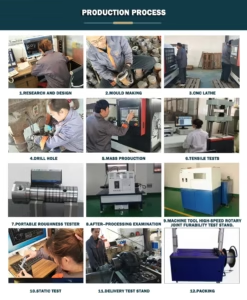
Strict Quality Control Throughout Production
Reliable rotary unions require more than precision machining. Every stage of production must be monitored to ensure that finished products meet consistent quality standards.
Our quality control process covers the entire manufacturing workflow.
Incoming Material Inspection
Before production begins, raw materials are inspected to verify:
- Material grade
- Dimensions
- Surface condition
- Mechanical properties
Only qualified materials proceed to machining.
In-Process Inspection
During production, technicians perform dimensional inspections on critical components to ensure machining accuracy.
Inspection items include:
- Shaft diameter
- Housing dimensions
- Thread accuracy
- Seal cavity dimensions
- Bearing fit
- Concentricity
This process helps prevent dimensional deviations before assembly.
Assembly Inspection
Each rotary joint is assembled according to standardized procedures.
Assembly technicians verify:
- Bearing installation
- Seal positioning
- Torque specifications
- Rotational smoothness
- Component cleanliness
Proper assembly directly affects sealing performance and product longevity.
Final Product Inspection
Before shipment, finished rotary joints undergo comprehensive inspection to verify overall quality and performance.
Inspection includes:
- Appearance inspection
- Dimensional verification
- Rotation check
- Connection inspection
- Identification verification
Only products that pass inspection move to testing and packaging.
Pressure and Leakage Testing
Industrial customers expect rotary joints to perform reliably from the moment they are installed.
To help ensure dependable operation, every dual channel rotary joint is tested before shipment.
Depending on product type and customer requirements, testing may include:
Pressure Testing
Pressure testing verifies that the rotary joint can safely withstand its specified operating pressure without deformation or leakage.
Leakage Testing
Each flow passage is checked independently to confirm sealing integrity.
Leakage testing helps verify that:
- External leakage is minimized.
- Internal cross leakage between the two channels is prevented.
- Sealing performance meets design requirements.
Rotation Testing
Rotary joints are rotated under controlled conditions to verify:
- Smooth operation
- Stable bearing performance
- Proper seal contact
- Consistent rotational resistance
Functional Verification
Connection dimensions, flow passage configuration, and assembly accuracy are verified before products are packaged for shipment.
These testing procedures help reduce installation issues and improve customer confidence.

Frequently Asked Questions
1. Can both channels transfer different media?
Yes. Each passage is independently sealed, allowing different compatible media such as cooling water, compressed air, hydraulic oil, vacuum, or coolant to flow simultaneously without mixing.
2. Can you manufacture a replacement for our existing rotary joint?
Yes. We manufacture compatible replacement rotary joints for many international brands. Simply provide the model number, technical drawing, or sample, and our engineers will evaluate the replacement solution.
3. Can you customize connection threads?
Absolutely.
Available connection standards include:
- BSP
- NPT
- Metric
- SAE
- Custom flange connections
Custom dimensions are also available.
4. What materials are available?
Material options include:
- Stainless steel
- Carbon steel
- Hardened alloy steel
- Brass
- Aluminum alloy
Material selection depends on the operating environment and transferred media.
5. What industries commonly use dual channel rotary joints?
Typical industries include:
- CNC machining
- Steel processing
- Injection molding
- Packaging
- Textile manufacturing
- Printing
- Tire production
- Robotics
- Automation
- Food processing
6. How long is the service life?
Service life depends on operating conditions such as pressure, speed, temperature, media cleanliness, and maintenance practices.
Under proper operating conditions, our rotary joints are designed for reliable long-term industrial service.
7. Do you provide OEM manufacturing?
Yes.
We support:
- OEM production
- Custom branding
- Private labeling
- Customized dimensions
- Engineering modifications
8. Can the rotary joint operate continuously?
Yes.
Our dual channel rotary joints are designed for continuous industrial operation when installed and maintained according to recommended operating conditions.
9. How can I choose the correct model?
Simply provide:
- Media type
- Pressure
- Temperature
- Rotational speed
- Connection dimensions
- Equipment drawings (if available)
Our engineering team will recommend the most suitable solution.
10. Why choose Dann Hydraulic?
Customers choose Dann Hydraulic because we offer:
- Professional rotary union manufacturing experience
- Precision CNC machining
- Strict quality inspection
- Flexible OEM capability
- Competitive factory-direct pricing
- Reliable technical support
- Fast production lead times
- Global export experience

Partner with Dann Hydraulic for Reliable Rotary Union Solutions
A rotary joint is a critical component in any rotating fluid transfer system. Its performance directly affects machine uptime, production efficiency, and maintenance costs.
At Dann Hydraulic, we combine engineering expertise, precision manufacturing, and rigorous quality control to deliver dual channel rotary joints that perform reliably in demanding industrial environments. Whether you need a standard model, a custom-engineered solution, or a cost-effective replacement for an imported rotary union, our team is ready to support your project.
From initial design consultation to production and after-sales technical assistance, we are committed to helping customers improve equipment reliability while reducing long-term operating costs.
Contact our engineering team today to discuss your application, request technical recommendations, or receive a customized quotation for your next project.
Related products
-
Sale!
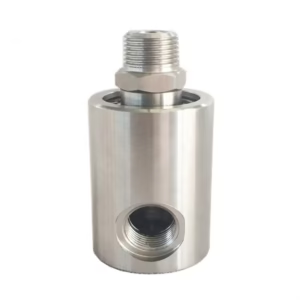
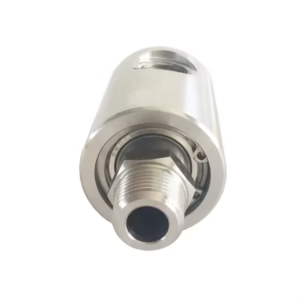
High Pressure Rotary Pressure Joint for Industrial Fluid Transfer
Original price was: $50.00.$35.00Current price is: $35.00. -
Sale!

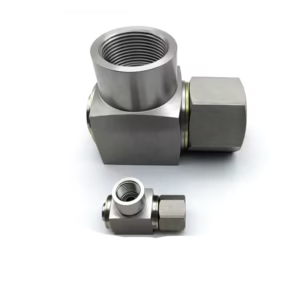
Stainless Steel High Pressure Hydraulic Right Angle Joint
Original price was: $20.00.$15.00Current price is: $15.00. -
Sale!
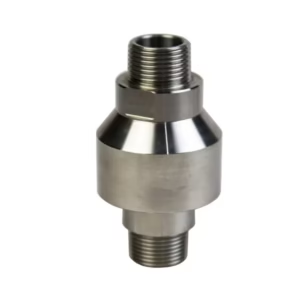
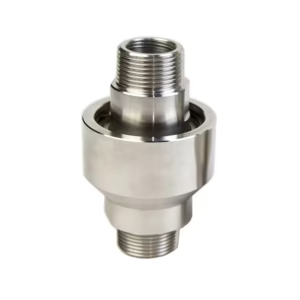
High Pressure Tower Crane Rotary Joint for Dust Removal
Original price was: $35.00.$30.00Current price is: $30.00. -