OEM vs Aftermarket Rotary Joint: Cost, Performance, and Lifespan Comparison
Introduction: Why Industrial Buyers Are Turning to Aftermarket Rotary Joints
In modern industrial environments, procurement teams are constantly challenged to balance equipment reliability with cost efficiency. Rotary joints—also known as rotary unions—are critical components used to transfer media such as coolant, oil, air, steam, or hydraulic fluid from stationary sources into rotating machinery. When these components fail, downtime can disrupt production lines and significantly inc.
Traditionally, many companies relied exclusively on OEM brands such as Deublin or Maier. While these brands are well known for engineering quality, they are often associated with high procurement costs, long lead times, and limited customization flexibility. As manufacturing technology advances globally, many industrial buyers now consider the Aftermarket Rotary Joint.
In the high-stakes world of industrial manufacturing—whether it’s paper, printing, rubber, or CNC machining—the rotary joint (or rotary union) is a critical component. When a rotary joint fails, production stops.
For decades, maintenance managers faced a binary choice: pay the premium price for an Original Equipment Manufacturer (OEM) part like Deublin, Maier, or Kadant to ensure quality, or risk operations with a “cheap” generic replacement.
However, the landscape of fluid handling technology has shifted. As a dedicated source manufacturer of aftermarket rotary joints based in China, we have witnessed this evolution firsthand. Today, the gap between top-tier aftermarket components and OEM parts has not only closed—in some specific customization scenarios, the aftermarket solution offers superior agility and value.
This article provides a transparent, technical comparison between OEM and high-quality Aftermarket Rotary Joints, strictly evaluating them on Cost, Performance, and Lifespan to help you make an informed procurement decision.
What Is an Aftermarket Rotary Joint?
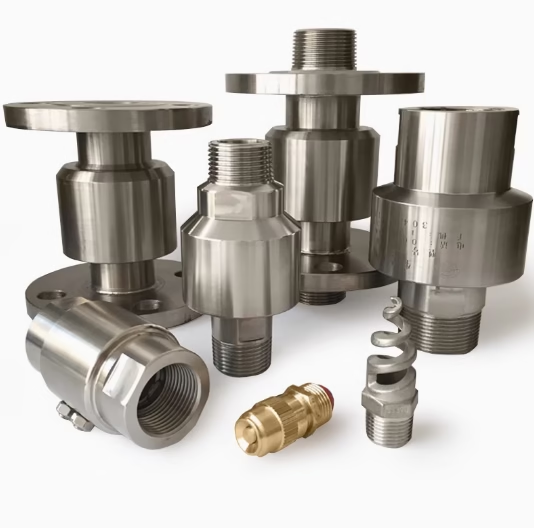
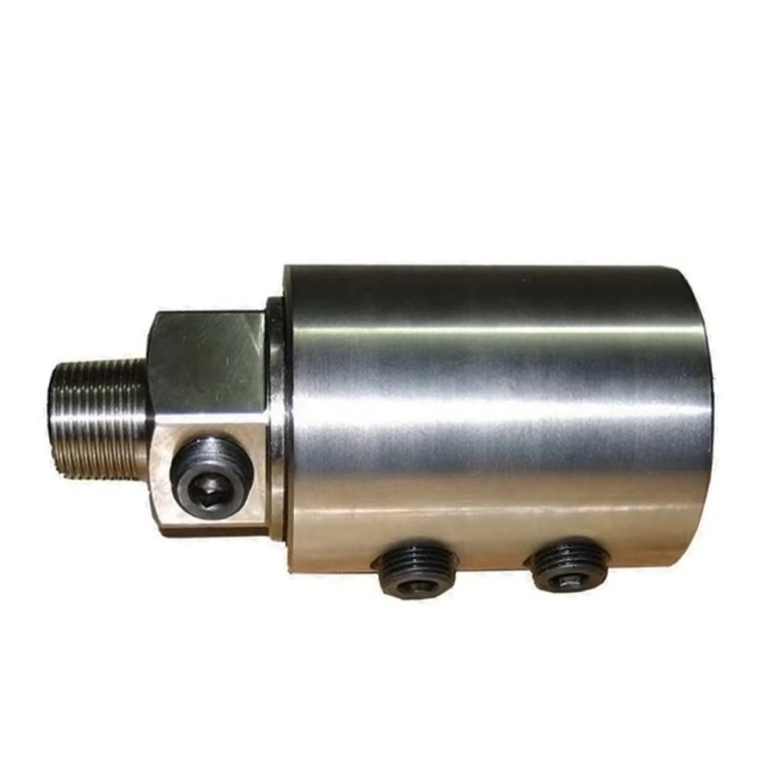
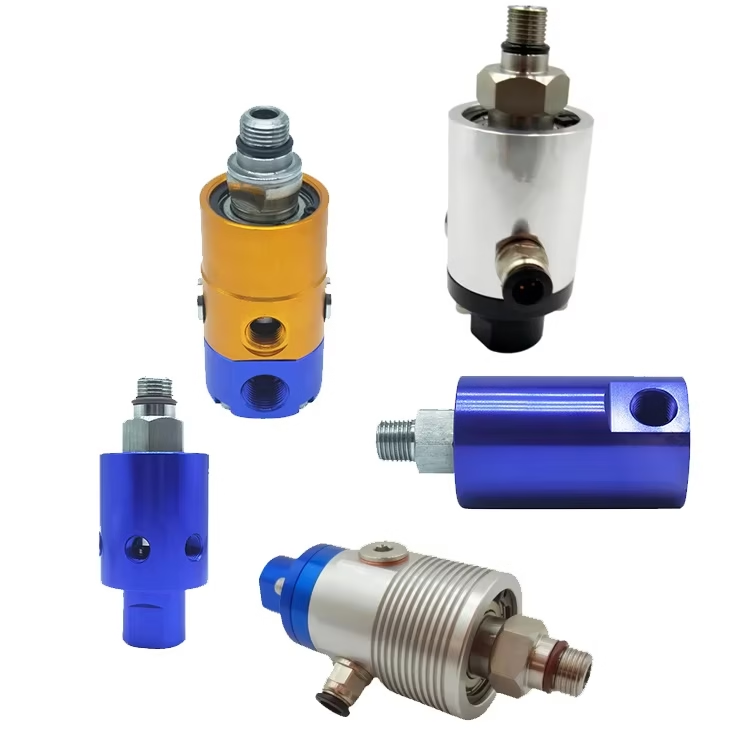
An Aftermarket Rotary Joint refers to a rotary union manufactured by an independent engineering company rather than the original equipment brand. These components are typically designed to be fully compatible replacements for existing equipment and may offer improvements in cost efficiency or availability.
Key characteristics of a high-quality aftermarket rotary joint include:
-
Compatibility with OEM installation dimensions
-
Equivalent or improved pressure and speed ratings
-
Use of advanced seal materials such as silicon carbide or carbon graphite
-
Support for cross-referencing international rotary joint models
-
Flexible engineering customization for specific industrial applications
Aftermarket rotary joints are widely used in CNC machining centers, rolling mills, paper production lines, plastic extrusion systems, printing machines, and automated industrial equipment.
1. Defining the Contenders: OEM vs. Professional Aftermarket
Before diving into the data, we must clarify what “Aftermarket” means in 2024.
-
The OEM (Original Equipment Manufacturer): Brands like Deublin or Maier. They set the standard. You are paying for their R&D, their brand legacy, and their global distribution network. Their quality is undeniable, but their pricing structure includes significant overhead.
-
The “Cheap” Aftermarket: Low-cost copycats often found on generic marketplaces. These use inferior seal materials (e.g., carbon graphite vs. tungsten carbide), adhere to loose tolerances, and lack pressure testing. We advise avoiding these.
-
The “Professional” Aftermarket (Our Tier): This category consists of specialized manufacturers (Source Factories) who engineer replacements that meet or exceed OEM specifications. We utilize the same raw materials (often imported seal faces) and CNC precision machining, but operate with a leaner supply chain.
Key Takeaway: When we discuss “Aftermarket Rotary Joints” in this article, we refer to Professional Engineered Replacements, not low-end imitations.
2. Cost Analysis: Beyond the Purchase Price
The most obvious driver for switching to an aftermarket rotary joint is cost. However, a savvy procurement officer looks at Total Cost of Ownership (TCO).
A. Direct Capital Expenditure (CAPEX)
Typically, a high-quality aftermarket rotary joint from a direct source factory costs 30% to 50% less than its OEM counterpart.
-
Why? You are not paying for the “Brand Premium,” the expensive European/American labor overhead, or the multi-tiered distribution markups. You are paying for the material and the machining.
B. Lead Time and Opportunity Cost
This is where the aftermarket often wins. OEM supply chains can be rigid. Ordering a specific, non-standard model might incur lead times of 6-8 weeks.
-
The Aftermarket Advantage: As a source factory, we maintain a stock of common replacements for Deublin and Maier series. Our production lines are agile. A one-day delay at a paper mill can cost thousands of dollars. If an aftermarket supplier can ship in 3 days vs. the OEM’s 3 weeks, the “cost” savings are exponential.
C. Inventory Costs
Because aftermarket units are more affordable, plants can afford to keep critical spares on the shelf. Holding an OEM spare might tie up $2,000 in capital; holding an equivalent aftermarket spare might tie up only $1,000.
| Cost Factor | OEM Rotary Joint | Pro Aftermarket Rotary Joint |
| Unit Price | High (100% baseline) | Moderate (50-70% of baseline) |
| Shipping Speed | Variable (often long for non-stock) | Fast (Agile manufacturing) |
| Customization Cost | Very High | Low (Direct communication with factory) |
3. Performance: The Engineering Reality
The skepticism surrounding aftermarket parts usually centers on performance. “Will it leak?” “Can it handle the RPM?”
Let’s break down the technical anatomy of a replacement rotary joint.
A. Sealing Technology (The Heart of the Joint)
The seal is the critical failure point. Top-tier aftermarket manufacturers use:
-
Seal Faces: Silicon Carbide (SiC) or Tungsten Carbide. We source these materials from the same global suppliers used by major brands.
-
Balanced Mechanical Seals: Just like OEM designs, high-end aftermarket joints use balanced seal technologies to reduce hydraulic pressure on the seal faces, minimizing wear and heat generation.
B. Machining Tolerances
Rotary unions require tight tolerances to prevent run-out (wobble).
-
OEM Standard: Typically maintains run-out within 0.005mm to 0.01mm.
-
Our Standard: Using modern 5-axis CNC machining centers, reputable Chinese factories now achieve these same tolerances. The era of “imprecise” manufacturing is largely over for ISO-certified facilities.
C. Bearings
OEMs use top-tier bearings (SKF, NSK, NTN).
-
Transparency: A trustworthy aftermarket supplier will openly state what bearings are inside. We use equivalent grade bearings (often NSK or SKF) to ensure the rotational stability matches the expected load and speed parameters.
Expert Insight: Performance issues in aftermarket parts usually stem from selecting the wrong model, not the manufacturing quality. Always ensure your aftermarket partner reviews your specific pressure (PSI), temperature, and media (water, steam, oil) requirements.
4. Lifespan Comparison: Longevity in the Field
How long will an aftermarket rotary joint last compared to a Deublin or Maier unit?
The Truth: In 90% of standard applications (water, air, hydraulic oil), the lifespan is statistically identical.
Factors Influencing Lifespan:
-
Media Purity: Dirty water kills both OEM and Aftermarket joints equally fast.
-
Alignment: Improper installation causes vibration, destroying bearings regardless of the brand.
-
Seal Wear Rate: Since we use equivalent material grades (e.g., Viton O-rings and Carbon/SiC seals), the wear rate curves are nearly superimposed.
Where OEM Might Have an Edge:
In extremely niche, hyper-critical applications (e.g., aerospace testing or extreme corrosive chemical handling), OEM proprietary coatings might offer a slight longevity edge. However, for general industrial machinery (printing, plastics, textiles), the aftermarket unit delivers the same cycle counts.
Engineering Experience: Real Industrial Use of Aftermarket Rotary Joints
In many industrial facilities, maintenance teams have transitioned from exclusive OEM procurement to mixed sourcing strategies that include aftermarket components. Field experience across various sectors demonstrates that aftermarket rotary joints are increasingly deployed in high-demand environments.
For example:
-
CNC machine tool operators often adopt aftermarket coolant rotary unions to reduce replacement costs without compromising spindle performance.
-
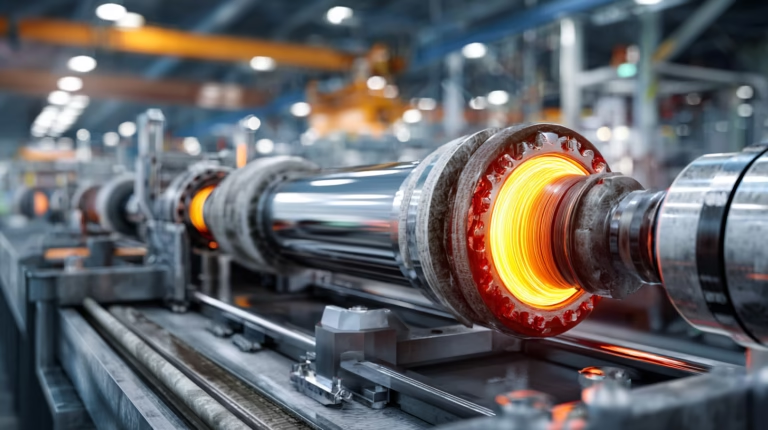
Steel processing plants utilize aftermarket roll cooling rotary joints to maintain consistent cooling under continuous operation.
-
Paper manufacturing lines implement aftermarket steam rotary joints to minimize downtime during scheduled maintenance intervals.
These practical applications show that the aftermarket rotary joint is no longer considered merely a budget alternative; instead, it represents a mature engineering solution supported by modern manufacturing capabilities.
Cost Comparison: OEM vs Aftermarket Rotary Joint
One of the primary motivations for considering an aftermarket rotary joint is cost optimization. OEM rotary joints frequently carry higher prices due to global distribution structures, brand premiums, and limited supply channels.
Typical Cost Observations
-
OEM rotary joints generally have higher upfront procurement costs.
-
Aftermarket rotary joints may reduce purchasing expenses by 30–60%.
-
Spare parts and maintenance components are often more affordable from aftermarket suppliers.
-
Custom engineering or modified dimensions can be produced more quickly by direct-source factories.
For facilities operating multiple machines or large production lines, transitioning to aftermarket rotary joints can significantly reduce total maintenance budgets while maintaining operational reliability.
Performance Comparison: Do Aftermarket Rotary Joints Match OEM Quality?
Modern aftermarket manufacturers invest heavily in precision engineering and material technology. High-quality aftermarket rotary joints are now produced using advanced CNC machining, high-precision grinding, and dynamic balancing techniques.
Seal Material Technology
Common advanced seal materials include:
-
Silicon carbide (SiC) for high-speed and high-wear applications
-
Tungsten carbide for high-pressure environments
-
Carbon graphite for thermal stability
-
Ceramic composite materials for extended service life
Engineering Performance Factors
-
Rotational speed capability
-
Pressure tolerance
-
Thermal resistance
-
Media compatibility
-
Leakage prevention performance
When properly engineered and tested, aftermarket rotary joints can deliver performance levels comparable to OEM solutions in many industrial applications.
Lifespan Comparison: Durability and Long-Term Reliability
Service life is determined by engineering design and operating conditions rather than brand origin alone. Key factors influencing lifespan include:
-
Seal material quality
-
Bearing structure and lubrication
-
Installation alignment
-
Operating pressure and temperature
-
Media cleanliness and cooling conditions
High-quality aftermarket rotary joints equipped with advanced sealing technology can achieve long operational lifespans in continuous industrial environments. In high-speed CNC spindle applications, aftermarket rotary unions with silicon carbide seal faces can support extended service intervals while maintaining stable sealing performance.
The “Source Factory” Advantage: Why Buy Direct from China?
As a global buyer, sourcing directly from a Chinese manufacturer offers distinct advantages beyond price.
-
Direct Technical Communication: You aren’t talking to a distributor’s sales rep who reads a catalog. You are talking to the engineers who machine the rotor. If you need a shaft modified or a different thread pitch, we can implement it immediately.
-
Traceability: We control every step, from raw material procurement (steel, brass, aluminum) to assembly and pressure testing.
-
Universal Compatibility: We engineer our products specifically to be drop-in replacements.
-
Example: If you use a Deublin 1109 Series, our replacement matches the mounting dimensions, thread sizes, and flow coefficients exactly. No retrofitting required.
-
OEM vs Aftermarket Rotary Joint Comparison Table
| Feature | OEM Rotary Joint | Aftermarket Rotary Joint |
|---|---|---|
| Initial Procurement Cost | High | Moderate to Low |
| Lead Time | Often Long | Flexible / Short |
| Custom Engineering | Limited | High Flexibility |
| Spare Part Cost | High | Lower |
| Installation Compatibility | OEM Specific | Cross-Referenced Models |
| Technical Performance | High | Comparable (Qualified Suppliers) |
| Maintenance Cost | High | Lower Lifecycle Cost |
| Availability | Restricted Channels | Direct Factory Supply |
When Should You Choose an Aftermarket Rotary Joint?
Industrial buyers may consider aftermarket rotary joints when:
-
OEM lead times exceed maintenance schedules
-
Equipment is out of warranty
-
Procurement budgets require optimization
-
Multiple machines require standardized spare parts
-
Rapid engineering customization is necessary
-
Local engineering support is preferred
Industries where aftermarket rotary joints are commonly adopted include CNC machining, steel processing, paper manufacturing, plastic extrusion, printing equipment, and automated assembly lines.
How to Evaluate Aftermarket Rotary Joint Suppliers (EEAT Trust Section)
To ensure reliability and long-term performance, buyers should evaluate suppliers using engineering and manufacturing criteria rather than price alone.
Recommended Evaluation Factors
-
In-house engineering design capability
-
Precision CNC machining and grinding equipment
-
Dynamic balancing technology for high-speed operation
-
Seal material research and testing capability
-
Pressure and rotational performance testing procedures
-
Quality management certifications, such as ISO standards
-
Proven OEM replacement experience
Direct-source manufacturers with specialized rotary joint engineering teams often provide more responsive technical support and more consistent product quality.
Case Study: Textile Factory Retrofit
Scenario: A large textile manufacturer in Southeast Asia was using Maier rotary joints for their cooling rollers. Problem: Maintenance costs were escalating, and lead times for replacements were averaging 5 weeks, causing production bottlenecks. Solution: They switched to our Aftermarket Rotary Joints (customized for high-temp steam). Result:
-
Cost Savings: Reduced annual procurement budget by 45%.
-
Performance: No detectable difference in steam leakage rates after 12 months of continuous operation.
-
Availability: Lead time reduced from 5 weeks to 10 days.
Common Buyer Questions About Aftermarket Rotary Joints
Can an aftermarket rotary joint replace a Deublin or Maier model?
Yes, provided installation dimensions, pressure ratings, speed limits, and media compatibility are verified during the selection process.
Are aftermarket rotary joints reliable for high-speed CNC machines?
High-speed designs using advanced seal materials and dynamic balancing can support demanding spindle coolant applications.
Will switching to aftermarket rotary joints affect equipment performance?
Performance depends on engineering quality and manufacturing precision rather than brand name alone.
Do aftermarket rotary joints require special installation procedures?
Most are designed for direct replacement with standard mounting interfaces, although correct alignment and installation remain essential.
What information should buyers provide when requesting a quotation?
Application details such as media type, pressure, temperature, rotational speed, mounting dimensions, and original model numbers help suppliers recommend suitable replacements.
Conclusion: Are Aftermarket Rotary Joints a Smart Engineering Choice?
The industrial landscape is evolving, and the Aftermarket Rotary Joint has become an increasingly attractive option for companies seeking to balance performance reliability with procurement efficiency. Advances in sealing technology, precision machining, and manufacturing quality have enabled modern aftermarket manufacturers to produce rotary joints that meet demanding operational requirements.
The debate between OEM vs. Aftermarket Rotary Joints is no longer about “Quality vs. Price.” It is about “Value.”
If you require a trusted brand name on the label and have an unlimited budget, OEM is a safe choice. However, if your priority is operational efficiency, cost reduction, and supply chain agility without compromising on sealing performance, high-quality aftermarket solutions are the rational engineering choice.
As a premier manufacturer, we invite you to test the difference. Don’t just take our word for it—request a sample, run it on your toughest line, and measure the results.
Ready to optimize your maintenance budget? [Contact our Engineering Team] for a cross-reference quote on your Deublin, Maier, or Kadant rotary unions today.