Multi Passage Rotary Union Applications Explained: A Complete Guide for Industrial Engineers
As industrial equipment becomes more automated, compact, and multifunctional, the demand for transferring multiple media through a single rotating interface continues to grow. Modern machinery often requires the simultaneous transmission of hydraulic oil, compressed air, coolant, vacuum, water, steam, and even electrical signals. Managing these different media efficiently while maintaining continuous rotation is a challenge that traditional single-channel rotary unions cannot solve. This is where the Multi-Passage Rotary Union becomes essential.
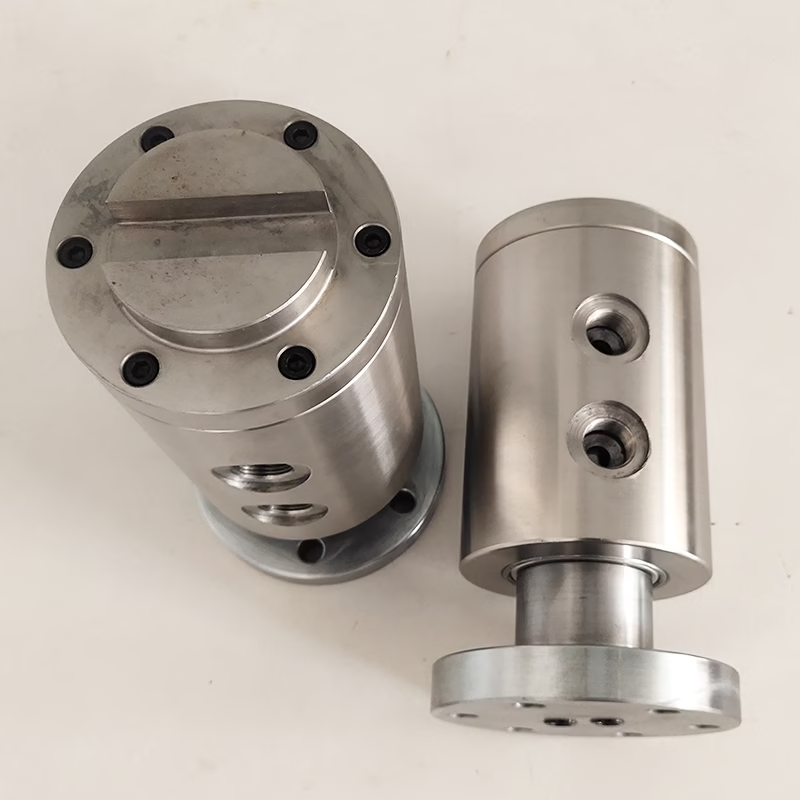
A multi-passage rotary union integrates several independent flow channels within one compact rotary interface, allowing multiple fluids or gases to pass from stationary sources to rotating equipment without leakage, pressure loss, or media contamination.
At our manufacturing facility, we have produced customized multi-passage rotary unions for customers in robotics, packaging, machine tools, steel processing, semiconductor equipment, printing machinery, offshore systems, and automation industries. Through years of design optimization and field experience, we have learned that selecting the correct multi-channel rotary union can significantly improve machine reliability, reduce maintenance costs, and increase production efficiency.
This guide explains how multi-passage rotary unions work, where they are used, common engineering challenges, and what factors engineers should consider when selecting a solution.
What Is a Multi-Passage Rotary Union?
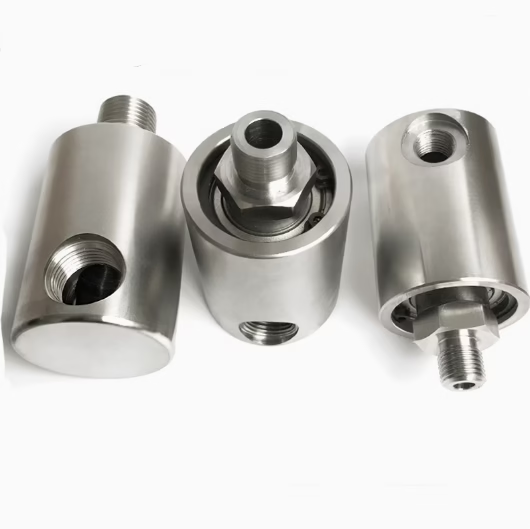
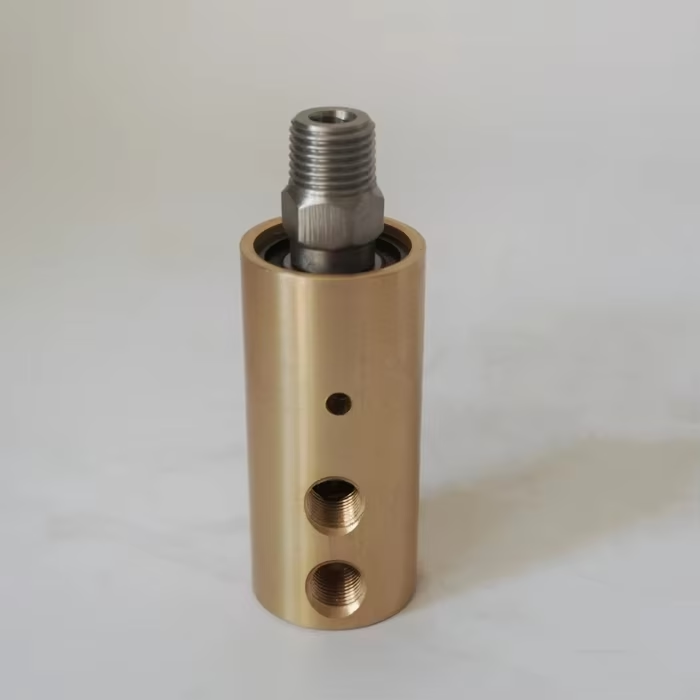
A Multi-Passage Rotary Union is a rotary sealing device designed with two or more independent flow channels.
Unlike a standard rotary union that transfers only one medium, a multi-passage design allows several fluids or gases to flow simultaneously through separate passages while the shaft rotates continuously.
Typical media include:
- Hydraulic oil
- Compressed air
- Vacuum
- Cooling water
- Hot oil
- Steam
- Nitrogen
- Lubricants
- Coolant
Some advanced versions combine fluid passages with:
- Electrical slip rings
- Ethernet transmission
- Fiber optic rotary joints
- Encoder signal channels
This integration creates a complete rotary transmission solution for highly automated systems.
How Does a Multi-Passage Rotary Union Work?
Each passage inside the rotary union is independently sealed using specialized sealing technology.
The design generally includes:
Rotor
Connected to the rotating shaft.
Housing
Connected to stationary fluid lines.
Independent Flow Channels
Separate passages prevent cross-contamination between different media.
Precision Bearings
Support rotational loads while maintaining seal alignment.
Mechanical Seals
Maintain leak-free operation under pressure and speed.
Internal Separation Chambers
Ensure media isolation.
When the machine rotates, each medium flows through its designated passage without mixing with adjacent channels.
The result is continuous, uninterrupted fluid transfer regardless of rotational movement.
Why Modern Machinery Requires Multi-Passage Rotary Unions
Industrial equipment has evolved significantly over the past decade.
Machines now require:
- Higher automation levels
- More process integration
- Reduced installation space
- Faster cycle times
- Greater reliability
Instead of installing several single-channel rotary unions, engineers increasingly choose one multi-passage rotary union because it offers:
Reduced Installation Space
One assembly replaces multiple rotary joints.
Simplified Piping
Fewer hoses and fittings reduce leak points.
Lower Maintenance Costs
Less hardware means fewer components to service.
Improved Reliability
Integrated designs reduce alignment issues.
Better Machine Aesthetics
Cleaner layouts improve accessibility and safety.
Key Applications of Multi-Passage Rotary Unions
1. Industrial Robotics
Robotics represents one of the fastest-growing applications for multi-pass rotary unions.
Modern robotic arms often require:
- Pneumatic grippers
- Vacuum suction systems
- Hydraulic actuators
- Sensor wiring
- Encoder signals
A multi-passage rotary union allows these systems to operate simultaneously through a single rotating interface.
Example
A robotic palletizing system may use:
- Two pneumatic channels
- One vacuum channel
- One electrical slip ring
This configuration allows the robot to pick, rotate, and place products continuously without cable twisting.
Manufacturing Experience
We regularly supply compact multi-channel rotary unions for robotic end-of-arm tooling (EOAT) applications where space constraints and high cycle rates are critical.
2. CNC Machining Centers
Machine tools require reliable fluid transmission during spindle rotation.
Common media include:
- Through-spindle coolant
- Air purge
- Lubrication oil
- Hydraulic clamping pressure
A multi-passage rotary union enables multiple functions within one spindle assembly.
Benefits
- Higher machining efficiency
- Improved tool life
- Faster tool changes
- Better chip evacuation
For high-speed CNC applications, balancing accuracy and seal design becomes a critical factor.
Our engineering team has developed customized high-speed solutions capable of operating in demanding machining environments where standard products often fail prematurely.
3. Packaging Machinery
Packaging equipment frequently uses rotating drums, indexing tables, and turret systems.
Required media may include:
- Vacuum
- Compressed air
- Cooling water
A multi-passenger rotary union allows these media to be supplied simultaneously during continuous rotation.
Applications include:
- Bottle filling systems
- Labeling machines
- Pharmaceutical packaging
- Food packaging lines
Because these systems often run 24/7, seal longevity becomes a major consideration.
4. Rotary Indexing Tables
Automated assembly lines rely heavily on indexing tables.
These systems commonly require:
- Pneumatic actuation
- Vacuum handling
- Hydraulic positioning
A multi-passage rotary union eliminates the need for complex hose management systems.
Benefits include:
- Increased uptime
- Faster assembly cycles
- Reduced maintenance
5. Semiconductor Manufacturing Equipment
Semiconductor production demands exceptional precision.
Typical applications include:
- Wafer handling systems
- Vacuum chambers
- Cleanroom automation
Requirements include:
- Ultra-low leakage
- Particle-free operation
- High-purity materials
In these environments, even microscopic contamination can affect production yield.
Our clean-manufacturing procedures ensure critical sealing surfaces meet stringent industrial requirements.
6. Printing Machinery
Printing presses require continuous transmission of:
- Air
- Cooling water
- Ink circulation fluids
Multi-passage rotary unions support:
- Flexographic printing
- Gravure printing
- Offset printing
By combining several channels into one assembly, operators reduce machine complexity and improve reliability.
7. Steel and Metal Processing Equipment
Steel mills operate under harsh conditions involving:
- High temperatures
- Scale contamination
- Heavy vibration
Applications include:
- Continuous casting machines
- Coil processing lines
- Roll cooling systems
A robust multi-passage rotary union provides multiple cooling and lubrication circuits while withstanding demanding operating environments.
8. Automated Welding Systems
Rotating welding fixtures require:
- Shielding gas
- Pneumatic clamping
- Cooling water
Multi-channel rotary unions simplify the integration of these services.
This enables:
- Faster production
- Improved weld quality
- Reduced maintenance
9. Offshore and Marine Equipment
Marine systems frequently require simultaneous transmission of:
- Hydraulic fluid
- Air
- Lubrication oil
Applications include:
- Winches
- Cranes
- Cable reels
- Offshore handling systems
Corrosion-resistant materials are critical in these environments.
We often manufacture marine rotary unions using stainless steel and special coatings to improve resistance to saltwater exposure.
Core Multi-Passage Rotary Union Applications Explained
Because they can consolidate complex fluid, power, and data lines into a compact footprint, multi-passage unions are the hidden heroes of industrial automation. Here are the four primary applications where our factory directly engineers solutions for global OEMs.
Application A: Heavy-Duty Excavators and Cranes (Central Swivel Joints)
When you watch a 30-ton excavator spin its upper cabin 360 degrees endlessly while still supplying power to the steel crawler tracks below, you are witnessing a massive multi-passage rotary union (often called a central swivel) at work.
-
The Challenge: The cabin houses the diesel engine and hydraulic pumps. The lower carriage houses the hydraulic drive motors for the tracks. The union sits dead-center in the pivot point, transferring massive volumes of hydraulic oil (often exceeding 350 Bar) while supporting the shock loads of an excavator digging through solid rock.
-
The Requirement: These unions typically require 6 to 12 passages. They must handle extreme pressure spikes (hydraulic hammering) and operate in heavily contaminated environments filled with mud, dust, and water.
-
Our Manufacturing Focus: For construction machinery, we focus on massive structural rigidity. We utilize high-grade forged steel housings and oversized thrust bearings capable of surviving intense radial and axial shock loads without misaligning the internal sealing gaps.
Application B: CNC Rotary Indexing Tables and Trunnions
Modern 4-axis and 5-axis CNC machining centers rely on rotary indexing tables to manipulate the workpiece. To automate this process, hydraulic and pneumatic lines must be routed into the spinning table to actuate work-holding clamps, while coolant lines must be routed to clear chips.
-
The Challenge: Space inside a CNC machine is highly restricted. The union must be incredibly compact, yet capable of handling 200 Bar of clamping hydraulics, 8 Bar of part-sensing air, and high-flow cutting coolant simultaneously.
-
The Requirement: Zero leakage. Even a single drop of hydraulic oil leaking onto a precision-machined aerospace component can ruin the surface finish and scrap a $10,000 part.
-
Our Manufacturing Focus: We engineer ultra-compact, lightweight aluminum-housed multi-passage unions specifically for the machine tool sector. We integrate specialized drainage channels to ensure that any microscopic bypass of cutting coolant is routed away from the machine’s precision encoders and bearings.
Application C: Plastic Injection and Blow Molding Machinery
In the production of plastic bottles, containers, and automotive components, rotary molds are used to massively increase production output. These rotating mold carousels require precise temperature control.
-
The Challenge: The plastic must be injected hot, and then rapidly cooled before the mold opens. This requires routing high-temperature heating fluids (like thermal oil at 180°C or steam) and chilled cooling water into the exact same rotating assembly.
-
The Requirement: Extreme thermal isolation. If the hot line and the cold line are adjacent, the thermal transfer within the metal housing of the rotary union will destroy the temperature efficiency of the process.
-
Our Manufacturing Focus: We design specialized multi-passage joints with air-gap insulation chambers machined directly into the rotor. This prevents thermal bleeding between passages. Furthermore, we utilize high-temperature Perfluoroelastomer (FFKM) secondary seals capable of surviving aggressive thermal cycling without hardening or cracking.
Application D: Steel and Aluminum Coil Slitting Lines
In metallurgical processing, massive coils of sheet metal are mounted onto expanding mandrels (decoilers and recoilers).
-
The Challenge: To grip the internal diameter of the 20-ton steel coil, the mandrel must expand outward. This is achieved by pumping high-pressure hydraulic oil into the spinning mandrel. Simultaneously, pneumatic lines may be needed to actuate braking mechanisms or engage safety locks.
-
The Requirement: High flow rates and absolute pressure retention. If hydraulic pressure drops during the recoiling process, the steel coil will slip, causing catastrophic damage to the production line and severe safety risks to the operators.
-
Our Manufacturing Focus: We engineer heavy-duty unions with optimized internal flow geometries to minimize pressure drop. Every unit is pressure-tested dynamically for 24 hours to ensure zero pressure decay before it leaves our facility.
Common Design Configurations
Two-Passage Rotary Union
Suitable for:
- Air + air
- Air + vacuum
- Water + water
Four-Passage Rotary Union
Common in automation systems.
Typical media combinations:
- Pneumatic channels
- Cooling water channels
Six-Passage Rotary Union
Used in robotics and packaging systems.
Eight-Passage Rotary Union
Designed for advanced automated machinery.
Custom Multi-Passage Designs
Some customer projects require:
- 12 passages
- 16 passages
- 24 passages
Custom engineering becomes essential in these applications.
Common Failure Modes and Solutions
Understanding failure causes helps maximize service life.
Seal Wear
Causes:
- Dry running
- Contamination
- Excessive pressure
Solution:
- Proper filtration
- Correct media selection
- Scheduled maintenance
Cross-Port Leakage
Causes:
- Seal damage
- Internal wear
Solution:
- High-quality sealing materials
- Precision machining
Bearing Failure
Causes:
- Misalignment
- Excessive radial load
Solution:
- Correct installation
- Proper shaft support
Overheating
Causes:
- Excessive rotational speed
- Poor lubrication
Solution:
- Optimized bearing selection
- Thermal management design
Why Manufacturing Experience Matters
Many rotary unions appear similar externally.
However, performance depends heavily on:
- Seal technology
- Bearing selection
- Surface finish quality
- Machining accuracy
- Assembly procedures
As a rotary union manufacturer, we have observed numerous failures caused by poorly controlled production processes rather than design limitations.
Our production facility emphasizes:
Precision CNC Machining
Critical sealing surfaces are machined to tight tolerances.
Dynamic Balancing
Essential for high-speed applications.
Pressure Testing
Every unit undergoes leak testing before shipment.
Material Traceability
Raw materials are documented and verified.
Customized Engineering Support
Our engineers work directly with customers to optimize designs for specific operating conditions.
With this manufacturing experience, we provide replacement solutions for many imported rotary union brands at competitive prices and with reliable performance.
Why Customers Trust Our Multi-Passage Rotary Union Solutions
Procuring a multi-passage rotary union from a standard catalog distributor is a massive risk. These units are highly application-specific. At our manufacturing facility in China, we bypass the middleman to provide direct engineering consultation, backed by rigorous quality control.
Uncompromising Concentricity Control
In a multi-passage joint featuring 8 different fluid channels, the rotor shaft is long. If that shaft is machined with even $0.05\text{ mm}$ of runout (wobble), it will act as a cam inside the housing, crushing the seals on one side and opening a leak path on the other.
We machine our rotors on multi-axis turning centers in a single setup. This ensures absolute concentricity across the entire length of the shaft. When our engineers verify the dimensions, we hold tolerances to the micron level.
Live, Multi-Media Dynamic Testing
We do not rely on static air-pressure tests. Every multi-passage union is hooked up to our proprietary dynamic test rigs.
If your application requires hydraulic oil, air, and water, we test it with all three simultaneously. We pressurize the adjacent channels, spin the unit to your maximum operational RPM, and monitor the vent holes with digital sensors to guarantee zero cross-talk before the component is crated for international shipping.
Transparent Material Selection
We believe in engineering transparency. When we provide a quote, we do not use vague terms like “high-quality seals.” We provide a full bill of materials (BOM) specifying the exact grade of the housing (e.g., 6061-T6 Aluminum or 316L Stainless Steel), the precise compound of the dynamic seals (e.g., Carbon-Filled PTFE), and the ABEC rating of the internal bearings. You know exactly what is protecting your machinery.
Future Trends in Multi-Passage Rotary Union Technology
Several trends are shaping the future of rotary transmission systems:
- Higher rotational speeds
- Increased automation
- Smart monitoring systems
- Integrated slip ring technology
- Compact lightweight designs
- Industry 4.0 compatibility
As machinery becomes more sophisticated, demand for advanced multi-passage rotary unions will continue to grow.
Conclusion
The Multi-Passage Rotary Union has become an essential component in modern industrial equipment. By enabling multiple fluids, gases, and signals to pass through a single rotating interface, these devices improve machine efficiency, simplify system design, and reduce maintenance requirements.
From robotics and CNC machining centers to packaging equipment, semiconductor manufacturing, steel mills, and offshore systems, multi-passage rotary unions provide the reliable rotary transmission needed for today’s automated production environments.
When selecting a solution, engineers should look beyond catalog specifications and consider manufacturing quality, sealing technology, field experience, and long-term reliability. A well-designed multi-passage rotary union is not simply a component—it is a critical contributor to overall machine performance and productivity.