Comprehensive Guide to Rotary Joints for Air: Working Principles, Types, and Applications
Introduction
In the realm of modern industrial automation and manufacturing, Rotary Joints for Air (also referred to as pneumatic rotary joints or air rotary unions) serve as critical components that facilitate uninterrupted airflow between stationary and rotating equipment. From robotic arms and packaging machines to high-speed spindles and indexing tables, these precision devices enable compressed air, vacuum, or inert gas to pass smoothly while allowing rotation and preventing leaks or contamination.
In this guide, you will learn:
-
What rotary joints for air are and how they work
-
Their construction and key design features
-
The main types of rotary joints for air are available
-
Where and how they are used in industry
-
How to select and maintain them for the best performance
What Are Rotary Joints for Air?
A Rotary Joint for Air is a mechanical assembly that allows the transfer of air (or gas) from a stationary supply line to a rotating component, maintaining a sealed passage while the component spins. Without such a device, hoses or rigid piping would twist or break, airflow would stop, or leakage would occur.
Essentially, the device solves three challenges:
-
Continuous rotation while maintaining airflow
-
A reliable sealing mechanism to prevent leaks
-
Mechanical stability to support rotation under pressure or speed
In short, if your machine involves rotation plus compressed air (or vacuum) supply, a rotary joint for air is the interface that makes it possible.
How Do Rotary Joints for Air Work?
The working principle of an air rotary joint connects the fixed and rotating parts through a carefully engineered seal and bearing system. Below is a simplified breakdown of the operation:
Step-by-Step Operation
-
Air Inlet – Compressed air enters the stationary side of the rotary joint via a fixed port connected to the supply line.
-
Rotor & Passage – Inside the housing, a rotor (or multiple passages) aligns with the rotating output port, allowing the air to flow into the rotating part of the system.
-
Sealing Mechanism – Mechanical seals (often carbon, ceramic, PTF, E, or other advanced materials) isolate the stationary and rotating components and maintain the pressure differential without leakage.
-
Bearing Support – The rotor is supported by bearings (ball, roller, er or sleeve) that allow smooth rotation at the required speed while minimizing friction and wear.
-
Continuous Rotation & Airflow – The assembly rotates as part of the machine while the air flow path remains intact, providing a constant pneumatic supply even under motion.
Key Points to Note
-
The seal’s job is critical: if the seal fails, leakage or pressure loss can occur.
-
Bearing quality matters: at higher RPMs or heavier loads, poor bearings can lead to vibration or early failure.
-
Flow path design (passage geometry) influences how much pressure drop and how much turbulence the device will generate.
-
The joint needs to handle the specific air pressure, rotational speed, temperature, and environment of the application.
Construction & Design Features of Rotary Joints for Air
Understanding how these components are built helps engineers and procurement professionals evaluate suitability and reliability.
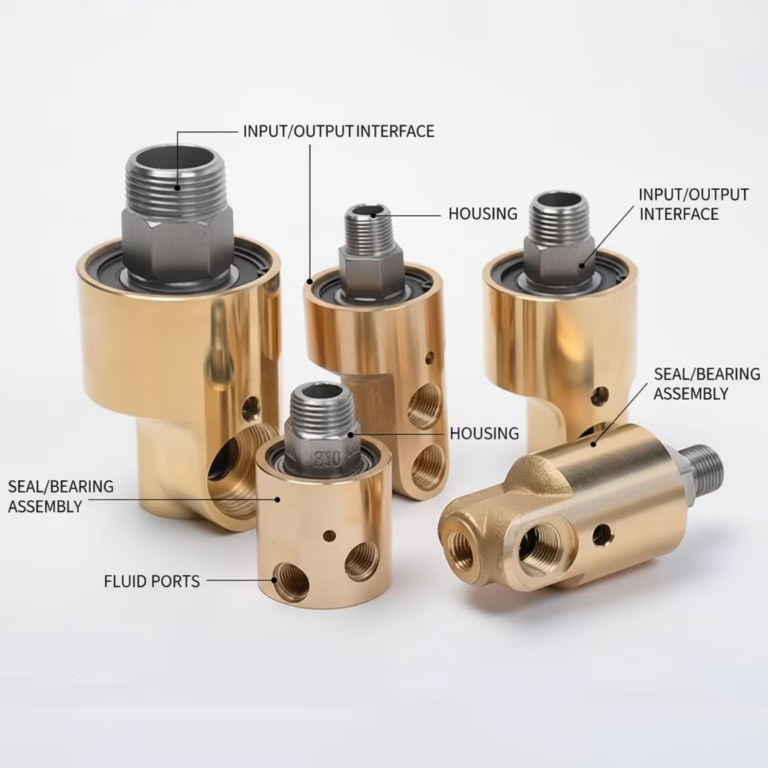
Major Components
-
Housing: The body that holds the rotating and stationary parts. Materials often include stainless steel (e.g., SS 304/SS 316) or high-grade aluminum for lightweight designs.
-
Rotor/Shaft: The rotating element through which the air passes into the rotating equipment.
-
Seal Assembly: Mechanical seal rings or cartridges that maintain an airtight contact between the stationary housing and the rotating shaft.
-
Bearings: Support elements (ball bearings, roller bearings, sleeve bearings) which allow rotation and handle radial/axial loads.
-
Ports / Connections: Inlet/outlet for air supply and rotating side. These may be threaded, flanged, or quick-connect, depending on installation.
Design Considerations
-
Sealing Material: For air rotary applications, the seal must resist wear, abrasion from particulates, and temperature changes. Carbon graphite, ceramic, and compound elastomers are common.
-
Rotation Speed (RPM): The joint must be balanced and designed for the rotational speed of the application; higher speeds impose higher demands on bearings and seal stability.
-
Pressure Rating: Typical pneumatic pressures (e.g., up to ~30 bar) may apply, but also vacuum or mixed media. The joint must maintain integrity under designated pressure.
-
Media Compatibility: While the name indicates “air”, many rotary joints support other gases or inert media; sometimes they are combined with fluids (multi-passage models).
-
Mounting & Orientation: Horizontal or vertical mounting, with attention to alignment and shaft support, ensures proper life-cycle.
-
Maintenance Accessibility: Some joints have serviceable seal cartridges so that internal parts can be replaced without total disassembly – improving uptime.
Main Types of Rotary Joints for Air
Rotary joints for air come in different configurations depending on the number of passages, speed, load, and complexity of the system. Below is a breakdown of common types:
1. Single-Passage Air Rotary Joints
These provide one fluid (air or gas) path between the stationary and rotating parts. They are the simplest form and are ideal for basic pneumatic tools, rotating air supply in rollers, small indexing machines, etc.
Key features: compact size, simpler sealing arrangement, lower cost.
2. Dual-Passage (Two-channel) Air Rotary Joints
These models allow two independent passages—often one for supply and one for return, or one for air and another for vacuum. The benefit is handling more complex pneumatic tasks where separate circuits are needed.
Applications: robotic arms, clamping systems, and other dual-function pneumatic mechanisms.
3. Multi-Passage Rotary Air Unions
When more than two air or gas lines must be transferred simultaneously—with or without other media (fluid, vacuum, electrical)—a multi-passage rotary union is used. Each channel has its own seal path, isolation from others, and is engineered for cross-contamination prevention.
Applications: complex automation systems, packaging machines with air + vacuum + signal lines, heavy-duty indexing tables.
4. High-Speed Pneumatic Rotary Joints
These are specifically designed for applications with very high rotational speeds (e.g., CNC spindles, high-speed packaging machines). They incorporate precision balancing, high-speed bearings, and minimal friction seals to handle rotation at thousands of RPM.
Key specs: high RPM rating, low vibration, minimal air pressure drop.
5. Swivel or Angular-Movement Air Rotary Joints
Less common but important in applications where not a full 360° continuous rotation is required, but some rotation or pivoting is present (e.g., assembly arms, turret drills). They allow rotation plus angular displacement while maintaining an air supply.
Applications: rotating indexing tables, turret machines, assembly robot “shoulder” joints.
Industrial Applications of Rotary Joints for Air
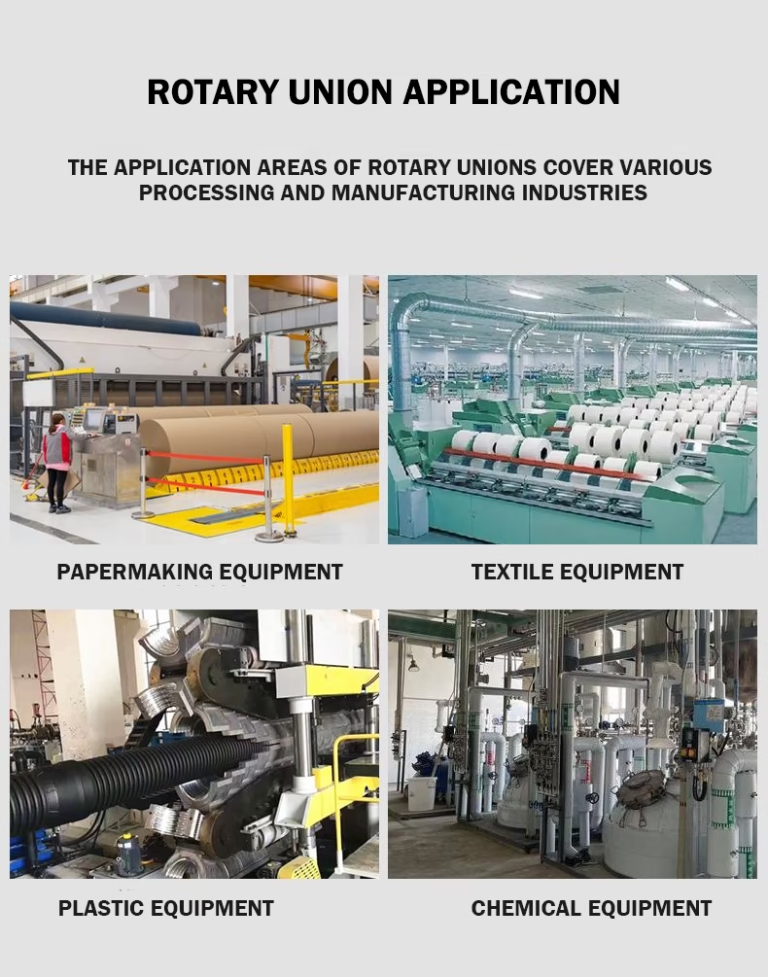
Rotary joints for air find use in many industries where pneumatic power and rotation meet. Some of the prime application areas include:
Automation & Robotics
Robotic arms frequently rotate while requiring compressed air for grippers, actuators, or vacuum systems. A rotary joint for air enables 360° rotation without twisting hoses or losing pressure.
Example: A six-axis robot in an auto assembly line uses a rotary air union at its base to supply actuators while the arm spins freely.
Machine Tools & CNC Systems
In CNC machining and tool-changing spindles, compressed air is often used for tool coolant, air blow-off, or spindle purge. High-speed air rotary joints allow air to pass safely into a spinning spindle without leakage, enabling high-precision machining.
Example: A 12,000 RPM spindle uses a single-pass or dual-pass air rotary joint to supply burst air cleaning while rotating.
Printing, Packaging & Converting Equipment
In printing presses, laminators, or packaging machines, rotating cylinders or rollers need air for blow-off, suction, or pneumatic clamping. Rotary air unions allow continuous rotation while maintaining supply and return airflow.
Example: A packaging line with a turret indexing table uses a multi-pass air rotary union to supply both actuators and vacuum to the rotating turret.
Textile, Rubber & Tire Manufacturing
Rotating drying drums or curing molds often use compressed air or vacuum along with rotation. Rotary joints for air enable airflow (or vacuum) into these spinning cylinders for drying, cooling, or molding operations.
Example: A tire curing press uses a dual-pass air rotary joint to deliver compressed air while the mold rotates.
Food, Beverage & Hygiene Industry
Where pneumatic automation is used—capping machines, labeling spindles, rotary filling heads—air rotary unions make it possible to supply air to rotating equipment while meeting hygiene or clean-design requirements.
Example: A rotary filling machine uses an air rotary union to supply a vacuum to rotating fill heads for bottle evacuation.
How to Select the Right Rotary Joint for Air
Consider the Operating Parameters
The first step in choosing the right rotary union for air is to consider the operating parameters of your application. This includes factors such as air pressure, temperature, and rotational speed. If your application requires high-pressure air transfer, you should select a rotary union that has the appropriate rating for that specific pressure. Similarly, if the air temperature is high, you need to choose a union with seals and materials capable of withstanding the elevated temperature. The rotational speed also influences the choice of rotary union, as high-speed applications demand unions with specialized bearings and seals to handle the centrifugal forces.
Determine the Required Number of Channels
Based on your application, you need to figure out how many air transfer channels you require. If you only need to supply a single air source to a rotating part, a single-channel air union will suffice. However, if your application involves multiple air – cair-controlledfunctions or different air pressures in the rotating part, you should opt for a multi-channel air union. Make sure to take into account any future expansion or changes in your application that might call for additional air channels.
Evaluate the Sealing and Bearing Technologies
The sealing and bearing technologies in a rotary union are crucial for its performance and reliability. Different types of seals, such as mechanical seals, o-rings, and lip seals, have distinct advantages and are suitable for different operating conditions. For example, we often use mechanical seals in high-pressure and high-speed applications, while O-rings are more common in lower-pressure and lower-speed scenarios. Similarly, when choosing bearings, such as ball bearings, roller bearings, or self-aligning bearings, you should base your decision on the load requirements and the potential degree of misalignment in your application.
Look for Compatibility with Your System
It is essential to make sure that the rotary union you choose is compatible with your existing system. This involves considering factors like the connection types (e.g., threaded, flanged), the size and dimensions of the union, and the materials used in its construction. The rotary union should integrate seamlessly with the stationary and rotating parts of your machinery, without causing any installation or compatibility problems.
Consider the Brand Reputation and After-Sales Support
It’s always a good idea to choose a rotary union from a reputable brand. Reputable brands are more likely to produce high-quality products that meet industry standards. Moreover, they often provide better after-sales support, such as technical assistance, spare parts availability, and warranty coverage. Before making a purchase, research the brand’s reputation in the market, read customer reviews, and consider the level of support they offer.
Maintenance and Troubleshooting of Rotary Unions for Air
Regular Maintenance
Regular maintenance is vital to ensure the long-term performance and reliability of rotary unions for air. This includes tasks like checking for air leaks, inspecting the seals and bearings for wear, and lubricating the moving parts. You can detect air leaks by using a soap-bubble solution or an electronic leak detector. If you find any leaks, you should replace the seals immediately. You should inspect the seals and bearings regularly for signs of wear, such as excessive play or damage to the seal faces. Follow the manufacturer’s recommendations and use the appropriate lubricant to lubricate the bearings and other moving parts.
Troubleshooting Common Issues
Air Leakage:
As mentioned before, air leakage is a common problem. If air leakage occurs, start by checking the seals. Worn-out or damaged seals are the most common cause of air leaks. If the seals are in good condition, check the connection points to make sure they are tightened properly. In some cases, a crack or damage in the body of the rotary union can also cause air leakage, and in such a situation, you may need to replace the union.
Excessive Vibration or Noise:
Excessive vibration or noise during the operation of the rotary union may indicate a problem with the bearings. Check the bearings for signs of wear, like pitting or roughness. If the bearings are worn, you should replace them. Uneven airflow or pressure fluctuations can also lead to vibration and noise. In such cases, check the air supply system to ensure that the air pressure is stable and the airflow is smooth. Reduced Performance:
If the equipment using the rotary union for air shows reduced performance, there could be several reasons. A clogged air passage in the rotary union may restrict the airflow, resulting in reduced performance. Check for any debris or contaminants in the air passages and clean them if needed. Additionally, worn-out seals or bearings can also cause a decrease in performance, as they may allow air leakage or increase friction.
Future Trends in Rotary Joints for Air
As automation, robotics, and Industry 4.0 evolve, the technology of rotary joints for air is also advancing:
-
Smart sensors embedded into rotary joints to monitor rotational speed, seal temperature, pressure drop, and predictive maintenance.
-
Lighter, composite-material housings for ultra-high speed robotic systems.
-
Hybrid multi-media rotary unions that combine air, vacuum, fluid, and even electrical signal transfer in one unit, reducing footprint and simplifying integration.
-
Improved sealing materials and coatings that reduce friction, enhance efficiency, and extend service life.
-
Enhanced energy efficiency by minimizing air leakage (compressed air is expensive) and optimizing flow path design.
Conclusion
In summary, Rotary Joints for Air are indispensable in modern pneumatic and rotating machinery systems. From enabling air flow in robotic arms to supplying high-speed spindles and packaging machines, the right rotary air union assures leak-free, continuous power and motion.
By understanding how they work, how they are built, which types are best for your machine, and how to maintain them, you can make informed decisions that improve productivity, reduce downtime, and increase system longevity.
When choosing your next rotary joint for air, pay close attention to speed, pressure, passages, materials, and maintenance features – and you’ll be well-positioned for success in your automation or pneumatic system.