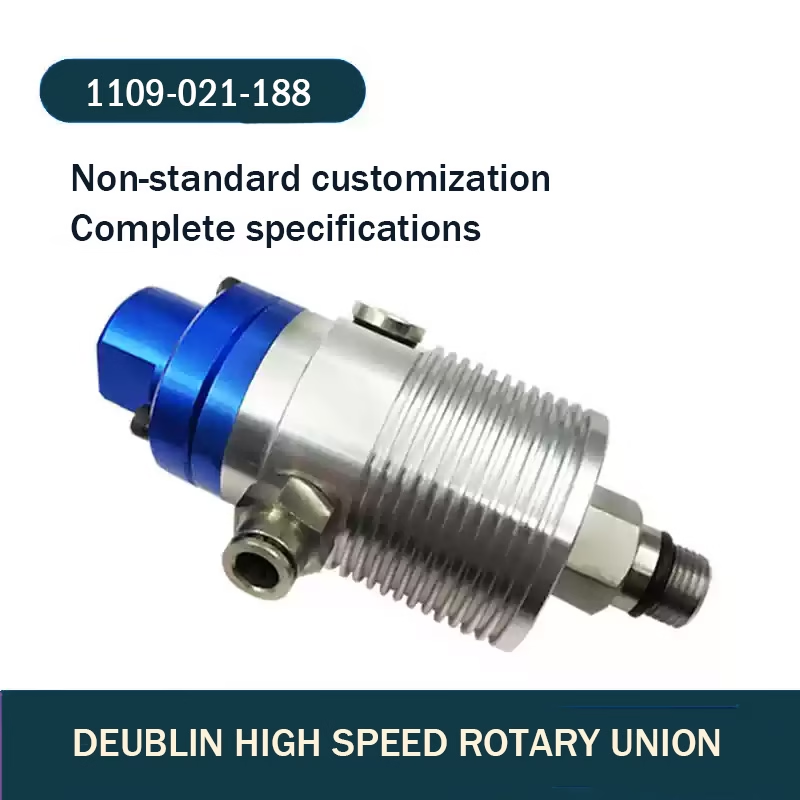
Deublin 1109-021-188 Rotary Union Replacement | High-Speed CNC Coolant Rotary Union Manufacturer
Original price was: $120.00.$108.00Current price is: $108.00.
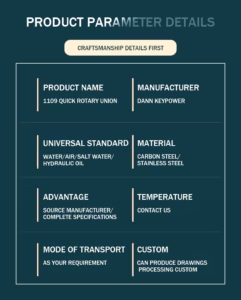
- Max Pressure: 210 bar (3,000 psi)
- Max Speed: 20,000 RPM
- Media: Water, Steam, Hydraulic Fluids, Compressed Air
- Materials: Stainless Steel, Brass
- Seals: Mechanical Seals, Silicon Carbide (Optional)
- Temperature Range: -40°C to 200°C (-40°F to 392°F)
Description
In modern CNC machining, stable coolant delivery through the spindle is essential for maintaining cutting accuracy, extending tool life, and improving production efficiency. As spindle speeds continue to increase and machining tolerances become tighter, the reliability of the rotary union has become one of the key factors affecting machine uptime. The Deublin 1109-021-188 rotary union is widely used in high-speed machining centers equipped with through-spindle coolant (TSC) systems. It transfers coolant from a stationary supply line into the rotating spindle while maintaining a reliable seal under continuous rotation. This design enables coolant to reach the cutting edge directly, improving chip evacuation and reducing heat generation during machining.
However, after years of continuous operation, many original rotary unions begin to experience seal wear, coolant leakage, bearing fatigue, or reduced coolant pressure. Replacing the rotary union before catastrophic failure helps avoid unexpected downtime and protects expensive spindle assemblies.
At Dann Hydraulic, we manufacture a fully compatible replacement for the Deublin 1109-021-188 rotary union. Our objective is not simply to duplicate the external dimensions of the original component, but to provide a dependable alternative built with precision machining, carefully selected sealing materials, and rigorous factory testing.
Unlike many trading companies that source standard products from multiple suppliers, we operate as a manufacturing factory specializing in rotary unions and hydraulic rotary joints. Our engineering team focuses on machining accuracy, sealing technology, bearing reliability, and production consistency to ensure every replacement rotary union performs reliably in demanding industrial environments.
Every rotary union is manufactured on CNC machining centers, assembled by experienced technicians, dynamically balanced when required, pressure-tested, leakage-tested, and inspected before shipment. These manufacturing procedures help ensure that customers receive a product capable of operating reliably under high rotational speeds and continuous coolant circulation.
Whether you are maintaining a single machining center or purchasing replacement parts for an equipment maintenance company, our Deublin-compatible rotary unions provide an economical solution without compromising reliability.
What Is the Deublin 1109-021-188 Rotary Union?
The Deublin 1109-021-188 is a single-passage rotary union specifically designed for through-spindle coolant applications in CNC machining centers. It allows coolant to flow continuously into a rotating spindle while preventing leakage between stationary and rotating components.
Unlike conventional coolant piping, which cannot rotate with the spindle, a rotary union creates a sealed interface that permits unrestricted spindle rotation while maintaining stable coolant pressure.
During machining, coolant is delivered through the rotary union, passes inside the spindle, and exits directly through the cutting tool. This process offers several important advantages:
- Faster heat removal from the cutting zone
- Improved chip evacuation
- Longer cutting tool life
- Better machining accuracy
- Higher spindle utilization
- Reduced production downtime
For manufacturers producing precision automotive components, aerospace parts, medical devices, molds, and complex mechanical components, stable through-spindle coolant delivery has become a standard requirement rather than an optional feature.
As spindle speeds increase, the rotary union experiences continuous mechanical stress caused by rotation, coolant pressure, temperature variation, and vibration. These operating conditions make machining precision and seal quality extremely important.
A poorly manufactured replacement may initially appear identical to the original product but can quickly develop coolant leakage, excessive vibration, or premature seal failure after only a short operating period.
This is why experienced maintenance engineers evaluate much more than dimensions when selecting a replacement rotary union.
Why More Customers Are Choosing High-Quality Replacement Rotary Unions
Over the past several years, we have seen a clear shift in purchasing behavior among machine repair companies, industrial distributors, and end users. While original OEM components remain the preferred option for some applications, an increasing number of customers are evaluating high-quality replacement rotary unions that offer comparable performance with greater purchasing flexibility.
The reasons are practical rather than purely cost-driven.
Many maintenance teams need to minimize machine downtime and cannot afford extended lead times for replacement parts. Others are responsible for servicing a large number of machining centers and require dependable components that fit within maintenance budgets. In these situations, a well-engineered replacement rotary union becomes an effective solution.
At Dann Hydraulic, our goal is not simply to manufacture a product that matches the external dimensions of the original. We focus on delivering consistent machining accuracy, reliable sealing performance, and stable long-term operation under real production conditions.
Before a replacement design enters production, our engineers carefully evaluate installation dimensions, sealing structure, material compatibility, coolant flow requirements, and machining tolerances. This engineering approach helps ensure that the rotary union performs as expected once installed in the customer’s equipment.
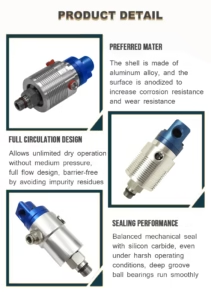
Engineering Advantages of Our Deublin 1109-021-188 Replacement
At Dann Hydraulic, we understand that customers purchasing replacement rotary unions expect more than dimensional compatibility.
They expect reliable operation throughout thousands of machining hours.
Our engineering team continuously improves manufacturing processes to ensure every rotary union delivers stable performance under demanding industrial conditions.
Precision CNC Machining
All critical components are manufactured using high-precision CNC equipment.
Critical dimensions are inspected throughout production to ensure consistent assembly accuracy.
Better machining accuracy contributes directly to improved sealing performance and longer service life.
Premium Mechanical Seal Materials
Seal materials are selected according to operating conditions.
Depending on customer applications, available sealing combinations include:
- Silicon Carbide vs. Carbon Graphite
- Silicon Carbide vs. Silicon Carbide
- Tungsten Carbide combinations
- Special materials for demanding coolant conditions
These materials provide:
- Excellent wear resistance
- Stable thermal performance
- Low friction
- Long operating life
High-Quality Bearing Configuration
Bearing reliability directly influences rotary union lifespan.
For demanding applications, we select premium-grade bearings designed for:
- High rotational speed
- Stable radial support
- Low vibration
- Long fatigue life
Correct bearing selection reduces friction and improves sealing stability.
Superior Surface Finishing
After machining, sealing faces undergo precision lapping.
Smooth sealing surfaces reduce:
- Friction
- Heat generation
- Wear rate
- Leakage risk
This finishing process plays an important role in extending mechanical seal life.
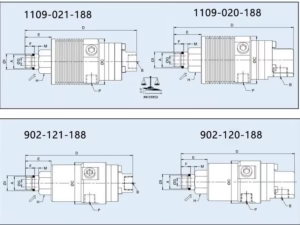
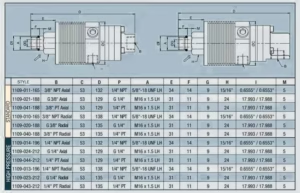
Excellent Interchangeability
Our replacement is engineered for straightforward installation on equipment originally designed for the Deublin 1109-021-188.
Customers benefit from:
- Compatible installation dimensions
- Matching connection interfaces
- Easy replacement during scheduled maintenance
- Minimal machine modification
This simplifies inventory management for maintenance departments servicing multiple CNC machines.
Stable Supply and Fast Production
Unlike companies that rely solely on external sourcing, we manufacture rotary unions in our own facility.
This enables us to offer:
- Stable production schedules
- Faster lead times
- Consistent manufacturing quality
- Flexible OEM and customized solutions
- Technical support from experienced engineers
Many industrial distributors choose us not only because of competitive pricing but because they can rely on consistent product quality and dependable delivery.
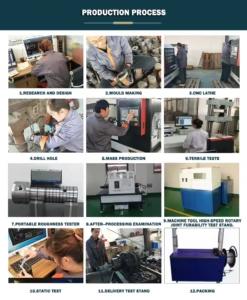
Every Rotary Union Is Tested Before Shipment
One of the biggest differences between a manufacturing factory and a trading company is the ability to verify product performance before delivery.
At Dann Hydraulic, testing is not optional—it is an essential part of production.
Each completed rotary union undergoes a series of inspections before packaging.
Dimensional Inspection
Critical dimensions are measured using calibrated inspection equipment.
Inspection items include:
- Overall length
- Mounting dimensions
- Thread specifications
- Shaft diameter
- Connection interfaces
- Concentricity
Only products meeting internal quality standards proceed to performance testing.
Air Leakage Test
Before hydraulic testing, every rotary union is checked using compressed air.
This test quickly identifies:
- Assembly errors
- Seal damage
- Improper installation
- Internal leakage paths
Detecting these issues early improves production efficiency and reduces waste.
Hydraulic Pressure Test
Each rotary union is then subjected to hydraulic pressure testing under controlled conditions.
The objective is to verify:
- Seal integrity
- Pressure resistance
- Stable operation
- Leakage performance
Products showing any abnormal leakage are rejected and returned for engineering review.
Rotation Performance Test
Rotation testing evaluates:
- Smooth bearing operation
- Rotational resistance
- Abnormal vibration
- Noise level
This inspection helps verify that the rotary union performs as intended before shipment.
Visual Inspection
Before packaging, every unit undergoes a final appearance inspection.
Technicians verify:
- Surface finish
- Protective coating
- Thread condition
- Identification marking
- Packaging completeness
Only after passing all inspection stages is the rotary union approved for shipment.
Traceable Quality Management
Consistency is critical in industrial manufacturing.
To improve product traceability, our production process records information including:
- Raw material batches
- Machining operations
- Assembly records
- Inspection results
- Pressure testing status
- Final approval
These production records allow continuous improvement and provide valuable technical support when customers request replacement parts or customized solutions.
Common Failure Modes of the Deublin 1109-021-188 Rotary Union
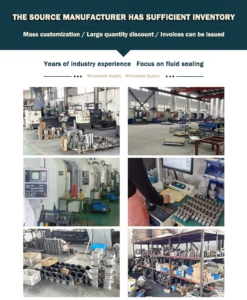
Although the Deublin 1109-021-188 rotary union is engineered for long service life, no rotary union is immune to wear. In our factory, we receive replacement inquiries almost every week from machine maintenance companies, distributors, and end users whose original rotary unions have reached the end of their service life.
Interestingly, many customers initially believe the rotary union itself is defective. However, after reviewing machine operating conditions, we often find that the root cause is related to coolant contamination, spindle condition, installation accuracy, or maintenance practices rather than a manufacturing defect.
Based on our experience manufacturing replacement rotary unions for CNC machining centers, the following are the most common failure modes encountered in the field.
Problem 1: Coolant Leakage Around the Rotary Union
Coolant leakage is by far the most frequent reason customers replace the Deublin 1109-021-188 rotary union.
The leakage may appear as a slow drip during machine idle time or become much more noticeable when the spindle rotates at high speed. In severe cases, coolant enters the spindle housing or contaminates nearby machine components, resulting in additional maintenance costs.
Possible Causes
Several factors can contribute to coolant leakage:
- Mechanical seal faces are worn after extended operation
- Abrasive particles in contaminated coolant damage the seal surfaces
- Incorrect installation causing uneven seal loading
- Excessive spindle vibration
- O-ring aging due to prolonged exposure to coolant additives
- Operation beyond the recommended pressure or speed limits
- Dry running during machine startup
Many users assume that replacing only the O-rings will eliminate leakage. In reality, once the precision-lapped seal faces become scratched or worn, replacing elastomer seals alone rarely restores proper sealing performance.
Factory Recommendation
Whenever leakage becomes visible, inspect the entire rotary union instead of replacing individual sealing components without diagnosis.
During our production process, every sealing face is precision-lapped to achieve an extremely smooth contact surface. This minimizes friction while maintaining a stable sealing film during rotation.
We also recommend installing coolant filtration systems capable of removing fine metal particles before they reach the rotary union.
Clean coolant significantly increases seal life.
Problem 2: Reduced Through-Spindle Coolant Pressure
Some customers contact us because coolant pressure gradually decreases even though the pump is functioning normally.
This issue often leads to poor chip evacuation, excessive cutting temperatures, shorter tool life, and reduced machining quality.
Possible Causes
Common reasons include:
- Internal seal wear
- Excessive internal clearance
- Partial blockage caused by coolant contamination
- Damaged rotating seal surfaces
- Coolant bypass due to internal leakage
- Incorrect rotary union selection
As sealing surfaces wear over time, coolant begins leaking internally instead of flowing directly through the spindle.
Although external leakage may not yet be visible, machining performance gradually declines.
Practical Example
One automotive component manufacturer experienced unstable coolant pressure on several machining centers after approximately four years of continuous production.
Machine operators initially suspected the coolant pump.
After inspection, technicians discovered significant wear on the rotary union’s sealing faces.
Replacing the rotary union immediately restored normal coolant pressure without replacing any hydraulic components.
Problem 3: Bearing Noise During High-Speed Rotation
Bearing noise is another common indicator that the rotary union has reached the end of its service life.
Operators may hear:
- High-frequency humming
- Metallic vibration
- Intermittent grinding sounds
- Increased spindle noise at higher RPM
Ignoring these symptoms can eventually damage the spindle itself.
Typical Causes
Bearing failure is usually related to:
- Coolant entering the bearing chamber
- Insufficient lubrication
- Bearing fatigue after prolonged operation
- Poor assembly accuracy
- Excessive spindle runout
- Rotor imbalance
- Continuous overload
Our Manufacturing Practice
Bearing performance depends not only on bearing quality but also on machining precision.
During production, we carefully control:
- Bearing seat concentricity
- Shaft roundness
- Housing alignment
- Surface roughness
- Assembly clearance
Even premium bearings cannot compensate for poor machining accuracy.
This is one reason why rotary unions manufactured solely according to external dimensions often fail much earlier than expected.
Problem 4: Rotary Union Overheating
Customers occasionally report that the rotary union housing becomes unusually hot during operation.
A moderate temperature increase is normal.
Excessive heat, however, usually indicates abnormal operating conditions.
Possible Reasons
- Excessive friction between seal faces
- Incorrect installation alignment
- Bearing deterioration
- Dry operation without coolant
- Coolant pressure fluctuations
- Excessive spindle speed
- Continuous heavy-duty operation
If left unresolved, overheating accelerates seal wear and bearing degradation.
Preventive Measures
We recommend monitoring operating temperature during routine machine maintenance.
A gradual temperature increase often provides early warning before catastrophic failure occurs.
Replacing the rotary union during scheduled maintenance is generally less expensive than repairing a damaged spindle.
Problem 5: Premature Mechanical Seal Failure
Mechanical seals are precision components designed to operate under continuous rotation.
Premature failure is usually associated with operating conditions rather than manufacturing defects.
Typical Causes
- Dirty coolant
- Frequent dry running
- Pressure spikes
- Poor spindle alignment
- Improper installation torque
- Incorrect seal material selection
In many machining workshops, coolant is rarely filtered adequately.
Fine metal chips suspended in coolant gradually scratch the seal faces.
Although individual scratches may appear insignificant, thousands of operating hours eventually produce internal leakage.
Problem 6: Excessive Vibration During Operation
Vibration is often overlooked because operators naturally associate vibration with spindle bearings.
However, a damaged rotary union can also contribute significantly to vibration.
Symptoms include:
- Coolant pipe movement
- Increased spindle vibration
- Abnormal machine noise
- Reduced machining accuracy
- Poor surface finish
Possible Causes
- Rotor imbalance
- Bearing wear
- Bent shaft
- Assembly errors
- Excessive spindle runout
At Dann Hydraulic, rotating components are machined with strict concentricity control, and selected models undergo dynamic balancing to reduce vibration during high-speed operation.
Stable rotation helps protect both the rotary union and the machine spindle.

Why Maintenance Companies Choose Factory-Direct Suppliers
Over the past several years, we have supplied replacement rotary unions to industrial distributors, machine rebuilders, CNC service companies, and equipment manufacturers worldwide.
Many customers originally purchased through trading companies before switching to direct factory sourcing.
The reasons are straightforward:
Faster Technical Support
Our engineers communicate directly with customers regarding installation dimensions, operating conditions, and application requirements.
Stable Manufacturing Quality
All production processes are controlled within our factory rather than outsourced to multiple suppliers.
This helps maintain consistent quality from one production batch to another.
Flexible Customization
Many customers require modifications such as:
- Special threads
- Custom hose connections
- Stainless steel housings
- Different sealing materials
- Laser marking
- Private labeling
Factory production allows these changes without lengthy communication through intermediaries.
Better Cost Efficiency
Purchasing directly from the manufacturer reduces unnecessary distribution costs while maintaining engineering support and quality assurance.
For distributors, machine builders, and maintenance companies, this provides a more competitive supply chain.

Typical Applications of Deublin 1109-021-188 Replacement
The Deublin 1109-021-188 rotary union is widely installed in CNC machine tools requiring reliable coolant transfer through the spindle. Although originally designed for specific machine builders, compatible replacements are now commonly used across many industries where high-speed machining is required.
Vertical Machining Centers
Vertical machining centers represent one of the largest application areas for this rotary union.
These machines perform drilling, milling, tapping, and contour machining while operating at spindle speeds that may exceed 10,000 RPM. During heavy cutting operations, coolant must be delivered precisely to the cutting edge to prevent excessive heat buildup.
A dependable rotary union helps maintain consistent coolant flow even during long production cycles, reducing thermal deformation and improving dimensional accuracy.
Typical workpieces include:
- Aluminum housings
- Steel brackets
- Engine components
- Mold inserts
- Hydraulic manifolds
- Precision fixtures
Horizontal Machining Centers
Horizontal machining centers often run continuously in automated production lines.
Because these machines remove large volumes of material, efficient chip evacuation becomes particularly important. Through-spindle coolant transports chips away from deep cavities where external coolant cannot easily reach.
Many maintenance departments replace aging rotary unions during scheduled machine servicing to avoid unexpected coolant leakage that could interrupt production.
Deep Hole Drilling Machines
Deep-hole drilling requires coolant to travel directly through the drill body.
Without stable coolant pressure, chips cannot be removed efficiently from the drilling zone, resulting in excessive heat, poor surface finish, and shortened tool life.
The rotary union, therefore, becomes a critical component of the entire drilling system.
Reliable sealing performance directly influences:
- Drilling depth
- Hole straightness
- Surface finish
- Tool life
- Production efficiency
CNC Milling Machines
High-speed milling generates significant cutting temperatures, particularly when machining hardened steel or titanium alloys.
Through-spindle coolant improves cooling efficiency by delivering coolant directly where it is needed most.
Many manufacturers upgrading older CNC machines choose compatible rotary unions that provide similar performance at a more competitive cost while maintaining installation compatibility.
Precision Mold Manufacturing
Injection mold manufacturers frequently perform long machining cycles involving hardened tool steels.
Maintaining consistent coolant delivery helps prevent thermal expansion of cutting tools while improving machining stability.
Reliable coolant flow also contributes to superior surface finish, reducing polishing time after machining.
Aerospace Component Manufacturing
Aerospace components are often produced from titanium alloys, stainless steels, and nickel-based superalloys.
These difficult-to-machine materials generate substantial cutting heat.
Through-spindle coolant significantly improves machining performance by lowering cutting temperatures and enhancing chip evacuation.
In these demanding applications, the reliability of the rotary union directly influences spindle uptime and overall manufacturing efficiency.
Automotive Manufacturing
Automotive factories rely heavily on automated machining centers operating around the clock.
Unexpected rotary union failure can stop an entire production line.
For this reason, maintenance engineers often replace rotary unions during preventive maintenance intervals instead of waiting for leakage or seal failure.
Applications include machining:
- Engine blocks
- Cylinder heads
- Transmission housings
- Brake components
- Steering systems
- Suspension parts
General Precision Engineering
Beyond automotive and aerospace industries, compatible replacements for the Deublin 1109-021-188 rotary union are widely used by:
- Machine tool manufacturers
- Industrial equipment builders
- Contract machining companies
- Precision engineering workshops
- Tool manufacturers
- Maintenance service providers
- Industrial distributors
- CNC retrofit specialists
These customers typically seek a replacement that combines reliable sealing performance, dimensional compatibility, competitive pricing, and consistent delivery times.

Frequently Asked Questions (FAQ)
1. Is your rotary union fully interchangeable with the Deublin 1109-021-188?
Yes. Our replacement rotary union is engineered to match the installation dimensions, mounting interface, and connection specifications of the original Deublin 1109-021-188. It can typically be installed without modifying the machine spindle or coolant piping.
However, before shipment, we always recommend confirming the original part number, machine model, or technical drawing to ensure complete compatibility.
2. What machines commonly use the Deublin 1109-021-188 rotary union?
This model is widely used in CNC machine tools equipped with through-spindle coolant systems, including:
- Vertical machining centers
- Horizontal machining centers
- CNC drilling machines
- High-speed milling machines
- Deep-hole drilling equipment
- Flexible manufacturing systems (FMS)
- Automated machining lines
It is commonly found in industries such as automotive manufacturing, aerospace machining, mold production, precision engineering, and general metalworking.
3. Can your rotary union handle high spindle speeds?
Yes.
Our replacement is designed for demanding machining environments where stable operation at high rotational speeds is essential.
To achieve this, we carefully control:
- Rotor concentricity
- Bearing alignment
- Seal face flatness
- Assembly precision
- Dynamic balance (for applicable models)
Actual operating speed depends on the machine design and operating conditions.
4. Which sealing materials are available?
We provide several sealing material combinations according to the application:
- Silicon Carbide + Carbon Graphite
- Silicon Carbide + Silicon Carbide
- Tungsten Carbide combinations
- Customized sealing materials for special media
Our engineering team recommends the most suitable material based on coolant type, pressure, rotational speed, and operating environment.
5. Can your rotary union be used with through-spindle coolant (TSC)?
Absolutely.
This replacement is specifically designed for through-spindle coolant applications where coolant passes through the rotating spindle directly to the cutting tool.
Stable coolant delivery improves:
- Tool life
- Surface finish
- Chip evacuation
- Machining accuracy
- Production efficiency
6. How long does the rotary union normally last?
Service life depends on several operating factors, including:
- Coolant cleanliness
- Operating pressure
- Rotational speed
- Machine vibration
- Maintenance practices
- Installation quality
With proper installation and regular maintenance, our rotary unions provide long and reliable service in demanding industrial applications.
7. Why does a rotary union start leaking?
Leakage is usually caused by one or more of the following:
- Mechanical seal wear
- Dirty coolant
- Bearing failure
- Excessive spindle vibration
- Dry running
- Improper installation
- Worn O-rings
- Pressure overload
Routine inspection helps identify these issues before major machine downtime occurs.
8. Do you test every rotary union before shipment?
Yes.
Every rotary union passes multiple quality inspections before packaging.
Typical inspections include:
- Dimensional inspection
- Air leakage testing
- Hydraulic pressure testing
- Rotation performance testing
- Visual inspection
- Assembly verification
Only products meeting our internal quality standards are released for shipment.
9. Can you manufacture customized rotary unions?
Yes.
As a manufacturing factory, we support OEM and customized production based on:
- Technical drawings
- Sample products
- Installation dimensions
- Pressure requirements
- Thread specifications
- Operating media
- Special materials
- Private branding
Many equipment manufacturers and industrial distributors work with us on customized rotary union projects.
10. What information should I provide before requesting a quotation?
The following information helps us recommend the correct replacement quickly:
- Original part number
- Machine manufacturer
- Machine model
- Operating pressure
- Maximum spindle speed
- Working medium
- Connection dimensions
- Photos or technical drawings
Providing complete information allows our engineers to verify compatibility before production.
11. How quickly can you manufacture replacement rotary unions?
Production time depends on the product type and order quantity.
For standard models, we maintain efficient production schedules and can usually arrange shipment within a relatively short lead time.
Customized rotary unions may require additional engineering review before production.
12. Why choose a factory-direct manufacturer instead of a trading company?
Working directly with the manufacturer provides several advantages:
- Faster technical communication
- Stable production quality
- Better cost control
- Flexible customization
- Engineering support
- Consistent delivery schedules
- Long-term supply capability
For maintenance companies and industrial distributors, factory-direct cooperation often improves purchasing efficiency while reducing overall procurement costs.

Partner with a Reliable Rotary Union Manufacturer
A rotary union may be a relatively small component within a CNC machining center, but its performance has a direct impact on coolant delivery, machining accuracy, spindle reliability, and overall production efficiency.
Selecting a well-manufactured replacement helps reduce unplanned downtime, lower maintenance costs, and improve long-term equipment reliability.
At Dann Hydraulic, we are committed to supplying rotary unions that combine precision manufacturing, dependable quality, and responsive technical support. Whether you need a direct replacement for the Deublin 1109-021-188, an OEM solution, or a customized rotary union for a specialized application, our engineering team is ready to assist.
If you are looking for a cost-effective alternative without compromising performance, we welcome the opportunity to discuss your requirements.
Related products
-
Sale!

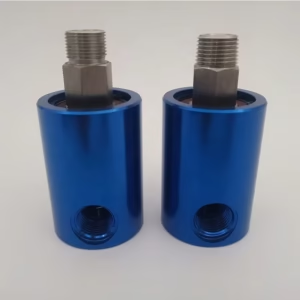
Hydraulic Rotary Union for High-Pressure Fluid Transfer Applications
Original price was: $60.00.$55.00Current price is: $55.00. -
Sale!

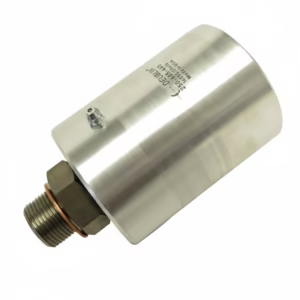
Deublin 250 Series Large Rotary Union Cost-Effective Alternative Manufacturer
Original price was: $280.00.$270.00Current price is: $270.00. -
Sale!
High Speed Pneumatic Rotary Union for Industrial Systems
Original price was: $35.00.$30.00Current price is: $30.00. -
Sale!

Deublin 1116-048-143 Replacement Rotary Union for CNC Machine Tools
Original price was: $80.00.$77.00Current price is: $77.00.