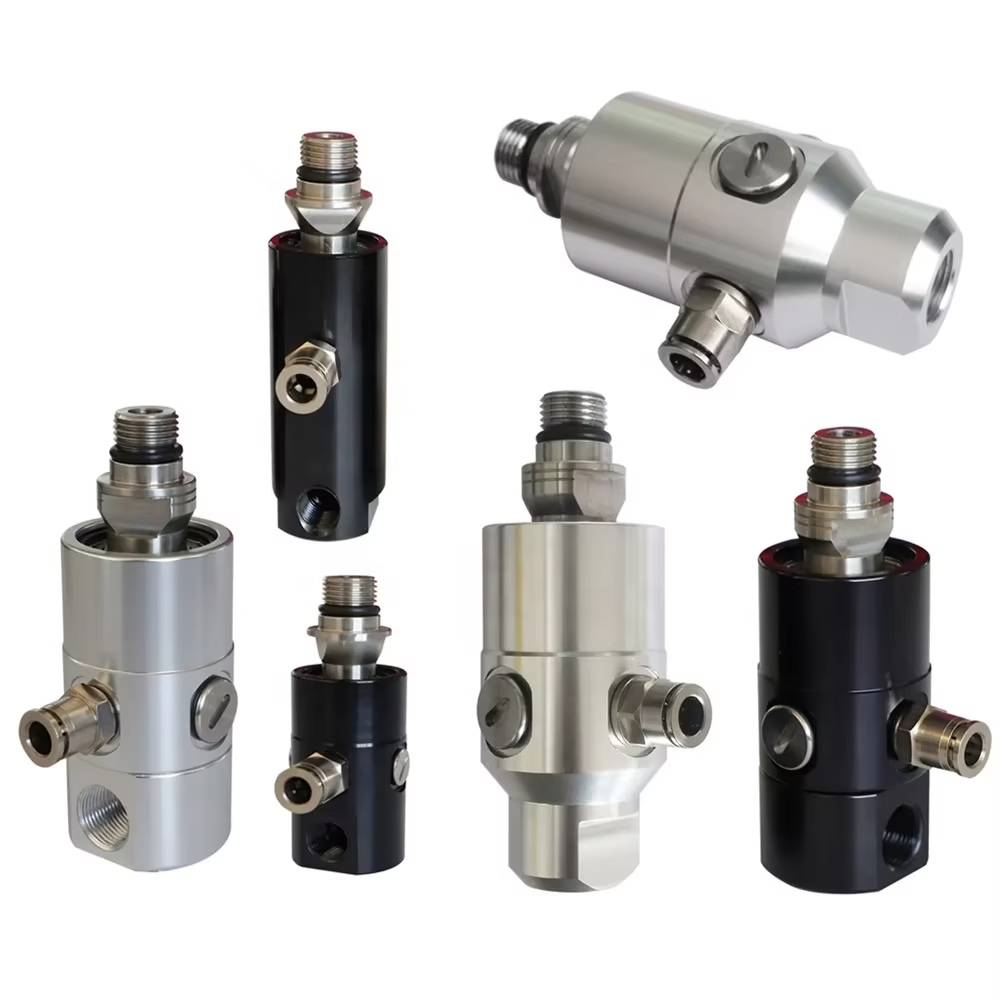
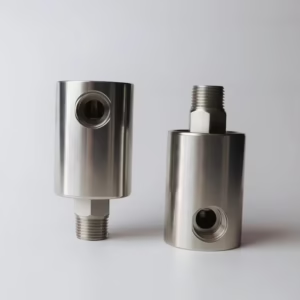
Hydraulic Oil Rotary Union Manufacturer for Continuous Rotating Machinery
Original price was: $100.00.$80.00Current price is: $80.00.
- Max Pressure: Up to 15,000 PSI (1,000 bar)
- Max Temperature: Up to 200°C (392°F)
- Rotational Speed: Up to 3,000 RPM
- Materials: Stainless Steel, Carbon Graphite Seals
- Seal Type: Balanced Mechanical Seals
Description
A hydraulic oil rotary union is a critical component in rotating equipment where hydraulic oil must pass between stationary piping and moving parts without leakage, pressure loss, or flow interruption. In industries that rely on continuous rotation, the rotary union is not a minor accessory. It is part of the core fluid transfer system that keeps the machine running safely and efficiently.
At Dann Hydraulic, we manufacture hydraulic oil rotary unions for demanding industrial environments where stable pressure, low leakage, and long service life matter. As a Chinese manufacturer specializing in rotary unions and rotary joints, we focus on precision machining, sealing reliability, and practical engineering based on real factory production experience.
Our hydraulic rotary unions are used in equipment that runs under continuous load, frequent start-stop cycles, high pressure, and harsh working conditions. Whether the application involves construction machinery, wind energy, mining equipment, marine systems, or industrial automation, the performance of the rotary union directly affects the reliability of the entire machine.
A well-designed hydraulic oil rotary union allows the hydraulic system to rotate freely while maintaining a sealed connection between the stationary supply line and the rotating assembly. This prevents hose twisting, reduces wear on external piping, improves system flexibility, and helps maintain stable hydraulic performance during operation.
For equipment manufacturers, maintenance teams, and industrial distributors, the main challenge is not simply finding a rotary union that fits the machine. The real requirement is finding a product that can withstand pressure, vibration, contamination, temperature changes, and long-term mechanical stress without failure.
That is exactly the type of product we build.

What is a Hydraulic Oil Rotary Union?
A hydraulic oil rotary union is a rotating sealing device designed to transfer hydraulic oil between stationary and rotating components. It is also commonly called a hydraulic rotary union, hydraulic rotary joint, or hydraulic swivel joint, depending on the application and industry terminology.
The basic function is simple, but the engineering behind it is demanding. The rotary union must:
- keep hydraulic oil sealed inside the system,
- maintain stable pressure during rotation,
- avoid internal leakage,
- reduce friction and heat,
- and operate smoothly under long-term mechanical load.
In many applications, the rotary union is mounted on a rotating shaft, drum, turntable, turret, or other moving part. Hydraulic oil enters through a stationary inlet port, passes through the internal flow path, and exits into the rotating equipment. The reverse arrangement is also common in return-flow systems.
Because the component must rotate continuously while sealing pressurized oil, every detail matters: shaft concentricity, bearing quality, seal material, surface finish, assembly accuracy, and pressure test performance.
A small error in machining or assembly may not be visible from the outside, but it can create leakage, overheating, or bearing wear after only a short period of operation.
That is why industrial buyers should evaluate more than appearance or catalog dimensions when selecting a hydraulic oil rotary union.

Where Hydraulic Oil Rotary Unions Are Used
Hydraulic oil rotary unions are widely used in equipment where rotation and hydraulic power must work together.
Construction Machinery
Construction equipment is one of the largest application areas for hydraulic rotary unions. Machines such as excavators, cranes, drilling rigs, and slewing platforms often require continuous rotation while hydraulic functions remain active.
In these machines, the rotary union helps transfer hydraulic oil to rotating assemblies without twisting hoses or disrupting pressure.
Mining Equipment
Mining machines work in harsh environments where dust, vibration, impact, and heavy load are common. Hydraulic rotary unions used in mining equipment must provide stable sealing performance even when the equipment is exposed to contamination and long operating hours.
Wind Turbine Systems
In wind energy systems, hydraulic rotary unions are often used in pitch control and other rotating mechanisms where hydraulic power must remain stable while the rotor or related components move continuously.
Marine and Offshore Equipment
Marine machinery often operates in corrosive, humid, and unpredictable environments. Hydraulic oil rotary unions used in this sector must be designed with corrosion resistance and reliable sealing in mind.
Industrial Automation and Rotary Tables
Automation equipment, rotary indexing tables, and special-purpose machines often use hydraulic rotary unions to supply fluid power to rotating fixtures or workholding systems. In these applications, smooth rotation and low leakage are essential for production stability.
Steel and Heavy Industry
Steel mills, rolling lines, and heavy processing equipment also rely on hydraulic rotary unions for rotating lubrication, clamping, or actuation systems. These environments demand strong housings, reliable sealing, and stable performance under heat and vibration.

Why Hydraulic Oil Rotary Unions Matter
Hydraulic systems depend on pressure stability. If a rotary union leaks, restricts flow, or creates internal pressure loss, the impact goes beyond the component itself. It can affect the entire machine.
A poor-quality rotary union may lead to:
- reduced hydraulic force,
- slower machine response,
- excessive oil leakage,
- overheating,
- unstable rotation,
- higher maintenance costs,
- and unplanned production downtime.
For this reason, many customers now prefer factory-direct hydraulic rotary unions built by manufacturers with real machining and testing capability.
At Dann Hydraulic, we understand that a rotary union is not just a part number. It is a functional component that must perform reliably inside a real machine, under real operating conditions, for a long service life.

Common Problems Found in Hydraulic Oil Rotary Unions
Based on our manufacturing experience and customer feedback, most hydraulic rotary union failures fall into several common categories.
Understanding these issues allows maintenance personnel to identify problems before costly machine downtime occurs.
Problem 1 – External Hydraulic Oil Leakage
Oil leakage around the rotary union housing is the most frequently reported problem.
Initially, operators may notice only a slight oil film around the seal area.
If ignored, leakage gradually becomes more severe.
Besides wasting hydraulic oil, leakage can create environmental contamination, slippery working conditions, and increased maintenance costs.
Typical Causes
- Worn mechanical seals
- Damaged O-rings
- Excessive operating pressure
- Shaft misalignment
- Bearing wear
- Poor installation
- Surface damage
Recommended Solution
Inspect the complete rotary union rather than replacing only external seals.
Check shaft alignment, operating pressure, bearing condition, and seal wear simultaneously.
Problem 2 – Internal Leakage
Internal leakage is more difficult to detect because hydraulic oil remains inside the rotary union.
Instead of visible leakage, customers often notice:
- Reduced hydraulic force
- Slow cylinder movement
- Pressure instability
- Lower system efficiency
- Increased pump operating time
Possible Causes
- Seal face wear
- Internal scoring
- Excessive internal clearance
- Seal damage caused by contamination
Internal leakage directly reduces hydraulic system efficiency.
Problem 3 – Pressure Loss
Stable hydraulic pressure is essential for machine performance.
Pressure loss inside the rotary union may cause:
- Reduced actuator force
- Slower machine operation
- Inconsistent hydraulic performance
- Lower production efficiency
Typical Causes
- Internal leakage
- Flow restriction
- Damaged seals
- Incorrect rotary union selection
- Excessive wear
Monitoring pressure changes during routine maintenance often helps identify problems early.
Problem 4 – Bearing Failure
Bearings support continuous rotation while maintaining accurate seal alignment.
When bearings begin to fail, secondary damage often follows.
Typical symptoms include:
- Abnormal noise
- Increased vibration
- Higher housing temperature
- Rough rotation
- Shaft movement
Common Causes
- Contaminated hydraulic oil
- Excessive side loading
- Poor lubrication
- Over-speed operation
- Improper installation
Replacing bearings before complete failure helps prevent damage to seals and rotating shafts.
Problem 5 – Hydraulic Oil Contamination
Contaminated hydraulic oil is one of the primary reasons for premature rotary union wear.
Typical contaminants include:
- Metal particles
- Dust
- Water
- Rust
- Rubber debris
- Oxidized oil
These particles gradually scratch sealing surfaces and accelerate bearing wear.
Installing proper hydraulic filtration significantly extends rotary union life.
Problem 6 – Excessive Operating Temperature
Hydraulic oil naturally generates heat during operation.
However, excessive housing temperature usually indicates abnormal internal friction.
Possible causes include:
- Bearing damage
- Dry running
- Seal friction
- Excessive rotational speed
- Poor lubrication
Ignoring overheating often results in seal failure.
Problem 7 – Excessive Vibration
Hydraulic rotary unions are designed to rotate smoothly.
If vibration develops during operation, both seals and bearings experience increased stress.
Possible causes include:
- Bent shaft
- Rotor imbalance
- Loose installation
- Bearing wear
- Misalignment
High vibration often shortens service life considerably.
Problem 8 – Premature Seal Failure
Customers sometimes assume seal failure indicates poor product quality.
In reality, operating conditions usually play a much larger role.
The most common reasons include:
- Dirty hydraulic oil
- Pressure spikes
- Incorrect installation
- Dry running
- Excessive shaft vibration
- Operation beyond design limits
Improving operating conditions often extends seal life more effectively than changing seal materials.

Engineering Advantages of Dann Hydraulic Hydraulic Oil Rotary Unions
Rather than focusing only on external dimensions, our engineers pay close attention to the internal details that determine long-term performance.
Optimized Internal Oil Flow Design
Our hydraulic oil rotary unions are designed with smooth internal flow passages to reduce turbulence and minimize pressure loss.
This helps maintain stable hydraulic performance throughout continuous operation.
Precision Mechanical Sealing System
Seal reliability determines the service life of every hydraulic rotary union.
Depending on the application, we offer:
- Silicon Carbide + Carbon Graphite
- Silicon Carbide + Silicon Carbide
- Tungsten Carbide combinations
- Customized sealing materials
Each material combination is selected according to operating pressure, hydraulic oil type, rotational speed, and service environment.
High-Precision CNC Manufacturing
Critical rotating components are machined using advanced CNC equipment.
Strict control is maintained over:
- Shaft concentricity
- Bearing seats
- Seal grooves
- Thread dimensions
- Internal oil passages
- Surface finish
Precision machining contributes directly to stable sealing and reduced vibration.
Heavy-Duty Bearing Design
Reliable bearings help maintain smooth rotation under continuous hydraulic load.
Our bearing selection emphasizes:
- Long fatigue life
- Low friction
- Stable rotation
- Reduced operating noise
- Improved sealing alignment
Multiple Material Options
Different applications require different housing materials.
Available options include:
- Aluminum alloy
- Carbon steel
- Brass
- Stainless Steel 304
- Stainless Steel 316
Material recommendations are based on corrosion resistance, pressure requirements, and operating environment.
OEM Manufacturing Capability
As a factory specializing in rotary unions, we provide customized manufacturing services including:
- Multi-passage designs
- Custom threads
- Special flange dimensions
- High-pressure versions
- Stainless steel construction
- Customer logo engraving
- OEM packaging
Our engineering team works directly with equipment manufacturers to develop application-specific hydraulic rotary unions.

Manufacturing Hydraulic Oil Rotary Unions That Perform in Real Working Conditions
Hydraulic oil rotary unions are often installed in equipment that operates under continuous pressure, heavy loads, and demanding environments. Unlike standard fluid transfer components, they must withstand constant rotation while maintaining reliable sealing and stable hydraulic pressure.
From our experience working with equipment manufacturers, industrial distributors, and maintenance companies, we know that a rotary union’s service life is determined long before it reaches the customer’s machine. Material selection, machining accuracy, assembly procedures, and quality inspection all influence how the product performs after thousands of hours of operation.
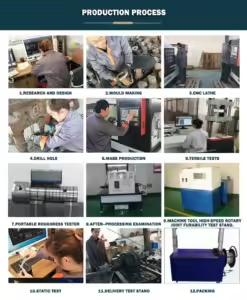
At Dann Hydraulic, we manufacture rotary unions with a practical engineering mindset. Every production step is designed to improve reliability, minimize leakage, and ensure consistent performance in real industrial applications—not just during laboratory testing.
How to Extend the Service Life of a Hydraulic Oil Rotary Union
The operating environment has a significant influence on product life.
The following practices help maximize reliability.
Maintain Clean Hydraulic Oil
Hydraulic oil should always remain clean.
Contaminants such as metal particles and dust accelerate wear on both seals and bearings.
Using high-quality filtration is one of the most effective methods of extending rotary union life.
Operate Within Design Limits
Every hydraulic rotary union is designed for a specific range of:
- Pressure
- Rotational speed
- Temperature
- Flow rate
Operating beyond these limits increases mechanical stress and shortens service life.
Prevent Dry Running
Mechanical seals depend on hydraulic oil for lubrication and cooling.
Running the rotary union without oil circulation may permanently damage the sealing surfaces within a short time.
Always establish oil flow before continuous operation.
Monitor Vibration
Excessive vibration increases:
- Bearing load
- Seal wear
- Heat generation
- Component fatigue
Correcting vibration problems early prevents secondary damage.
Replace Before Complete Failure
Waiting until severe oil leakage develops often results in additional repair costs.
Replacing the rotary union during scheduled maintenance minimizes production interruptions and protects surrounding hydraulic components.

Frequently Asked Questions (FAQ)
1. What is a Hydraulic Oil Rotary Union?
A hydraulic oil rotary union is a precision rotary sealing device that transfers pressurized hydraulic oil between stationary piping and rotating equipment while maintaining continuous rotation without external leakage.
It is widely used in construction machinery, industrial automation, mining equipment, wind turbines, marine equipment, steel mills, and other hydraulic systems.
2. What is the difference between a Hydraulic Rotary Union and a Hydraulic Swivel Joint?
The two terms are often used interchangeably, but there are subtle differences depending on the industry.
A hydraulic rotary union generally refers to a precision mechanical sealing device designed for continuous rotation at higher speeds and tighter leakage control.
A hydraulic swivel joint is commonly used in heavy construction equipment where rotation angles may be continuous or limited and the primary purpose is hydraulic fluid transfer.
Both products perform the same basic function of transferring hydraulic oil across rotating interfaces.
3. What hydraulic oil can be used?
Our hydraulic oil rotary unions are compatible with most common industrial hydraulic fluids, including:
- Mineral hydraulic oil
- ISO VG hydraulic oils
- Anti-wear hydraulic oils
- Synthetic hydraulic fluids
- Fire-resistant hydraulic fluids (with appropriate seal materials)
If special hydraulic fluids are used, our engineering team can recommend the most suitable sealing materials.
4. What operating pressure can the rotary union handle?
Operating pressure depends on the specific model and application.
Factors affecting pressure capacity include:
- Number of passages
- Seal design
- Housing material
- Rotational speed
- Hydraulic oil type
Our engineers will recommend the appropriate rotary union after reviewing your application parameters.
5. Which industries commonly use Hydraulic Oil Rotary Unions?
Our hydraulic rotary unions are widely used in:
- Construction machinery
- Excavators
- Truck-mounted cranes
- Rotary drilling rigs
- Forestry equipment
- Mining machinery
- Wind turbine systems
- Steel mills
- Marine equipment
- Industrial automation
- Rotary indexing tables
- Hydraulic clamping systems
6. How do I know when the rotary union should be replaced?
Common warning signs include:
- Hydraulic oil leakage
- Pressure loss
- Reduced actuator performance
- Bearing noise
- Excessive vibration
- High operating temperature
- Internal leakage
- Slow hydraulic response
Replacing the rotary union before complete failure helps avoid costly downtime and protects other hydraulic components.
7. What sealing materials do you offer?
Depending on the application, we provide:
- Silicon Carbide + Carbon Graphite
- Silicon Carbide + Silicon Carbide
- Tungsten Carbide combinations
- Customized sealing materials
Seal selection is based on pressure, temperature, hydraulic oil compatibility, and rotational speed.
8. Can you manufacture customized hydraulic rotary unions?
Yes.
As a factory specializing in rotary unions, we support OEM and custom manufacturing services.
Customization options include:
- Single or multi-passage configurations
- BSP, NPT, Metric, and SAE threads
- Custom shaft dimensions
- Special flange designs
- Stainless steel housings
- High-pressure versions
- Customer logo engraving
- Private-label packaging
9. How do you ensure product quality?
Every hydraulic oil rotary union undergoes a comprehensive inspection process before shipment.
Quality control includes:
- Raw material verification
- CNC machining inspection
- Dimensional measurement
- Mechanical seal inspection
- Bearing inspection
- Air leakage testing
- Hydraulic pressure testing
- Rotation performance testing
- Final visual inspection
This process helps ensure consistent quality and reliable field performance.
10. What information should I provide before requesting a quotation?
To help us recommend the most suitable product, please provide:
- Equipment type
- Operating pressure
- Rotational speed
- Hydraulic oil type
- Number of passages
- Connection type
- Installation dimensions
- Technical drawing or photographs (if available)
The more application details we receive, the faster we can recommend the correct solution.
11. Do you provide OEM and private-label manufacturing?
Yes.
We regularly cooperate with:
- Equipment manufacturers
- Hydraulic system integrators
- Industrial distributors
- Maintenance companies
- Engineering contractors
OEM services include customized design, laser marking, private-label packaging, and long-term production support.
12. Why purchase directly from a rotary union manufacturer?
Working directly with the manufacturer offers several practical advantages:
- Direct communication with experienced engineers
- Consistent product quality
- Faster response to technical questions
- Flexible customization
- Stable production scheduling
- Competitive factory pricing
- Reliable after-sales support
For long-term industrial projects, factory-direct cooperation often reduces procurement costs while improving product consistency.

Partner with a Reliable Hydraulic Rotary Union Manufacturer
A hydraulic oil rotary union may appear to be a relatively small component, but its performance directly affects hydraulic pressure stability, equipment reliability, operating efficiency, and maintenance costs.
Choosing a well-engineered rotary union helps minimize oil leakage, reduce unexpected downtime, and improve the long-term performance of hydraulic systems.
At Dann Hydraulic, we combine precision manufacturing, engineering expertise, and strict quality control to deliver rotary unions that perform reliably in demanding industrial environments.
Whether you require a standard hydraulic oil rotary union, a customized multi-passage design, or an OEM manufacturing partner, our engineering team is ready to support your project.
Related products
-
Sale!

Spring Type Rotary Union For Steam
Original price was: $65.00.$52.00Current price is: $52.00. -
Sale!


Rotary Union for Textile Sizing Machine | Reliable Rotary Joint Manufacturer
Original price was: $35.00.$30.80Current price is: $30.80. -
Sale!

Rotary Union Hot Oil Hydraulic High pressure 360° rotary joint
Original price was: $45.00.$34.20Current price is: $34.20. -
Sale!
Corrosion-Resistant Stainless Steel Hydraulic Rotary Union Manufacturer
Original price was: $35.00.$31.00Current price is: $31.00.