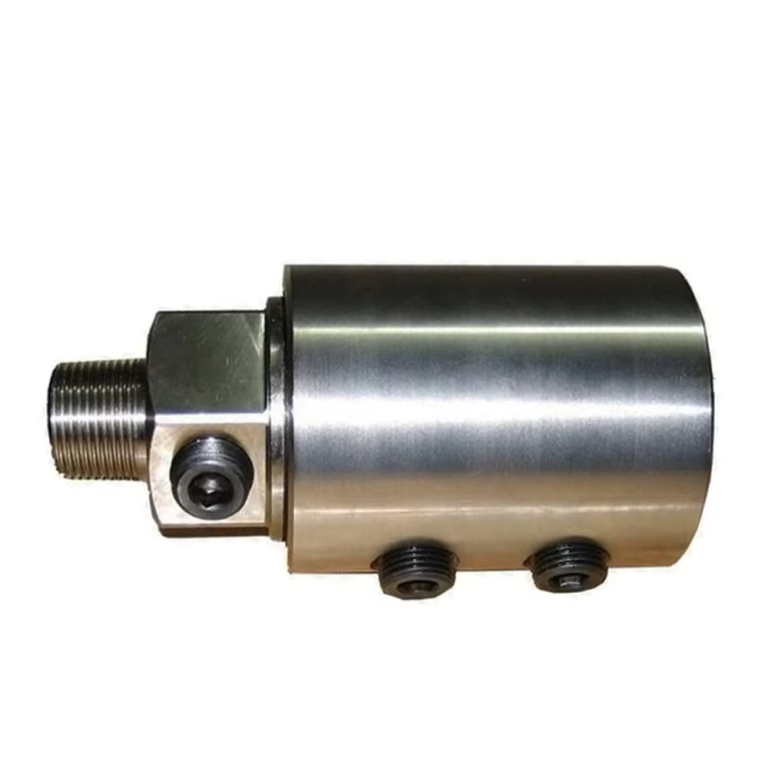

Best Alternative Deublin Rotary Union in 2026: The Engineer’s Guide to OEM Replacements
For decades, Deublin rotary unions have been recognized as a benchmark in industries such as machine tools, paper manufacturing, steel processing, printing, plastics, textiles, and automation. Their products are widely installed on OEM equipment and production lines around the world because of their stable sealing performance and broad product portfolio.
However, the industrial purchasing landscape has changed significantly over the past few years. Rising operating costs, longer procurement cycles, discontinued models, and the need for flexible OEM support have encouraged many manufacturers, maintenance teams, and equipment builders to look beyond a single brand.
As a result, searches for terms such as Alternative Deublin Rotary Union, Deublin alternative, and Deublin replacement have grown steadily among procurement engineers and maintenance professionals. The goal is no longer simply to find a lower-priced product. Instead, buyers are searching for a replacement rotary union that offers equivalent performance, dependable quality, shorter lead times, and responsive technical support.
At Dann Hydraulic, we have spent years manufacturing rotary unions for customers across Europe, North America, South America, Southeast Asia, and the Middle East. Rather than copying existing products, our engineering team focuses on producing dimensionally interchangeable rotary unions that are designed for real industrial operating conditions while meeting demanding quality standards.
This article explains what makes a reliable Deublin alternative, how to evaluate replacement suppliers, and what engineering factors truly determine the long-term reliability of a rotary union.
Why Are More Companies Looking for an Alternative Deublin Rotary Union?
Industrial equipment owners are becoming more practical in their purchasing decisions. Instead of specifying a particular brand, many maintenance departments now evaluate suppliers based on measurable factors such as performance, compatibility, delivery time, technical support, and total operating cost.
Several industry trends are driving this shift.
1. Faster Delivery Has Become a Competitive Advantage
Unexpected downtime can stop an entire production line. Waiting several weeks for replacement components is often more expensive than the cost of the rotary union itself.
For industries operating continuous production, such as:
- Paper mills
- Steel plants
- Printing factories
- Tire manufacturing
- Food processing
- Textile production
- CNC machining
maintenance teams increasingly prefer suppliers capable of providing compatible rotary unions with shorter production cycles.
A qualified Deublin replacement supplier should maintain flexible manufacturing capacity and standardized production processes that allow critical models to be delivered quickly without sacrificing quality.
2. Many Older Models Are Difficult to Source
Industrial equipment often remains in service for decades. Machines installed fifteen or twenty years ago may still operate efficiently, but obtaining original replacement parts can become increasingly difficult.
Engineers frequently encounter situations where:
- Original models are discontinued
- Documentation is incomplete
- Equipment manufacturers no longer provide support
- Spare part availability is limited
- Procurement lead times continue to increase
An experienced Deublin alternative manufacturer can reverse engineer existing rotary unions, verify critical dimensions, analyze sealing structures, and produce compatible replacements without requiring major machine modifications.
For maintenance departments, this approach significantly reduces downtime while extending the service life of valuable production equipment.
3. Procurement Departments Are Paying Greater Attention to Total Cost
Price alone is no longer the deciding factor.
Industrial buyers increasingly evaluate the total cost of ownership, including:
- Expected service life
- Maintenance frequency
- Seal replacement costs
- Bearing durability
- Energy efficiency
- Downtime losses
- Availability of technical support
A rotary union that performs reliably for several years with minimal maintenance often provides far greater value than a cheaper component that requires frequent replacement.
Consequently, many purchasing managers now compare multiple qualified manufacturers before making sourcing decisions.
4. OEM Manufacturers Need Flexible Engineering Support
Equipment manufacturers frequently require customized rotary unions rather than standard catalog products.
Common requirements include:
- Special thread connections
- Modified flange dimensions
- Multiple passages
- Integrated electrical slip rings
- Higher operating pressure
- Higher rotational speed
- Corrosion-resistant materials
- Customer branding
Large international brands generally focus on standardized products, while specialized rotary union manufacturers often provide greater engineering flexibility for OEM projects.
This flexibility has become one of the major reasons why machine builders seek an Alternative Deublin Rotary Union supplier.
What Makes a Reliable Deublin Replacement?
Not every replacement rotary union offers the same level of engineering quality.
Although two products may appear identical externally, their internal design often determines long-term reliability.
Professional buyers generally evaluate replacement suppliers based on the following criteria.
Dimensional Compatibility
A reliable replacement should fit directly into the existing equipment without requiring modifications.
Critical dimensions include:
- Thread specifications
- Shaft diameter
- Housing diameter
- Mounting interface
- Overall installation length
- Port orientation
- Rotor alignment
Even minor dimensional deviations can increase installation time or create sealing problems.
Seal Technology
The seal is the most critical component inside any rotary union.
Its performance directly affects:
- Leakage resistance
- Service life
- Friction
- Heat generation
- Rotational stability
Different operating conditions require different seal materials.
For example:
| Operating Medium | Recommended Seal Material |
|---|---|
| Water | Carbon Graphite / Silicon Carbide |
| Coolant | Silicon Carbide |
| Steam | Carbon Graphite |
| Thermal Oil | Carbon Graphite |
| Hydraulic Oil | Tungsten Carbide |
| Air | Carbon Graphite |
Experienced manufacturers select sealing materials according to actual operating conditions rather than using a universal design for every application.
Bearing Quality
Bearings directly influence rotational accuracy and durability.
High-quality rotary unions typically use:
- Precision angular contact bearings
- High-speed bearings
- Heavy-load bearings
- Preloaded bearing arrangements
- Optimized lubrication systems
Inferior bearings often become the first point of failure under continuous operation.
Material Selection
Different industrial environments require different housing materials.
Common choices include:
- Aluminum alloy
- Brass
- Carbon steel
- Stainless steel 304
- Stainless steel 316
- Hardened alloy steel
For corrosive environments such as chemical processing or food manufacturing, stainless steel is generally preferred.
For high-speed spindle applications, lightweight aluminum alloy may improve rotational balance.
Manufacturing Precision
Even with premium materials, poor machining accuracy can significantly reduce performance.
Professional rotary union manufacturers invest heavily in:
- Multi-axis CNC machining centers
- Precision grinding
- Coordinate measuring machines
- Surface roughness inspection
- Dynamic balancing
- Assembly fixtures
- Precision leak testing
These manufacturing capabilities have a direct impact on sealing stability and operational reliability.
A Reliable Replacement Is More Than a Copy
One of the biggest misconceptions in the market is that a replacement rotary union simply replicates the appearance of the original product.
In reality, professional manufacturers focus on reproducing the functional performance, not merely the external dimensions.
This includes evaluating factors such as:
- Seal balance ratio
- Bearing preload
- Thermal expansion
- Fluid flow path
- Pressure distribution
- Rotor concentricity
- Surface finish
- Material compatibility
By optimizing these engineering details, a modern Deublin replacement can achieve reliable operation in demanding industrial environments while remaining fully compatible with existing equipment.
For end users, the most valuable replacement is not necessarily the least expensive—it is the one that minimizes downtime, extends maintenance intervals, and integrates seamlessly into existing machinery.
Original vs. Alternative Deublin Rotary Union: What Really Matters?
Many buyers assume that the original brand automatically provides better performance. In reality, the reliability of any rotary union depends on engineering quality, manufacturing precision, material selection, and quality control—not simply the logo on the housing.
When comparing an original rotary union with a professionally engineered Deublin replacement, the following factors deserve the closest attention.
1. Dimensional Interchangeability
The first requirement for any replacement is compatibility with existing equipment.
A properly engineered Deublin alternative should match the original in terms of:
- Thread specifications
- Shaft dimensions
- Mounting interface
- Overall installation length
- Port configuration
- Rotor alignment
- Connection size
This allows maintenance teams to replace worn components without modifying the machine or changing piping layouts, reducing installation time and minimizing production interruptions.
2. Internal Seal Design
The external appearance reveals very little about how a rotary union performs.
The sealing system determines:
- Leakage resistance
- Friction
- Heat generation
- Wear rate
- Maximum rotational speed
- Service life
Different applications require different seal combinations.
For example:
- Silicon carbide vs. silicon carbide offers excellent wear resistance for coolant and water applications.
- Carbon graphite vs. silicon carbide provides stable performance in steam service due to its self-lubricating properties.
- Tungsten carbide is well suited for hydraulic oil and abrasive environments where higher hardness is required.
Rather than using a universal seal configuration, experienced manufacturers optimize the seal pair according to the working medium and operating conditions.
3. Bearing Arrangement
Bearings support both radial and axial loads while maintaining rotor stability.
High-quality rotary unions commonly incorporate:
- Precision angular contact bearings
- Preloaded bearing systems
- High-speed bearing configurations
- Optimized lubrication paths
Proper bearing selection helps reduce vibration, improve concentricity, and extend service life, especially in CNC spindles and other high-speed equipment.
4. Pressure and Speed Balance
Maximum pressure and maximum rotational speed cannot be evaluated independently.
A rotary union operating at 30 MPa and 200 RPM behaves very differently from one running at 6 MPa and 6,000 RPM.
Experienced engineers consider factors such as:
- Seal contact pressure
- Rotational friction
- Centrifugal force
- Bearing temperature
- Lubrication effectiveness
- Thermal expansion
Balancing these variables is essential to achieving reliable performance.
Industrial Applications for Deublin Replacement Rotary Unions
Rotary unions are used across a wide range of industries. Although the operating principles are similar, each application presents unique engineering challenges.
CNC Machine Tools
High-speed machining centers require stable coolant delivery directly through the spindle.
Key requirements include:
- High rotational accuracy
- Minimal vibration
- Low leakage
- Excellent dynamic balance
- Long bearing life
A reliable Deublin replacement helps maintain consistent coolant flow while protecting spindle bearings from contamination.
Paper Manufacturing
Paper machines operate continuously, often around the clock.
Steam rotary unions are used to heat drying cylinders, making sealing reliability essential.
Challenges include:
- High temperatures
- Condensate management
- Thermal expansion
- Continuous operation
- Corrosive environments
Seal materials and condensate removal design play a significant role in extending maintenance intervals.
Steel and Metallurgy
Steel mills expose rotary unions to some of the harshest industrial conditions.
Typical operating challenges include:
- Heavy vibration
- High temperatures
- Cooling water contamination
- Scale and debris
- Continuous production schedules
In these environments, robust bearing support and durable sealing systems are critical for long-term reliability.
Plastic and Rubber Processing
Extrusion lines, injection molding machines, and rubber presses commonly use rotary unions to transfer:
- Cooling water
- Thermal oil
- Steam
These applications often involve frequent heating and cooling cycles, making resistance to thermal expansion particularly important.
Printing Industry
Modern printing presses operate at high speeds while requiring precise temperature control.
Rotary unions help circulate cooling water and other media through rotating rollers.
Stable sealing minimizes maintenance and helps maintain print quality during continuous production.
Textile Machinery
Textile equipment typically operates for extended periods with high rotational speeds.
Applications require:
- Smooth rotation
- Low friction
- Compact design
- Reliable sealing
Reducing vibration and maintaining consistent fluid transfer contribute to higher production efficiency.
The Most Common Reasons Rotary Unions Fail
After analyzing returned products from customers worldwide, we have found that most rotary union failures are caused by operating conditions rather than manufacturing defects.
Understanding these issues helps users extend equipment life and reduce maintenance costs.
Incorrect Media Selection
Not every rotary union is suitable for every fluid.
Problems often occur when:
- Steam rotary unions are used for thermal oil
- Water seals are used with hydraulic oil
- Coolant seals operate in dry conditions
- Abrasive fluids are used without appropriate seal materials
Selecting a rotary union based on the actual operating medium is essential.
Dry Running
Mechanical seals rely on the working fluid for lubrication and cooling.
If the equipment operates without sufficient fluid flow:
- Friction increases rapidly
- Seal faces overheat
- Surface damage develops
- Leakage begins shortly afterward
Proper startup procedures can significantly reduce this risk.
Shaft Misalignment
Even small alignment errors create uneven loading on the seal faces and bearings.
Symptoms include:
- Premature leakage
- Excessive bearing wear
- Vibration
- Increased operating temperature
Accurate installation is just as important as product quality.
Excessive Pressure
Operating beyond the design pressure places additional stress on both the seals and bearings.
Common consequences include:
- Seal deformation
- Bearing overload
- Increased friction
- Reduced service life
Pressure fluctuations should also be considered when selecting a replacement.
Contaminated Media
Solid particles can rapidly damage sealing surfaces.
Typical contaminants include:
- Metal chips
- Rust
- Sand
- Scale
- Welding residue
Installing appropriate filtration helps protect both the rotary union and downstream equipment.
Improper Maintenance
Routine inspection often prevents unexpected failures.
Recommended maintenance includes:
- Checking for leakage
- Monitoring operating temperature
- Inspecting bearings
- Verifying fluid cleanliness
- Replacing worn seals before catastrophic failure
Preventive maintenance usually costs far less than emergency production downtime.
How to Choose the Right Alternative Deublin Rotary Union
Not every replacement supplier offers the same engineering capability. Before placing an order, procurement engineers should evaluate more than just the product catalog.
Consider asking the following questions:
Does the supplier understand your application?
A knowledgeable manufacturer should ask about:
- Working medium
- Pressure
- Rotational speed
- Temperature
- Duty cycle
- Mounting dimensions
- Equipment type
If a supplier recommends a product without understanding these details, the risk of premature failure increases.
Can the supplier verify compatibility?
Reliable manufacturers provide:
- Dimensional drawings
- CAD models
- Cross-reference information
- Technical consultation
- Installation guidance
These resources help ensure a smooth replacement process.
Does the manufacturer control production?
Suppliers with in-house manufacturing generally offer better consistency than companies relying entirely on outsourced production.
Key capabilities include:
- CNC machining
- Precision grinding
- Heat treatment
- Assembly
- Pressure testing
- Dynamic balancing
- Final inspection
A controlled production process supports consistent product quality.
Can they support OEM customization?
Many industrial projects require more than standard catalog models.
An experienced Deublin alternative manufacturer should be able to customize:
- Thread types
- Flanges
- Port locations
- Materials
- Seal combinations
- Surface treatments
- Special mounting configurations
Engineering flexibility becomes especially valuable for machine builders and equipment manufacturers.
Engineering Partnership Matters More Than Brand Names
Industrial buyers today are not simply purchasing a replacement part—they are investing in equipment reliability.
The best Alternative Deublin Rotary Union suppliers act as engineering partners, helping customers solve problems related to sealing performance, compatibility, maintenance, and long-term operating costs. By combining application knowledge with precision manufacturing and responsive technical support, a well-designed Deublin replacement can provide dependable performance across demanding industrial environments.
Engineering Starts Long Before Production
Every rotary union begins with an engineering review rather than a machining program.
When customers send us a Deublin part number or an existing sample, our engineering team does not simply duplicate its appearance. Instead, we analyze how the rotary union functions within the customer’s operating environment.
Typical evaluation includes:
- Working medium
- Operating pressure
- Rotational speed
- Continuous or intermittent duty
- Ambient temperature
- Maximum media temperature
- Shaft installation method
- Equipment vibration
- Existing failure history
This process often identifies opportunities to improve sealing performance or extend service life without changing the installation dimensions.
For example, a rotary union used in a paper mill has different engineering priorities than one installed on a high-speed machining center. Although both products may appear similar externally, their seal combinations, bearing arrangements, lubrication methods, and balancing requirements differ significantly.
Engineering should always begin with the application—not the catalog.
Manufacturing Precision Determines Service Life
A rotary union operates under continuous rotation while maintaining a reliable seal between stationary and rotating components.
This requires exceptional machining accuracy.
Minor dimensional errors can lead to:
- Seal face misalignment
- Excessive friction
- Uneven bearing loading
- Leakage
- Increased operating temperature
- Reduced service life
To achieve consistent quality, our production process combines modern CNC equipment with standardized inspection procedures.
Precision Machining
Critical components are manufactured using CNC turning and machining centers capable of maintaining tight dimensional tolerances across production batches.
Each machining operation follows documented work instructions to ensure consistency from prototype production through large-volume orders.
Special attention is given to:
- Rotor concentricity
- Seal contact surfaces
- Bearing seats
- Thread accuracy
- Fluid passage geometry
These details directly influence sealing stability during high-speed rotation.
Material Selection Is Based on Operating Conditions
No single material is suitable for every industrial application.
Instead of applying a standard material across all product lines, experienced manufacturers match materials to operating environments.
Common housing materials include:
- Aluminum alloy for lightweight, high-speed applications
- Brass for general industrial service
- Carbon steel for heavy-duty machinery
- Stainless Steel 304 for corrosion resistance
- Stainless Steel 316 for aggressive chemical environments
Seal face materials are selected according to the transferred medium and operating temperature.
Typical combinations include:
| Operating Condition | Recommended Seal Materials |
|---|---|
| Water | Carbon Graphite / Silicon Carbide |
| Coolant | Silicon Carbide / Silicon Carbide |
| Steam | Carbon Graphite / Silicon Carbide |
| Hydraulic Oil | Tungsten Carbide / Tungsten Carbide |
| Thermal Oil | Carbon Graphite / Silicon Carbide |
| Compressed Air | Carbon Graphite |
Selecting appropriate materials significantly improves wear resistance and operational stability.
Bearing Selection Requires Engineering Experience
Bearings support continuous rotation while maintaining precise alignment between stationary and rotating components.
Choosing bearings based solely on load ratings is insufficient.
Engineering considerations include:
- Rotational speed
- Axial loading
- Radial loading
- Thermal expansion
- Lubrication method
- Expected operating hours
For demanding industrial applications, precision angular contact bearings are commonly selected because they provide excellent rigidity and rotational accuracy.
Correct bearing preload also contributes to improved sealing performance and longer service life.
Manufacturing Is Only One Part of Quality Control
Reliable rotary unions result from controlled manufacturing processes combined with systematic inspection.
Quality control begins before assembly and continues through final testing.
Incoming material inspection verifies:
- Material certification
- Surface quality
- Dimensional accuracy
- Hardness (where applicable)
During production, operators inspect critical machining dimensions before components proceed to the next manufacturing stage.
Assembly technicians follow standardized procedures to maintain consistent seal installation and bearing positioning.
Every stage contributes to the final performance of the product.
Every Finished Rotary Union Should Be Tested
Testing is one of the clearest indicators of a manufacturer’s commitment to product quality.
Rather than relying solely on dimensional inspection, each completed rotary union should undergo functional verification before shipment.
Typical factory testing includes:
Pressure Testing
Products are tested under specified operating pressure to confirm sealing integrity.
Pressure testing verifies that the assembled rotary union can withstand working conditions without leakage.
Air Leakage Testing
Compressed air testing helps identify micro-leakage that may not be visible during assembly.
This additional inspection improves confidence before shipment.
Rotational Performance Testing
Rotating test benches evaluate:
- Seal stability
- Bearing operation
- Rotational smoothness
- Abnormal vibration
- Noise
Testing under rotation provides valuable information that static inspection cannot reveal.
Dimensional Verification
Critical installation dimensions are inspected before packaging to ensure interchangeability with the original equipment.
Consistent dimensions reduce installation time and eliminate unnecessary modifications on the customer’s production line.
OEM Manufacturing Requires More Than Production Capacity
Many equipment manufacturers require rotary unions designed specifically for their machinery.
Supporting OEM customers involves much more than manufacturing standard catalog products.
Typical OEM services include:
- Dimension optimization
- Custom connection threads
- Special flange configurations
- Multiple fluid passages
- Material upgrades
- Surface treatments
- Laser marking
- Private labeling
- Customized packaging
Engineering collaboration during product development helps reduce installation challenges and improves long-term equipment reliability.
Continuous Improvement Through Customer Feedback
One advantage of working directly with industrial users is the opportunity to learn from real operating conditions.
Returned products provide valuable engineering information.
Our technical team analyzes:
- Seal wear patterns
- Bearing condition
- Surface damage
- Corrosion
- Lubrication performance
- Installation issues
Rather than viewing product returns as isolated incidents, we use them to improve future designs and manufacturing processes.
For example, adjustments to seal balance ratios, drainage structures, or bearing support can significantly extend service life in demanding applications.
Continuous improvement is an ongoing engineering process rather than a one-time design activity.
Building Long-Term Trust With Industrial Customers
Industrial customers rarely evaluate suppliers based on a single order.
Instead, they consider whether a manufacturer can provide reliable support throughout the equipment lifecycle.
A trustworthy rotary union manufacturer should offer:
- Technical consultation before ordering
- Accurate dimensional confirmation
- Engineering recommendations based on operating conditions
- Consistent manufacturing quality
- Stable delivery schedules
- After-sales technical support
- Replacement guidance for discontinued models
These services help reduce procurement risk and establish long-term business relationships.
Why More Global Buyers Work With Dann Hydraulic
At Dann Hydraulic, rotary unions are not trading products sourced from multiple factories. We manufacture and assemble our products in-house, allowing us to control critical stages of production—from raw material inspection and CNC machining to assembly, testing, and final quality verification.
Our engineering team has extensive experience developing Deublin replacement solutions for industries including machine tools, paper production, steel processing, printing, rubber and tire manufacturing, plastics, textile machinery, food processing, and automation equipment.
Customers choose us not simply because we offer an Alternative Deublin Rotary Union, but because they value:
- Engineering communication before production
- Stable manufacturing quality
- Reliable dimensional interchangeability
- Flexible OEM and custom design support
- Shorter lead times for replacement models
- Consistent quality across repeat orders
- Technical assistance throughout the product lifecycle
For procurement managers and equipment manufacturers, these capabilities reduce sourcing uncertainty and contribute to more reliable production operations.
Frequently Asked Questions About Alternative Deublin Rotary Unions
1. Can an Alternative Deublin Rotary Union directly replace the original product?
In many cases, yes.
A professionally engineered replacement is designed to be dimensionally interchangeable, allowing installation without modifying the machine.
Before production, the supplier should verify:
- Part number
- Installation dimensions
- Thread specifications
- Working medium
- Pressure
- Speed
- Temperature
If complete drawings are unavailable, an experienced manufacturer can often identify the correct replacement from photos, measurements, or an existing sample.
2. Will a Deublin replacement perform as well as the original?
Performance depends on engineering quality—not simply on branding.
A high-quality replacement manufactured with:
- Precision CNC machining
- Appropriate seal materials
- High-grade bearings
- Controlled assembly procedures
- Comprehensive testing
can deliver reliable long-term performance in industrial applications.
The key is selecting a manufacturer with proven engineering capabilities rather than choosing solely based on price.
3. How do I know which seal material is right?
Seal selection depends primarily on:
- Working medium
- Temperature
- Pressure
- Rotational speed
- Operating cycle
For example:
| Application | Typical Seal Combination |
|---|---|
| Water | Carbon Graphite + Silicon Carbide |
| Coolant | Silicon Carbide + Silicon Carbide |
| Steam | Carbon Graphite + Silicon Carbide |
| Hydraulic Oil | Tungsten Carbide |
| Thermal Oil | Carbon Graphite |
| Air | Carbon Graphite |
An experienced manufacturer should recommend the most appropriate seal configuration after reviewing your application.
4. Can discontinued Deublin models still be replaced?
Yes.
Many industrial machines remain in service for decades, even after original components have been discontinued.
If the original rotary union is no longer available, a qualified engineering team can typically:
- Measure critical dimensions
- Analyze the sealing structure
- Identify material requirements
- Produce a compatible replacement
This approach helps extend the service life of valuable equipment without requiring major modifications.
5. Can you manufacture according to customer drawings?
Absolutely.
Many OEM customers provide:
- 2D drawings
- 3D CAD models
- Existing samples
- Modified specifications
Custom manufacturing is a common requirement, particularly for machine builders seeking unique installation dimensions or specialized operating characteristics.
6. What information should I provide before requesting a quotation?
The more technical information available, the more accurate the recommendation.
Helpful information includes:
- Original part number
- Equipment manufacturer
- Working medium
- Operating pressure
- Maximum speed
- Temperature
- Thread type
- Installation dimensions
- Photos of the existing rotary union
Providing complete information helps reduce engineering time and improves compatibility.
7. How long does a rotary union typically last?
Service life varies depending on:
- Operating conditions
- Maintenance practices
- Fluid cleanliness
- Installation accuracy
- Operating hours
A properly selected and correctly installed rotary union can operate reliably for many years under normal industrial conditions.
Preventive maintenance and routine inspection remain the best methods for maximizing service life.
8. Can rotary unions be repaired?
In many situations, yes.
Depending on wear conditions, repair may involve replacing:
- Mechanical seals
- Bearings
- O-rings
- Springs
However, heavily worn housings or shafts may make complete replacement the more economical option.
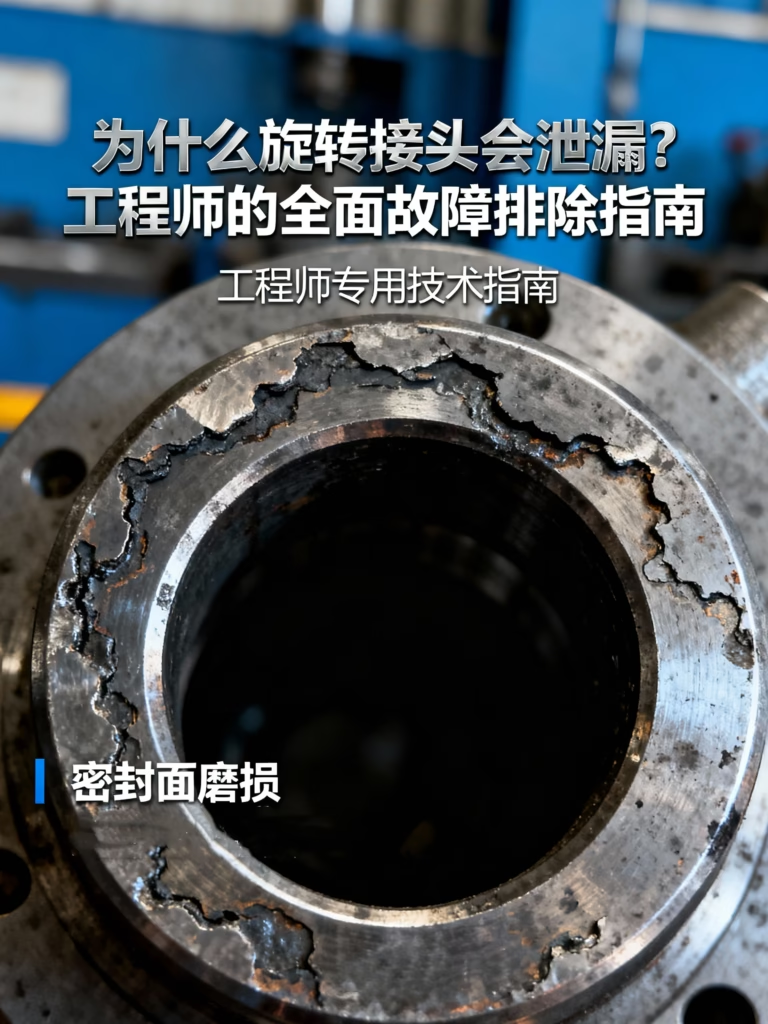
9. Why do rotary unions begin leaking?
Common causes include:
- Normal seal wear
- Dry running
- Shaft misalignment
- Excessive pressure
- Contaminated fluid
- Bearing failure
- Improper installation
Identifying the root cause is essential before installing a replacement unit; otherwise, the same issue may recur.
10. Is lower cost always better?
Not necessarily.
A lower purchase price may result in:
- Shorter service life
- Increased maintenance
- More downtime
- Higher replacement frequency
Most industrial buyers evaluate the total cost of ownership, considering reliability, maintenance intervals, technical support, and production continuity rather than the initial purchase price alone.
11. Can one rotary union handle multiple media?
Yes, if it is specifically designed as a multi-passage rotary union.
These units can simultaneously transfer combinations such as:
- Air and coolant
- Hydraulic oil and air
- Water and electrical signals (with slip ring integration)
- Multiple independent fluid circuits
The design must ensure complete separation between each passage to prevent cross-contamination.
12. Do you support OEM branding?
Yes.
Many distributors and equipment manufacturers request:
- Laser marking
- Private labeling
- Customized packaging
- Product identification
- Special documentation
These services help customers strengthen their own brands while maintaining product consistency.
13. Do replacement rotary unions require special installation procedures?
Generally, no.
However, best practices include:
- Checking shaft alignment
- Cleaning threaded connections
- Applying the recommended tightening torque
- Avoiding excessive side loads
- Verifying media cleanliness before startup
Proper installation significantly extends service life.
14. What industries use Deublin replacement rotary unions?
Our replacement solutions are widely used in:
- CNC machining centers
- Paper mills
- Steel plants
- Printing presses
- Plastic extrusion lines
- Rubber and tire production
- Textile machinery
- Food processing equipment
- Packaging machinery
- Automation systems
Each industry has different engineering requirements, making application-specific design essential.
15. Why work directly with a rotary union manufacturer instead of a trading company?
Working directly with the manufacturer offers several advantages:
- Faster technical communication
- Better control over product quality
- Flexible customization
- Stable production schedules
- Shorter lead times
- More competitive pricing
- Direct engineering support
For long-term industrial projects, direct collaboration often leads to more efficient problem-solving and stronger supply chain reliability.
A Practical Checklist Before Purchasing a Deublin Alternative
Before selecting a supplier, verify the following:
- Can the manufacturer confirm dimensional compatibility?
- Do they understand your operating conditions?
- Are material and seal selections based on your application?
- Is every product pressure-tested before shipment?
- Do they manufacture in-house?
- Can they support OEM customization?
- Are technical drawings available?
- Can they provide engineering support after delivery?
- Do they have experience replacing discontinued models?
- Can they ensure consistent quality across repeat orders?
If the answer to these questions is yes, you are likely working with a capable manufacturing partner rather than a simple reseller.
Why Dann Hydraulic Is a Trusted Alternative Deublin Rotary Union Manufacturer
At Dann Hydraulic, we specialize in manufacturing rotary unions that are engineered to replace many widely used Deublin models while meeting the practical needs of modern industry.
Instead of focusing only on product catalogs, we emphasize engineering collaboration and manufacturing consistency.
Our capabilities include:
Precision Manufacturing
Every critical component is produced using advanced CNC machining equipment, ensuring dimensional consistency and reliable interchangeability.
Comprehensive Quality Control
Each production stage is monitored through standardized inspection procedures, from incoming material verification to final assembly and pressure testing.
Engineering Support
Our engineers assist customers with:
- Model selection
- Drawing confirmation
- Material recommendations
- Seal optimization
- OEM development
- Reverse engineering of discontinued products
Flexible Manufacturing
Whether you require a single replacement unit or a long-term OEM production program, we provide scalable manufacturing solutions supported by consistent quality control.
Global Supply Experience
We work with industrial customers, distributors, and equipment manufacturers across Europe, North America, South America, Southeast Asia, and the Middle East, supporting a wide range of applications from high-speed machine tools to heavy-duty steel production.
Our objective is not simply to supply a Deublin replacement, but to become a long-term engineering partner that helps customers reduce downtime, improve equipment reliability, and optimize lifecycle costs.
Conclusion
As industrial equipment continues to evolve, buyers are placing greater emphasis on engineering expertise, manufacturing transparency, and dependable technical support. The search for an Alternative Deublin Rotary Union is no longer driven solely by cost—it reflects a broader focus on supply chain resilience, operational efficiency, and long-term value.
A reliable Deublin alternative should provide more than dimensional compatibility. It should deliver consistent sealing performance, dependable manufacturing quality, and the confidence that every unit has been engineered, machined, assembled, and tested for demanding industrial environments.
For OEM manufacturers, maintenance teams, and distributors, choosing the right Deublin replacement means selecting a supplier with proven engineering knowledge, modern manufacturing capabilities, and a commitment to continuous improvement.
At Dann Hydraulic, we combine precision manufacturing, application-focused engineering, rigorous quality control, and responsive technical support to help customers keep their equipment operating efficiently. Whether you need a direct replacement for an existing model, a custom-designed rotary union, or a dependable OEM manufacturing partner, our team is ready to support your project with practical solutions built for long-term performance.
Looking for a reliable Alternative Deublin Rotary Union?
Contact our engineering team today to discuss your application, request dimensional verification, or receive a customized replacement solution tailored to your equipment. We are committed to helping you reduce downtime, improve reliability, and build a more resilient supply chain with high-quality rotary union solutions.