
How to Extend Rotary Union Service Life: A Practical Guide from a Rotary Union Manufacturer
Rotary unions are critical components in modern industrial systems. Whether transferring water, steam, thermal oil, hydraulic fluid, coolant, compressed air, or vacuum, a rotary union operates continuously under pressure, temperature, and rotational stress. Yet many factories experience premature rotary union failures long before the expected service interval. Leakage, bearing damage, seal wear, vibration, and overheating often lead to costly downtime and production losses. The good news is that most rotary union failures are preventable. This guide explains the factors that affect Rotary Union Service Life and provides practical methods to significantly extend operational lifespan while reducing maintenance costs.
In heavy continuous processing—whether you are managing a 24/7 corrugated packaging line, a multi-axis CNC machining center, or a high-speed textile calender—the rotary union is the critical chokepoint of your fluid and thermal management system. When this component operates correctly, it is invisible. When it fails, the results are immediate: catastrophic fluid loss, seized spindle bearings, and expensive unscheduled downtime.
Most plant engineers accept rotary joint replacement as an inevitable, frequent maintenance task. However, our data proves otherwise. As a direct fluid transmission manufacturer with over a decade of experience engineering and producing heavy-duty rotary unions, we analyze thousands of failed joints on our factory test benches every year. Our engineering consensus is clear: premature failure is rarely a flaw in the fundamental metallurgy. In over 80% of cases, shortened Rotary Union Service Life is a direct result of improper installation, inadequate fluid filtration, or a mismatch between the seal tribology and the application environment.
This comprehensive technical guide strips away generic catalog advice. Written directly from the manufacturing floor, we will detail the physical mechanics of seal wear and provide actionable, factory-backed protocols to double or even triple your rotary union service life.
Why Rotary Union Service Life Matters
A rotary union is often a small component within a larger machine, but its reliability directly impacts production efficiency.
When a rotary union fails unexpectedly, manufacturers may face:
- Production interruptions
- Product quality issues
- Increased maintenance expenses
- Safety risks
- Damage to adjacent equipment
For high-speed equipment operating 24/7, extending rotary union service life by even a few months can generate significant savings.
For example:
| Industry | Typical Downtime Cost |
|---|---|
| Paper Mill | $5,000–$20,000/hour |
| Steel Processing | $10,000–$50,000/hour |
| CNC Manufacturing | $500–$5,000/hour |
| Textile Production | $300–$2,000/hour |
This is why rotary union lifecycle optimization has become an important maintenance objective for industrial plants.
Understanding the Main Causes of Rotary Union Failure
Before extending service life, it is important to understand why rotary unions fail.
Based on our factory’s after-sales records and failure analysis reports, over 80% of failures are caused by five common issues.
1. Incorrect Rotary Union Selection
Many failures occur because the rotary union is not designed for the actual operating conditions.
Common mismatches include:
- Pressure exceeds design limits
- Excessive rotational speed
- Temperature beyond seal capability
- Incompatible media
- Insufficient flow capacity
For example:
A standard water rotary union may fail rapidly when used with high-temperature steam.
Likewise, a low-speed rotary union installed on a high-speed spindle can experience bearing destruction within weeks.
Proper product selection is the foundation of long service life.
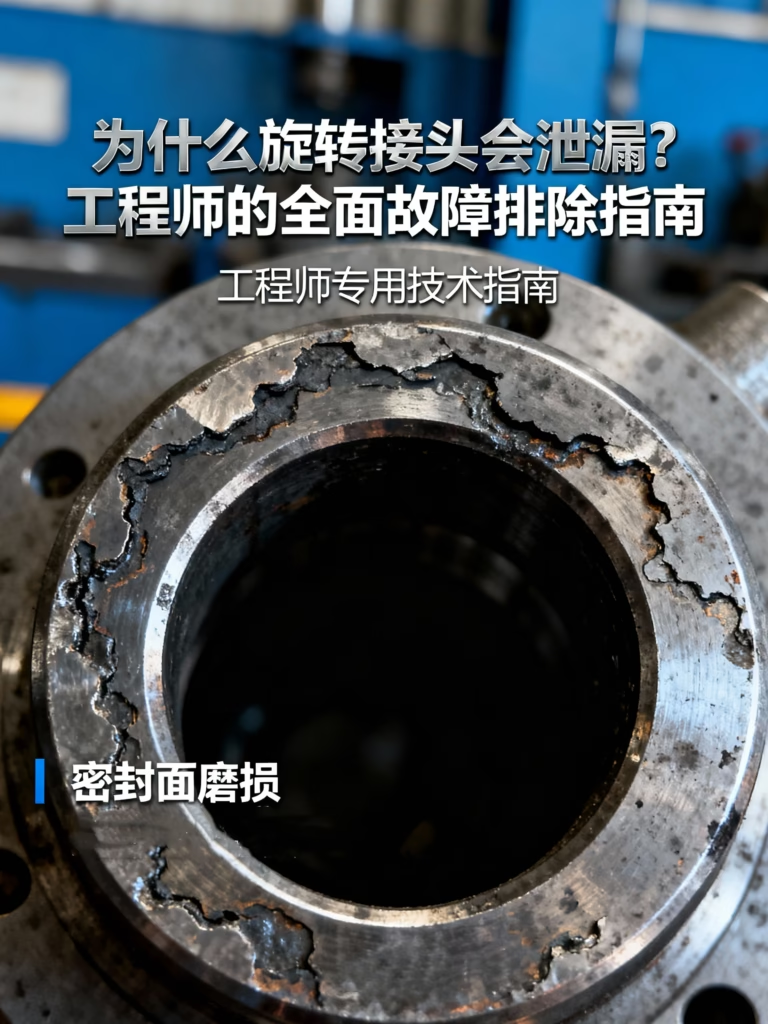
2. Seal Wear
The mechanical seal is the heart of every rotary union.
During operation, seal faces continuously slide against one another.
Over time, friction causes:
- Surface wear
- Reduced sealing effectiveness
- Leakage
- Heat generation
Factors accelerating seal wear include:
- Poor lubrication
- Dry running
- Contaminated media
- Excessive pressure
- Thermal shock
High-quality seal materials such as:
- Silicon Carbide
- Tungsten Carbide
- Carbon Graphite
- Ceramic
can significantly improve wear resistance.
3. Bearing Failure
Bearings support rotating components and maintain shaft stability.
When bearings fail, the entire rotary union quickly deteriorates.
Typical causes include:
- Misalignment
- Overloading
- Contamination
- Lack of lubrication
- Excessive vibration
In our manufacturing experience, bearing-related issues account for nearly 30% of rotary union failures.
4. Contaminated Operating Media
Industrial fluids often contain contaminants.
Examples include:
- Metal particles
- Rust
- Scale
- Fibers
- Dirt
- Sludge
These particles can damage seal faces and bearings.
Industries most affected include:
- Steel mills
- Paper manufacturing
- Mining equipment
- Coolant circulation systems
Installing proper filtration systems can dramatically increase rotary union lifespan.
5. Installation Errors
Even premium rotary unions fail prematurely if installed incorrectly.
Common installation mistakes include:
- Pipe strain
- Improper torque
- Shaft misalignment
- Unsupported hoses
- Incorrect connection orientation
Many early failures occur within the first month after installation due to these avoidable errors.
How to Extend Rotary Union Service Life
Now, let’s examine proven methods used by industrial maintenance teams.
Select the Right Rotary Union for the Application
The first step is always proper engineering selection.
Consider:
Operating Pressure
Choose a rotary union with an adequate pressure margin.
Recommended safety factor:
- Operating Pressure ≤ 70% of Rated Pressure
Operating Temperature
Seal materials must withstand actual temperatures.
Examples:
| Media | Recommended Seal Materials |
|---|---|
| Water | Carbon / Ceramic |
| Steam | Silicon Carbide |
| Thermal Oil | Tungsten Carbide |
| Hydraulic Oil | Carbon Graphite |
Rotational Speed
High-speed applications require:
- Precision bearings
- Balanced rotor assemblies
- Optimized seal loading
A rotary union designed for 100 RPM should never be used at 3,000 RPM.
Maintain Proper Alignment
Misalignment is one of the most overlooked factors affecting the service life of rotary unions.
Even a slight angular deviation can cause:
- Seal face distortion
- Bearing overload
- Increased vibration
Best practices include:
- Laser alignment tools
- Precision-machined mounting surfaces
- Flexible hose connections
- Regular alignment inspections
Prevent Dry Running
Dry running is one of the fastest ways to destroy mechanical seals.
Without fluid lubrication:
- Seal temperatures rise rapidly
- Friction increases
- Surface damage occurs
Recommendations:
- Ensure fluid flow before startup
- Install flow monitoring devices
- Use automatic shutdown systems
- Follow proper startup procedures
Control Vibration Levels
Excessive vibration shortens seal and bearing life.
Sources of vibration include:
- Unbalanced rollers
- Bent shafts
- Motor issues
- Worn couplings
Routine vibration analysis can identify problems before catastrophic failure occurs.
Improve Fluid Cleanliness
Clean operating media dramatically improves component longevity.
Recommended filtration levels:
| Application | Filter Rating |
|---|---|
| Hydraulic Oil | 10–25 Microns |
| Coolant Systems | 25–50 Microns |
| Water Systems | 50–100 Microns |
Regular filter replacement is equally important.
Follow a Preventive Maintenance Schedule
Many companies wait until leakage appears before taking action.
This reactive approach often results in unexpected downtime.
Instead, implement preventive maintenance.
Monthly inspections should include:
Visual Inspection
Check for:
- External leakage
- Corrosion
- Loose connections
Temperature Monitoring
Abnormal temperature increases often indicate:
- Bearing wear
- Seal friction
- Lubrication problems
Noise Monitoring
Unusual sounds may signal:
- Bearing damage
- Internal wear
- Misalignment
Upgrade to Advanced Seal Technology
Modern rotary unions use advanced seal designs that significantly extend service life.
Examples include:
Balanced Mechanical Seals
Benefits:
- Reduced contact pressure
- Lower friction
- Longer wear life
Silicon Carbide Seal Faces
Advantages:
- Superior hardness
- Excellent thermal conductivity
- High chemical resistance
Spring-Loaded Seals
Provide:
- Stable sealing force
- Better compensation for wear
- Improved reliability
Real Factory Case Study: Extending Service Life in a Steel Processing Plant
A steel-processing customer contacted us after repeatedly replacing rotary unions every 3 months.
Original Conditions
- Cooling water application
- 24-hour operation
- High vibration environment
- Imported rotary union brand
Problems Identified
Our engineering team found:
- Pipe strain is causing misalignment
- Inadequate filtration
- Bearing overload
Solutions Implemented
We recommended:
- Dual-bearing rotary union design
- Flexible hose installation
- Improved filtration system
- Precision alignment procedure
Results
Service life increased from:
3 Months → 18 Months
Maintenance costs were reduced by more than 60%.
This example demonstrates that operational improvements often have a greater impact than simply changing brands.
EEAT: Why Manufacturing Experience Matters
Google increasingly rewards content created by genuine industry experts.
As a rotary union manufacturer, we believe practical experience is more valuable than generic product descriptions.
Experience
Our engineering team has worked with rotary union applications involving:
- Continuous casting lines
- Paper drying cylinders
- CNC machining centers
- Rubber tire presses
- Textile machinery
- Food processing equipment
Every year, we analyze hundreds of real-world failure cases.
Expertise
Our production capabilities include:
- CNC precision machining
- Dynamic balance testing
- Pressure testing
- Leakage testing
- Material analysis
- Seal performance validation
This allows us to understand how design details influence service life.
Authoritativeness
We supply rotary union solutions for customers in:
- North America
- Europe
- Southeast Asia
- Middle East
- South America
Our products support both OEM manufacturers and maintenance replacement markets.
Trustworthiness
Every rotary union undergoes:
- Dimensional inspection
- Pressure testing
- Seal integrity verification
- Performance validation
Our objective is not simply to sell a component but to help customers achieve reliable long-term operation.
How We Manufacture for Maximum Longevity
As a direct Chinese source manufacturer, we do not simply assemble catalog parts. We control the entire metallurgical and tribological manufacturing pipeline. When plant engineers ask us why our rotary unions outlast generic trading-company alternatives.
Sub-Micron Optical Lapping Cleanrooms
For mechanical seals, initial wear occurs during the “bedding-in” phase. If a seal face is microscopically rough, the high points will clash, generating heat and shedding debris into the seal chamber.
We eliminate this bedding-in wear. Our manufacturing facility features dedicated lapping cleanrooms equipped with automated diamond-slurry platens. Every single Silicon Carbide and Tungsten Carbide seal ring is lapped to an optical flatness of less than 2 light bands (0.58 microns). We verify this tolerance using monochromatic optical flat crystals. Because our faces are perfectly mated right out of the box, frictional heat generation is minimized, extending the Rotary Union Service Life significantly.
Antimony-Impregnated Carbon Matrices
In high-temperature steam and thermal oil applications, cheap carbon-graphite dust blocks disintegrate rapidly. We source and process premium isostatically pressed carbon blocks, which are then impregnated under vacuum with antimony metal.
Antimony impregnation vastly increases the compressive strength and thermal conductivity of the carbon ring. As the joint rotates, the antimony conducts frictional heat away from the sealing face and into the media, preventing the carbon from blistering or oxidizing under 200°C steam.
100% Dynamic Run-In Testing
Static pressure tests are insufficient for dynamic components. Before any unit leaves our factory for international export, it is mounted to our proprietary dynamic testing rigs.
-
We spin the joints up to their maximum rated RPM.
-
We pressurize the units to 1.5x their rated operational pressure.
-
We monitor the real-time thermal curves using infrared thermography to ensure bearing friction is within baseline limits.
By subjecting our products to severe factory run-in protocols, we guarantee that you receive a component proven to survive your exact industrial realities.
Frequently Asked Questions
How long should a rotary union last?
Service life depends on operating conditions. Under proper installation and maintenance, many rotary unions operate reliably for several years.
What is the biggest cause of rotary union failure?
Incorrect application selection and installation errors are among the most common causes.
Does higher pressure reduce rotary union life?
Yes. Higher pressure increases seal loading and bearing stress, accelerating wear.
How often should rotary unions be inspected?
Critical applications should be inspected monthly. General industrial applications typically benefit from quarterly inspections.
Can a leaking rotary union be repaired?
In many cases, seals and bearings can be replaced. However, severe shaft or housing damage may require replacement.
Conclusion
Extending Rotary Union Service Life is not achieved through a single solution. It requires proper product selection, precise installation, clean operating conditions, preventive maintenance, and high-quality engineering design.
From our experience as a rotary union manufacturer, the majority of premature failures can be prevented through systematic attention to operating conditions and maintenance practices.
Companies that focus on lifecycle management rather than emergency replacement often achieve lower operating costs, higher equipment reliability, and significantly longer rotary union service life.
If you are evaluating rotary unions for a new project or experiencing repeated failures in an existing application, a detailed engineering review can often reveal opportunities to increase service life by several times while reducing total ownership costs.