Custom Rotary Union Manufacturing Process: Inside a Professional Factory from Design to Final Testing
In modern industrial equipment, reliability is rarely determined by the largest or most expensive component. More often, it depends on the performance of small but critical parts that operate continuously under demanding conditions. One of those components is the custom rotary union.
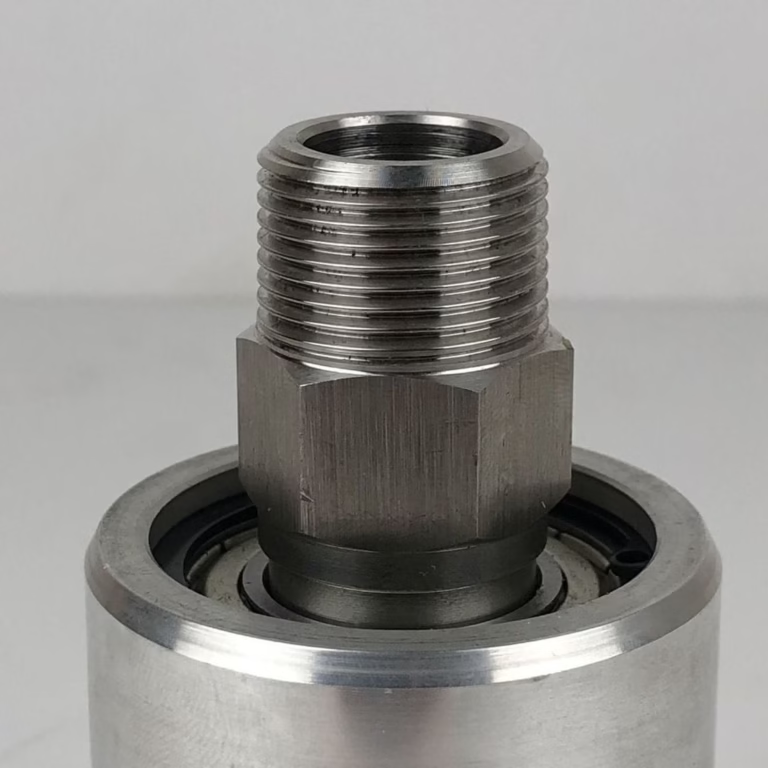
A rotary union provides a sealed connection that allows fluids such as hydraulic oil, coolant, water, steam, compressed air, vacuum, or thermal oil to transfer from a stationary supply line into rotating equipment. Although the basic principle appears straightforward, designing and manufacturing a rotary union that can withstand high pressure, high speed, elevated temperatures, or multiple media simultaneously requires extensive engineering expertise and manufacturing experience.
For this reason, leading OEMs and industrial users are increasingly opting for the custom rotary union rather than modifying standard catalog products. A custom solution is engineered specifically for the operating environment, ensuring better sealing performance, longer service life, and improved equipment reliability.
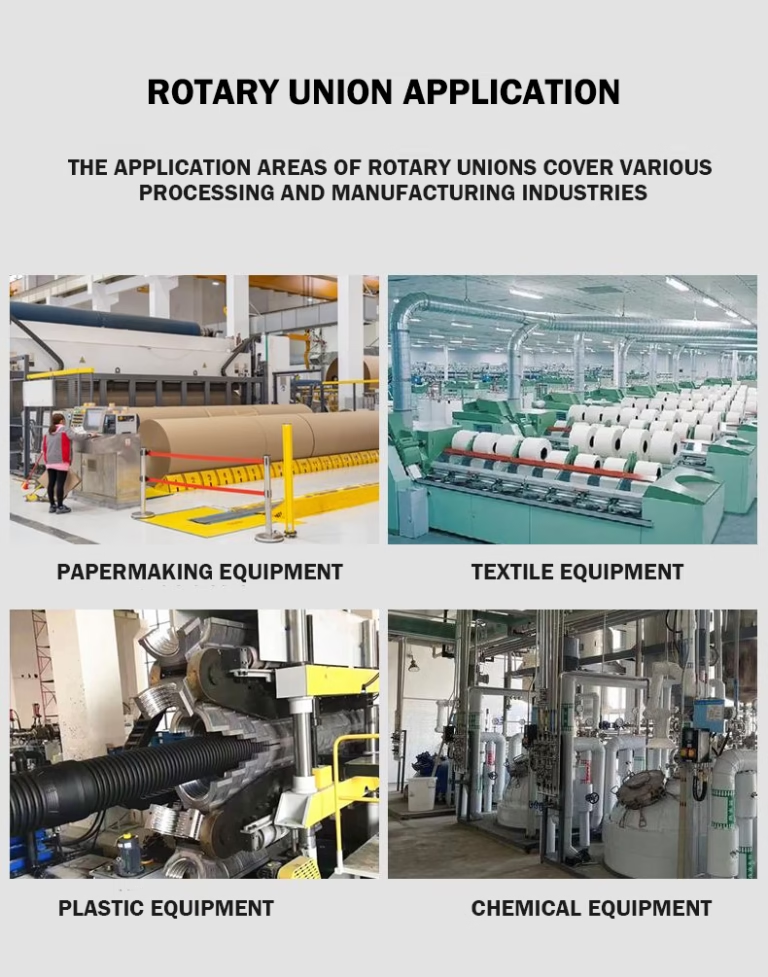
As a professional custom rotary union manufacturer in China, we have worked with machine builders, maintenance companies, and industrial equipment manufacturers from Europe, North America, Southeast Asia, and the Middle East. Over the past decade, we have manufactured thousands of custom rotary union for applications including CNC machining centers, steel mills, paper machines, rubber and tire presses, textile equipment, hydraulic systems, marine machinery, wind turbines, and automated production lines.
This article provides a detailed look inside our manufacturing process. More importantly, it explains why each manufacturing step directly affects the performance, reliability, and service life of a custom rotary union. Whether you are an equipment designer, maintenance engineer, purchasing manager, or OEM manufacturer, understanding these processes will help you select the right supplier and avoid costly failures.
Why Standard Rotary Unions Often Fail in Industrial Applications
When handling industrial procurement, many buyers hold a widespread misunderstanding: they believe rotary unions are universal standard mechanical parts, so they only need to pick matching models directly from product catalogs by merely referencing thread dimensions or pressure parameters. In reality, no two operating environments are exactly alike.
Every machine has unique working conditions, and even small differences in application can significantly influence the performance of a rotary union. Using a standard product in a specialized system often leads to premature failure, increased maintenance costs, and unplanned production downtime.
Similarly, the custom rotary union operating at 300 RPM behaves very differently from one rotating at 12,000 RPM inside a high-speed machining center. At higher rotational speeds, centrifugal force, bearing temperature, vibration, and seal friction increase dramatically.
Temperature is another critical factor that is frequently underestimated. Steam systems operating above 180°C require materials capable of maintaining dimensional stability during continuous thermal expansion.
Chemical compatibility presents another challenge. Fluids such as aggressive chemicals, thermal oils, food-grade cleaning solutions, or corrosive seawater require carefully selected housing materials and sealing components. Stainless steel, silicon carbide, carbon graphite, tungsten carbide, PTFE, EPDM, FKM, and other materials all have different chemical resistance characteristics. Choosing materials solely based on cost rather than application often results in corrosion, swelling of elastomer seals, or premature mechanical seal failure.
Multi-passage rotary unions introduce an additional level of complexity. Modern automation equipment frequently requires several independent flow channels within a single rotary union to simultaneously transfer hydraulic oil, compressed air, coolant, electrical signals, or vacuum. Designing reliable internal sealing structures while preventing media cross-contamination requires advanced engineering experience that cannot be achieved by simply modifying a standard product.
These examples illustrate a fundamental principle that experienced manufacturers understand well:
A rotary union should always be engineered around the application—not the application adjusted to fit an existing rotary union.
Why Custom Rotary Unions Have Become the Preferred Choice for OEM Manufacturers
As industrial equipment becomes more advanced, the demand for customized rotary unions continues to grow. Today’s OEM manufacturers are no longer looking for generic components; they require engineered solutions that integrate seamlessly with their equipment while delivering consistent performance over many years of continuous operation.
Custom rotary unions provide several important advantages over standard catalog products.
Perfect Mechanical Compatibility
One of the primary reasons customers request custom designs is to achieve precise compatibility with their machinery. Shaft dimensions, thread specifications, flange configurations, installation space, and internal flow requirements often differ from standard industry sizes. A custom rotary union eliminates the need for adapters, additional fittings, or structural modifications, simplifying installation while reducing potential leak points.
Improved Operational Reliability
Every aspect of a custom rotary union—from bearing selection to seal geometry—is optimized for the intended application. Instead of compromising with a general-purpose design, engineers can tailor the product to the customer’s pressure, rotational speed, temperature, and media requirements. This targeted engineering approach significantly improves sealing stability, reduces friction, and extends service life.
Lower Lifetime Operating Costs
Although a custom rotary union may require a slightly higher initial investment than a standard model, it typically results in a much lower total cost of ownership. Longer maintenance intervals, reduced downtime, fewer replacement parts, and improved equipment efficiency often generate substantial savings over the lifetime of the machine.
Better Integration with OEM Equipment
Many of our customers are machine manufacturers developing proprietary equipment for global markets. Rather than adapting their designs to accommodate existing rotary unions, they require components specifically engineered to complement their machines. This approach allows them to optimize equipment layout, reduce assembly complexity, and improve the overall competitiveness of their products.
Easier Future Maintenance
An experienced manufacturer also considers long-term serviceability during the design stage. Bearings, seals, and wear components are selected not only for performance but also for ease of replacement and maintenance. This reduces future maintenance costs while minimizing production interruptions for end users.
From our experience working with OEM customers worldwide, the most successful custom rotary union projects begin with a thorough understanding of the customer’s application—not with a quotation or a drawing. The manufacturing process starts long before the first piece of metal is machined. It begins with engineering communication, application analysis, and the careful evaluation of every operating parameter that will influence the performance of the finished product.
Every Successful Custom Rotary Union Starts
One of the biggest differences between an experienced rotary union manufacturer and a trading company is what happens before production begins.
Many suppliers immediately ask customers for a drawing or part number. While drawings are important, they rarely tell the whole story. A rotary union may look identical externally, but the internal structure can vary significantly depending on operating conditions.
Over the years, we have found that the majority of premature rotary union failures are not caused by machining defects—they originate during the specification stage. If the application is misunderstood, even a perfectly machined product may fail because the internal design is unsuitable for the actual working environment.
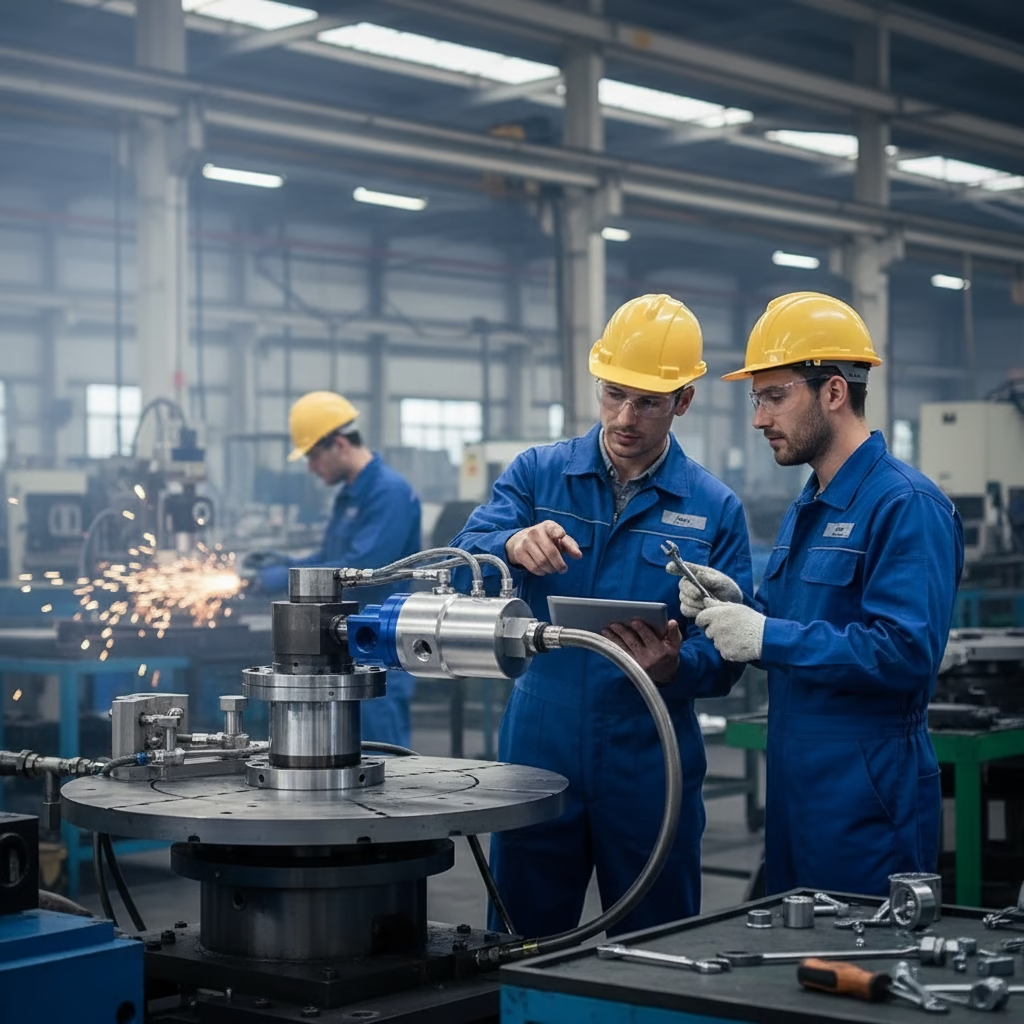
Our engineers work directly with customers to understand how the rotary union will operate in real production, not just how it appears on a technical drawing.
Typical questions include:
- What medium will pass through the rotary union?
- Is the medium clean or contaminated?
- What is the normal operating pressure?
- What is the maximum pressure during system startup?
- What rotational speed does the equipment reach?
- Does the machine operate continuously or intermittently?
- What is the working temperature?
- Is there vibration or axial movement?
- Is installation space limited?
- What service life is expected?
These questions may seem basic, but they often determine whether the final product operates reliably for five years—or fails within six months.
By redesigning the seal geometry, selecting higher-strength spring components, and optimizing the pressure balance inside the rotary union, we eliminated the leakage problem without changing the machine itself.
This type of engineering analysis cannot be obtained from a product catalog—it comes from practical manufacturing experience and a deep understanding of rotary sealing technology.
Transforming Customer Requirements into an Engineering Solution
Once the application has been fully evaluated, our engineering department begins transforming operational requirements into a manufacturable product.
Rather than copying an existing rotary union, we analyze how each internal component contributes to performance under the customer’s specific operating conditions.
Every custom design is developed as a complete engineering project.
The design process typically includes:
- Three-dimensional CAD modeling
- Internal flow channel optimization
- Mechanical seal arrangement
- Bearing configuration
- Rotor structural analysis
- Housing strength verification
- Tolerance stack-up analysis
- Assembly feasibility review
- Maintenance accessibility evaluation
Modern CAD software allows our engineers to visualize every component before manufacturing begins.
This not only reduces development time but also minimizes production risks.
For complex multi-passage rotary unions, digital modeling helps us verify that multiple media channels remain completely isolated from each other while maintaining sufficient structural strength around internal passages.
In many projects, several design revisions are completed before a single component enters production.
Although this engineering phase is invisible to the customer, it often determines whether the finished rotary union delivers years of reliable service.
Designing Internal Flow Paths for Maximum Efficiency
The internal flow path is one of the most overlooked aspects of rotary union design.
Many people assume that fluid simply enters one side and exits the other. In reality, the geometry of the internal passages directly influences flow efficiency, pressure loss, heat generation, and even seal life.
Poorly designed flow channels can create turbulence inside the rotary union.
Turbulent flow increases pressure drop and may generate localized heating, particularly in hydraulic and high-speed coolant applications.
Our engineering team carefully designs internal passages to:
- Reduce unnecessary flow resistance
- Maintain stable pressure distribution
- Eliminate sharp directional changes
- Improve coolant circulation
- Minimize cavitation risk
- Reduce internal energy loss
For customers operating high-speed machining centers, even a small improvement in coolant flow efficiency can contribute to better cutting performance and longer tool life.
Similarly, in hydraulic systems, smoother internal flow helps reduce pressure fluctuations that can accelerate seal wear.
These design details are rarely visible from the outside, yet they significantly influence the long-term reliability of the rotary union.
Material Selection Is an Engineering Decision, Not a Purchasing Decision
Selecting the right material is one of the most critical stages in custom rotary union manufacturing.
Unfortunately, it is also one of the areas where low-cost suppliers often compromise.
Some manufacturers use identical materials for every product regardless of application.
Professional manufacturers take the opposite approach.
We begin by asking a simple question:
What operating environment will this rotary union experience over the next five to ten years?
The answer determines every material decision that follows.
Housing Materials
Different industries require different housing materials.
Common options include:
- Aluminum alloy for lightweight, high-speed equipment
- Brass for general industrial applications
- Carbon steel for heavy-duty machinery
- Stainless Steel 304 for moisture resistance
- Stainless Steel 316 for marine, food processing, and corrosive environments
For offshore equipment exposed to saltwater, stainless steel is usually the preferred choice because of its superior corrosion resistance.
Conversely, for high-speed machining centers where reducing rotating mass is important, aluminum alloy often provides the best balance between strength and weight.
Selecting the Right Mechanical Seal Materials
Mechanical seals are the heart of every rotary union.
Their performance directly determines leakage resistance and service life.
Different operating conditions require different seal face combinations.
Common material combinations include:
- Carbon Graphite vs. Silicon Carbide
- Silicon Carbide vs. Silicon Carbide
- Tungsten Carbide vs. Tungsten Carbide
Each combination has unique advantages.
Carbon graphite provides excellent self-lubricating properties and performs well in many coolant and water applications.
Silicon carbide offers outstanding wear resistance, making it ideal for high-speed and abrasive environments.
Tungsten carbide is often selected for demanding hydraulic systems because of its exceptional hardness and pressure resistance.
There is no universally “best” seal material.
The optimal combination depends entirely on the customer’s application.
Choosing Secondary Seals for Long-Term Reliability
While mechanical seals receive most of the attention, secondary sealing elements are equally important.
O-rings and auxiliary seals must withstand continuous exposure to pressure, temperature, and chemical media.
Our engineers commonly select from:
- NBR for hydraulic oil
- FKM (Viton®) for elevated temperatures
- EPDM for hot water and steam
- PTFE for aggressive chemicals and low-friction applications
Selecting an incompatible elastomer can result in swelling, hardening, cracking, or chemical degradation.
Although these failures may appear minor, they frequently become the starting point of serious leakage problems.
Bearing Selection Determines Service Life
Bearings support every rotating component inside the rotary union.
Their quality directly influences rotational stability, vibration, noise, and operating life.
For demanding industrial applications, we typically specify premium bearings from internationally recognized manufacturers such as SKF or FAG, depending on customer requirements.
Bearing selection considers numerous variables, including:
- Rotational speed
- Radial load
- Axial load
- Operating temperature
- Lubrication conditions
- Expected service life
For high-speed rotary unions used in machining centers, bearing preload is carefully optimized to minimize vibration while maintaining smooth rotation.
Choosing a lower-cost bearing may reduce the purchase price, but it often shortens service life significantly under continuous industrial operation.
Engineering Before Manufacturing Creates Better Products
From our experience, customers often focus on machining precision because it is easy to measure.
However, machining accuracy alone cannot compensate for an unsuitable design.
A rotary union manufactured to micron-level tolerances will still fail if the wrong seal material, bearing configuration, or internal flow structure has been selected.
That is why we believe engineering is the foundation of manufacturing.
Only after every design parameter has been reviewed, verified, and approved does the project move to the next stage—precision CNC machining, where engineering concepts are transformed into physical components with the dimensional accuracy required for long-term industrial performance.
Precision Manufacturing: From Raw Material to High-Performance Rotary Union Components
Engineering determines how a custom rotary union should perform, but manufacturing determines whether that performance can actually be achieved.
Even the most advanced design will fail if components are produced with poor dimensional accuracy, unstable material quality, or inconsistent machining processes. In rotary union manufacturing, differences measured in microns can determine whether a product operates leak-free for several years or develops sealing problems after only a few hundred operating hours.
At our factory, CNC machining is not simply about producing parts that match a drawing. Every machining process is planned around one objective: maintaining the precision required for stable sealing, smooth rotation, and long service life.
Selecting High-Quality Raw Materials
The manufacturing process begins long before the first machine starts cutting metal.
Incoming raw materials are inspected before entering production because dimensional accuracy means little if the material itself cannot meet mechanical requirements.
Depending on the application, we commonly machine rotary unions from:
- Aluminum Alloy
- Brass
- Carbon Steel
- Stainless Steel 304
- Stainless Steel 316
- Alloy Steel for high-pressure applications
Each material offers different advantages.
For example, aluminum alloy is lightweight and ideal for high-speed rotating equipment where minimizing rotational inertia improves machine performance.
Brass remains an excellent choice for many water, coolant, and general industrial applications because of its machinability and corrosion resistance.
Carbon steel provides excellent mechanical strength for heavy industrial equipment, while stainless steel is preferred for food processing, marine, pharmaceutical, and corrosive environments.
Rather than recommending the same material for every customer, our engineers select materials according to actual operating conditions, expected service life, and maintenance requirements.
CNC Machining: Precision Is Measured in Microns
Once the material has been approved, production moves to the CNC workshop.
A rotary union may appear mechanically simple, but internally it contains multiple precision-machined components that must fit together perfectly.
These include:
- Rotor
- Housing
- Shaft
- Bearing Seats
- Seal Cavities
- Threaded Connections
- Flow Channels
- End Covers
- Locking Components
Each part must be manufactured within carefully controlled tolerances.
The sealing faces inside a rotary union are especially critical.
Even slight variations in concentricity or flatness can increase seal loading, causing uneven wear and leakage during operation.
To achieve this level of accuracy, our factory uses modern CNC turning centers and machining centers capable of maintaining consistent repeatability throughout production.
Typical machining operations include:
- Precision Turning
- CNC Milling
- Deep Hole Drilling
- Internal Boring
- Thread Machining
- Precision Reaming
- Surface Grinding
- Deburring
Every machining program is verified before production begins to ensure dimensional consistency between batches.
For customized products, trial machining is often performed before full-scale production to verify that all critical dimensions meet engineering requirements.
Tolerance Control Is More Important Than Maximum Precision
Many manufacturers advertise extremely tight machining tolerances.
However, experienced engineers understand that the smallest tolerance is not always the best solution.
What matters is functional tolerance.
Every dimension inside a rotary union interacts with another component.
If tolerances are too loose, internal leakage may occur.
If tolerances are unnecessarily tight, assembly becomes difficult, thermal expansion may create excessive friction, and manufacturing costs increase without improving performance.
Our engineering and production departments work together to establish realistic tolerance ranges for every critical dimension.
Particular attention is paid to:
- Shaft concentricity
- Bearing seat diameter
- Mechanical seal alignment
- Rotor roundness
- Thread accuracy
- Surface flatness
- Seal face positioning
Maintaining these relationships throughout production is one of the reasons our rotary unions achieve stable operation under demanding industrial conditions.
Surface Finish Directly Affects Seal Performance
Machining dimensions alone cannot guarantee reliable sealing.
Surface finish is equally important.
Mechanical seal faces operate under continuous contact while rotating at high speed.
Any machining marks, scratches, or irregularities increase friction and accelerate wear.
Critical sealing surfaces therefore receive additional finishing processes after machining.
Surface roughness is carefully controlled to achieve the finish required for each seal design.
Proper surface finishing provides several benefits:
- Lower friction
- Reduced heat generation
- Improved sealing stability
- Longer mechanical seal life
- Lower starting torque
Although customers rarely see these finished surfaces after assembly, they play a major role in determining the long-term reliability of the rotary union.
Heat Treatment Improves Component Durability
Not every component inside a rotary union requires the same hardness.
Some parts must resist wear.
Others require toughness to absorb mechanical loads without cracking.
Depending on the application, selected components undergo additional heat treatment processes such as:
- Quenching
- Tempering
- Nitriding
- Induction Hardening
These treatments improve:
- Surface hardness
- Fatigue resistance
- Wear resistance
- Structural stability
- Load-bearing capacity
For high-pressure hydraulic rotary unions, properly heat-treated shafts significantly reduce long-term wear caused by continuous rotation under heavy loads.
Surface Treatments for Corrosion Protection
Industrial equipment often operates in environments where moisture, chemicals, salt spray, or coolant continuously attack metal surfaces.
To improve durability, many rotary union components receive additional surface treatments after machining.
Depending on customer requirements, these may include:
- Hard Anodizing
- Nickel Plating
- Chrome Plating
- Black Oxide Treatment
- Anti-Corrosion Passivation
For marine applications, corrosion resistance is often just as important as sealing performance.
Similarly, food processing equipment requires smooth, cleanable surfaces that comply with hygienic operating requirements.
Selecting the appropriate surface treatment extends component life while reducing maintenance costs.
Every Component Is Inspected During Production
Quality inspection is not limited to the final product.
Every critical component is inspected throughout manufacturing.
Operators perform routine dimensional checks using calibrated measuring equipment, including:
- Digital Micrometers
- Bore Gauges
- Dial Indicators
- Height Gauges
- Thread Gauges
- Coordinate Measuring Equipment (for selected components)
Rather than waiting until final assembly to discover dimensional errors, inspections are performed continuously during machining.
This approach minimizes scrap while ensuring consistent quality across production batches.
Cleanliness Is an Essential Part of Manufacturing
One manufacturing step that receives little attention outside the industry is component cleaning.
After machining, microscopic metal chips, abrasive particles, coolant residue, and cutting oil remain on component surfaces.
If these contaminants enter the mechanical seal during assembly, they can scratch sealing faces and significantly reduce service life.
For this reason, every precision component undergoes a dedicated cleaning process before entering the assembly workshop.
Our cleaning procedure typically includes:
- Removal of machining debris
- Degreasing
- Ultrasonic cleaning for critical components
- Compressed air drying
- Visual cleanliness inspection
For hydraulic rotary unions used in demanding fluid power systems, internal cleanliness is especially important because contaminants can circulate throughout the hydraulic circuit.
Manufacturing Consistency Matters More Than Individual Precision
Producing one high-quality rotary union is relatively straightforward.
Producing hundreds or thousands of identical rotary unions with consistent quality is a much greater challenge.
Consistency depends on standardized manufacturing procedures rather than individual operator skill.
At our factory, every production stage follows documented process specifications covering:
- CNC machining parameters
- Tool replacement schedules
- Inspection frequency
- Material traceability
- Heat treatment records
- Surface treatment verification
- Cleaning procedures
These standardized processes ensure that every rotary union performs consistently, whether it is the first unit produced or the thousandth.
For OEM customers, this consistency is essential because every machine leaving their production line must meet the same performance standards.
Manufacturing Experience Creates Long-Term Reliability
After years of producing rotary unions for industries ranging from CNC machining centers and steel mills to paper machines and offshore equipment, we have learned that manufacturing excellence is not achieved through expensive machinery alone.
Reliable products result from the combination of:
- Experienced engineers
- Skilled machinists
- Stable production processes
- Strict quality standards
- Continuous process improvement
Every machining operation influences the next manufacturing step, and every component contributes to the overall performance of the finished rotary union.
This attention to detail is one of the reasons many of our OEM customers continue to work with us on new custom projects year after year.
However, even perfectly machined components must still be assembled with the same level of precision.
Precision Assembly, Dynamic Balancing, and 100% Performance Testing
Producing precision-machined components is only half of the manufacturing process. A custom rotary union does not become a finished product until every component is assembled, adjusted, tested, and verified according to strict engineering standards.
In our experience, many rotary union failures are not caused by poor materials or inaccurate machining. Instead, they result from improper assembly procedures, contaminated seal faces, incorrect bearing preload, or insufficient factory testing.
Unlike ordinary mechanical products, a rotary union combines mechanical sealing technology, precision bearings, rotating components, and fluid transmission into one compact assembly. Every part interacts with the others, which means even a small assembly error can affect sealing performance, rotational stability, and service life.
For this reason, assembly is treated as a critical manufacturing process rather than a simple production step.
Precision Assembly Requires Experience, Not Just Instructions
Many people assume that assembly simply means putting machined parts together according to a drawing. In reality, assembling a high-performance rotary union requires years of practical experience.
Mechanical seal faces, for example, are manufactured with extremely fine surface finishes. Although these surfaces appear durable, they can be permanently damaged by improper handling.
A fingerprint containing oil residue, a tiny metal particle, or a minor scratch during assembly may eventually develop into a leakage path once the rotary union begins operating under pressure.
To eliminate these risks, our assembly technicians follow standardized procedures developed through years of production experience.
Before assembly begins:
- Every component is rechecked for dimensional accuracy.
- Seal faces are inspected under proper lighting.
- Bearings are verified before installation.
- O-rings are inspected for deformation or surface defects.
- Threaded components are cleaned again if necessary.
Assembly is performed in a clean working environment to minimize contamination.
Although our products are designed for harsh industrial environments, they are assembled under carefully controlled conditions because cleanliness directly influences sealing performance.
Installing Mechanical Seals with Precision
The mechanical seal is often described as the heart of a rotary union.
Its purpose is deceptively simple—to prevent fluid from leaking while allowing continuous rotation. Achieving this under high pressure and high rotational speed is far more complex.
Proper seal installation requires attention to several factors:
- Seal face orientation
- Spring preload
- Axial positioning
- Contact pressure
- Lubrication compatibility
- Surface cleanliness
Too much spring force increases friction and heat generation.
Too little spring force may cause leakage under pressure.
Our technicians use dedicated assembly tools designed specifically for mechanical seals to avoid damaging the sealing surfaces.
Metal tools are never allowed to contact polished seal faces directly.
Depending on the application, compatible assembly lubricants are applied only where necessary.
Excess lubricant can contaminate the sealing interface, while insufficient lubrication may damage elastomer seals during installation.
These details are often invisible after assembly, but they have a significant impact on long-term reliability.
Bearing Installation Determines Rotational Stability
Bearings perform much more than a supporting function.
They determine:
- Rotational accuracy
- Vibration level
- Noise
- Running temperature
- Seal loading
- Overall service life
Improper bearing installation can create excessive preload or internal clearance, both of which reduce bearing life.
For high-speed rotary unions, bearing preload is especially important.
Excessive preload increases friction and operating temperature.
Insufficient preload may allow shaft movement, increasing vibration and reducing sealing stability.
Our assembly procedures include careful verification of:
- Bearing alignment
- Axial clearance
- Rotational smoothness
- End play
- Torque resistance
Only after these parameters meet engineering specifications does assembly proceed to the next stage.
Every Fastener Has a Purpose
Although fasteners may appear to be ordinary components, they play an essential role in maintaining structural integrity.
Improper tightening torque can distort housings, affect bearing alignment, or alter mechanical seal loading.
Critical fasteners are tightened using calibrated torque tools according to standardized procedures.
Thread-locking compounds are applied where required to prevent loosening during long-term vibration.
These practices improve reliability, particularly in applications involving continuous rotation or frequent pressure fluctuations.
Dynamic Balancing for High-Speed Performance
One manufacturing process that distinguishes professional rotary union manufacturers from many low-cost suppliers is dynamic balancing.
As rotational speed increases, even microscopic mass imbalance produces centrifugal forces that grow exponentially.
Without proper balancing, excessive vibration may result in:
- Premature bearing wear
- Seal face damage
- Increased operating noise
- Higher machine vibration
- Reduced machining accuracy
- Shortened service life
For rotary unions operating at several thousand revolutions per minute, dynamic balancing is essential rather than optional.
Our balancing process identifies mass distribution irregularities throughout the rotating assembly.
Material is then adjusted where necessary to achieve smooth rotation within the required operating speed range.
This process significantly improves rotational stability while reducing long-term mechanical stress.
For customers using high-speed machining centers, dynamic balancing contributes not only to rotary union reliability but also to the overall precision of the machine tool.
Pressure Testing Verifies Manufacturing Quality
A rotary union should never leave the factory without being tested under operating conditions.
Pressure testing is the stage where engineering, machining, and assembly quality are verified together.
Every finished rotary union undergoes performance testing before shipment.
Depending on product type and customer requirements, testing may include:
Hydraulic Pressure Testing
Hydraulic systems require verification that the rotary union can withstand specified working pressures without internal or external leakage.
Test pressure is generally higher than the normal operating pressure to provide an appropriate safety margin.
Pneumatic Leak Testing
Compressed air testing helps identify even extremely small leakage paths that may not be immediately visible during hydraulic testing.
Leak detection is particularly important for pneumatic systems and vacuum applications.
Rotational Performance Testing
Pressure alone cannot evaluate rotary union performance.
During rotational testing, the rotary union operates under controlled speed while engineers observe:
- Seal stability
- Bearing temperature
- Rotational smoothness
- Noise level
- Leakage performance
Products that perform well under static pressure but develop leakage during rotation are rejected for further inspection.
High-Speed Endurance Testing
For rotary unions used in CNC machining centers and automated production equipment, additional endurance testing may be performed.
These tests simulate actual operating conditions by combining:
- High rotational speed
- Continuous pressure
- Elevated temperature
- Extended running time
Monitoring these parameters helps verify that the rotary union maintains stable performance under realistic working conditions.
Temperature and Torque Monitoring
During performance testing, engineers continuously monitor operating characteristics rather than simply checking for leakage.
Important indicators include:
- Surface temperature
- Bearing temperature
- Rotational torque
- Noise
- Vibration
Unexpected temperature increases often indicate excessive friction or incorrect assembly.
Similarly, abnormal torque values may suggest excessive seal loading or bearing preload.
Identifying these issues before shipment prevents future field failures.
Final Quality Inspection Before Shipment
After successful testing, every rotary union enters the final inspection stage.
Our inspectors verify:
Dimensional Accuracy
Critical mounting dimensions are confirmed to ensure compatibility with customer equipment.
Appearance Inspection
The housing is inspected for machining defects, scratches, coating quality, and identification markings.
Thread Verification
Internal and external threads are checked to ensure smooth installation without damaging mating components.
Rotation Check
Every finished rotary union is manually rotated to confirm smooth operation without abnormal resistance or noise.
Documentation Review
Test reports, inspection records, and manufacturing documentation are reviewed before approval for shipment.
Only products that pass every inspection stage are released to packaging.
Traceability Supports Long-Term Customer Service
One aspect of manufacturing that customers often appreciate only after years of operation is product traceability.
Each rotary union produced in our factory can be traced back through its manufacturing history.
Production records typically include:
- Raw material batch
- CNC machining records
- Heat treatment information
- Surface treatment records
- Assembly technician
- Inspection reports
- Pressure testing results
- Production date
If technical support is required years later, these records allow our engineering team to quickly identify the original manufacturing specifications and recommend the most effective maintenance or replacement solution.
For OEM customers managing large numbers of machines worldwide, this level of traceability provides valuable long-term support throughout the product lifecycle.
Manufacturing Is Not Finished Until Performance Is Proven
From our perspective, manufacturing does not end when the last bolt is tightened.
A rotary union is only complete after it has demonstrated stable performance under conditions that closely resemble real industrial operation.
Engineering design, precision machining, and careful assembly all contribute to reliability, but testing provides the final proof that these processes have been successfully executed.
This commitment to comprehensive testing is one of the reasons many of our customers report significantly longer service intervals after switching to our custom rotary unions.
However, even the highest-quality manufacturing process must ultimately be judged by performance in real industrial environments.
Real Industrial Applications, Engineering Challenges, and How We Help OEM Customers
A custom rotary union should not be evaluated only by its drawings, machining accuracy, or pressure test results. Its real value is demonstrated after thousands of hours of continuous operation in demanding industrial environments.
Every industry presents unique engineering challenges. A rotary union used in a CNC machining center faces completely different operating conditions from one installed on a paper machine, a hydraulic swivel system, or a steel mill. Designing a reliable solution requires more than selecting suitable materials—it requires understanding how the equipment actually operates.
Over the years, our engineering team has worked with OEM machine builders, maintenance contractors, and end users in more than 40 countries. Many projects involved replacing discontinued rotary unions, solving recurring leakage problems, or redesigning existing products to improve reliability and reduce maintenance costs.
The following examples illustrate how application-specific engineering makes the difference between a standard component and a truly customized rotary union.
CNC Machine Tools: High Speed Demands Precision
One of the most demanding applications for rotary unions is the CNC machining industry.
Modern machining centers often operate at spindle speeds exceeding 12,000 RPM, while some high-speed machining systems reach 20,000 RPM or more. At these rotational speeds, even slight imbalance or seal friction can significantly reduce bearing life and machining accuracy.
A standard rotary union designed for moderate speeds usually cannot maintain stable sealing performance under these conditions.
For high-speed CNC applications, our engineering team typically focuses on:
- Optimizing rotor balance
- Selecting premium high-speed bearings
- Using silicon carbide mechanical seals
- Reducing rotating mass
- Improving coolant flow efficiency
- Minimizing friction and heat generation
Another common challenge is coolant-through-spindle machining.
High-pressure coolant systems require stable sealing while maintaining unrestricted flow to improve chip evacuation and extend cutting tool life.
Small improvements in internal flow path design can reduce pressure loss and improve coolant delivery directly to the cutting edge.
Because CNC equipment often operates around the clock, reliability becomes just as important as maximum performance.
Steel Mills: Surviving Heat, Scale, and Continuous Operation
Steel production presents an entirely different set of engineering challenges.
Rotary unions installed on continuous casting machines, rolling mills, and strip processing equipment operate in environments characterized by:
- High temperatures
- Heavy vibration
- Metal dust
- Water scale
- Continuous operation
- Large mechanical loads
These harsh conditions accelerate wear on seals and bearings.
In many cases, the original rotary union fails not because of pressure but because contaminants gradually damage sealing surfaces or enter the bearing chamber.
To improve reliability in steel mills, our custom designs often include:
- Reinforced bearing protection
- Improved sealing arrangements
- Heavy-duty housing structures
- Wear-resistant mechanical seals
- Corrosion-resistant materials
- Optimized drainage channels
For customers operating continuous production lines, extending maintenance intervals by even a few months can result in significant savings by reducing scheduled shutdowns.
Paper Manufacturing: Reliability Is More Important Than Maximum Pressure
Paper machines operate continuously for weeks or even months.
Unlike hydraulic equipment that experiences frequent pressure fluctuations, paper manufacturing emphasizes long-term stability.
Rotary unions are commonly used to transfer:
- Steam
- Condensate
- Cooling water
- Thermal oil
Steam applications are particularly demanding because high temperature causes continuous thermal expansion.
Improper material selection often leads to:
- Seal hardening
- Thermal distortion
- Leakage
- Increased friction
For paper industry customers, our engineers carefully evaluate operating temperatures before selecting seal materials and designing thermal compensation structures.
Long service life is often more valuable than achieving the highest pressure rating.
Hydraulic Systems: Preventing Leakage Under High Pressure
Hydraulic rotary unions require an entirely different engineering approach.
Operating pressures commonly range from 150 to 350 bar, with some specialized equipment operating at even higher pressures.
Under these conditions, sealing surfaces experience enormous loads.
Common failure causes include:
- Incorrect seal geometry
- Insufficient housing strength
- Poor pressure balance
- Inadequate bearing support
When designing hydraulic rotary unions, we focus on maintaining stable sealing under both continuous pressure and sudden pressure spikes.
Pressure spikes during system startup frequently exceed normal operating pressure.
If this factor is ignored during design, leakage often occurs even though the rotary union appears suitable on paper.
Food Processing and Pharmaceutical Equipment
Food-grade equipment requires much more than reliable sealing.
Materials must also satisfy hygiene requirements.
Depending on customer specifications, our custom rotary unions may incorporate:
- Stainless Steel 316 housings
- Food-grade sealing materials
- Smooth external surfaces
- Easy-to-clean structural designs
- Corrosion-resistant components
Dead zones that trap contaminants are minimized during the design stage.
Surface finishes are also optimized to simplify cleaning and maintenance.
Marine and Offshore Equipment
Marine environments combine several factors that significantly shorten equipment life:
- Saltwater corrosion
- High humidity
- Continuous vibration
- Variable temperatures
For offshore equipment, corrosion resistance becomes one of the primary design considerations.
We commonly recommend:
- Stainless Steel 316
- Enhanced corrosion-resistant coatings
- Marine-grade sealing materials
- Reinforced bearing protection
Although these materials increase manufacturing cost, they substantially reduce maintenance frequency over the service life of the equipment.
Common Design Mistakes We Frequently Encounter
After manufacturing custom rotary unions for many years, we have noticed that similar problems appear repeatedly across different industries.
These problems are rarely caused by manufacturing defects.
Instead, they usually originate during product selection or equipment design.
Selecting by Thread Size Alone
Many buyers assume that matching thread specifications guarantees compatibility.
In reality, pressure, rotational speed, media type, and installation method are equally important.
Two rotary unions with identical thread sizes may have completely different internal structures.
Ignoring Pressure Spikes
Equipment rarely operates under perfectly stable conditions.
Hydraulic startup, emergency stops, and rapid valve switching often create pressure spikes much higher than normal operating pressure.
These transient loads must be considered during design.
Underestimating Rotational Speed
Higher rotational speed increases:
- Bearing load
- Seal friction
- Heat generation
- Dynamic imbalance
Choosing a rotary union designed for moderate speeds often results in rapid failure.
Using Incompatible Seal Materials
Seal materials must be compatible with both the working fluid and operating temperature.
An elastomer that performs well in hydraulic oil may fail quickly in steam or chemical applications.
Material compatibility should always be verified before manufacturing begins.
Supporting OEM Customers Beyond Manufacturing
One reason many OEM customers continue working with us is that we provide engineering support throughout the entire project—not simply finished products.
Our engineers regularly assist customers with:
Reverse Engineering
Some customers possess only a worn rotary union without drawings.
Our engineering team measures, analyzes, and recreates the product while incorporating improvements where appropriate.
Replacing Obsolete Products
Many imported rotary unions are discontinued after years of service.
Rather than forcing customers to redesign their machines, we develop fully compatible replacement solutions while improving materials and manufacturing quality.
Improving Existing Designs
Not every customer requires a completely new product.
Sometimes a few engineering improvements produce substantial gains in reliability.
Typical optimizations include:
- Better seal materials
- Improved bearing arrangements
- Reduced pressure loss
- Enhanced corrosion resistance
- Stronger housing structures
- Easier maintenance
OEM and Private Label Manufacturing
Many international equipment manufacturers choose us as their long-term OEM production partner.
We support:
- Customer-specific branding
- Customized packaging
- Confidential engineering projects
- Batch production
- Stable long-term supply
For OEM customers, consistency is just as important as performance.
Every production batch must maintain identical quality standards to ensure reliable equipment assembly.
Experience Is Built Through Thousands of Manufacturing Projects
Technical knowledge can be learned from textbooks, but practical engineering experience is developed only through real manufacturing.
Every project completed in our factory contributes to a growing database of application knowledge.
When we encounter a new customer requirement today, it is often similar to a challenge we have already solved in another industry.
This accumulated experience allows our engineers to identify potential risks early in the design stage, recommend practical improvements, and avoid problems before production even begins.
It also enables us to communicate more effectively with customers because we understand not only the rotary union itself but also the operating environment in which it will be installed.
For us, manufacturing is not simply producing components—it is solving engineering problems that improve the reliability of our customers’ equipment.
Why Experience Matters More Than Specifications
Two rotary unions may have identical dimensions, pressure ratings, and speed limits listed on a catalog page, yet their real-world performance can be completely different.
The difference lies in engineering judgment, manufacturing consistency, assembly quality, and the ability to understand how the product will perform after years of continuous operation.
This practical experience is the foundation of our manufacturing philosophy and one of the reasons customers from industries such as CNC machining, steel production, paper manufacturing, hydraulic equipment, marine engineering, and automation continue to choose us as their long-term rotary union manufacturing partner.
How to Choose the Right Custom Rotary Union Manufacturer
Selecting a custom rotary union supplier is not simply a purchasing decision—it is an engineering decision that directly affects the reliability, maintenance cost, and service life of your equipment.
Many buyers compare suppliers based only on price, delivery time, or appearance. However, after years of supporting OEM machine builders and industrial maintenance companies, we have learned that the true cost of a rotary union is rarely reflected in its purchase price.
A rotary union that fails unexpectedly can stop an entire production line, damage expensive bearings or spindles, contaminate hydraulic systems, and create costly downtime. In many industries, a single hour of unplanned shutdown can cost significantly more than the rotary union itself.
For this reason, experienced equipment manufacturers evaluate a supplier not only by what they produce, but how they design, manufacture, test, and support the product throughout its entire lifecycle.
What Makes a Professional Custom Rotary Union Manufacturer?
The global market contains thousands of companies selling rotary unions, but only a small percentage actually manufacture and engineer them.
Many suppliers are trading companies that purchase standard products from different factories and add their own labels. While this model may work for general applications, it often falls short when customers require customized engineering solutions or long-term technical support.
When evaluating a custom rotary union manufacturer, we recommend considering the following capabilities.
1. Engineering Expertise Before Quotation
A professional manufacturer should begin by understanding your application rather than immediately sending a quotation.
Their engineers should ask detailed questions about:
- Working media
- Operating pressure
- Rotational speed
- Temperature
- Installation dimensions
- Duty cycle
- Maintenance expectations
The more questions they ask, the more likely they are to understand your application and design a reliable solution.
2. In-House Manufacturing Capability
Engineering drawings alone do not guarantee product quality.
Ask whether the supplier actually manufactures the rotary unions.
A factory with in-house production can usually provide:
- Faster engineering modifications
- Better quality control
- Consistent production standards
- Shorter lead times
- More flexible customization
Direct communication between engineering and manufacturing teams also allows problems to be identified and resolved much more efficiently.
3. Complete Quality Control System
Quality should never depend solely on final inspection.
Professional manufacturers monitor quality throughout the entire production process, including:
- Incoming material inspection
- CNC machining verification
- Heat treatment records
- Surface finish inspection
- Assembly procedures
- Pressure testing
- Final dimensional inspection
Consistent manufacturing processes produce consistent products.
4. Comprehensive Testing Facilities
Factory testing demonstrates confidence in product quality.
A manufacturer that invests in pressure testing, leakage testing, dynamic balancing, and endurance testing is usually committed to long-term product reliability rather than short-term sales.
Whenever possible, ask suppliers about their testing procedures before placing an order.
5. Practical Industry Experience
Experience cannot be replaced by catalogs or software.
Manufacturers who have supplied rotary unions for industries such as CNC machining, paper manufacturing, steel production, hydraulics, marine equipment, and automation have accumulated valuable knowledge that can reduce development risks for new projects.
Practical experience often allows engineers to identify potential problems before production even begins.
Why Customers Choose Our Factory
As a Chinese manufacturer specializing in custom rotary unions, we understand that customers are looking for more than competitive pricing.
They need a reliable engineering partner who can support both prototype development and long-term production.
Over the years, we have supplied custom rotary unions for customers across Europe, North America, South America, Southeast Asia, the Middle East, and other international markets.
Our manufacturing philosophy is based on four core principles.
Engineering First
Every project begins with understanding the customer’s application.
Instead of recommending the same solution for every machine, our engineers analyze operating conditions before proposing a design.
Precision Manufacturing
From CNC machining and heat treatment to assembly and pressure testing, every production stage follows standardized procedures developed through years of manufacturing experience.
Our goal is not simply to meet dimensional requirements but to ensure long-term operational reliability.
Continuous Quality Improvement
Manufacturing is an ongoing process of refinement.
Customer feedback, field performance, and production data are continuously reviewed to improve future designs and manufacturing procedures.
This commitment to continuous improvement has helped us reduce failure rates while extending product service life.
Long-Term Technical Support
Our relationship with customers does not end after shipment.
We continue providing technical assistance for:
- Product installation
- Application optimization
- Replacement parts
- Reverse engineering
- Product upgrades
- OEM development
Many of our customers have worked with us for years because they know technical support remains available whenever new engineering challenges arise.
Frequently Asked Questions
Can you manufacture a rotary union according to our drawings?
Yes.
We regularly manufacture custom rotary unions based on customer drawings, CAD files, technical specifications, or physical samples.
If drawings are unavailable, our engineering team can reverse engineer existing products and recommend improvements where appropriate.
Can you replace rotary unions from international brands?
Yes.
We manufacture compatible replacement rotary unions for many internationally recognized brands, including products used in CNC machining centers, paper machines, steel mills, hydraulic equipment, and automation systems.
When appropriate, we also optimize internal structures, seal materials, or bearing configurations to improve service life compared with the original design.
What information is required for a custom project?
The more information available, the better the engineering solution.
Useful information includes:
- Working medium
- Pressure
- Temperature
- Rotational speed
- Installation dimensions
- Connection type
- Number of passages
- Available installation space
- Duty cycle
- Existing drawings or samples
Our engineering team reviews this information before recommending a suitable design.
What materials are available?
We manufacture rotary unions using various materials, including:
- Aluminum Alloy
- Brass
- Carbon Steel
- Stainless Steel 304
- Stainless Steel 316
Mechanical seal materials include:
- Carbon Graphite
- Silicon Carbide
- Tungsten Carbide
Secondary seals are selected from:
- NBR
- FKM (Viton®)
- EPDM
- PTFE
Material selection depends on the customer’s operating conditions rather than a standard configuration.
Does every rotary union undergo testing before shipment?
Yes.
Every finished rotary union is tested before delivery.
Depending on the application, testing may include:
- Hydraulic pressure testing
- Pneumatic leakage testing
- Rotational testing
- Temperature monitoring
- Dynamic performance verification
Only products that pass all inspection procedures are approved for shipment.
What industries do your custom rotary union serve?
Our products are widely used in:
- CNC machining centers
- Steel and metallurgy
- Paper and pulp production
- Textile machinery
- Rubber and tire manufacturing
- Food and beverage equipment
- Marine engineering
- Wind energy
- Hydraulic systems
- Industrial automation
- Packaging machinery
- Plastic extrusion equipment
Each industry presents different engineering challenges, which is why every custom project begins with application analysis rather than standard product selection.
Final Thoughts
A high-quality custom rotary union is the result of engineering knowledge, manufacturing precision, rigorous quality control, and continuous improvement. It is not simply a collection of machined components assembled according to a drawing.
Throughout this guide, we have explored every major stage of the manufacturing process—from application analysis and engineering design to material selection, CNC machining, heat treatment, precision assembly, dynamic balancing, pressure testing, and final inspection. Each step contributes directly to the reliability, efficiency, and service life of the finished product.
From our experience as a custom rotary union manufacturer, the most successful projects are built on close collaboration between the customer and the engineering team. Understanding the machine’s operating conditions, anticipating potential challenges, and validating every design decision before production begins are the keys to delivering dependable performance in demanding industrial environments.
Whether you are developing a new machine, upgrading an existing production line, or replacing an obsolete rotary union, choosing an experienced manufacturing partner can significantly reduce technical risk, maintenance costs, and long-term operating expenses.
At Dann Hydraulic, we combine engineering expertise with in-house manufacturing to provide custom rotary union solutions for OEMs, equipment manufacturers, and industrial users worldwide. From a single prototype to high-volume production, every rotary union is designed around the customer’s application, manufactured under strict quality standards, and tested before shipment.
Our commitment goes beyond delivering a product—we strive to become a long-term engineering partner, helping customers improve equipment reliability, extend service life, and solve complex rotary fluid transfer challenges through practical manufacturing experience.