How Does a Hydraulic Swivel Joint Work? A Factory Engineer Real Industrial Experience
How Does a Hydraulic Swivel Joint Work?
A hydraulic swivel joint is one of the most important components in modern hydraulic systems where continuous rotation and high-pressure fluid transfer must occur simultaneously. Whether installed on truck-mounted cranes, excavators, drilling rigs, forestry equipment, or offshore machinery, a hydraulic swivel allows hydraulic oil to pass between stationary and rotating components without twisting hoses or causing leakage.
Many online articles simply describe a hydraulic swivel as “a rotating joint that transfers hydraulic fluid.” While technically correct, this explanation barely scratches the surface. In real industrial environments, the performance of a hydraulic swivel depends on much more than its basic function. Seal selection, machining accuracy, bearing arrangement, surface treatment, pressure balancing, and assembly quality all determine whether a swivel will operate reliably for thousands of hours or fail after only a few months.
As a Chinese manufacturer specializing in rotary unions, rotary joints, and hydraulic swivels, we have manufactured customized rotating fluid transfer solutions for OEM equipment manufacturers, maintenance contractors, and industrial distributors worldwide. Over the years, we have learned that most hydraulic swivel failures are not caused by extreme operating conditions—they are caused by improper design selection, poor machining tolerances, or incorrect seal configurations.
This article explains not only how a hydraulic swivel joint works, but also what we have learned from years of manufacturing, pressure testing, and solving real customer problems.
What is a Hydraulic Swivel joint?
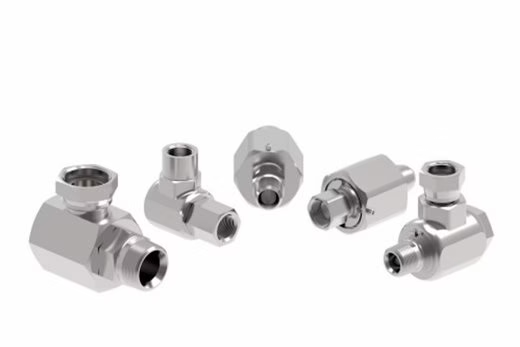
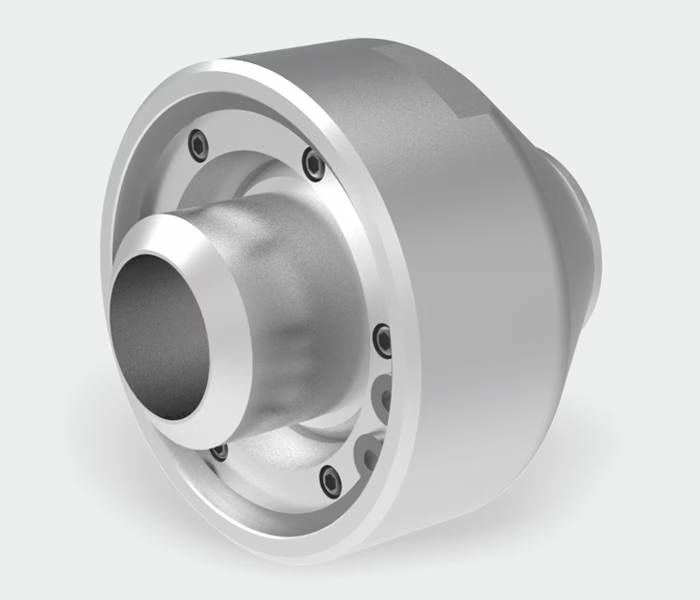
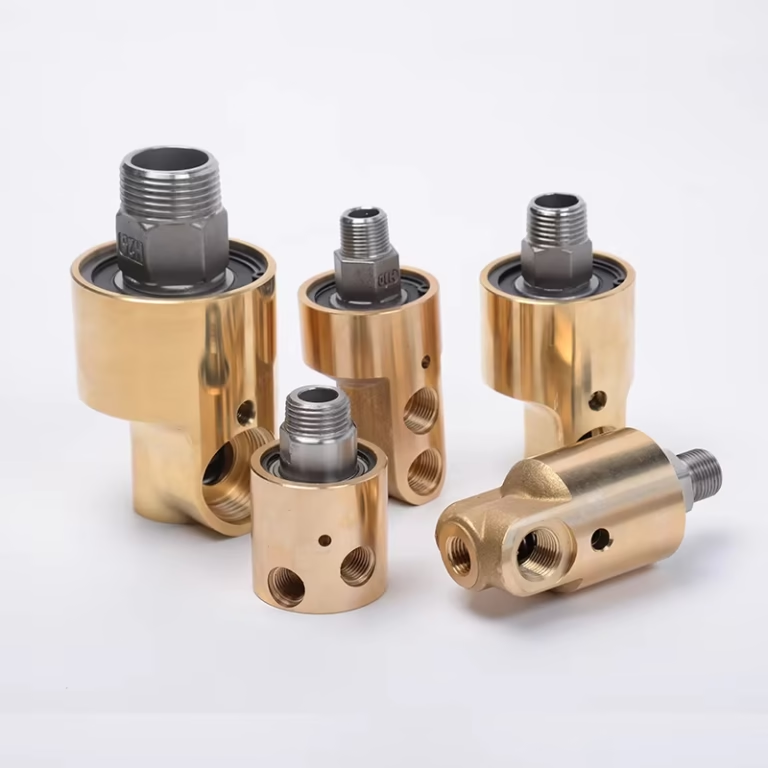
A hydraulic swivel joint is a precision mechanical component that transfers hydraulic fluid between a stationary hydraulic circuit and a rotating machine component. Unlike ordinary hydraulic fittings, a swivel rotates continuously while maintaining a sealed fluid path.
Its primary functions include:
- Delivering pressurized hydraulic oil during continuous rotation
- Preventing hydraulic hoses from twisting or tangling
- Maintaining pressure without leakage
- Allowing unlimited rotational movement
- Improving equipment reliability and safety
Depending on the application, hydraulic swivels may contain:
- One hydraulic passage
- Two hydraulic passages
- Multiple independent passages
- Combined hydraulic and pneumatic passages
- Hydraulic passages with electrical slip rings
The design depends entirely on the machine’s operating requirements.
For example:
Construction Equipment
Excavators, truck cranes, and rotary drilling rigs require hydraulic swivels to transmit oil between the upper rotating structure and the stationary chassis.
Forestry Machinery
Harvesters and log loaders rotate continuously while operating hydraulic grapples.
Industrial Automation
Rotating fixtures require uninterrupted hydraulic pressure for clamping and positioning.
Marine Equipment
Deck cranes and offshore winches rely on hydraulic swivels to transfer oil under harsh environmental conditions.
Each application presents unique challenges involving pressure, rotational speed, contamination, and temperature. This is why a one-size-fits-all hydraulic swivel rarely delivers the best long-term performance.
How Does a Hydraulic Swivel Joint Work?
Although hydraulic swivels are available in many configurations, their operating principle remains the same.
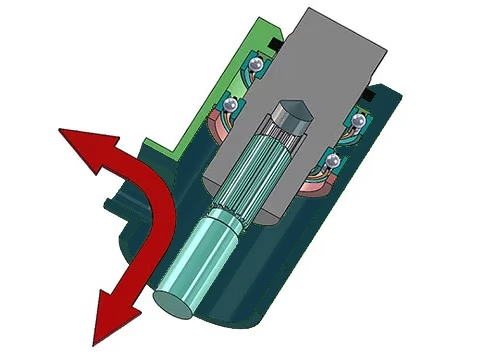
The swivel creates one or more sealed flow passages between stationary and rotating components while allowing unrestricted rotational movement.
The process works as follows:
Step 1 – Hydraulic Oil Enters the Stationary Housing
Pressurized hydraulic oil enters the stationary housing through threaded ports or flange connections.
The housing remains fixed to the machine frame and does not rotate.
Step 2 – Oil Flows Through Internal Passages
Inside the housing, precision-machined flow channels direct the hydraulic oil toward the rotating shaft.
Each passage is carefully isolated using dynamic seals to prevent oil from mixing between circuits.
For multi-passage hydraulic swivels, several completely independent flow channels operate simultaneously.
This allows different hydraulic functions—such as lifting, gripping, rotating, and clamping—to operate independently through a single rotating connection.
Step 3 – Dynamic Seals Maintain Pressure
This is where the engineering challenge begins.
Unlike static seals found in ordinary hydraulic fittings, hydraulic swivel seals must maintain a leak-free barrier while rotating continuously under pressure.
The seal must withstand:
- High hydraulic pressure
- Continuous rotation
- Temperature fluctuations
- Pressure pulsation
- Shaft vibration
- Side loads
- Hydraulic shock
In our factory, seal selection is never based solely on pressure ratings.
Before recommending a sealing configuration, our engineers evaluate:
- Rotational speed
- Operating pressure
- Hydraulic medium
- Ambient temperature
- Duty cycle
- Contamination level
- Expected service life
For example, a swivel operating continuously on a drilling rig requires a different seal arrangement than one installed on a truck-mounted crane that rotates only intermittently.
Choosing the wrong seal material often causes premature leakage, even when pressure ratings appear acceptable.
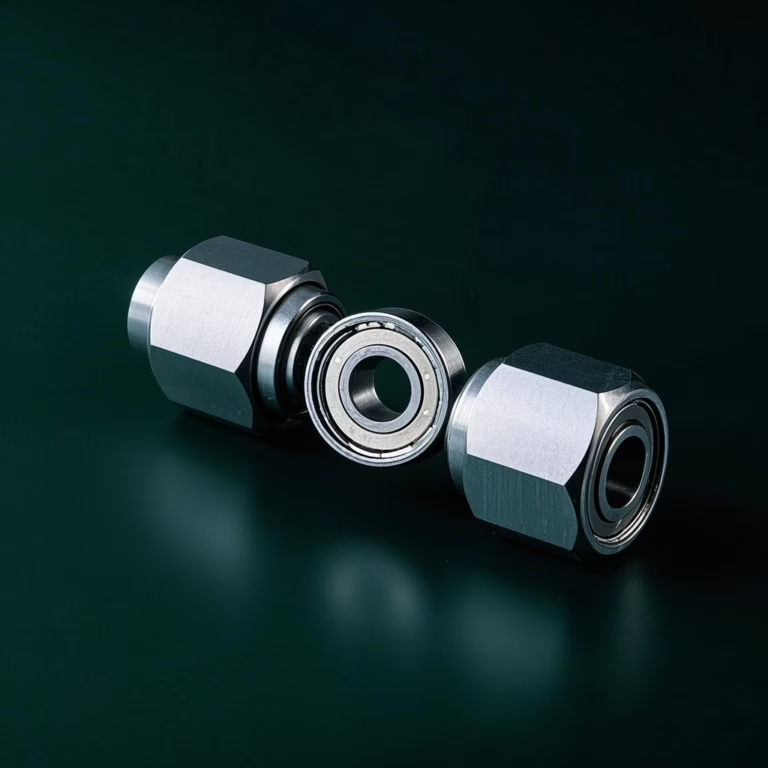
Step 4 – Bearings Support Rotation
Precision bearings allow the rotating shaft to move smoothly while carrying both radial and axial loads.
Many users assume bearings simply reduce friction.
In reality, bearing quality directly influences seal life.
If bearing clearance becomes excessive, shaft movement increases.
Even a small amount of shaft deflection can damage dynamic seals and eventually create external leakage.
For heavy-duty hydraulic swivels used on construction equipment, we often recommend reinforced bearing arrangements that provide greater rigidity under shock loading.
Although this increases manufacturing cost slightly, it significantly extends the service life in demanding applications.
Step 5 – Hydraulic Oil Exits Through the Rotating Shaft
After passing through the internal flow channels, hydraulic oil exits through the rotating shaft and enters the rotating actuator, motor, cylinder, or attachment.
Throughout this process, the housing remains stationary while the shaft rotates continuously.
The operator never notices this internal movement, but every rotation depends on the precise interaction of bearings, seals, machined surfaces, and pressure-balanced flow paths.
Inside a Hydraulic Swivel joint: Components That Matter Most
From the outside, most hydraulic swivels look relatively simple. Internally, however, they contain several precision components that must work together under demanding operating conditions.
From our manufacturing experience, these components have the greatest influence on long-term reliability.
1. Housing
The housing forms the pressure vessel of the hydraulic swivel.
Depending on customer requirements, we manufacture housings using:
- Carbon steel
- Alloy steel
- Stainless steel
- Corrosion-resistant special alloys
Material selection depends on operating pressure, environmental conditions, and hydraulic media.
For offshore or chemical applications, stainless steel provides superior corrosion resistance.
For heavy construction equipment, alloy steel offers excellent strength and fatigue resistance.
2. Rotating Shaft
The rotating shaft transfers hydraulic oil while withstanding torsional loads and continuous rotation.
Surface finish is particularly important.
During production, every shaft is machined on CNC equipment before undergoing precision grinding to achieve the required dimensional accuracy and surface roughness.
A smoother sealing surface reduces friction, minimizes seal wear, and helps maintain stable sealing performance over long operating periods.
In our production experience, many hydraulic swivel failures traced back from customer sites were not caused by seal material alone but by insufficient shaft surface quality or poor concentricity. Even high-quality seals cannot compensate for inaccurate machining.
This is why we inspect shaft runout, concentricity, and critical dimensions before assembly rather than relying solely on final pressure testing.
Factory Manufacturing Experience: What Determines the Reliability of a Hydraulic Swivel Joint?
Many articles explain the structure of a hydraulic swivel but rarely discuss what happens before the product leaves the factory. From our perspective as a manufacturer, the difference between a swivel that lasts 500 hours and one that operates reliably for several years is usually determined during machining, assembly, and testing—not after installation.
Over the years, we have produced hydraulic swivels for OEM machinery manufacturers, maintenance companies, and industrial equipment distributors. While every project has unique requirements, one lesson has remained consistent: precision manufacturing and process control are more important than simply selecting premium materials.
Instead of focusing on marketing claims, our engineering team pays close attention to machining accuracy, sealing performance, pressure verification, and quality consistency throughout production.
Precision CNC Machining Is the Foundation
Every hydraulic swivel begins as a forged or machined steel blank. Before assembly, every pressure-containing component must be processed to meet dimensional requirements that allow seals, bearings, and rotating components to work together without excessive friction or leakage.
In our workshop, housing bodies and rotating shafts are machined on CNC turning centers and machining centers capable of maintaining stable dimensional consistency over long production runs.
The machining process typically includes:
- Rough turning
- Semi-finish machining
- Finish machining
- Precision grinding of sealing surfaces
- Thread machining
- Deburring
- Dimensional inspection
The sealing surfaces receive particular attention because they directly influence seal life.
If surface roughness is too high, seals wear rapidly. If dimensions exceed tolerance, hydraulic oil bypasses the sealing interface. Or shaft concentricity is poor, seal lips experience uneven loading during rotation.
Rather than relying solely on final leak testing, we inspect critical dimensions during multiple production stages. This reduces variation between batches and helps ensure that every swivel performs consistently after installation.
Why Seal Selection Is Never One-Size-Fits-All
Customers often ask which sealing material is “the best.”
In reality, there is no universal answer.
The optimal seal depends on the operating environment.
Before recommending a sealing configuration, our engineers evaluate several key operating parameters:
- Working pressure
- Rotational speed
- Hydraulic fluid type
- Operating temperature
- Continuous or intermittent rotation
- Contamination level
- Expected maintenance interval
For example, a hydraulic swivel used on a forestry harvester experiences very different conditions from one installed on a steel mill manipulator.
Although both transfer hydraulic oil, the operating cycles, contamination levels, shock loading, and rotational speeds differ significantly.
As a result, the sealing arrangement must also change.
Depending on customer applications, we commonly manufacture hydraulic swivels using:
- NBR seals for general hydraulic applications
- FKM seals for elevated temperatures
- PTFE-based sealing systems for high-speed rotation
- Wear-resistant composite seals for abrasive environments
Selecting the correct sealing combination often increases service life far more effectively than simply increasing seal hardness.
Bearing Arrangement Has a Major Impact on Seal Life
One of the most overlooked design factors is bearing support.
Some users assume that leakage is always caused by worn seals.
In many cases, the actual cause is bearing wear.
As bearing clearance increases, shaft movement also increases.
This additional movement places uneven stress on dynamic seals.
Eventually, even a high-quality seal begins to leak because it can no longer maintain uniform contact with the rotating shaft.
For heavy-duty hydraulic swivels, our engineers frequently recommend reinforced bearing arrangements designed to withstand:
- Axial loads
- Radial loads
- Shock loading
- Continuous vibration
Although these bearing systems increase manufacturing cost, they often extend service life considerably under demanding working conditions.
Pressure Testing Before Every Shipment
Every hydraulic swivel should be tested before it reaches the customer.
Pressure testing is one of the most important steps in our manufacturing process because it verifies both sealing integrity and assembly quality.
Depending on customer specifications, pressure testing may include:
- Static pressure testing
- Dynamic pressure testing
- Leakage inspection
- Rotational testing
- Multi-passage flow verification
Rather than checking only for visible leakage, our technicians monitor pressure stability throughout the testing cycle.
Even a small pressure drop may indicate an assembly issue that requires investigation before shipment.
Testing each production batch also allows us to identify process variations early and maintain consistent product quality.
A Real Example from Our Production Experience
Several years ago, an OEM customer producing rotary drilling equipment contacted us after experiencing repeated leakage problems with hydraulic swivels purchased from another supplier.
The swivels operated under high pressure while rotating continuously in dusty outdoor environments.
Initially, the customer believed that poor seal quality caused the failures.
After reviewing the operating conditions and inspecting returned components, our engineers found that the primary issue was not the seal itself.
Instead, excessive shaft deflection under heavy radial loading caused uneven seal wear.
To address the problem, we implemented several engineering improvements:
- Increased shaft rigidity
- Optimized bearing spacing
- Modified the seal support geometry
- Improved surface finish on the sealing area
- Adjusted assembly tolerances
The revised hydraulic swivel demonstrated significantly improved sealing stability during factory testing.
According to customer feedback over the following maintenance cycles, leakage incidents decreased substantially, reducing both downtime and replacement frequency.
Experiences like this remind us that solving field problems often requires understanding the complete mechanical system rather than replacing individual components.
Material Selection Based on Application, Not Cost Alone
Different industries require different material characteristics.
For this reason, we do not recommend identical material combinations for every hydraulic swivel joint.
Typical material options include:
| Component | Common Materials | Typical Applications |
|---|---|---|
| Housing | Carbon Steel, Alloy Steel, Stainless Steel | Construction, Marine, Industrial Equipment |
| Shaft | Hardened Alloy Steel | High-pressure rotation |
| Bearings | High-strength Bearing Steel | Heavy-duty rotating equipment |
| Seals | NBR, FKM, PTFE, Composite Materials | Pressure- and temperature-specific applications |
For corrosive environments such as offshore platforms or chemical processing equipment, stainless steel housings provide better resistance against moisture and aggressive media.
For mining and construction machinery, hardened alloy steel offers excellent fatigue resistance under repeated shock loading.
Choosing the correct material combination during the design stage often reduces maintenance costs throughout the equipment’s operating life.
Quality Control Throughout the Manufacturing Process
Quality inspection should not begin after assembly—it should be integrated into every production stage.
Our internal inspection process typically includes:
Incoming Material Inspection
Raw materials are verified for dimensions, surface condition, and material specifications before entering production.
In-Process Dimensional Inspection
Critical dimensions are checked throughout machining rather than only after completion.
Surface Quality Verification
Sealing surfaces are inspected for roughness, machining marks, and concentricity.
Assembly Inspection
Technicians verify bearing preload, seal orientation, lubrication, and torque values before final assembly.
Final Functional Testing
Completed hydraulic swivels undergo pressure and leakage testing before packaging.
By identifying potential issues at each production stage, we reduce rework and improve overall manufacturing consistency.
Manufacturing Experience Cannot Be Replaced by Drawings Alone.
Many hydraulic swivels look nearly identical on engineering drawings, yet their real-world performance can differ dramatically.
Over the years of production, we have learned that small details often determine long-term reliability:
- The transition radius between sealing surfaces
- Bearing preload during assembly
- Surface roughness after grinding
- Seal installation methods
- Lubrication during initial startup
- Dimensional consistency between production batches
These details are rarely visible in product catalogs, but they directly influence service life in demanding industrial environments.
This practical manufacturing experience allows us to recommend design improvements based not only on theoretical calculations but also on feedback from equipment manufacturers and maintenance engineers who use hydraulic swivels every day.
Real Industrial Applications, Common Failures, and Lessons Learned from the Field
A hydraulic swivel joint is often a small component in a large machine, but when it fails, the entire hydraulic system may stop working. Over the years, we have supported customers in construction, mining, steel production, agriculture, marine engineering, and industrial automation. One thing we have learned is that hydraulic swivel failures rarely happen without warning. Most problems begin with improper selection, unsuitable operating conditions, or neglected maintenance.
By understanding how hydraulic swivels perform in real equipment, engineers can significantly reduce downtime and improve the overall reliability of hydraulic systems.
Where Are Hydraulic Swivels Used?
Although hydraulic swivels share the same basic operating principle, each industry places different demands on sealing systems, bearing structures, and pressure capacity.
1. Construction Machinery
Construction equipment represents one of the largest application areas for hydraulic swivels.
Typical machines include:
- Hydraulic excavators
- Truck-mounted cranes
- Rotary drilling rigs
- Aerial work platforms
- Concrete pumps
- Material handlers
These machines operate in dusty environments while experiencing continuous vibration and frequent shock loading.
For this reason, customers in the construction industry generally prioritize:
- High-pressure capability
- Excellent sealing reliability
- Resistance to contamination
- Long maintenance intervals
In many projects, we recommend reinforced bearing arrangements together with double-sealing systems to improve durability under harsh job-site conditions.
2. Rotary Drilling Equipment
Rotary drilling rigs present one of the most demanding operating environments.
The hydraulic swivel must continue transferring pressurized oil while the drill head rotates continuously for extended periods.
Challenges include:
- Continuous rotation
- Abrasive dust
- Mud contamination
- Heavy radial loading
- High hydraulic pressure
- Long daily operating hours
Several drilling equipment manufacturers have asked us to redesign existing swivels after repeated seal failures.
In many cases, improving shaft rigidity and optimizing seal support proved more effective than simply changing seal materials.
3. Agricultural Machinery
Modern agricultural equipment increasingly relies on hydraulic rotation.
Applications include:
- Bale wrappers
- Sprayers
- Forestry harvesters
- Feed mixers
- Irrigation reels
Unlike construction machinery, agricultural equipment often experiences seasonal operation followed by long storage periods.
This creates additional challenges such as:
- Seal aging
- Corrosion
- Moisture ingress
- Contaminated hydraulic oil
For these customers, corrosion protection and appropriate seal materials become just as important as pressure capacity.
4. Steel and Metallurgical Equipment
Steel mills expose hydraulic swivels to conditions rarely encountered elsewhere.
Typical operating conditions include:
- High ambient temperatures
- Scale contamination
- Continuous production cycles
- Heavy vibration
- High-duty operation
Downtime in a steel mill can be extremely costly.
Because of this, many steel manufacturers request customized hydraulic swivels with enhanced bearing capacity and high-temperature sealing systems.
5. Marine and Offshore Equipment
Marine applications introduce another set of engineering challenges.
Saltwater, humidity, and continuous exposure to harsh weather accelerate corrosion.
Common applications include:
- Ship deck cranes
- Offshore winches
- Port handling equipment
- Marine lifting systems
For these environments, stainless steel housings and corrosion-resistant surface treatments significantly improve long-term performance.
Five Common Hydraulic Swivel Failures
Although hydraulic swivels are designed for long service life, failures still occur.
From our experience repairing returned products and analyzing customer feedback, these are the most common issues.
Failure 1 – External Oil Leakage
External leakage is by far the most common complaint.
Possible causes include:
- Worn dynamic seals
- Damaged shaft surfaces
- Excessive bearing clearance
- Incorrect installation
- Operating pressure exceeding design limits
Many users immediately replace the seals.
However, if shaft wear or bearing movement causes the leakage, replacing seals alone rarely solves the problem.
We always recommend inspecting the complete rotating assembly before ordering replacement parts.
Failure 2 – Excessive Rotational Resistance
Some customers report that the swivel becomes increasingly difficult to rotate.
Possible reasons include:
- Bearing damage
- Internal contamination
- Lack of lubrication
- Corrosion
- Improper assembly
Continuing to operate under these conditions accelerates seal wear and increases the likelihood of sudden failure.
Failure 3 – Internal Leakage Between Passages
Multi-passage hydraulic swivels rely on independent sealing systems.
If one sealing interface becomes damaged, hydraulic oil may flow between adjacent circuits.
Symptoms often include:
- Unexpected cylinder movement
- Reduced operating pressure
- Slow hydraulic response
- Difficulty controlling multiple functions
This type of failure usually requires complete disassembly and inspection.
Failure 4 – Bearing Wear
Bearings support both rotational movement and external loads.
Bearing wear often develops gradually.
Common warning signs include:
- Increased vibration
- Noise during rotation
- Shaft movement
- Seal wear
- Oil leakage
Replacing bearings before severe damage occurs can often prevent more expensive repairs.
Failure 5 – Premature Seal Wear
When customers report seal failure within a few months, we rarely assume poor seal material is responsible.
Instead, our engineers investigate:
- Hydraulic oil cleanliness
- Shaft concentricity
- Surface roughness
- Rotational speed
- Pressure spikes
- Installation accuracy
Many premature failures result from operating conditions that differ significantly from the original design assumptions.
Lessons from Customer Projects
One advantage of being a manufacturer rather than simply a distributor is that we receive direct feedback from equipment builders and maintenance engineers.
These conversations help us continuously improve product designs.
Case Study 1 – Crane Manufacturer
A customer producing truck-mounted cranes experienced recurring seal failures after approximately eight months of operation.
After reviewing returned swivels, we discovered noticeable shaft wear caused by abrasive contamination entering through the external environment.
Instead of changing only the seal material, we redesigned the dust protection structure and added an improved secondary sealing arrangement.
Following implementation, the customer reported a much longer maintenance interval and fewer field replacements.
Case Study 2 – Steel Plant Maintenance Team
A maintenance contractor servicing steel production equipment requested a hydraulic swivel capable of operating reliably in high-temperature environments.
Standard sealing materials hardened prematurely due to continuous heat exposure.
Working with the customer, we selected a higher-temperature sealing system and optimized internal lubrication.
Subsequent field feedback showed significantly improved sealing stability during extended production cycles.
Case Study 3 – OEM Equipment Manufacturer
An OEM customer developing automated rotary handling equipment required a compact hydraulic swivel with multiple independent oil passages.
Space inside the rotating assembly was extremely limited.
Rather than modifying an existing design, our engineering team developed a customized housing with optimized internal flow channels.
Prototype testing confirmed stable pressure distribution across all hydraulic circuits while maintaining compact overall dimensions.
The project later moved into regular production for the customer’s equipment line.
Practical Maintenance Recommendations
Proper maintenance often extends hydraulic swivel service life far more effectively than replacing components after failure.
Based on our production and after-sales experience, we recommend the following practices:
Keep Hydraulic Oil Clean
Contaminated hydraulic oil accelerates wear on seals and bearings.
Regular filtration and oil analysis reduce the risk of premature component failure.
Inspect for Early Leakage
Small leaks rarely disappear on their own.
Early inspection often prevents larger mechanical failures.
Monitor Operating Pressure
Repeated pressure spikes shorten seal life even if average operating pressure remains within specifications.
Pressure monitoring helps identify abnormal operating conditions before damage occurs.
Avoid Side Loading
Hydraulic swivels are designed primarily to transfer fluid, not to support excessive external mechanical loads.
Improper mounting can increase bearing stress and reduce sealing performance.
Follow Scheduled Maintenance
Replacing seals and bearings during planned maintenance is usually more economical than waiting for unexpected equipment shutdowns.
Why Field Experience Matters
Engineering drawings provide dimensions.
Simulation software predicts stress.
Laboratory testing verifies design assumptions.
However, real operating environments often reveal challenges that cannot be fully reproduced in controlled testing.
Every returned product tells a story.
Some reveal contamination problems.
Others highlight installation errors.
Some expose unexpected operating conditions that were never included in the original specification.
By analyzing these field experiences, we continuously refine our hydraulic swivel designs, improve manufacturing processes, and recommend more suitable solutions for future applications.
For us, every customer project contributes valuable engineering knowledge. This practical experience is one of the reasons why many OEM equipment manufacturers choose to work directly with a factory that not only manufactures hydraulic swivels but also understands how they perform in demanding industrial environments.
How to Choose the Right Hydraulic Swivel Joint, Why Work with an Experienced Manufacturer, and Frequently Asked Questions
Choosing a hydraulic swivel is about more than matching thread sizes or pressure ratings. A swivel that performs well in one application may fail quickly in another because operating conditions, duty cycles, contamination levels, and rotational speeds are completely different.
As a manufacturer, we often receive inquiries that begin with a simple question:
“Can you supply a replacement for this hydraulic swivel?”
Our answer is usually another question:
“Can you tell us how the machine actually works?”
Understanding the equipment is the key to selecting a hydraulic swivel that delivers long service life rather than simply fitting into the available space.
How to Select the Right Hydraulic Swivel Joint
Before recommending a model, our engineering team typically reviews the following information.
1. Working Pressure
Pressure is one of the first specifications customers provide, but maximum pressure alone does not tell the complete story.
We also consider:
- Continuous working pressure
- Peak pressure
- Pressure fluctuations
- Hydraulic shock loads
A machine operating continuously at 250 bar may require a different sealing arrangement than another machine reaching 250 bar only occasionally.
2. Rotational Speed
Rotational speed has a direct influence on sealing performance and bearing life.
Higher speeds generally generate:
- More friction
- Higher temperatures
- Faster seal wear
For high-speed applications, we often recommend low-friction sealing materials together with optimized lubrication and precision-balanced rotating components.
3. Number of Fluid Passages
Different machines require different hydraulic circuits.
Hydraulic swivels may include:
- Single-passage designs
- Dual-passage designs
- Four-passage configurations
- Six or more independent passages
- Hydraulic and pneumatic combination designs
Each passage must remain completely isolated to prevent pressure loss or internal leakage.
4. Hydraulic Medium
Not every hydraulic fluid behaves the same.
Examples include:
- Mineral hydraulic oil
- Synthetic hydraulic oil
- Water glycol
- Emulsions
- Biodegradable hydraulic fluids
Different media affect seal compatibility, corrosion resistance, and lubrication characteristics.
Selecting the wrong sealing material may significantly shorten service life.
5. Operating Environment
Environmental conditions often determine whether standard or customized designs should be used.
Typical considerations include:
- Outdoor operation
- Dust exposure
- High humidity
- Salt spray
- High ambient temperature
- Low-temperature environments
- Chemical exposure
For example, equipment operating in coastal ports generally benefits from corrosion-resistant materials and protective surface treatments.
OEM and Custom Hydraulic Swivel Manufacturing
Standard catalog products do not always meet the requirements of modern machinery.
Many of our customers are equipment manufacturers developing new machines or upgrading existing designs.
Instead of asking customers to redesign their equipment, we customize hydraulic swivels according to actual operating requirements.
Our engineering capabilities include:
- Reverse engineering from existing samples
- Manufacturing based on customer drawings
- Customized thread standards
- Special flange connections
- Multi-passage configurations
- Combined hydraulic and pneumatic designs
- Material upgrades
- Seal optimization
- Surface treatment improvements
Before production begins, our engineers review the application together with the customer to reduce technical risks and avoid unnecessary redesign later.
Why Many Customers Choose a Chinese Hydraulic Swivel Manufacturer
Over the past decade, more equipment manufacturers have sourced hydraulic swivels directly from specialized Chinese factories.
The reason is no longer based solely on pricing.
Today, customers also expect:
- Stable manufacturing quality
- Flexible customization
- Faster engineering communication
- Shorter lead times
- Reliable technical support
As a factory specializing in rotary unions and hydraulic swivels, we work directly with OEM equipment manufacturers, distributors, and industrial maintenance companies.
Without multiple trading layers, engineering discussions move faster, and design modifications can be implemented more efficiently.
For customers replacing discontinued or expensive imported rotary unions, we can often manufacture fully compatible alternatives based on technical drawings, samples, or dimensional measurements.
Our Manufacturing Process
Although every hydraulic swivel is different, our production workflow generally follows the same quality-oriented process.
Step 1 – Technical Review
Our engineers review:
- Application
- Pressure
- Speed
- Hydraulic medium
- Installation method
- Service life requirements
Step 2 – Material Selection
Appropriate materials are selected according to operating conditions rather than simply minimizing manufacturing cost.
Step 3 – Precision CNC Machining
Critical components are manufactured using CNC equipment with dimensional inspections performed throughout production.
Step 4 – Assembly
Experienced technicians assemble bearings, seals, and rotating components according to standardized assembly procedures.
Step 5 – Pressure and Leakage Testing
Every completed hydraulic swivel undergoes functional testing before shipment.
When customer specifications require additional verification, we can also provide customized testing procedures.
Step 6 – Final Inspection and Packaging
Before packaging, finished products undergo visual inspection, dimensional verification, and identification marking to ensure traceability.
Frequently Asked Questions
1. What is the difference between a hydraulic swivel and a rotary union?
Both transfer fluid between stationary and rotating components. In industrial practice, hydraulic swivels are generally designed for hydraulic oil under higher pressure, while rotary unions are more commonly used for water, steam, air, coolant, thermal oil, and other process media. However, the terminology often overlaps depending on the industry.
2. How long does a hydraulic swivel typically last?
Service life depends on operating conditions, maintenance, fluid cleanliness, and equipment design.
With proper installation and regular maintenance, hydraulic swivels can operate reliably for many thousands of working hours.
3. Can a hydraulic swivel rotate continuously?
Yes.
Hydraulic swivels are specifically designed for continuous or intermittent rotation while maintaining sealed hydraulic flow.
4. Why does my hydraulic swivel leak?
Common causes include:
- Worn seals
- Bearing wear
- Contaminated hydraulic oil
- Excessive pressure
- Improper installation
- Shaft surface damage
Determining the root cause usually requires inspection of both the swivel and the surrounding hydraulic system.
5. Can you manufacture a replacement for imported hydraulic swivels?
Yes.
Our engineering team regularly develops compatible replacements based on:
- Technical drawings
- Samples
- Photographs
- Dimensional measurements
- OEM specifications
6. Can hydraulic swivels be customized?
Absolutely.
Customization is common for OEM machinery where standard products cannot satisfy installation space or performance requirements.
7. Which sealing material should I choose?
Seal selection depends on:
- Pressure
- Speed
- Temperature
- Hydraulic medium
- Operating environment
Our engineers recommend the most suitable configuration after reviewing the application.
8. How often should hydraulic swivels be inspected?
Inspection intervals vary by application.
For equipment operating continuously under heavy loads, routine inspection during scheduled maintenance helps detect wear before unexpected failures occur.
9. Can hydraulic swivels handle multiple hydraulic circuits?
Yes.
Multi-passage hydraulic swivels allow several independent hydraulic circuits to operate simultaneously without mixing fluids.
10. What information should I provide when requesting a quotation?
Providing the following information allows us to recommend the most suitable solution:
- Working pressure
- Rotational speed
- Number of passages
- Hydraulic medium
- Connection type
- Thread specifications
- Installation drawing or photos
- Existing model number (if available)
Conclusion
Hydraulic swivels may appear to be simple mechanical components, but reliable performance depends on careful engineering, precision manufacturing, and a thorough understanding of real operating conditions.
After years of manufacturing rotary unions and hydraulic swivels for customers across construction, mining, steel production, agriculture, marine engineering, and industrial automation, we have found that successful applications are rarely achieved by selecting products from a catalog alone. Long-term reliability comes from matching the swivel design to the equipment, operating environment, and maintenance requirements.
At our factory, every project begins with understanding how the customer’s machine works. We evaluate pressure, rotational speed, fluid type, environmental conditions, installation space, and expected service life before recommending a solution. This engineering-first approach has enabled us to provide reliable hydraulic swivel solutions for both standard industrial equipment and highly customized OEM applications.
Whether you need a direct replacement for an imported hydraulic swivel joint, a customized multi-passage design, or technical support during equipment development, our engineering team is ready to help. We believe that long-term cooperation starts with reliable products, honest technical communication, and consistent manufacturing quality.
If you are looking for a trusted hydraulic swivel joint manufacturer in China, we welcome the opportunity to discuss your application and provide a solution tailored to your equipment—not just another standard product.