Hydraulic Rotary Joint Maintenance Guide: How Factory Engineers Extend Service Life in Real Industrial Applications
Maintaining a hydraulic rotary joints is about far more than replacing worn seals. In industrial applications, the service life of a rotary joint depends on a combination of product design, machining accuracy, installation quality, operating conditions, and preventive maintenance. From our experience as a hydraulic rotary joint manufacturer, we have seen identical rotary joints operate for more than five years in one factory while failing within a few months in another. The difference is rarely the product itself—it is almost always the operating environment and maintenance practices.
Over the years, our engineering team has manufactured thousands of hydraulic rotary joints for customers in steel processing, paper production, machine tools, rubber equipment, plastic extrusion lines, hydraulic systems, and automated production machinery. We also receive returned products for inspection whenever customers experience leakage, overheating, pressure instability, or unexpected failures. Every returned rotary joint provides valuable information about real-world operating conditions and helps us continuously improve both our products and our maintenance recommendations.
One conclusion has remained consistent throughout years of manufacturing and field support:
Most hydraulic rotary joints failures are preventable.
In many cases, the sealing components remain in good condition, while contamination, shaft misalignment, improper installation, or neglected maintenance causes premature failure. A well-designed rotary joint can only perform reliably if the entire rotating system is maintained correctly.
This guide shares practical maintenance knowledge based on our manufacturing experience, quality inspections, and customer applications. Whether you are a maintenance engineer, equipment designer, purchasing manager, or production supervisor, these recommendations can help reduce downtime, extend equipment life, and improve production reliability.
Why Hydraulic Rotary Joint Maintenance Is Critical
A hydraulic rotary joint creates a sealed connection between stationary piping and rotating equipment, allowing hydraulic oil or other pressurized fluids to flow continuously during rotation. Unlike conventional pipe fittings, a rotary joint operates under dynamic conditions where sealing surfaces, bearings, rotating shafts, and hydraulic pressure interact continuously.
Even a small increase in shaft vibration or hydraulic contamination can gradually damage internal sealing faces. Because wear develops slowly, many operators do not recognize early warning signs until leakage becomes visible or equipment performance declines.
Ignoring routine maintenance often leads to a chain reaction of failures:
- Internal seal wear
- Bearing damage
- Increased friction
- Higher operating temperature
- Hydraulic oil leakage
- Pressure loss
- Production interruption
- Damage to connected equipment
In many industrial facilities, replacing a rotary joint takes less than one hour. However, unexpected production downtime can stop an entire manufacturing line for several hours or even an entire shift, making preventive maintenance significantly more cost-effective than emergency repairs.
What We Have Learned from Manufacturing and Failure Analysis
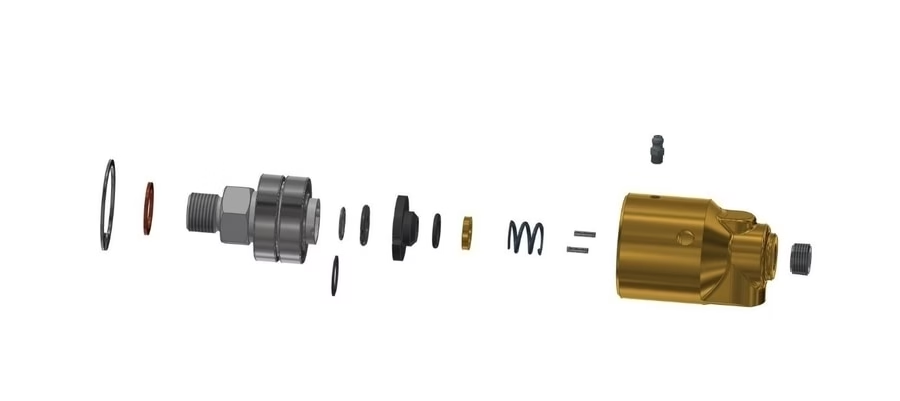
As a factory specializing in rotary unions and rotary joints, we inspect every major component before assembly, including housings, shafts, bearings, seal faces, springs, and precision-machined sealing surfaces. Before shipment, each hydraulic rotary joint undergoes pressure testing, leakage inspection, and rotational performance verification.
However, our work does not end when the product leaves the factory.
Customers frequently return failed rotary joints for engineering analysis, allowing us to identify recurring failure patterns across different industries. After examining a large number of returned products, we found that manufacturing defects account for only a small percentage of failures. Most issues originate during installation or operation.
The most common causes include:
| Failure Cause | Approximate Frequency in Returned Products | Preventable |
|---|---|---|
| Hydraulic oil contamination | Very High | Yes |
| Shaft misalignment | High | Yes |
| Dry running | Medium | Yes |
| Incorrect installation | High | Yes |
| Bearing wear caused by vibration | Medium | Yes |
| Excessive operating pressure | Medium | Yes |
| Seal aging | Normal | Partially |
| Manufacturing defects | Very Low | Factory Controlled |
This pattern demonstrates an important reality: maintenance has a greater influence on service life than many users expect.
Common Operating Environments That Demand Regular Maintenance
Maintenance requirements vary depending on the application. A rotary joint operating in a clean laboratory environment experiences very different conditions than one installed in a steel mill or paper machine.
Based on our production experience, these industries require particularly careful maintenance planning.
Steel Processing Equipment
Steel plants expose rotary joints to high temperatures, scale dust, vibration, and continuous operation. Even though hydraulic oil systems are usually filtered, airborne contaminants can accumulate around rotating seals.
During inspections of returned products from steel mills, we often observe hardened seals caused by prolonged exposure to radiant heat. In some cases, external contamination gradually enters the bearing area because protective covers were damaged during routine equipment maintenance.
For these applications, we recommend more frequent visual inspections and regular cleaning around the rotating shaft.
Paper Manufacturing
Paper machines often operate continuously for weeks without shutdown. Hydraulic rotary joints installed on reel drums, calenders, and winding equipment experience constant rotation under stable pressure.
The biggest challenge in paper production is moisture combined with fine paper fibers.
Over time, accumulated fibers can mix with lubricants around the bearing area. If maintenance intervals become too long, bearing resistance increases, leading to higher operating temperatures.
Many customers initially suspect seal failure, but factory inspection often reveals that bearing degradation caused the seal damage rather than the opposite.
CNC Machine Tools
Machine tools require high rotational accuracy and precise hydraulic pressure.
One common issue we observe involves coolant contamination entering hydraulic systems because maintenance personnel accidentally connect incompatible fluid circuits during servicing.
Although the rotary joint itself functions correctly, contaminated hydraulic oil gradually scratches precision sealing surfaces.
In these situations, replacing seals alone does not solve the problem. The entire hydraulic system requires cleaning before installing a new rotary joint.
Plastic and Rubber Machinery
Extrusion equipment and rubber processing lines usually operate under elevated temperatures with continuous rotation.
Thermal expansion changes shaft dimensions during long production cycles.
If shaft alignment is only measured while equipment is cold, alignment may become unacceptable after several hours of production.
For this reason, experienced maintenance teams often verify shaft runout under normal operating temperatures rather than during shutdown.
The Hidden Cost of Poor Maintenance
When customers contact us after experiencing leakage, their first question is often:
“How long should a hydraulic rotary joint last?”
The answer depends less on calendar time than on operating conditions.
We have supplied identical rotary joints to two manufacturers producing similar products.
The first customer established a preventive maintenance schedule that included:
- Weekly visual inspections
- Monthly oil cleanliness checks
- Quarterly alignment measurements
- Annual seal inspections
Those rotary joints remained in operation for several years with only routine maintenance.
The second customer operated equipment continuously until leakage became severe enough to interrupt production. During inspection, we found contaminated hydraulic oil, worn bearings, damaged sealing faces, and excessive shaft vibration. Although replacing the seals temporarily stopped the leakage, the underlying mechanical issues quickly caused another failure.
The cost difference between these two maintenance strategies extended far beyond the price of replacement parts. Emergency shutdowns disrupted production schedules, increased labor costs, and shortened the service life of multiple hydraulic components connected to the same system.
From a manufacturing perspective, preventive maintenance is one of the most economical investments an industrial facility can make.
10 Early Warning Signs of Hydraulic Rotary Joint Failure
1. Minor Oil Leakage Around the Housing
A few drops of hydraulic oil may seem insignificant, but they often indicate the beginning of seal wear.
Many operators simply wipe away the oil and continue production. Unfortunately, this only hides the symptom while the internal sealing surfaces continue to deteriorate.
During our failure analysis, we frequently find that slight leakage has already damaged bearings because oil escaped gradually over an extended period.
If leakage appears repeatedly after cleaning, the rotary joint should be inspected rather than ignored.
2. Rising Operating Temperature
Temperature is one of the most valuable indicators of rotary joint health.
Under normal operating conditions, the housing temperature should remain relatively stable. A gradual increase often suggests:
- Bearing wear
- Insufficient lubrication
- Increased friction between sealing faces
- Internal contamination
- Shaft misalignment
Some factories now use infrared thermometers during routine inspections. Even a temperature increase of 10–15°C compared with normal operation deserves further investigation.
3. Abnormal Noise
Hydraulic rotary joints are designed to operate smoothly.
Grinding, squealing, clicking, or intermittent scraping noises should never be considered normal.
Our engineers often identify bearing failures simply by listening during pressure testing.
Typical noise sources include:
- Worn bearings
- Dry bearings
- Damaged sealing faces
- Loose internal components
- Excessive shaft vibration
Ignoring unusual sounds usually leads to more expensive repairs.
4. Increased Vibration
Excessive vibration accelerates wear throughout the entire rotary joint.
Even the highest-quality seals cannot compensate for excessive shaft movement.
When customers return leaking rotary joints, we routinely measure wear patterns on sealing faces. Uneven wear almost always indicates vibration or shaft runout rather than poor seal quality.
Whenever vibration increases unexpectedly, inspect:
- Shaft alignment
- Bearing condition
- Couplings
- Machine balance
- Mounting bolts
5. Pressure Instability
Hydraulic systems rely on stable pressure.
If pressure fluctuates while pumps and valves operate normally, the rotary joint should not be overlooked.
Internal leakage caused by damaged seals may reduce system efficiency long before external leakage becomes visible.
Pressure fluctuations often appear first in:
- Hydraulic cylinders
- Rotating clamps
- Rotary tables
- Automatic tooling systems
6. Frequent Seal Replacement
Some maintenance departments replace seals every few months and consider this normal.
Based on our manufacturing experience, frequent seal replacement usually indicates another mechanical problem.
Common root causes include:
- Contaminated oil
- Excessive shaft runout
- Improper installation
- Bearing damage
- Incorrect operating pressure
Replacing seals without identifying the underlying cause only repeats the failure cycle.
7. Hydraulic Oil Discoloration
Hydraulic oil reveals a great deal about system condition.
Darkened oil, metallic particles, or cloudy appearance often indicate:
- Bearing wear
- Internal corrosion
- Contamination
- Excessive operating temperature
Whenever unusual oil contamination appears, inspect the rotary joint together with filters and pumps.
8. Visible Shaft Wear
During scheduled shutdowns, maintenance personnel should inspect the rotating shaft carefully.
Watch for:
- Scoring
- Grooves
- Corrosion
- Surface discoloration
- Excessive polishing
Damaged shafts rapidly destroy new seals, regardless of seal quality.
9. Reduced Equipment Performance
Sometimes the rotary joint is not visibly leaking, yet equipment performance gradually declines.
Examples include:
- Slower hydraulic cylinders
- Reduced clamping force
- Lower rotational torque
- Inconsistent hydraulic pressure
Internal leakage may already be affecting overall system efficiency.
10. Frequent Emergency Repairs
If maintenance records show repeated rotary joint repairs within a short period, the issue is rarely the replacement parts.
Instead, engineers should investigate:
- Installation procedures
- Hydraulic oil quality
- Equipment alignment
- Operating pressure
- Maintenance intervals
Long-term reliability depends on solving the root cause rather than repeatedly replacing components.
Daily Maintenance Checklist
Daily inspections require only a few minutes but often prevent major failures.
Our factory recommends including the following items in every operator’s routine inspection:
| Inspection Item | What to Check | Recommended Action |
|---|---|---|
| Oil leakage | Around housing and shaft | Clean and monitor |
| Temperature | Compare with normal operating temperature | Investigate unusual increases |
| Noise | Grinding or abnormal sounds | Report immediately |
| Vibration | Excessive movement | Inspect alignment |
| Hydraulic pressure | Stable system pressure | Record abnormal readings |
| External contamination | Dust, paper fibers, metal particles | Clean surrounding area |
These inspections require no equipment disassembly and can easily become part of normal production routines.
Weekly Preventive Maintenance
Weekly inspections provide a more detailed evaluation of the rotary joint and surrounding hydraulic system.
Our field engineers generally recommend the following procedures:
Clean the Rotary Joint Exterior
Dust and debris trap heat and hide developing leaks.
Use a lint-free cloth and appropriate industrial cleaning solution. Avoid directing high-pressure water toward rotating seals.
Inspect Hydraulic Hoses
Check for:
- Loose fittings
- Cracks
- Abrasion
- Twisting
- Oil seepage
A damaged hose can introduce vibration into the rotary joint assembly.
Verify Mounting Bolts
Continuous vibration may gradually loosen mounting hardware.
Loose mounting bolts often create shaft misalignment, accelerating seal wear.
Always tighten according to manufacturer torque specifications.
Observe Shaft Rotation
During slow-speed operation, visually inspect shaft rotation.
The shaft should rotate smoothly without wobbling or eccentric movement.
Noticeable runout should be corrected before seal damage develops.
Monthly Preventive Maintenance
Monthly inspections should involve maintenance technicians rather than machine operators.
These inspections focus on long-term reliability.
Check Hydraulic Oil Cleanliness
Oil contamination remains one of the leading causes of premature rotary joint failure.
Our quality department often analyzes failed components and finds abrasive particles embedded in sealing faces.
Common contamination sources include:
- Dirty reservoirs
- Worn pumps
- Damaged filters
- Poor maintenance practices
- Improper oil storage
Regular oil analysis helps identify contamination before significant wear occurs.
Inspect Filter Performance
Filters protect the entire hydraulic system.
Blocked or damaged filters allow contaminants to circulate continuously.
Replace filters according to operating hours rather than waiting for obvious performance problems.
Measure Shaft Runout
Precision alignment significantly affects seal life.
Using a dial indicator, measure shaft runout during maintenance shutdowns.
Although acceptable tolerances vary by equipment design, excessive runout dramatically shortens seal and bearing life.
In our factory, shaft alignment is always verified during assembly because even small deviations can reduce sealing performance during long-term operation.
Examine Bearing Condition
Bearings support both rotational accuracy and sealing stability.
Watch for:
- Rough rotation
- Excessive play
- Overheating
- Lubrication loss
- Surface corrosion
Replacing bearings before complete failure often prevents damage to more expensive sealing components.
Maintenance Mistakes We Frequently Observe
Working directly with industrial customers has given us insight into several recurring maintenance errors.
Mistake 1: Replacing Only the Seal
Many customers assume every leak originates from worn seals.
However, factory inspections frequently reveal damaged bearings or shaft misalignment as the true cause.
Mistake 2: Ignoring Small Leaks
Minor leakage rarely remains minor.
Over time, escaped hydraulic oil attracts dust and contaminants, increasing wear on both seals and bearings.
Mistake 3: Mixing Different Hydraulic Oils
Different hydraulic oils may contain incompatible additive packages.
Mixing oils can reduce lubrication performance and shorten seal life.
Always verify oil compatibility before changing hydraulic fluid.
Mistake 4: Installing the Rotary Joint Under Mechanical Stress
Forcing piping into position during installation places unnecessary stress on the housing.
After several months of operation, this stress often contributes to premature leakage.
Proper piping alignment is just as important as shaft alignment.
Advanced Troubleshooting: Finding the Root Cause Instead of Replacing Parts
One of the most common questions we receive from maintenance engineers is:
“The rotary joint is leaking. Should we replace the seal or replace the entire unit?”
Our answer is always the same:
Do not replace any parts until you understand why the failure occurred.
During factory inspections, we often receive rotary joints that customers believe have reached the end of their service life. After complete disassembly, however, we sometimes discover that the seals are still usable. The actual problem may be bearing failure, contaminated hydraulic oil, excessive shaft runout, or improper installation.
Replacing seals without correcting the underlying issue only delays the next failure.
The troubleshooting process used by our engineers follows a systematic approach rather than relying on assumptions.
Step 1: Determine the Type of Leakage
Not all leaks originate from the same location.
Before removing the rotary joint, carefully identify where the oil is escaping.
Leakage Around the Shaft
Possible causes include:
- Worn dynamic seals
- Excessive shaft runout
- Bearing wear
- Shaft surface damage
- Dry operation
This is the most common leakage pattern we observe.
Leakage Around Pipe Connections
Possible causes include:
- Loose fittings
- Damaged O-rings
- Incorrect thread sealing
- Improper installation torque
Many customers mistakenly assume the rotary joint itself has failed when the leak actually comes from the pipe connection.
Leakage Around the Housing
Possible causes include:
- Housing cracks
- Mechanical impact damage
- Excessive system pressure
- Incorrect assembly after maintenance
Always inspect the housing carefully before replacing internal components.
Step 2: Review Operating Conditions
Every returned rotary joint tells part of the story, but maintenance records tell the rest.
Our engineers usually ask customers the following questions before beginning failure analysis:
- What is the operating pressure?
- What is the maximum rotational speed?
- Which hydraulic oil is being used?
- Has the operating temperature changed recently?
- Were any machine components replaced before the failure?
- Has shaft alignment been checked recently?
- Has the hydraulic filter been replaced according to schedule?
These questions often reveal the real cause before disassembly even begins.
Step 3: Inspect the Hydraulic Oil
Oil condition reflects the health of the entire hydraulic system.
Whenever we disassemble a returned rotary joint, we carefully examine any remaining hydraulic oil inside the housing.
Common findings include:
Metallic Particles
Usually indicate:
- Bearing wear
- Pump wear
- Internal mechanical damage
Black Oil
Often caused by:
- Excessive operating temperature
- Oxidation
- Poor lubrication
Milky Oil
Usually indicates water contamination.
Water reduces lubrication performance and accelerates corrosion of bearings and sealing components.
Dirty Oil
The most common contamination source we observe.
Fine abrasive particles gradually polish away precision sealing surfaces until leakage develops.
Step 4: Examine Seal Wear Patterns
The condition of the seals reveals valuable information.
Rather than simply replacing worn seals, our quality engineers study wear patterns under magnification.
Different wear patterns point to different causes.
| Seal Condition | Likely Cause |
|---|---|
| Even wear | Normal service life |
| One-sided wear | Shaft misalignment |
| Deep scratches | Contaminated hydraulic oil |
| Burn marks | Dry running or overheating |
| Cracked seal | Chemical incompatibility or aging |
| Torn sealing lip | Installation damage |
This inspection allows us to recommend corrective actions rather than temporary repairs.
Step 5: Inspect Bearings Before Installing New Seals
This is one of the most overlooked maintenance procedures.
Many maintenance teams immediately replace seals after discovering leakage.
However, if worn bearings remain inside the rotary joint, new seals will fail quickly because shaft movement exceeds design limits.
In our workshop, bearing inspection is mandatory whenever seals are replaced.
If necessary, both components are replaced together.
Real Factory Case Studies
The following examples are based on actual service cases encountered by our engineering team. Customer names have been omitted for confidentiality, but the technical details accurately reflect the issues we have investigated.
Case Study 1 – Leakage After Only Three Months
Industry
Hydraulic equipment manufacturing
Customer Complaint
Oil leakage appeared after approximately three months of operation.
The customer initially suspected defective seals.
Factory Inspection
After receiving the rotary joint, our engineers measured shaft wear, seal condition, bearing clearance, and sealing surfaces.
Surprisingly:
- Seals showed only moderate wear.
- Bearings were still in acceptable condition.
- Internal sealing faces remained smooth.
However, shaft runout measured nearly three times higher than our recommended installation tolerance.
The rotary joint had been installed on a shaft with significant eccentricity.
Solution
The customer corrected shaft alignment before installing a replacement rotary joint.
More than eighteen months later, the same production line continues operating without leakage.
The rotary joint was never the primary problem.
Case Study 2 – Repeated Seal Failures
Industry
Paper manufacturing
Problem
Maintenance personnel replaced seals four times within one year.
Each replacement temporarily solved the leakage before the problem returned.
Factory Findings
Oil analysis revealed large quantities of fine paper fibers mixed with lubricant.
These particles entered the bearing area because damaged protective covers had not been replaced during scheduled maintenance.
The contaminated bearings gradually increased shaft vibration.
Higher vibration accelerated seal wear.
Corrective Action
The customer:
- Replaced protective covers.
- Improved cleaning procedures.
- Installed new bearings.
- Added more frequent inspection intervals.
Seal life increased from approximately three months to more than one year.
Case Study 3 – Unexpected Bearing Failure
Industry
Steel processing
Steel plants expose rotary joints to continuous vibration and elevated temperatures.
The customer experienced overheating but reported no external leakage.
Inspection Results
Our engineers discovered:
- Bearing grease had deteriorated because of prolonged exposure to radiant heat.
- Bearings developed excessive internal clearance.
- Increased shaft movement damaged the sealing faces.
The seals failed only after the bearings had already deteriorated.
Lessons Learned
Temperature monitoring would have identified the problem weeks before leakage occurred.
Lessons We Have Learned from Manufacturing Thousands of Rotary Joints
Manufacturing provides valuable knowledge that cannot always be obtained from maintenance alone.
Every production stage influences long-term reliability.
Over the years, we have refined our manufacturing process based on customer feedback, returned product inspections, and continuous quality improvements.
Several lessons stand out.
Precision Machining Directly Influences Seal Life
A sealing system performs only as well as the surfaces supporting it.
Our production workshop uses CNC machining centers to manufacture critical rotating components with tight dimensional consistency.
After machining, sealing surfaces undergo additional finishing processes to improve surface smoothness.
Even small improvements in surface finish reduce friction and help extend seal life during continuous operation.
Material Selection Must Match the Application
Different industries require different material combinations.
For example:
- Stainless steel offers excellent corrosion resistance in humid environments.
- Hardened alloy steel provides higher wear resistance for demanding hydraulic systems.
- Carbon graphite, silicon carbide, and tungsten carbide each perform differently depending on operating pressure, temperature, lubrication conditions, and fluid compatibility.
Selecting the correct material often contributes more to service life than simply increasing seal hardness.
Every Rotary Joint Is Pressure Tested Before Shipment
Before leaving our factory, every hydraulic rotary joint undergoes functional testing.
Depending on the product type, testing may include:
- Pressure holding tests
- Leakage inspection
- Rotational testing
- Visual inspection
- Dimensional verification
- Assembly verification
This process confirms that each unit performs as expected before delivery.
However, successful factory testing cannot compensate for incorrect installation or inadequate maintenance after installation.
Continuous Improvement Comes from Customer Feedback
Returned products provide some of the most valuable information for improving future designs.
Whenever customers send failed rotary joints back to our factory, our engineering team documents:
- Operating hours
- Failure symptoms
- Industry application
- Wear patterns
- Material condition
- Installation history
These records allow us to identify recurring trends and continuously optimize product design, machining processes, and maintenance recommendations.
Instead of viewing failures as isolated events, we treat them as opportunities to improve product reliability for every customer.
Best Practices from Our Manufacturing and Field Experience
Over the years, we have visited customer production lines, supported equipment commissioning, analyzed returned products, and worked closely with maintenance teams across different industries. Although every application is unique, several best practices consistently improve rotary joint reliability.
Keep the Hydraulic System Clean
Contamination remains the most common reason for premature seal wear.
Many maintenance teams focus only on replacing the rotary joint while overlooking the condition of the hydraulic oil, reservoirs, and filters.
Even microscopic abrasive particles gradually damage precision sealing surfaces.
Whenever a rotary joint is replaced, we recommend inspecting the entire hydraulic circuit rather than installing the new unit into a contaminated system.
Never Ignore Alignment
During production, we frequently machine sealing components to tolerances measured in microns.
Unfortunately, those machining tolerances can quickly become meaningless if the rotary joint is installed on a shaft with excessive runout.
Proper alignment protects:
- Mechanical seals
- Bearings
- Rotating shafts
- Connected hydraulic equipment
Alignment should always be verified after replacing bearings, motors, couplings, or rotating shafts.
Use Compatible Hydraulic Fluids
Seal materials are selected according to fluid compatibility.
Changing to a different hydraulic oil without confirming compatibility may reduce seal life.
Whenever customers plan to introduce a new hydraulic fluid, our engineering team recommends verifying compatibility with sealing materials before operation begins.
Do Not Exceed Design Limits
Every rotary joint is designed for a specific operating range.
Running above the recommended pressure or rotational speed may not cause immediate failure, but it significantly increases long-term wear.
When customers need higher performance, selecting the appropriate rotary joint model is usually more reliable than operating an undersized model beyond its intended limits.
How We Manufacture Hydraulic Rotary Joints for Long-Term Reliability
A maintenance guide would not be complete without discussing manufacturing quality.
Preventive maintenance becomes much more effective when it begins with a well-designed product.
As a manufacturer specializing in rotary joints and rotary unions, we understand that every machining operation affects long-term performance. Small dimensional deviations can increase seal wear, while poor surface finish may reduce sealing efficiency.
For this reason, quality control begins long before final assembly.
Precision CNC Machining
Critical components are produced using CNC machining equipment to achieve consistent dimensional accuracy.
After machining, sealing surfaces receive additional finishing to improve flatness and surface quality.
Maintaining stable machining processes helps ensure that every production batch delivers consistent performance.
Material Inspection
Incoming raw materials are inspected before entering production.
Depending on customer requirements, we manufacture hydraulic rotary joints using materials such as:
- Stainless steel
- Hardened alloy steel
- Brass
- Aluminum alloys for lightweight applications
Mechanical seals are selected according to operating conditions, including pressure, rotational speed, temperature, and media compatibility.
Assembly and Quality Verification
Assembly technicians follow standardized procedures to maintain consistency across every production batch.
Before shipment, each hydraulic rotary joint undergoes inspections that may include:
- Dimensional verification
- Pressure testing
- Leakage inspection
- Rotation testing
- Visual inspection
- Surface quality verification
These quality checks help ensure that every product leaving our factory meets the required performance standards.
Continuous Product Improvement
Manufacturing does not stop after shipment.
Customer feedback plays an important role in product development.
Whenever customers report unusual operating conditions or return products for inspection, our engineering team analyzes the results and shares the findings with our production and quality departments.
This continuous feedback loop has helped us improve sealing structures, optimize material selection, refine machining processes, and enhance assembly procedures over many years.
Our goal is not simply to manufacture rotary joints but to help customers achieve longer service life, lower maintenance costs, and more reliable equipment operation.
Frequently Asked Questions
How long should a hydraulic rotary joint last?
There is no universal answer because service life depends on operating pressure, rotational speed, fluid cleanliness, installation accuracy, and maintenance practices.
In clean hydraulic systems with proper preventive maintenance, many rotary joints remain in service for several years.
What is the most common reason for premature failure?
Based on our manufacturing and failure analysis experience, hydraulic oil contamination is one of the leading causes.
Contaminants gradually damage sealing faces and bearings, reducing service life even when the rotary joint is manufactured correctly.
Can seals be replaced without replacing the entire rotary joint?
Yes, provided the housing, shaft, bearings, and sealing surfaces remain within acceptable limits.
However, replacing seals without addressing the underlying cause of failure often results in repeated leakage.
A complete inspection is always recommended before deciding which components should be replaced.
Should hydraulic rotary joints receive lubrication?
This depends on the product design.
Some models contain permanently lubricated bearings, while others require periodic lubrication according to the manufacturer’s recommendations.
Applying excessive or incorrect lubricant can be just as harmful as insufficient lubrication.
How can operators detect problems before leakage occurs?
Routine monitoring provides the best early warning.
Watch for:
- Increasing operating temperature
- Unusual vibration
- Abnormal noise
- Pressure fluctuations
- Changes in hydraulic oil condition
These symptoms usually appear before visible leakage develops.
Is preventive maintenance really worth the cost?
Absolutely.
In our experience, the cost of scheduled inspections is minimal compared with the financial impact of emergency shutdowns, damaged hydraulic equipment, lost production time, and unplanned repairs.
Many customers have significantly extended rotary joint service life simply by introducing regular inspections and maintaining cleaner hydraulic systems.
Conclusion
Hydraulic rotary joints are often small components within large industrial systems, yet they play a critical role in maintaining continuous fluid transfer between stationary piping and rotating equipment. When they operate reliably, production continues without interruption. When they fail unexpectedly, even a single leaking rotary joint can stop an entire production line.
Throughout years of manufacturing hydraulic rotary joints, supporting customers across multiple industries, and analyzing returned products, we have learned that long service life is rarely the result of one factor alone. It comes from the combination of sound engineering, precision manufacturing, proper installation, clean hydraulic systems, and consistent preventive maintenance.
Our factory has supplied rotary joints for applications ranging from steel mills and paper machines to CNC machining centers, hydraulic equipment, rubber processing lines, and automated production systems. Every project strengthens our understanding of how rotary joints perform in real operating environments, allowing us to refine our designs and provide practical recommendations based on experience rather than theory.
Whether you are specifying rotary joints for new equipment, maintaining existing hydraulic systems, or searching for a reliable replacement solution, a proactive maintenance strategy will always deliver better results than waiting for failure.
If your team is facing recurring leakage, unusually short service life, or challenging operating conditions, we are ready to help. By combining manufacturing expertise with practical application experience, we can recommend the most suitable hydraulic rotary joint solution, assist with troubleshooting, and support you in extending equipment reliability while reducing long-term maintenance costs.