How Is a 360 Degree Swivel Joint Made? Design, Manufacturing Process, Applications & Common Failures
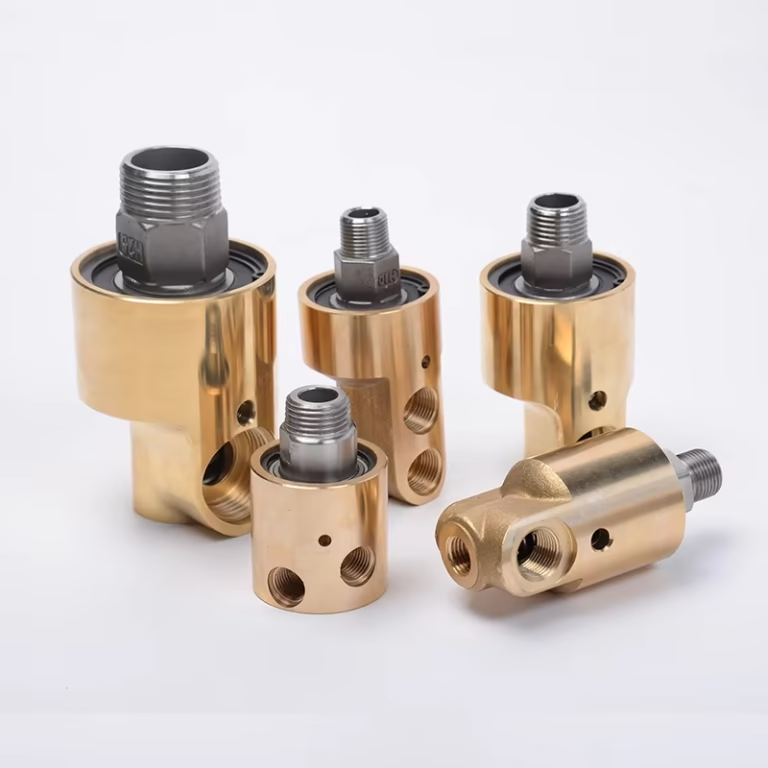
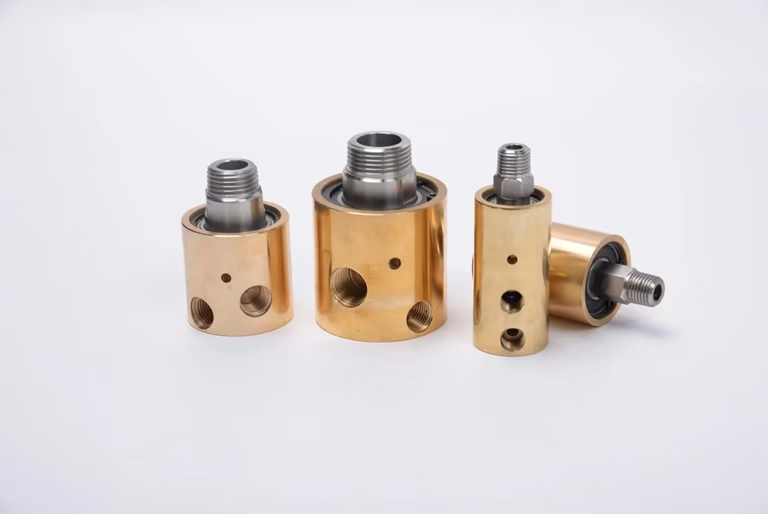
A 360-degree swivel joint is designed to transfer hydraulic oil, water, air, coolant, or other industrial media between stationary and rotating components while allowing unlimited continuous rotation. Although the principle appears simple, designing a swivel joint that operates reliably under high pressure and continuous movement requires precision engineering, strict manufacturing control, and extensive field experience.
Many online articles explain what a swivel joint is, but very few discuss how industrial swivel joints are actually designed, manufactured, tested, and improved after years of operation in demanding environments.
As a manufacturer specializing in hydraulic swivel joints and rotary unions, we have supplied products for construction machinery, agricultural equipment, steel mills, machine tools, offshore systems, and industrial automation. Through manufacturing, pressure testing, and inspecting returned products, we have learned that long service life depends on far more than selecting the correct thread or pressure rating.
This guide explains how a 360-degree swivel joint works, how it is manufactured, where it is used, and what manufacturing practices contribute to reliable long-term performance.
What Is a 360-Degree Swivel Joint?
A 360-degree swivel joint is a rotary fluid transfer component that allows one section of a hydraulic or fluid system to rotate continuously without twisting hoses or pipelines.
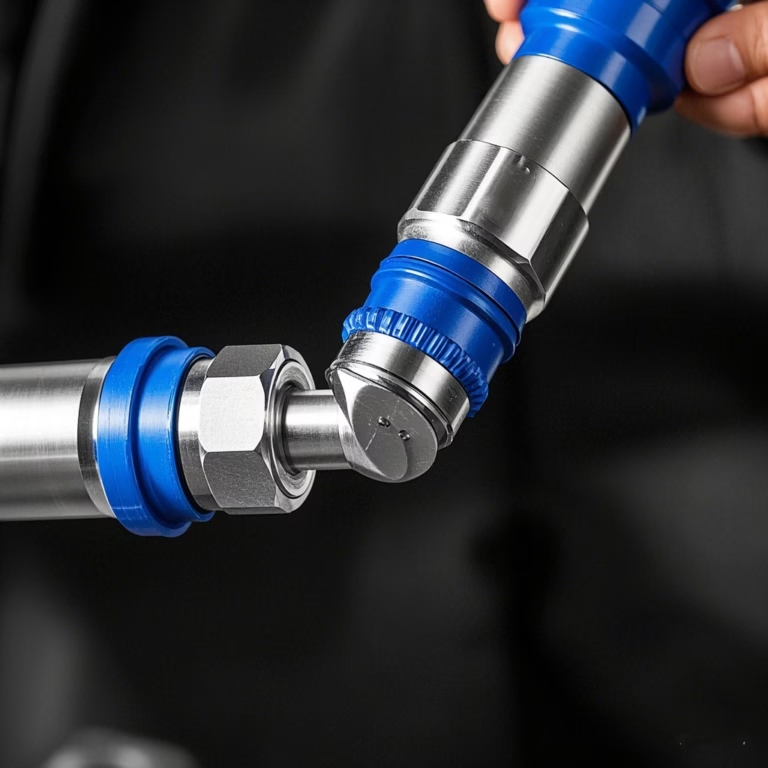
Unlike a fixed pipe connection, a swivel joint maintains a sealed flow path while one side rotates freely through a full 360 degrees—and in many industrial applications, it can continue rotating indefinitely.
Depending on its design, a swivel joint may transfer:
- Hydraulic oil
- Water
- Coolant
- Compressed air
- Vacuum
- Lubricating oil
- Other compatible industrial fluids
The number of passages varies according to the application. Some swivel joints transfer a single fluid through one passage, while others incorporate multiple independent flow channels for more complex hydraulic systems.
How Does a 360-Degree Swivel Joint Work?
Although there are many structural variations, the operating principle remains consistent.
One section of the swivel joint remains stationary while the other rotates with the machine.
Inside the housing, precision sealing components maintain separation between the stationary and rotating sections, allowing fluid to pass through internal flow channels without external leakage.
Several key components work together.
Rotating Shaft
The shaft rotates together with the connected equipment.
Its machining accuracy directly influences:
- Concentricity
- Bearing life
- Seal stability
- Leakage performance
Even slight shaft runout may reduce seal life significantly during continuous operation.
Housing
The housing supports internal components while connecting to the stationary hydraulic circuit.
It must withstand:
- Internal pressure
- External mechanical loads
- Vibration
- Temperature variation
Depending on the application, housings may be manufactured from carbon steel, stainless steel, or aluminum alloys.
Mechanical Seals
Mechanical seals prevent fluid from escaping between stationary and rotating components.
Seal performance depends on:
- Surface flatness
- Material combination
- Contact pressure
- Lubrication
- Operating conditions
Proper seal design allows continuous rotation while minimizing friction and wear.
Bearings
Bearings support the rotating shaft and maintain precise alignment.
Many leakage problems originate not from the seals themselves but from worn bearings that allow excessive shaft movement.
For this reason, bearing quality is one of the most important factors influencing swivel joint reliability.
O-Rings and Static Seals
Static sealing elements prevent leakage between non-rotating components.
Material selection depends on:
- Fluid compatibility
- Temperature
- Pressure
- Chemical exposure
Proper elastomer selection contributes to long-term sealing stability.
Swivel Joint vs. Rotary Union: What Is the Difference?
The terms swivel joint and rotary union are sometimes used interchangeably, but in industrial applications, they often describe products designed for different operating conditions.
A rotary union is commonly used on equipment such as CNC machine tools, paper machines, steel mills, and printing presses, where high rotational speed and continuous fluid transfer are required. Precision balancing, low friction, and stable operation at elevated speeds are key design priorities.
A360-degreee swivel joint, by contrast, is more frequently found on mobile and heavy-duty equipment where rotational movement is slower but external loads are significantly higher. Construction machinery, cranes, drilling rigs, forestry equipment, and hydraulic attachments are typical examples. These applications place greater emphasis on structural strength, impact resistance, and durability under harsh working conditions.
Understanding this distinction helps engineers choose the most suitable product for a specific application instead of relying solely on pressure ratings or connection sizes.
Where Are 360-Degree Swivel Joint Used?
The ability to rotate continuously without twisting hoses makes swivel joints indispensable across many industries.
Typical applications include:
Hydraulic Excavators
Swivel joints transfer hydraulic oil between the upper structure and the undercarriage, allowing continuous machine rotation while maintaining hydraulic power.
Truck-Mounted Cranes
Cranes rely on swivel joints to supply hydraulic pressure to rotating booms without damaging hoses during repeated slewing movements.
Concrete Pump Trucks
Continuous boom rotation requires dependable hydraulic connections capable of operating under high pressure and frequent movement.
Forestry Equipment
Harvesters, log loaders, and wood processing machines operate in muddy, dusty environments with heavy shock loads.
Swivel joints used in these applications require excellent sealing performance and resistance to contamination.
Agricultural Machinery
Modern agricultural equipment frequently incorporates rotating hydraulic systems for planting, spraying, and harvesting operations.
Reliable swivel joints reduce hose fatigue while improving equipment flexibility.
Offshore and Marine Equipment
Marine cranes, winches, and deck machinery use swivel joints to transfer hydraulic oil under corrosive environmental conditions.
Material selection becomes especially important where saltwater exposure is unavoidable.
What We Have Learned from Manufacturing Swivel Joints
As a manufacturer, one of our greatest advantages is the opportunity to examine products after years of actual industrial service.
Returned swivel joints often reveal valuable engineering information that cannot be obtained through laboratory testing alone.
Every returned unit is completely disassembled and inspected.
Our engineers examine:
- Bearing condition
- Seal wear patterns
- Shaft surfaces
- Housing dimensions
- Internal flow passages
- O-rings
- Signs of contamination
- Corrosion damage
After inspecting products from many different industries, one conclusion has become clear.
Visible leakage is rarely the original failure.
In many cases, leakage is simply the final symptom of another problem that has been developing inside the swivel joint.
For example, on several construction machinery projects, we observed that bearings had gradually developed excessive clearance after thousands of operating hours. This slight movement caused the rotating shaft to lose perfect alignment. Although the movement measured only fractions of a millimeter, it repeatedly altered the contact pressure between the seal faces during every rotation. Eventually, hydraulic oil escaped through microscopic gaps created by this instability.
We have also investigated swivel joints from forestry equipment where contamination proved to be the primary issue. Fine dust and abrasive particles entered damaged protective seals and gradually accelerated wear on both bearings and sealing surfaces.
These field inspections continue to shape how we manufacture every swivel joint today. Improvements in machining accuracy, material selection, assembly cleanliness, and quality inspection are all based on practical operating experience—not only theoretical design calculations.
How We Manufacture a 360 Degree Swivel Joint: From Raw Material to Pressure Testing
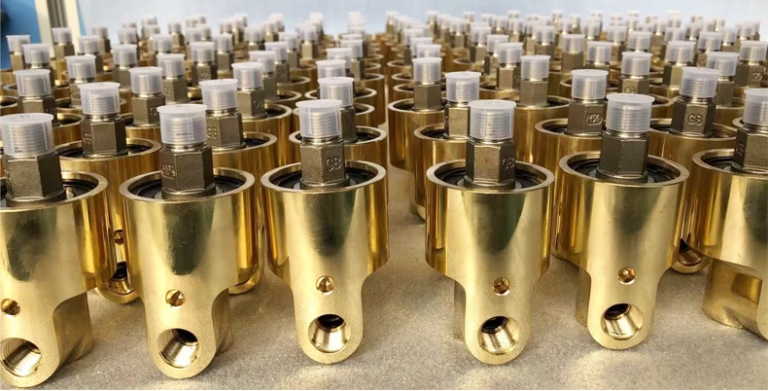
Design is only one part of building a reliable swivel joint. Long service life depends on how every component is manufactured, assembled, and inspected before shipment.
Over the years, we have found that many swivel joints fail not because the original design is incorrect, but because small manufacturing deviations accumulate during production. A slight error in shaft concentricity, an improperly finished sealing surface, or contamination introduced during assembly may not cause immediate leakage, but these issues often reduce service life after thousands of operating hours.
For this reason, our manufacturing process emphasizes consistency at every stage rather than relying on final inspection alone.
Step 1 – Selecting the Right Raw Materials
The manufacturing process begins with material selection.
Different applications require different combinations of strength, corrosion resistance, and wear resistance.
Depending on operating conditions, commonly used materials include:
Carbon Steel
Carbon steel provides excellent mechanical strength and is widely used in construction machinery, hydraulic equipment, and industrial applications where corrosion resistance is not the primary concern.
Advantages include:
- High structural strength
- Good machinability
- Stable performance under high hydraulic pressure
- Cost-effective production
Stainless Steel
For marine equipment, food processing machinery, chemical plants, and outdoor applications, stainless steel offers improved corrosion resistance.
Benefits include:
- Excellent resistance to rust
- Better performance in humid environments
- Longer service life where water or chemicals are present
- Easier maintenance
Aluminum Alloys
In applications where reducing equipment weight is important, aluminum housings may be selected without sacrificing machining precision.
Step 2 – Precision CNC Machining
Once materials are approved, components move into CNC machining.
Critical dimensions include:
- Shaft diameter
- Bearing seats
- Seal cavities
- Thread dimensions
- Internal flow passages
- Housing concentricity
For swivel joints, concentricity is particularly important.
Even a small amount of shaft eccentricity can produce uneven seal loading during rotation.
Instead of attempting to correct dimensional errors during assembly, we focus on machining components accurately from the beginning.
Our inspection process includes repeated dimensional verification throughout production to maintain batch consistency.
Step 3 – Heat Treatment and Surface Improvement
Some swivel joint components operate under continuous load and repeated rotation for thousands of hours.
Depending on the product design, heat treatment may be applied to improve:
- Surface hardness
- Wear resistance
- Fatigue strength
- Dimensional stability
Where appropriate, surface treatments are also used to improve corrosion resistance or reduce friction in demanding operating environments.
The exact process depends on the application and customer requirements rather than applying one standard treatment to every product.
Step 4 – Manufacturing the Seal System
The sealing system is one of the most important parts of any swivel joint.
Its purpose is simple in theory but demanding in practice.
The seal must:
- Prevent leakage
- Maintain low friction
- Operate continuously
- Resist wear
- Tolerate pressure fluctuations
Selecting Seal Face Materials
Different applications require different seal combinations.
Our engineering team commonly recommends:
Silicon Carbide
Suitable for continuous operation requiring excellent wear resistance and dimensional stability.
Tungsten Carbide
Frequently selected for demanding hydraulic applications involving high pressure or abrasive conditions.
Carbon Graphite
Provides stable performance where adequate lubrication conditions are available.
Material selection is always based on the actual operating environment rather than simply choosing the hardest available material.
Elastomer Selection
Static sealing elements are equally important.
Depending on operating conditions, we may use:
- NBR
- FKM
- PTFE
Selection depends on:
- Hydraulic fluid compatibility
- Temperature range
- Chemical exposure
- Pressure requirements
Choosing the correct elastomer helps maintain sealing performance throughout the service life of the swivel joint.
Step 5 – Bearing Installation
Bearings directly influence rotational stability.
During factory inspections of returned swivel joints, bearing wear consistently ranks among the leading causes of leakage.
For this reason, bearing installation receives particular attention during assembly.
Technicians verify:
- Correct bearing orientation
- Proper installation force
- Rotational smoothness
- Bearing preload where required
- Lubrication
Stable bearing performance allows the seal faces to remain properly aligned during continuous rotation.
Step 6 – Clean Assembly Procedures
One lesson repeatedly confirmed through returned product analysis is that contamination introduced during assembly can shorten service life long before the product enters operation.
Our assembly process therefore emphasizes cleanliness.
Before final assembly:
- Components are cleaned and visually inspected.
- Seal faces are protected from scratches.
- Internal passages are checked for chips and debris.
- Bearings are handled using appropriate assembly procedures.
- O-rings are inspected before installation.
Although these steps require additional time, they significantly reduce the risk of premature failures caused by contamination.
Step 7 – Pressure Testing and Functional Verification
Every swivel joint should be verified before shipment.
Factory testing confirms that the assembled product performs according to design specifications.
Depending on product type, testing may include:
- Hydrostatic pressure testing
- Internal leakage testing
- External leakage inspection
- Rotational testing
- Dimensional verification
- Visual inspection
Testing provides confidence that the swivel joint performs correctly before installation in customer equipment.
What Returned Products Continue to Teach Us
Manufacturing does not end when a swivel joint leaves the factory.
Returned products provide valuable engineering information that helps improve future production.
Our engineers routinely compare:
- Seal wear patterns
- Bearing condition
- Shaft wear
- Corrosion damage
- Internal contamination
- Evidence of installation problems
Several recurring trends have influenced our manufacturing process.
For example, one group of returned swivel joints from mobile cranes showed uneven seal wear despite relatively low operating hours.
After investigation, we discovered that excessive hose loads were being transferred directly into the swivel joint. The issue was not related to material quality but to installation practices.
As a result, our technical support team now discusses hose routing and external loading whenever supporting similar applications.
In another case involving hydraulic drilling equipment, repeated leakage was traced to pressure spikes rather than average working pressure. Although the swivel joint operated within its nominal pressure rating, rapid pressure fluctuations accelerated seal wear. Following discussions with the customer, adjustments to the hydraulic circuit significantly improved service life.
Experiences such as these continually improve both our manufacturing process and our engineering recommendations.
Why Customers Prefer Working Directly with a Manufacturer
Many customers first contact us because they are searching for an alternative to expensive imported swivel joints.
After working together, they often recognize additional advantages beyond pricing.
As a manufacturer, we can provide:
- Direct communication with engineers
- OEM and private-label manufacturing
- Customized dimensions and port configurations
- Material recommendations based on application requirements
- Stable production schedules
- Faster lead times
- Technical support throughout the product lifecycle
Rather than supplying a standard catalog item, our objective is to help customers select a swivel joint that performs reliably under their actual operating conditions.
Typical Industrial Applications
Hydraulic Excavators
Hydraulic excavators are among the largest users of 360-degree swivel joints.
The swivel joint is installed between the upper structure and the undercarriage, allowing hydraulic oil to pass continuously while the upper body rotates.
Without a swivel joint:
- Hydraulic hoses would twist.
- Hose fatigue would increase rapidly.
- Machine rotation would be limited.
Operating Challenges
Excavators typically operate under:
- High hydraulic pressure
- Heavy shock loads
- Mud and dust contamination
- Continuous rotation
- Outdoor weather exposure
These conditions require excellent sealing performance and robust bearing support.
Truck-Mounted Cranes
Truck cranes rely on swivel joints to maintain hydraulic power while the boom rotates.
In these applications, operators expect:
- Smooth rotation
- Stable hydraulic pressure
- Minimal leakage
- Reliable long-term operation
One common issue we have observed is excessive external force from poorly supported hydraulic hoses.
When hose loads are transferred directly into the swivel joint, bearings and seals experience additional stress, reducing service life.
Drilling Equipment
Rotary drilling systems frequently operate under demanding pressure conditions.
The swivel joint must withstand:
- Continuous rotation
- Pressure fluctuations
- Abrasive environments
- Long operating hours
Selecting suitable seal materials is especially important in drilling applications where contamination is difficult to avoid.
Forestry Machinery
Forestry equipment presents one of the harshest operating environments.
Machines work continuously in:
- Wood chips
- Dust
- Mud
- Rain
- Low winter temperatures
Returned swivel joints from forestry equipment often show contamination entering through damaged external protection components.
Routine inspection of protective seals can significantly extend service life.
Offshore and Marine Equipment
Marine cranes, deck machinery, and offshore hydraulic systems require swivel joints capable of operating reliably in corrosive environments.
For these applications, engineers often prioritize:
- Corrosion-resistant materials
- Reliable sealing
- Stable operation
- Long maintenance intervals
Selecting stainless steel components where appropriate helps improve durability under saltwater exposure.
Steel Mills
Steel plants use swivel joints in:
- Hydraulic manipulators
- Rotary cooling equipment
- Coil handling systems
- Material handling equipment
These machines operate under:
- Elevated temperatures
- Heavy vibration
- Continuous production
Returned products from steel mills frequently show contamination caused by metallic particles circulating throughout the hydraulic system.
Improving hydraulic oil cleanliness often produces significant improvements in service life.
Common Failure Modes
Although swivel joints are designed for continuous rotation, every component eventually experiences wear.
The most common causes of failure include the following.
Hydraulic Oil Leakage
Visible oil leakage is usually the first symptom noticed by maintenance personnel.
Possible causes include:
- Mechanical seal wear
- Bearing clearance
- Shaft misalignment
- Pressure spikes
- Contaminated hydraulic oil
Replacing the seal without identifying the root cause often results in repeated failures.
Bearing Damage
Bearing wear gradually changes shaft alignment.
Typical warning signs include:
- Abnormal operating noise
- Increased vibration
- Higher operating temperature
- Uneven seal wear
Early bearing replacement usually prevents additional damage to sealing components.
Internal Leakage
Sometimes no external oil leakage is visible.
Instead, operators notice:
- Reduced hydraulic efficiency
- Slower machine movement
- Pressure loss
- Increased oil temperature
Internal leakage may indicate worn sealing surfaces or excessive internal clearance.
Corrosion
Outdoor equipment and marine applications are particularly susceptible to corrosion.
Affected areas include:
- Housing
- Shafts
- Springs
- Threaded connections
Selecting appropriate materials during product design is generally more economical than repairing corrosion damage later.
Contamination
Hydraulic oil contamination remains one of the leading causes of premature swivel joint failure.
Typical contaminants include:
- Metal particles
- Dust
- Water
- Rubber debris
- Rust
Maintaining clean hydraulic oil protects both seals and bearings.
Preventive Maintenance Recommendations
Our engineers generally recommend preventive maintenance instead of waiting for leakage to appear.
Daily Inspection
Operators should check:
- External leakage
- Abnormal noise
- Vibration
- Loose hydraulic connections
Small changes often indicate developing problems.
Weekly Inspection
Maintenance personnel should verify:
- Hydraulic pressure stability
- Hose condition
- Mounting bolts
- Rotation smoothness
- Bearing noise
Scheduled Maintenance
During planned shutdowns, inspect:
- Bearings
- Mechanical seals
- O-rings
- Shaft wear
- Housing condition
Replacing inexpensive wear components during scheduled maintenance often prevents costly production interruptions.
Factory Experience That Shapes Our Products
One advantage of manufacturing swivel joints is the continuous feedback obtained from returned products.
Every returned swivel joint is completely disassembled.
Our engineers record:
- Seal wear
- Bearing condition
- Internal contamination
- Shaft damage
- Corrosion
- Installation evidence
These inspection reports are reviewed by both our production and engineering departments.
Several manufacturing improvements implemented over recent years originated directly from these inspections.
Examples include:
- Improving machining tolerances for critical sealing surfaces
- Optimizing seal material combinations for different hydraulic fluids
- Refining bearing selection for continuous rotation
- Updating assembly procedures to improve cleanliness
- Expanding inspection standards before shipment
Rather than relying only on laboratory testing, these improvements are based on practical operating experience collected from customers working in demanding industrial environments.
Why Customers Choose Our Swivel Joints
Many customers initially contact us because they are looking for a cost-effective replacement for well-known international brands.
However, long-term cooperation is usually built on engineering support rather than price alone.
Working directly with our factory provides several advantages.
Precision Manufacturing
Critical components are produced using CNC machining with strict dimensional control.
Comprehensive Quality Inspection
Every swivel joint undergoes inspection before shipment, including dimensional verification, pressure testing, leakage inspection, and assembly checks.
Engineering Support
Our technical team assists customers with:
- Product selection
- Installation recommendations
- Drawing review
- Material selection
- Troubleshooting
- OEM customization
Flexible Manufacturing
We support:
- Custom thread configurations
- Special mounting dimensions
- Multiple flow passages
- Private labeling
- OEM production
Frequently Asked Questions
Can your swivel joint replace products from other international manufacturers?
Yes.
We manufacture dimensionally compatible swivel joints for many industrial applications. Our engineers can review drawings or samples to verify compatibility before production.
How do I select the correct 360-degree swivel joint?
Selection depends on:
- Working pressure
- Flow medium
- Rotational speed
- Number of passages
- Connection type
- Installation space
- Operating environment
Providing complete application information helps us recommend the most suitable solution.
Why does my swivel joint leak after installation?
Possible causes include:
- Incorrect installation
- Misalignment
- Contaminated hydraulic oil
- Pressure fluctuations
- Bearing wear
A technical inspection is recommended before replacing components.
Can swivel joints be customized?
Yes.
We regularly manufacture customized products for OEM equipment, including modified dimensions, special materials, alternative port configurations, and customer branding.
How is every swivel joint tested?
Depending on the product type, inspections typically include:
- Hydrostatic pressure testing
- Leakage testing
- Rotational testing
- Dimensional inspection
- Visual inspection
- Functional verification
Conclusion
A 360-degree swivel joint is far more than a rotating connector. It is a precision hydraulic component that directly affects machine reliability, operational safety, and maintenance costs.
Our experience as a manufacturer has shown that successful swivel joint performance depends on the combination of precision machining, proper material selection, controlled assembly, comprehensive testing, and application-specific engineering. Products that deliver the longest service life are those designed and manufactured with a clear understanding of the customer’s actual operating environment.
At Dann Hydraulic, we continue improving our swivel joints through practical manufacturing experience, returned product analysis, and close cooperation with OEM manufacturers and industrial maintenance teams. Every customer project helps us refine our production processes, optimize product designs, and provide more reliable solutions for future applications.
Whether you are replacing an existing swivel joint, developing new equipment, or searching for a dependable alternative to international brands, our engineering team is ready to help. By combining manufacturing expertise with real-world application knowledge, we aim to deliver swivel joints that reduce downtime, improve reliability, and provide long-term value throughout the equipment lifecycle.