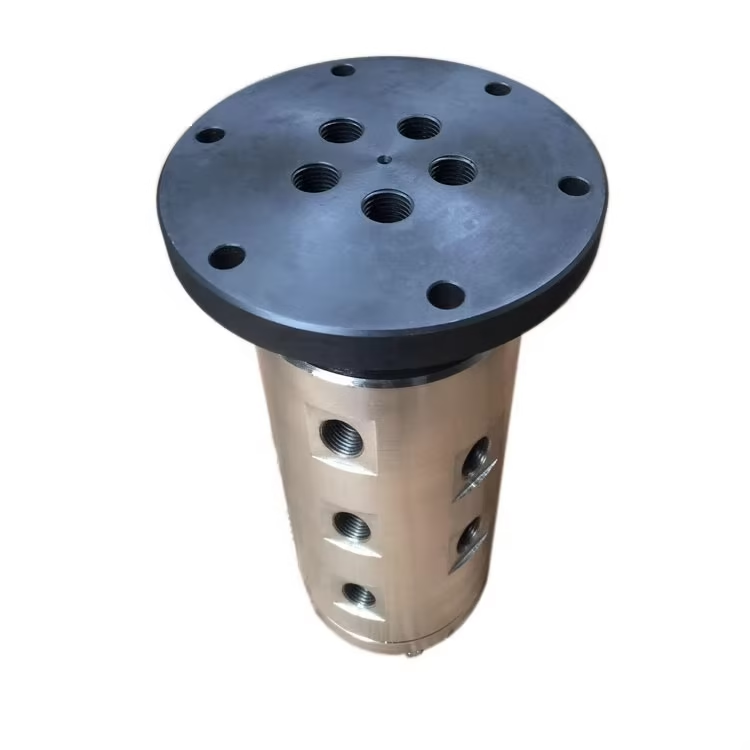
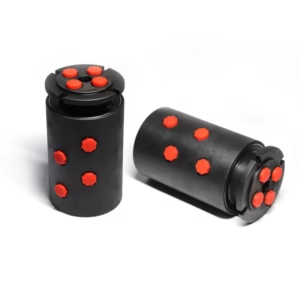
Multi Passage Rotating Union for Hydraulic, Pneumatic and Mixed-Media Applications
Original price was: $120.00.$110.00Current price is: $110.00.
- Maximum Passages: Up to 24
- Operating Pressure : Up to 6000 psi
- Temperature Range: -40°C to +150°C
- Seal Type : Customizable seal designs
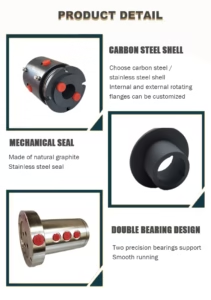
- Material: Stainless steel / High-strength alloys
- Rotation: Bi-directional
Description
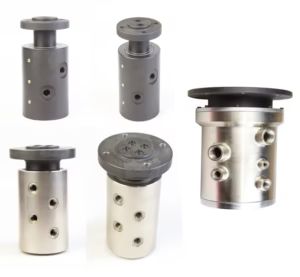
A Multi-Passage Rotating Union is designed to transfer multiple fluids, gases, or vacuum lines simultaneously between stationary and rotating components while keeping each passage completely isolated.
Unlike a standard single-passage rotary union, a multi-passage rotating union allows several independent circuits to operate through a compact rotating interface. This makes it an ideal solution for modern automated equipment where hydraulic oil, compressed air, coolant, vacuum, or other media must be transmitted simultaneously.
As industrial machinery becomes increasingly automated and space-constrained, multi-passage rotating unions have become essential components in robotic systems, indexing tables, packaging equipment, lithium battery production lines, semiconductor equipment, and custom automation machinery.
As a Chinese rotary union manufacturer, we have supplied customized multi-passage rotating unions to equipment builders worldwide and accumulated extensive experience in solving sealing, cross-contamination, and reliability challenges in complex rotating systems.
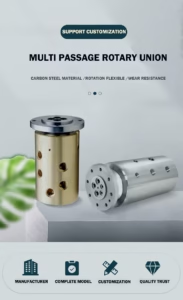
Common Problems Found in Multi-Passage Rotary Union Applications
After supporting hundreds of equipment manufacturers, we have identified several recurring issues.
Understanding these problems helps engineers select the right solution.
Problem 1: Internal Media Cross-Contamination
One of the most serious failures occurs when media from different passages mix internally.
Examples include:
- Hydraulic oil entering pneumatic lines
- Coolant entering vacuum channels
- Air leakage between circuits
Consequences include:
- Equipment malfunction
- Product contamination
- Increased maintenance costs
Our Solution
We utilize independent sealing chambers between passages and carefully engineered isolation structures to minimize the risk of internal media migration.
Problem 2: Leakage at High Rotational Speeds
As rotational speed increases, sealing conditions become more demanding.
Common causes include:
- Excessive seal loading
- Shaft runout
- Thermal expansion
- Inadequate bearing support
Our Solution
For high-speed applications, we optimize:
- Seal balance ratio
- Bearing configuration
- Rotor concentricity
- Dynamic balancing
This improves sealing stability while reducing friction.
Problem 3: Premature Bearing Failure
Bearing damage remains one of the most common causes of rotary union downtime.
Typical causes include:
- Radial loading
- Misalignment
- Contamination
- Excessive operating speed
Our Solution
We incorporate precision bearings selected according to actual operating loads and rotational speeds.
Additional bearing protection structures help prevent contamination from entering critical areas.
Problem 4: Insufficient Flow Capacity
Many rotating unions fail to deliver required flow rates because internal passages are undersized.
Symptoms include:
- Pressure drop
- Reduced actuator performance
- Poor cooling efficiency
Our Solution
We optimize internal flow passages using application-specific designs to maintain stable flow characteristics.
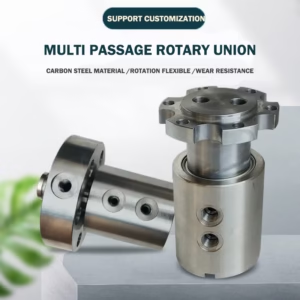
Engineering Features of Our Multi-Passage Rotating Union
Independent Passage Design
Each channel is engineered to operate independently.
Benefits include:
- Reduced cross-contamination risk
- Stable pressure transmission
- Improved system reliability
Modular Channel Configuration
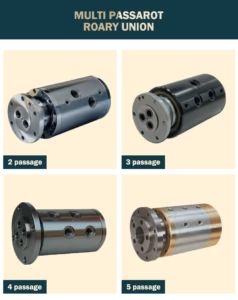
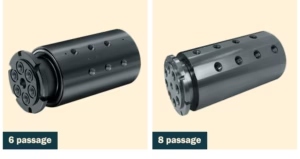
Available configurations include:
- 2 Passage
- 4 Passage
- 6 Passage
- 8 Passage
- Custom multi-channel designs
This flexibility allows equipment designers to integrate multiple media within a compact assembly.
Precision Machined Components
Critical sealing surfaces are CNC-machined to tight tolerances.
This contributes to:
- Longer seal life
- Lower leakage rates
- Improved operating stability
High-Performance Seal Materials
Depending on application requirements, sealing materials may include:
- Carbon Graphite
- Silicon Carbide
- Tungsten Carbide
- Engineering Polymers
Material selection is based on pressure, speed, temperature, and media compatibility.
Practical Customer Experience
A customer manufacturing automated rotary assembly tables experienced repeated failures with imported rotary unions.
The equipment required simultaneous transmission of:
- Compressed air
- Vacuum
- Hydraulic pressure
Their existing solution suffered from internal leakage between passages after several months of operation.
After reviewing the application, our engineers redesigned the internal sealing arrangement and optimized bearing support.
Results included:
- Significant reduction in leakage incidents
- Improved equipment uptime
- Longer maintenance intervals
This project reinforced the importance of application-specific engineering rather than relying solely on catalog products.
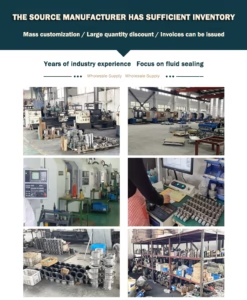
Why Work with a Rotary Union Manufacturer Instead of a Trading Company?
Many suppliers simply resell standard products.
A manufacturer can provide:
- Engineering consultation
- Custom designs
- Application analysis
- Material recommendations
- Technical troubleshooting
This becomes particularly important for multi-passage applications where operating conditions vary significantly.
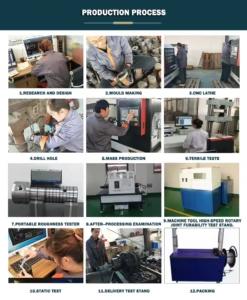
Manufacturing Experience Matters
A multi-passage rotating union is significantly more complex than a standard rotary union.
Maintaining reliable sealing across multiple independent channels requires manufacturing precision and assembly expertise.
At our facility, production includes:
CNC Precision Machining
Critical dimensions are controlled using advanced machining equipment.
Seal Matching
Seal combinations are selected according to operating conditions.
Pressure Testing
Each assembly is tested before shipment.
Rotation Testing
Operational testing verifies sealing performance during rotation.
Quality Inspection
Dimensional and functional inspections are performed throughout production.
These procedures help ensure reliable field performance.

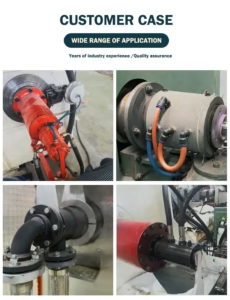
Typical Applications of Multi-Passage Rotating Unions
One of the biggest mistakes equipment designers make is assuming all rotary unions perform the same function.
In reality, application requirements vary significantly.
Industrial Automation Equipment
Automated assembly lines often require multiple pneumatic circuits operating simultaneously.
Typical functions include:
- Air cylinder control
- Vacuum gripping
- Sensor air supply
- Blow-off systems
A multi-passage rotating union enables all these functions through a single rotating interface.
Rotary Indexing Tables
Rotary indexing tables frequently require multiple channels for:
- Compressed air
- Hydraulic pressure
- Vacuum
- Cooling circuits
Instead of installing multiple rotary unions, a multi-passage design simplifies installation and reduces maintenance requirements.
Robotic Equipment
Modern robotic systems often integrate:
- Pneumatic control
- Vacuum handling
- Cooling systems
A compact multi-channel rotary union minimizes hose management problems while improving reliability.
Lithium Battery Manufacturing Equipment
Battery production equipment often uses rotating stations requiring:
- Vacuum transfer
- Air supply
- Cooling circulation
Media isolation becomes critical in these applications.
Semiconductor Manufacturing Systems
Semiconductor production environments demand:
- High cleanliness
- Stable sealing performance
- Reliable vacuum transmission
Multi-passage rotary unions provide the flexibility needed for complex processing equipment.

Why Equipment Manufacturers Choose Customized Multi-Passage Rotary Unions
Standard products do not always meet application requirements.
Many OEM customers require:
- Specific port arrangements
- Unique passage combinations
- Mixed hydraulic and pneumatic circuits
- Special mounting interfaces
Our engineering team regularly develops customized rotary union solutions based on customer drawings and operating specifications.

Frequently Asked Questions
What is a multi-passage rotating union?
A multi-passage rotating union transfers multiple fluids, gases, or vacuum circuits simultaneously between stationary and rotating equipment.
Can hydraulic oil and compressed air pass through the same rotary union?
Yes. Multi-passage designs can accommodate different media through isolated channels.
How many passages can a rotary union have?
Common configurations range from 2 to 12 passages, while custom designs may support additional channels.
How do you prevent media cross-contamination?
Independent sealing structures and dedicated passage isolation systems are used to keep media separated.
Can you customize port sizes and configurations?
Yes. We provide customized solutions based on application requirements and equipment layouts.

Your Partner for Multi-Passage Rotating Union Solutions
Selecting a multi-passage rotating union is not simply a matter of choosing the number of channels. Reliability depends on sealing technology, bearing design, machining accuracy, media compatibility, and application-specific engineering.
As a rotary union manufacturer with experience supporting automation equipment, robotics, indexing tables, battery production systems, and industrial machinery, we help customers develop reliable fluid transfer solutions that reduce downtime and improve equipment performance.
Whether you need a standard multi-passage rotary union or a fully customized solution, our engineering team can assist with design selection, technical evaluation, and long-term application support.
Related products
-
Sale!

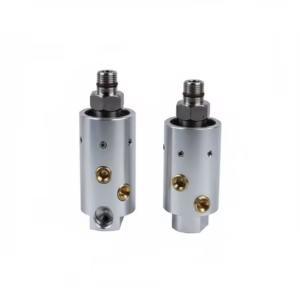
Tool Center Outlet High Speed Rix Rotary Union
Original price was: $110.00.$106.00Current price is: $106.00. -
Sale!

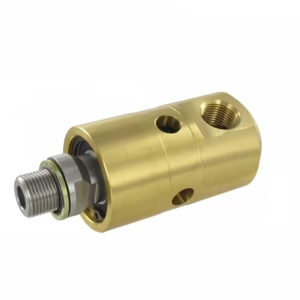
Rotoflux S Series Large Capacity Universal Rotary Unions For Printing Machines
Original price was: $80.00.$60.00Current price is: $60.00. -
Sale!
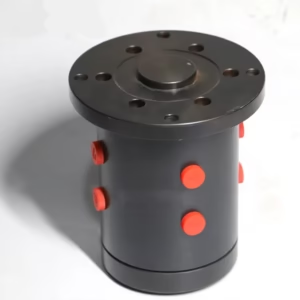
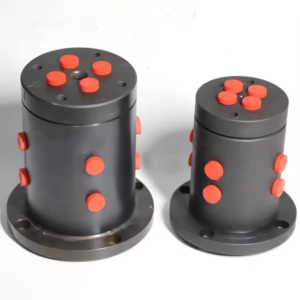
Rotary Union Custom Timing for Precision Fluid Transfer Applications
Original price was: $220.00.$201.00Current price is: $201.00. -
Sale!
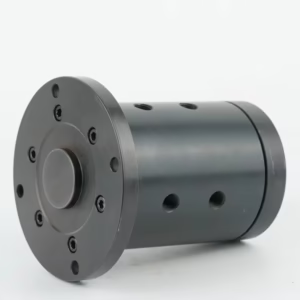
High Performance Replacement Solution for Deublin Type 4 Passage Rotary Unions
Original price was: $220.00.$201.00Current price is: $201.00.