Common Rotary Union Seal Failures Explained: Causes, Prevention, and Real Industrial Solutions
In high-pressure, high-temperature, and high-speed industrial operations, the rotary union is a small but critical link in the production chain. Whether it is delivering high-pressure coolant to a CNC spindle, steam to a paper mill corrugated roll, or hydraulic fluid to an automated indexing table, this component must maintain an absolute, leak-free barrier between static supply lines and rotating machinery. When a fluid system fails, the root cause is almost always traced back to a rotary union seal failure.
A leaking seal does not merely create a mess on your shop floor; it triggers a cascade of operational crises. It vents steam pressure, contaminates bearing grease, ruins workpiece surface finishes, and causes catastrophic machine downtime.
In our factory, rotary union seal failure analysis is one of the most common technical support tasks we handle for customers in CNC machining, steel processing, paper mills, rubber manufacturing, textile machinery, food equipment, and heavy industrial fluid systems. Over the years, we have inspected failed carbon seals, cracked mechanical seals, burned O-rings, and thermally damaged sealing faces from hundreds of rotary union applications.
Most failures are not caused by the rotary union housing itself. The actual weak point is almost always the seal system.
This guide explains the most common rotary union seal failures, including:
- Rotary union seal failure mechanisms
- Carbon seal damage
- Mechanical seal wear
- Thermal cracking
- Dry running failures
- Improper media compatibility
- Installation mistakes
- High-speed sealing problems
- How manufacturers prevent premature seal failure
More importantly, this article explains how experienced rotary union manufacturers engineer sealing systems to survive real industrial operating conditions.
Why Rotary Union Seals Fail
A rotary union seal operates between rotating and stationary surfaces while preventing leakage of fluid, air, steam, coolant, thermal oil, or vacuum media.
Unlike static seals, rotary union seals experience:
- Constant friction
- Rotational heat generation
- Pressure loading
- Surface wear
- Thermal expansion
- Dynamic misalignment
Even minor operating problems can rapidly destroy the seal interface.
The most common causes of rotary union seal failure include:
| Failure Cause | Typical Result |
|---|---|
| Dry running | Carbon burning, thermal damage |
| Poor lubrication | Excessive friction and scoring |
| Thermal shock | Cracked seal faces |
| Improper installation | Uneven wear and leakage |
| Contaminated media | Abrasive wear |
| Excessive RPM | Seal instability |
| Pressure spikes | Face separation |
| Misalignment | Uneven contact surfaces |
| Wrong seal material | Chemical attack |
| Poor machining accuracy | Premature leakage |
In many industrial applications, seal failure starts gradually but becomes catastrophic very quickly once face flatness deteriorates.
Understanding Carbon Seal Failures
What Is a Carbon Seal?
Carbon graphite seals are widely used in rotary unions because they offer:
- Excellent self-lubricating properties
- Low friction coefficient
- Good thermal stability
- Reliable operation at high speed
- Compatibility with water, steam, coolant, and oil
Carbon seals are especially common in:
- CNC rotary unions
- Steam rotary joints
- High-speed spindle rotary unions
- Paper machine rotary joints
- Hot oil rotary unions
At our manufacturing facility, carbon seal material selection is customized according to:
- Rotational speed
- Operating temperature
- Media type
- Pressure
- Surface load
- Duty cycle
Not all carbon grades behave the same under thermal stress.
Common Carbon Seal Damage Patterns
1. Surface Scoring
Surface scoring appears as circular scratches or grooves on the carbon face.
Causes:
- Dirty coolant
- Metal particles
- Inadequate filtration
- Hard contaminants are entering the sealing gap
Result:
- Leakage
- Increased friction
- Accelerated wear
In CNC applications, contaminated through-spindle coolant is one of the leading causes of carbon seal scoring.
Many low-cost rotary unions fail because manufacturers use inferior filtration recommendations or low-density carbon materials.
Our engineering team typically recommends:
- 10–25 micron filtration
- Proper coolant cleanliness
- Hardness-matched seal faces
- Precision-lapped sealing surfaces
These measures dramatically improve seal lifespan.
2. Carbon Seal Chipping
Carbon material is durable but relatively brittle.
Improper handling during installation can chip the seal edges.
Common causes:
- Dropping the seal
- Excessive tightening force
- Shaft impact during assembly
- Misaligned installation
Once edge chipping begins, seal face pressure becomes uneven, eventually leading to leakage.
This is why experienced manufacturers use:
- Precision assembly fixtures
- Controlled torque procedures
- Seal face inspection systems
- Protective packaging during shipment
In our production line, every carbon sealing surface undergoes flatness and concentricity inspection before assembly.
3. Carbon Seal Burn Marks
Burned carbon seals usually indicate excessive heat generation.
Typical symptoms include:
- Blackened seal faces
- Surface glazing
- Burn odor
- Rapid leakage
Primary causes:
- Dry running
- Lack of coolant flow
- Excessive RPM
- Incorrect spring load
- Thermal overload
Once the carbon face overheats, friction rises rapidly, and seal destruction accelerates.
This problem is particularly common in:
- High-speed CNC spindle unions
- Air rotary unions without lubrication
- Steam rotary joints during startup
Mechanical Seal Failures in Rotary Unions
What Is a Mechanical Seal?
Mechanical seals use two precision-machined sealing faces:
- One rotating face
- One stationary face
The faces remain in contact through spring force and fluid film lubrication.
Mechanical seals are widely used in:
- High-pressure rotary unions
- Thermal oil systems
- Steam applications
- Chemical processing equipment
Their performance depends heavily on:
- Face flatness
- Surface finish
- Thermal balance
- Material pairing
Common Mechanical Seal Problems
Face Wear
Mechanical seal faces gradually wear during operation.
Normal wear is expected, but excessive wear indicates operating problems.
Causes:
- High friction
- Contamination
- Poor lubrication
- Excessive pressure
- Improper material combination
Seal face wear leads to:
- Leakage
- Heat buildup
- Reduced sealing efficiency
Our factory uses CNC lapping and precision grinding equipment to maintain extremely tight sealing tolerances on carbide and carbon faces.
For high-speed applications, even microscopic face distortion can shorten service life dramatically.
Seal Face Distortion
Mechanical seal faces must remain extremely flat.
Thermal expansion can distort the sealing geometry during operation.
This often occurs in:
- Steam rotary unions
- Hot oil rotary unions
- High-temperature drying cylinders
Symptoms include:
- Intermittent leakage
- Thermal cycling leakage
- Uneven wear patterns
To solve this issue, experienced manufacturers optimize:
- Seal face geometry
- Thermal expansion compensation
- Balanced seal structure
- Material thermal conductivity
In our high-temperature rotary union series, we carefully match the expansion characteristics of carbon and tungsten carbide to reduce thermal distortion.
Common Rotary Union Seal Failure Mode
Failure Mode 1: Dry Running (The Leading Killer of Mechanical Seals)
In a perfectly tuned fluid system, the liquid being transferred acts as a coolant and lubricant for the seal faces. Dry running occurs when the rotary union operates without this vital fluid barrier at the seal interface.
The Physics of Dry Run Destruction
When a machine operates dry, the coefficient of friction between the rotating and stationary seal faces skyrockets instantly.
-
Frictional Heat Spike: Within seconds of dry rotation at high speeds, face temperatures can pass 300°C.
-
Thermal Shock: When fluid is suddenly reintroduced to the system, the ice-cold coolant hits the blistering-hot seal faces. This creates an intense thermal differential that shatters hard materials like silicon carbide or tungsten carbide.
-
Blistering of Carbon: If the union uses a carbon seal, the intense heat vaporizes any moisture trapped inside the porous carbon structure. This creates internal pressure cells, causing the carbon surface to blister, pit, and flake away.
Typical Field Scenarios
In CNC machining centers, dry running occurs frequently during tool-to-tool transitions. If the spindle continues to spin at 15,000 RPM while the coolant pump turns off for a tool change, a standard closed-face seal will burn up in a matter of cycles.
Our Factory-Direct Solution: Auto-Sense / Pop-Off Technology
To eliminate dry-run rotary union seal failure, our facility engineers advanced “Pop-Off” and “Auto-Sense” seals.
-
When Pressure is present, the internal hydraulic pressure forces the seal faces together to create a leak-proof path.
-
When Pressure Drops (Dry Milling): The seal faces are mechanically separated by a few microns. This allows the spindle to spin freely at maximum RPM without any physical contact between the friction pair, eliminating friction heat and premature wear.
Failure Mode 2: Thermal Cracking and Heat Checking
High temperatures change the structural integrity of metals and ceramics. Thermal cracking (frequently referred to in the field as “heat checking”) is the direct result of excessive, localized thermal stress on the seal faces.
Visual Identification under a Microscope
If you open a failed union and examine the seal rings under a magnifying lens, thermal cracking is easy to spot. It manifests as a series of fine, radial cracks radiating outward from the center of the seal face. It often resembles a shattered spiderweb or dried mud.
Why Thermal Cracking Happens
-
Localized Hot Spots: Even if the overall fluid temperature is within normal limits, microscopic high spots on the seal faces generate localized friction zones. These “hot spots” expand faster than the cooler surrounding material.
-
Cyclic Thermal Stress: The continuous heating and rapid cooling cycles cause the material to exceed its tensile strength limit, forming micro-fractures.
-
Aggressive Media: High-temperature steam or thermal oil accelerates this failure if the seal material lacks sufficient thermal conductivity to dissipate the heat.
Material Upgrades: Moving Beyond Cheap Materials
Many budget components fail because they use low-grade, resin-bonded carbon or cheap carbon steel rotors.
To prevent thermal cracking in heavy-duty steam environments, our factory replaces standard materials with premium antimony-impregnated carbon graphite paired with solid Silicon Carbide (SiC) or Tungsten Carbide (TC). Antimony-impregnated carbon features vastly superior thermal conductivity, allowing the seal face to dump heat into the surrounding fluid before localized hot spots can form.
Failure Mode 3: Abrasive Scoring and Media Contamination
Industrial fluids are rarely perfectly clean. Closed-loop water lines, recycled through-spindle coolants, and raw steam lines carry a heavy load of abrasive particles, including pipe scale, rust, sand, and fine metal chips.
Mechanics of Abrasive Seal Damage
When these micro-contaminants find their way to the seal interface, they cause rapid seal damage:
-
Embedding: In a hard-on-soft seal pair, abrasive particles easily press into the soft carbon seal face.
-
Act as a Cutting Tool: The embedded particle turns the carbon ring into a grinding wheel. As the hard mating ring rotates against it, the particle cuts deep concentric grooves into the opposing face.
-
Loss of Flatness: Once these concentric tracks are carved into the face, the capillary fluid film thickness becomes uneven, leading to an immediate, unpreventable spray leak.
The Solution: Hard-to-Hard Sealing Patterns
For systems with poor filtration or abrasive media (like cast iron milling or steel mill continuous casting lines), our engineering team utilizes strict Hard-on-Hard sealing profiles. By running Silicon Carbide directly against Silicon Carbide, the seal faces are harder than the passing debris. Any grit or scale that attempts to enter the interface is crushed into harmless powder and washed away, leaving the precision-lapped faces untouched.
Failure Mode 4: Mechanical Fracturing from Shock and Alignment Errors
Not all rotary union seal failures are caused by heat or friction. Mechanical stress from improper installation or machine tool instability can snap a seal face instantly.
Shaft Misalignment and Concentricity Deviations
If the rotary union shaft is not installed perfectly concentric to the machine spindle or drying cylinder journal, the housing will wobble.
-
The Result: This wobble forces the internal mechanical seal to compress and decompress unevenly during every single revolution.
-
The Consequence: At high speeds, the spring mechanism cannot keep up with this cyclic wobble. The seal faces begin to “bounce” apart, allowing high-pressure fluid to blow through. When they slam back together, the impact shatters brittle ceramic or carbide faces.
The Hard-Piping Blunder
Installing rigid steel piping directly into the ports of a rotary union restricts its ability to flex. As the machine heats up and undergoes thermal expansion, the rigid piping exerts massive side-loads on the union housing. This side-load deforms the internal bearing alignment, creating angular stress across the seal faces and causing instant edge-wear and leakage.
Comprehensive Diagnostic Matrix for Field Engineers
To help your maintenance technicians diagnose issues quickly on the plant floor, use this diagnostic matrix compiled by our quality assurance department:
| Visual Indicator on Seal Face | Primary Root Cause | Contributing Factor | Corrective Action |
| Fine radial cracks (webbing) | Thermal Cracking | Severe frictional heat / Dry running | Upgrade to SiC faces; verify fluid flow. |
| Deep concentric grooves | Abrasive Scoring | Contaminated media / Failed filters | Install a 20-micron inline fluid strainer. |
| Chipped or fractured edges | Mechanical Shock | Shaft misalignment / Severe vibration | Verify spindle runout using a dial indicator. |
| Blistering/Pitting on Carbon | Vaporization | High-temperature flashing | Switch to antimony-impregnated carbon seals. |
| Uneven face wear (one-sided) | Angular Misalignment | Rigid hard-piping installation | Replace rigid pipes with flexible metal hoses. |
The Manufacturing Difference Behind Reliable Seals
Many rotary unions appear visually similar from the outside.
The real difference lies inside the sealing system.
In industrial applications, long-term reliability depends heavily on manufacturing quality.
Precision Machining
Seal stability depends on:
- Concentricity
- Surface finish
- Dynamic balance
- Face flatness
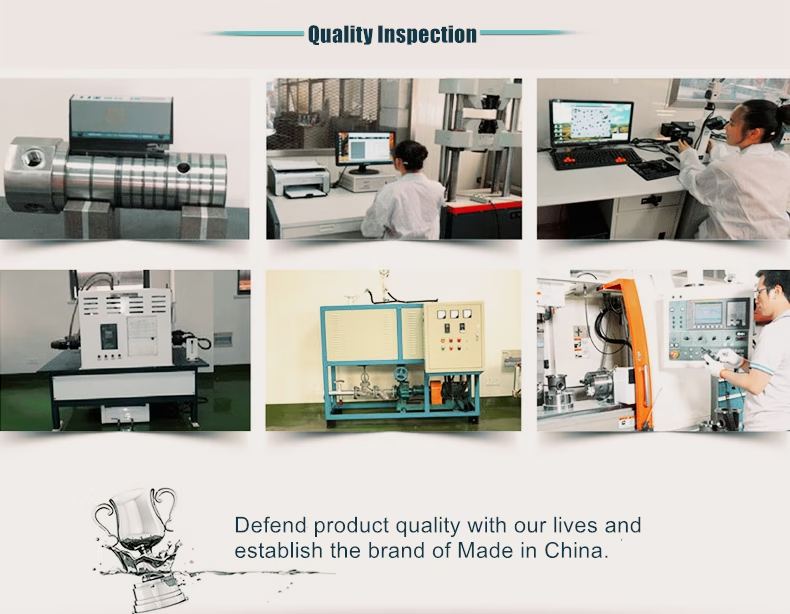
Our factory uses:
- CNC turning centers
- Precision grinding machines
- Dynamic balancing equipment
- Leak testing systems
- Coordinate measurement inspection
These processes ensure consistent sealing performance.
Material Traceability
Low-quality raw materials create inconsistent seal behavior.
We maintain traceability for:
- Carbon grades
- Carbide materials
- Stainless steel components
- Elastomers
- Springs
This is especially important for OEM replacement rotary unions.
Real Application Testing
Laboratory testing alone is not enough.
Our engineering team validates rotary unions under:
- High RPM operation
- Thermal cycling
- Continuous-duty conditions
- Pressure fluctuation
- Steam applications
- Contaminated coolant environments
Field testing provides critical data for seal optimization.
Warning Signs of Rotary Union Seal Failure
Operators should never ignore early leakage symptoms.
Early intervention prevents catastrophic equipment damage.
Common warning signs include:
- Small external leakage
- Increased operating temperature
- Unusual vibration
- Squealing noise
- Pressure instability
- Coolant contamination
- Steam escaping near the seal area
Ignoring these symptoms often leads to:
- Spindle damage
- Bearing failure
- Production downtime
- Expensive machine repairs
How to Extend Rotary Union Seal Life
Maintain Proper Fluid Filtration
Contamination destroys sealing surfaces.
Recommended practices:
- Install proper filters
- Clean systems regularly
- Monitor coolant quality
Avoid Dry Running
Always ensure:
- Fluid flow before startup
- Stable pressure
- Proper venting
Monitor Operating Temperature
Excessive heat accelerates wear.
Install:
- Temperature monitoring
- Flow sensors
- Pressure alarms
Use Correct Seal Materials
Never use general-purpose seals in specialized applications.
Engineering evaluation matters.
Install Rotary Unions Correctly
Improper installation causes:
- Misalignment
- Face distortion
- Bearing overload
Always follow the manufacturer’s installation procedures.
Why Industrial Customers Choose Experienced Rotary Union Manufacturers
In rotary union manufacturing, seal engineering experience matters far more than appearance.
Customers increasingly require:
- Longer service life
- Stable high-speed performance
- Reduced downtime
- Lower maintenance costs
- OEM-compatible replacements
Achieving these goals requires:
- Precision machining capability
- Real sealing expertise
- Material engineering knowledge
- Application-specific design experience
At our factory, we work closely with customers to analyze:
- Failure modes
- Operating conditions
- Seal wear patterns
- Media compatibility
- Thermal behavior
This allows us to recommend rotary union solutions that perform reliably in real production environments, not just in catalogs.
Engineering Excellence: 10 Years of Manufacturing Defenses
In the B2B industrial market, anyone can buy a CNC machine and copy an engineering drawing. However, true reliability is forged through a decade of material science research, field testing, and strict quality control.
Over the past 10 years, our facility in China has transformed from a component vendor into an engineering partner for global distributors and manufacturing plants. Here is how our production capability eliminates common seal vulnerabilities:
 Optical Lapping to Sub-Micron Precision
A mechanical seal is only as good as its flatness. Our factory floor is equipped with advanced monochromatic light testing stations and automated optical lapping machines. Specifically, we lap our sealing faces to a flatness threshold of 2 light bands (0.58 microns). This extreme precision ensures that the capillary fluid film remains completely stable across the entire face, preventing leakage even under pressures up to 70 Bar.
Direct Metallurgy and Forging Control
We do not use cheap, porous cast metals for our rotors or housings. All high-pressure and high-speed shafts are CNC-machined in-house from solid billets of forged 304/316 stainless steel or aircraft-grade aluminum. This eliminates hidden porosity defects that can cause pressure drops and seal face distortion under load.
100% Dynamic Multi-Parameter Testing
We do not perform statistical sampling. Every single rotary union that leaves our shipping dock must pass a comprehensive dynamic test run. We mount the units on our custom test benches, spin them to their maximum rated RPM, subject them to maximum operating pressures, and run them through thermal cycles. If a union shows even a microscopic drop of moisture or anomalous vibration, it is rejected and torn down for analysis.
Cost-Effective, High-EEAT Brand Alternatives
Industrial facilities face constant pressure to lower their MRO (Maintenance, Repair, and Operations) expenses. Our product range offers direct, drop-in replacements for major international brands like Deublin, Maier, Rotoflux, and Kadant. Because you are buying directly from the source factory, you receive identical or upgraded material specifications (such as our premium 355 series for steam) at a fraction of the cost, accompanied by fast global delivery.
Conclusion: Stop Swapping Parts, Start Solving Problems
A rotary union seal failure should never be treated as an unavoidable cost of doing business. It is a clear symptom of an underlying system issue—whether it is an unmonitored dry running condition, an unresolved shaft misalignment, or an incorrect selection of seal materials.
By understanding the mechanics of seal damage, you can transition your maintenance team from reactive troubleshooting to proactive system engineering.
With ten years of manufacturing experience, an elite team of fluid dynamics engineers, and a world-class production facility in China, we are ready to help you eliminate leaks and protect your spindles and drums. Stop purchasing short-lived components from middlemen. Partner with a source factory that designs for reliability.
Are you dealing with chronic seal failures on your production line? Contact our engineering team today with your current model numbers and operating parameters. We will provide a comprehensive technical analysis and an optimized cross-reference quote within 24 hours.
