It seems we can’t find what you’re looking for. Perhaps searching can help.
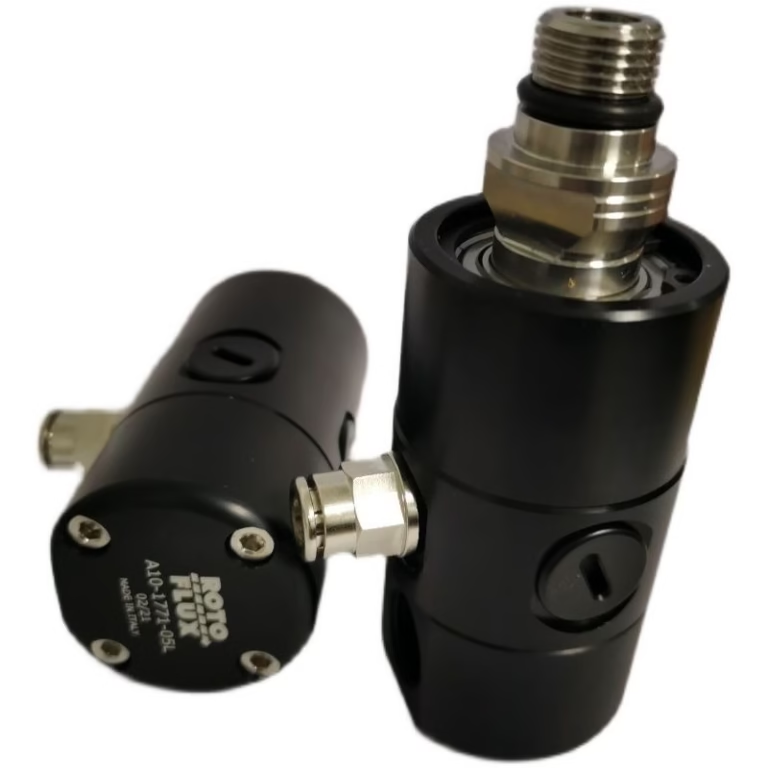
A rotary joint seal plays a vital role in ensuring the efficient and leak-free transfer of media—such as water, air, steam, oil, or coolant—between stationary and rotating components. Found in machinery like paper mills, printing presses, steel manufacturing lines, and CNC machines, these seals are engineered to maintain dynamic sealing performance under high-speed, temperature, and pressure conditions.
Rotary joint seals, also known as rotary union seals or mechanical seals, prevent fluid leakage while allowing rotation between connected parts. They form the heart of any rotary union or swivel joint assembly, directly determining its durability and efficiency.
In every rotary union or rotary joint, the seal functions as a barrier between the fluid passage and the external environment. It compensates for wear, pressure variations, and misalignment while maintaining a tight seal between rotating and stationary surfaces.
Seal Face Design – Usually composed of a hard material (like silicon carbide or tungsten carbide) against a softer mating surface (like carbon graphite or PTFE) to ensure low friction and minimal wear.
Spring Mechanism – Applies axial force to maintain contact between seal faces under changing conditions.
Elastomers and O-rings – Ensure secondary sealing, typically made of Viton, NBR, EPDM, or FKM materials.
Media Compatibility – Seals are selected based on whether the fluid is hydraulic oil, steam, coolant, or air.
A properly configured rotary joint seal plays a crucial role in fluid system performance. It effectively prevents leakage during continuous or high-pressure operation. Moreover, the correct seal alignment and material pairing significantly extend the service life of the rotary union. In addition, this optimized configuration enhances overall system reliability and operational stability. As a result, the rotary joint continues to perform efficiently even under the most demanding industrial applications.
Depending on operating conditions and design requirements, rotary joint seals come in several types:
Mechanical Face Seals: The most common design, featuring two precision faces pressed together.
Lip Seals: Suitable for lower pressure and high-speed air rotary joints.
Labyrinth Seals: Non-contact sealing for high-speed, low-pressure operations.
O-Ring Seals: Used as secondary sealing elements in multi-passage rotary unions.
PTFE Seals: Excellent for chemical resistance and low-friction performance.
Each seal type offers unique performance characteristics optimized for specific temperature, pressure, and media compatibility.
A rotary joint seal is not just a small component—it is the key to keeping entire fluid systems efficient, safe, and long-lasting. Whether you need seals for steam, oil, or coolant transfer, choosing a reliable and high-quality rotary joint seal ensures stable performance, minimizes maintenance costs, and improves machine uptime.
Explore our complete selection of rotary joint seals today and discover how advanced sealing technology can enhance your system’s performance.
It seems we can’t find what you’re looking for. Perhaps searching can help.
Deublin Rotary Union Replacement Manufacturer | Custom Solutions Available