Rotary Union HSN Code Guide 2026 | Customs Classification, HSN, HTS & Tariff Codes
When importing or exporting rotary unions, one of the most common questions from purchasing managers, customs brokers, and international distributors is: “What is the correct HSN Code for a rotary union?” Although the question sounds simple, the answer often depends on the product’s design, function, construction, and the customs regulations of the destination country.
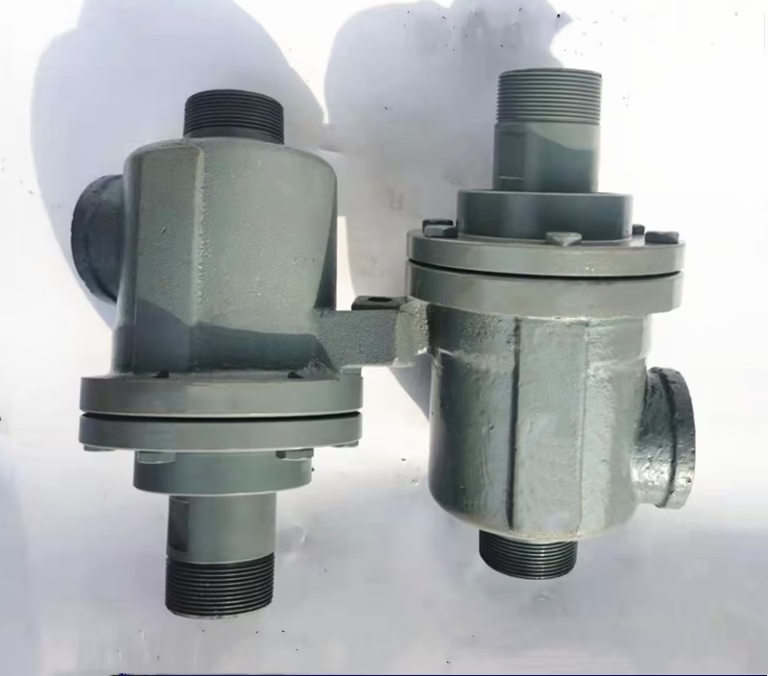
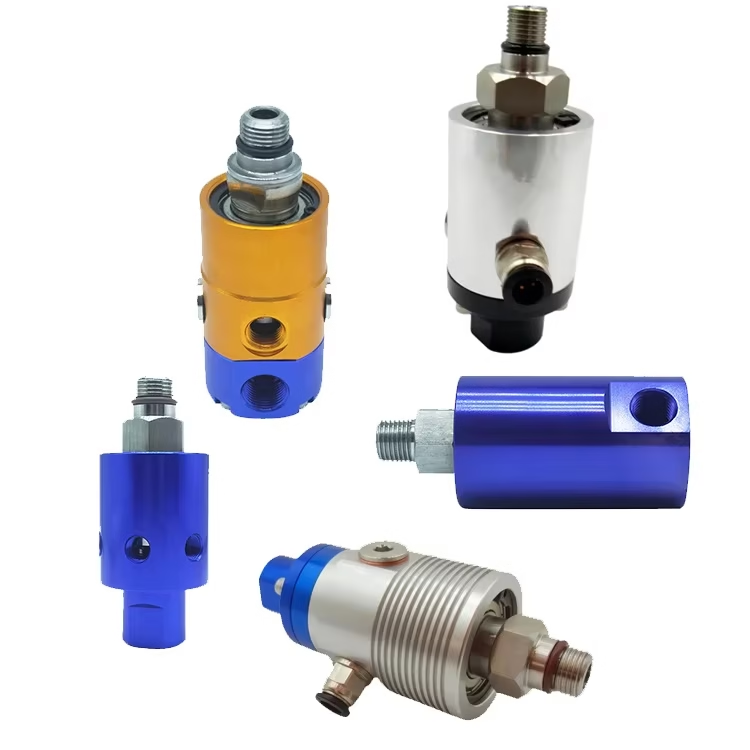
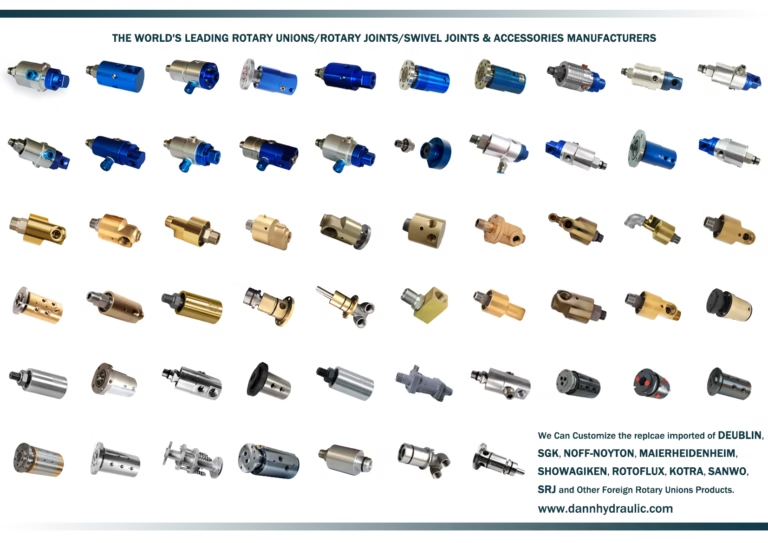
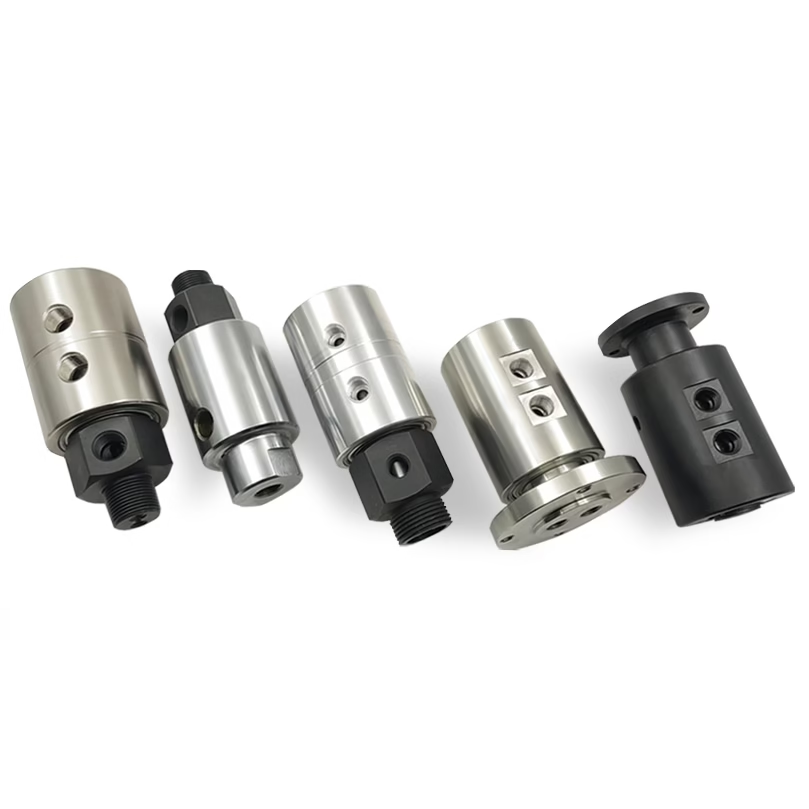
A rotary union—also known as a rotary joint or rotary swivel joint—is used to transfer fluids, steam, air, hydraulic oil, coolant, or vacuum between stationary piping and rotating equipment. Because it combines sealing technology with mechanical transmission, customs authorities may classify similar products differently if the product description is incomplete.
Incorrect HS classification may result in:
- Customs clearance delays
- Additional import duties
- Incorrect tariff calculations
- Documentation amendments
- Shipment inspections
- Unexpected logistics costs
As a professional rotary union manufacturer in China with years of international export experience, Dann Hydraulic has supplied rotary unions to customers across North America, Europe, Southeast Asia, the Middle East, and South America. Our export team works closely with freight forwarders and customs brokers to prepare commercial invoices, packing lists, certificates of origin, and technical documentation for smooth customs clearance.
This guide explains how rotary unions are commonly classified, compares HSN codes used in different countries, highlights common declaration mistakes, and shares practical recommendations based on real export experience.
What Is an HSN Code?
The Harmonized System (HS) Code is an internationally standardized commodity classification system developed by the World Customs Organization (WCO).
More than 200 countries use the Harmonized System as the basis for:
- Customs declarations
- Import and export regulations
- Tariff calculations
- Trade statistics
- Duty assessments
- Free trade agreements
The first six digits of an HSN Code are internationally standardized, while many countries extend the code to eight, ten, or more digits for domestic tariff purposes.
For example:
| System | Example |
|---|---|
| HSN Code | 8481.80 |
| HSN Code (India) | 84818090 |
| HTS Code (United States) | 8481809050 |
| TARIC Code (European Union) | Country-specific extension |
Although these extended codes differ by country, they all originate from the same international Harmonized System.
Why Does the Correct HSN Code Matter?
Many buyers assume that customs classification is simply an administrative requirement. In reality, the HS code influences nearly every aspect of international trade.
Using the wrong classification can lead to:
Higher Import Duties
Some tariff classifications carry significantly higher import taxes than others.
A rotary union incorrectly declared as a general machinery part may attract a different duty rate than one classified as a fluid control device.
Customs Inspection
When product descriptions do not match the declared HS code, customs officers may request:
- Product drawings
- Technical specifications
- Product catalogs
- Material certificates
- Product photographs
- Operating principles
This review process often extends customs clearance.
Shipping Delays
Incorrect commodity codes frequently trigger customs reviews, delaying production schedules and equipment installation projects.
For industries such as paper mills, steel plants, and machine tool manufacturing, even a short delay may interrupt maintenance planning or factory commissioning.
Trade Compliance
Accurate HS classification supports compliance with:
- Import licenses
- Preferential tariff agreements
- Country-of-origin documentation
- Export control requirements
Professional exporters, therefore, verify HS codes before every shipment rather than relying on previous declarations.
What Is the HSN Code for Rotary Unions?
There is no single universal HSN code that applies to every rotary union worldwide.
However, many industrial rotary unions are commonly classified under:
HS Code 8481.80
Taps, cocks, valves, and similar appliances for pipes, boiler shells, tanks, vats, or the like.
Because rotary unions regulate and transfer pressurized media between stationary and rotating components, customs authorities in many countries consider them part of this category.
Typical products include:
- Hydraulic rotary unions
- Steam rotary joints
- Pneumatic rotary unions
- Coolant rotary unions
- Water rotary unions
- Thermal oil rotary joints
- Multi-passage rotary unions
- Single-passage rotary unions
However, the final classification always depends on:
- Product structure
- Operating function
- Internal sealing mechanism
- Number of passages
- Application
- National customs interpretation
For specialized products, customs authorities may classify them differently.
Therefore, exporters should always confirm the applicable tariff code with local customs brokers before shipment.
Rotary Union HSN Code by Country
Although the first six digits are internationally standardized, different countries may extend the classification for statistical or tariff purposes.
The following table summarizes commonly used classifications for industrial rotary unions.
| Country/Region | Common Classification* | Description |
|---|---|---|
| United States | 8481809050 | Other valves and similar appliances |
| China | 8481809090 | Industrial valves and related products |
| India | 84818090 | Other valves |
| European Union | 84818099 | Other appliances |
| United Kingdom | 84818099 | Industrial valve products |
| Canada | Based on HS 8481.80 | National tariff extension |
| Australia | Based on HS 8481.80 | National tariff extension |
*Note: Classification may vary depending on product design, customs interpretation, and national tariff schedules. Importers should always verify the applicable code with the customs authority or licensed customs broker in the destination country.
How Customs Authorities Classify Rotary Unions
Unlike standard pipe fittings, rotary unions combine several engineering functions into one compact component.
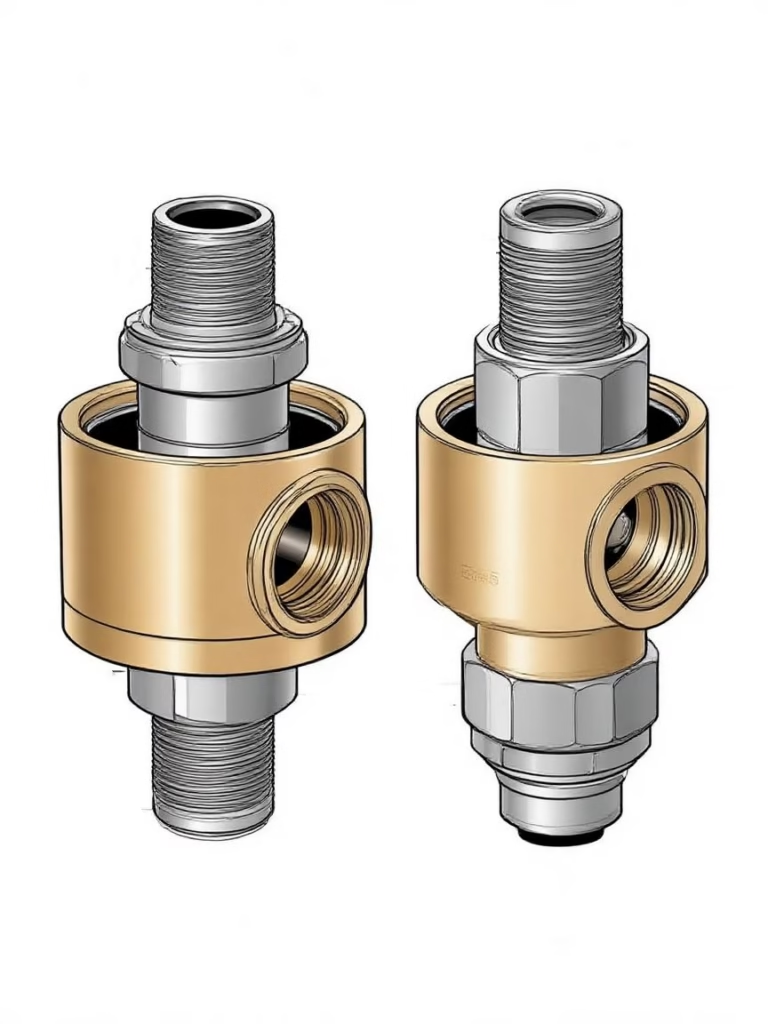
A typical rotary union includes:
- Precision mechanical seals
- Bearings
- Rotating shafts
- Fluid passages
- Housing
- Connection threads or flanges
Because of this hybrid structure, customs officers generally examine the product’s primary function rather than its individual components.
In our export projects, customs authorities typically focus on the following questions:
Does the product transfer pressurized media?
Hydraulic oil, steam, compressed air, coolant, water, vacuum, or thermal oil all indicate a fluid-transfer application.
Does the product connect stationary piping to rotating equipment?
The rotary sealing function is a key characteristic that distinguishes rotary unions from conventional valves.
Is the product designed specifically for industrial machinery?
Industrial rotary unions are commonly used on:
- CNC machining centers
- Paper machines
- Steel processing lines
- Plastic extrusion equipment
- Textile machinery
- Rubber and tire manufacturing lines
- Wind turbines
- Rotary indexing tables
- Packaging machinery
The more accurately these functions are described on commercial documents, the easier customs authorities to determine the appropriate classification.
Rotary Union, Rotary Joint, or Rotary Swivel—Do They Use the Same HSN Code?
These three terms are often used interchangeably in industrial markets, but their application may vary by industry or manufacturer.
| Product Name | Typical Use |
|---|---|
| Rotary Union | Hydraulic, pneumatic, coolant, water, oil, vacuum |
| Rotary Joint | Steam, thermal oil, and paper mills |
| Rotary Swivel | Hydraulic systems, construction equipment, cranes |
Although the terminology differs, customs authorities generally focus on the product’s function rather than its commercial name. In many cases, these products fall under the same HS chapter, provided they perform the same fluid-transfer role.
Industry Applications and Customs Considerations
Rotary unions are used in a wide range of industrial applications where fluids, gases, or thermal media must pass from a stationary source into rotating equipment. While the product function remains similar, how it is described on shipping documents can vary by industry.
Providing a clear and technically accurate product description helps customs officers understand the intended application and reduces the likelihood of additional inspections.
Paper and Pulp Industry
Paper machines rely heavily on steam rotary joints to transfer steam into drying cylinders while continuously removing condensate. These rotary joints operate under elevated temperatures and are designed for long service life in demanding production environments.
Typical customs description:
Steam Rotary Union for Paper Machine Drying Cylinder
Recommended supporting documents:
- Product drawing
- Pressure rating
- Steam temperature specification
- Material certificate
Steel and Metal Processing
Steel mills use rotary unions to deliver cooling water, hydraulic oil, compressed air, or lubrication media to continuously rotating rolls and spindles.
Typical customs description:
Hydraulic Rotary Union for Steel Rolling Equipment
Common media include:
- Cooling water
- Hydraulic oil
- Emulsion
- Lubricating oil
CNC Machine Tools
Modern machining centers frequently use high-speed rotary unions to supply coolant through the spindle during drilling, milling, and tapping operations.
Typical customs description:
High-Speed Coolant Rotary Union for CNC Spindle
Supporting documentation should specify:
- Maximum rotational speed
- Operating pressure
- Coolant type
- Connection size
Plastic Extrusion and Injection Molding
Rotary unions are widely installed on extruders, rotating molds, and injection molding machines to circulate cooling water or thermal oil.
Typical customs description:
Water Rotary Union for Plastic Extrusion Line
or
Thermal Oil Rotary Joint for Extrusion Equipment
Rubber and Tire Manufacturing
Tire presses and rubber processing equipment commonly use steam rotary joints and thermal oil rotary unions for temperature control.
Recommended description:
Textile Machinery
Rotary unions provide cooling water or compressed air to rotating rollers in textile production lines.
Typical description:
Rotary Union for Textile Finishing Machine
Food and Beverage Equipment
Stainless steel rotary unions are often selected for hygienic production environments where corrosion resistance is essential.
Typical customs description:
Stainless Steel Rotary Union for Food Processing Equipment
Wind Energy and Heavy Equipment
Large multi-passage rotary unions are widely used in wind turbines, offshore equipment, cranes, and hydraulic systems.
Typical description:
Multi-Passage Hydraulic Rotary Union
How Customs Authorities Evaluate Rotary Unions
One of the most common misconceptions among exporters is that customs officers classify products solely by their commercial name.
In reality, customs authorities evaluate a combination of technical and commercial information.
During our export projects, the following information is frequently reviewed:
Product Function
What does the product do?
For rotary unions, the primary function is to transmit fluid, gas, or thermal media between stationary and rotating components.
Operating Medium
The declared working medium often helps customs officers understand the product category.
Examples include:
- Hydraulic oil
- Water
- Steam
- Coolant
- Compressed air
- Vacuum
- Thermal oil
- Lubricating oil
Construction
Customs may review whether the product includes:
- Bearings
- Mechanical seals
- Multiple fluid passages
- Precision-machined housing
- Threaded or flanged connections
Machinery Application
Instead of simply writing “Rotary Union,” provide a more informative description to improve customs efficiency.
For example:
- Rotary Union for CNC Machine Tool
- Steam Rotary Joint for Paper Machine
- Hydraulic Rotary Union for Steel Rolling Mill
These descriptions provide valuable context without changing the product classification.
Common HS Code Declaration Mistakes
Many customs delays are caused by incomplete or inaccurate product descriptions rather than the HS code itself.
Below are some of the most common issues encountered in international trade.
Mistake 1 – Using Only the Product Name
Poor description:
Rotary Union
Better description:
High-Pressure Hydraulic Rotary Union for Industrial Machinery
The second description provides the product function and intended application, making classification easier.
Mistake 2 – Declaring as a General Machinery Part
Some exporters describe rotary unions simply as:
Machine Parts
This broad description lacks technical detail and may lead customs officers to request additional documentation.
A functional description is generally preferable.
Mistake 3 – Copying an Existing HS Code Without Verification
Different countries may extend the Harmonized System differently.
Using the same tariff code for every destination market can create unnecessary compliance risks.
Always verify local tariff schedules before shipment.
Mistake 4 – Omitting Technical Specifications
Including basic technical information helps customs authorities understand the product.
Useful information includes:
- Working pressure
- Operating temperature
- Connection type
- Number of passages
- Seal material
- Media type
Mistake 5 – Using Inconsistent Product Descriptions
The commercial invoice, packing list, and product catalog should describe the product consistently.
For example:
Commercial Invoice:
Hydraulic Rotary Union
Packing List:
Rotary Swivel
Catalog:
Rotary Joint
Although these names are similar, inconsistent terminology may trigger questions during customs review.
Maintaining consistent product descriptions across all export documents improves efficiency.
Real Export Experience
At Dann Hydraulic, we export rotary unions to customers in Europe, North America, Southeast Asia, the Middle East, and South America.
Over the years, we have learned that successful customs clearance depends not only on selecting an appropriate HS code but also on preparing complete technical documentation.
For many shipments, customers request additional documents such as:
- Commercial Invoice
- Packing List
- Certificate of Origin
- Product Datasheet
- Technical Drawing
- Material Certificate
- Pressure Test Report
- Product Photos
Providing these documents before customs requests them often shortens clearance time and reduces communication delays.
Case Study 1 – Hydraulic Rotary Union for the United States
A customer importing hydraulic rotary unions for automated manufacturing equipment initially planned to declare the products using a general machinery parts classification.
After reviewing the product structure and application, we recommended updating the product description to clearly identify it as a hydraulic rotary union used for fluid transmission.
The shipment proceeded through customs without additional technical inquiries, helping the customer avoid unnecessary delays.
Case Study 2 – Steam Rotary Joint for Europe
A paper mill customer required replacement steam rotary joints during a scheduled maintenance shutdown.
Because production downtime was critical, all shipping documents—including technical specifications and product drawings—were prepared before dispatch.
The shipment completed customs clearance efficiently, allowing the customer to install the replacement components within the planned maintenance window.
Case Study 3 – Multi-Passage Rotary Union for Southeast Asia
A systems integrator ordered custom multi-passage rotary unions for an automated assembly line.
The products combined hydraulic oil, compressed air, and electrical signal transmission in a single assembly.
To support customs classification, our export team prepared:
- Product drawings
- Media descriptions
- Technical specifications
- Application details
- Commercial documentation
Providing complete information from the outset helped simplify the customs review process.
Best Practices for Commercial Invoice Descriptions
Instead of using short or generic descriptions, exporters should identify the product’s function and application.
Examples include:
| Recommended Description | Suitable Application |
|---|---|
| Hydraulic Rotary Union for Industrial Machinery | Hydraulic systems |
| Steam Rotary Joint for Paper Machine | Paper industry |
| High-Speed Coolant Rotary Union for CNC Spindle | Machine tools |
| Multi-Passage Rotary Union for Automation Equipment | Robotics and automation |
| Stainless Steel Rotary Union for Food Processing Equipment | Hygienic production |
These descriptions provide customs officers with sufficient technical context while remaining concise and professional.
Required Export Documents for Rotary Union Shipments
Accurate customs classification is only one part of a successful international shipment. Preparing complete export documentation is equally important for reducing customs delays and ensuring smooth import procedures.
Depending on the destination country and customer requirements, rotary union shipments may require the following documents:
Commercial Invoice
The commercial invoice should include:
- Accurate product description
- Quantity
- Unit price
- Country of origin
- Declared HS code
- Incoterms
- Manufacturer information
Avoid vague descriptions such as “Machine Parts.” Instead, describe the product according to its actual function.
Example:
High-Pressure Hydraulic Rotary Union for Industrial CNC Equipment
Packing List
A packing list typically contains:
- Package dimensions
- Gross weight
- Net weight
- Number of cartons or pallets
- Item quantities
Consistent product descriptions between the commercial invoice and packing list help prevent customs questions.
Certificate of Origin
Many customers request a Certificate of Origin to support preferential tariff treatment under applicable trade agreements.
Technical Datasheet
A technical datasheet should clearly state:
- Working pressure
- Maximum rotational speed
- Operating temperature
- Connection type
- Media compatibility
- Seal materials
- Bearing configuration
Providing these details demonstrates product professionalism and helps customs officers understand the product’s intended use.
Product Drawings
Engineering drawings are particularly useful for custom rotary unions or multi-passage rotary unions.
Typical drawings include:
- Overall dimensions
- Thread specifications
- Flow passages
- Installation dimensions
Material Certificates
Material certificates may be required for industries such as:
- Food processing
- Pharmaceutical manufacturing
- Chemical processing
- Marine engineering
Common materials include:
- Stainless steel
- Carbon steel
- Brass
- Aluminum alloy
Why Importers Choose Dann Hydraulic
Selecting a rotary union supplier involves more than comparing prices. Reliable manufacturers provide engineering support, stable production quality, and professional export documentation.
At Dann Hydraulic, we support customers throughout the entire procurement process—from product selection to customs documentation and after-sales technical assistance.
Manufacturing Experience
We specialize in the design and production of rotary unions for industrial fluid transfer applications.
Our product portfolio includes:
- Hydraulic rotary unions
- Steam rotary joints
- Coolant rotary unions
- Pneumatic rotary unions
- Vacuum rotary unions
- Thermal oil rotary unions
- Multi-passage rotary unions
- Custom-engineered rotary unions
Precision Manufacturing
Each rotary union is manufactured using CNC machining equipment and undergoes dimensional inspection before assembly.
Key quality control procedures include:
- Precision machining inspection
- Dynamic balance verification (where applicable)
- Pressure testing
- Leakage testing
- Assembly inspection
- Final appearance inspection
OEM and Replacement Solutions
Many customers require replacements compatible with existing equipment.
We provide replacement solutions for numerous internationally recognized rotary union brands while also supporting OEM customization based on customer drawings or samples.
Global Export Support
Our export team assists customers by preparing:
- Commercial invoices
- Packing lists
- Product catalogs
- Technical drawings
- Certificates of origin
- Product specifications
- Customs documentation
This documentation helps reduce communication time with customs brokers and freight forwarders. Technical Support
Selecting the correct rotary union depends on several operating conditions, including:
- Working medium
- Operating pressure
- Rotational speed
- Temperature
- Installation method
- Number of passages
Our engineering team helps customers evaluate these parameters before production begins.
Frequently Asked Questions
1. What is the HSN code for a rotary union?
Industrial rotary unions are commonly classified under HS Code 8481.80, although the complete tariff code varies by country. Importers should verify the final classification with local customs authorities.
2. Is the HS code the same worldwide?
No. The first six digits are internationally standardized, but countries often extend the code with additional digits for national tariff purposes.
3. Is an HSN code different from an HS code?
Yes. The HS Code is the international six-digit standard, while the HSN Code is India’s extended version used for customs and GST purposes.
4. Does the United States use HSN codes?
No. The United States uses the Harmonized Tariff Schedule (HTS), which extends the international HS Code.
5. Can hydraulic and steam rotary unions use the same HS code?
In many cases, yes. However, classification depends on product construction, function, and local customs regulations.
6. What information should appear on the commercial invoice?
A professional invoice should include:
- Product name
- Product application
- Quantity
- Unit price
- Country of origin
- HS code
- Manufacturer information
7. Can customs request technical drawings?
Yes. For specialized industrial equipment, customs authorities may request technical drawings or product specifications.
8. Does material affect HS classification?
Generally, the primary function is more important than the material itself, although material information may still be required during customs review.
9. Can a multi-passage rotary union have a different classification?
It may, depending on its structure and integrated functions. Products that combine fluid transfer with electrical or signal transmission may require additional classification review.
10. Should the replacement rotary union use the same HSN code as the original brand?
Usually, yes, provided the products perform the same function and share similar construction. Final classification remains subject to local customs interpretation.
11. What is the best product description for customs?
A clear functional description is recommended, for example:
Hydraulic Rotary Union for Industrial Machinery
This is generally more informative than simply stating “Machine Parts.”
12. Can incorrect HS codes delay customs clearance?
Yes. Incorrect or incomplete declarations frequently result in customs inspections, requests for additional documents, or shipment delays.
13. Does Dann Hydraulic provide export documentation?
Yes. We provide standard export documentation, including commercial invoices, packing lists, technical specifications, and other supporting documents as required.
14. Can rotary unions be customized?
Yes. Custom designs are available for different operating pressures, temperatures, media, rotational speeds, and connection configurations.
15. How can I confirm the correct HSN code for the rotary union?
The safest approach is to consult your local customs authority or licensed customs broker before importing. Providing complete technical specifications and product descriptions helps ensure accurate classification.
Conclusion
Determining the correct HSN code for a rotary union is more than selecting a number from a tariff schedule. Customs authorities evaluate the product’s function, construction, intended application, and supporting documentation before confirming its classification.
Whether you are importing hydraulic rotary unions, steam rotary joints, coolant rotary unions, or custom multi-passage designs, providing complete technical information and accurate product descriptions can significantly improve customs efficiency and reduce unnecessary delays.
At Dann Hydraulic, we combine manufacturing expertise with practical export experience to support customers throughout the entire purchasing process—from product selection and engineering consultation to export documentation and after-sales service.
If you are uncertain about the appropriate customs classification for your rotary union project, our technical team can help review your application and provide supporting product information before shipment.