
What Types of Water Rotary Unions Are Used in Industrial Applications? Factory Manufacturing Experience and Practical Engineering Insights
Water rotary unions are widely used in industrial equipment where cooling water or process water must transfer continuously between stationary piping and rotating machinery. Although water rotary unions may appear simple externally, their actual operating environments are often far more demanding than many users expect. As a factory manufacturer producing rotary unions for CNC machines, steel processing lines, paper mills, rubber equipment, textile machinery, and cooling systems, we have learned that selecting the correct types of water rotary unions depends heavily on:
- operating pressure
- rotational speed
- water quality
- temperature
- installation conditions
- sealing requirements
- continuous operating time
In real industrial applications, improper use of all types of water rotary unions frequently causes leakage, seal wear, corrosion, vibration problems, and unexpected downtime.
This article explains the most common types of water rotary unions from a practical manufacturing and engineering perspective based on our factory production experience.
What is a Water Rotary Union?
A water rotary union is a mechanical sealing device designed to transfer cooling water or process water from a stationary source into rotating equipment.
The rotary union allows continuous fluid flow while the machine rotates.
Water rotary unions are commonly used in:
- CNC machining centers
- rolling mills
- continuous casting equipment
- plastic machinery
- rubber processing equipment
- paper machinery
- textile equipment
- printing systems
- cable manufacturing equipment
Although water is considered a relatively simple medium, water rotary unions often fail because of environmental and operating conditions rather than basic design defects.
In our factory experience, cooling water systems can become extremely challenging when combined with:
- contamination
- high rotational speed
- unstable temperature
- vibration
- poor filtration
- continuous operation
Key Components
| Component | Function |
|---|---|
| Housing | Contains internal seals and bearings; typically made from stainless steel, brass, or aluminum. |
| Shaft / Rotor | The rotating part connected to the machine shaft, enabling media transfer. |
| Seals | Prevent leakage between stationary and rotating components; made of carbon graphite, silicon carbide, or ceramic. |
| Bearings | Support rotation and reduce friction; may be ball bearings or non-bearing types. |
Why Water Rotary Union Selection Matters
Many users assume that all types of water rotary unions perform similarly.
However, different industrial applications require completely different rotary union structures.
For example:
- a low-speed cooling drum
- a high-speed CNC spindle
- a steel mill cooling system
- a paper machine drying cylinder
All require different sealing technologies and material configurations.
Incorrect selection often causes:
- premature seal wear
- leakage
- bearing damage
- corrosion
- excessive maintenance cost
In many customer cases, we discovered that rotary union failure was caused by improper application matching rather than manufacturing defects.
Single Passage Water Rotary Unions
Single-passage rotary unions are the most common type used in industrial cooling systems.
These rotary unions transfer one flow path of cooling water.
They are widely used in:
- cooling rollers
- simple rotating shafts
- low-speed machinery
- cooling drums
Because of their relatively simple structure, single-passage water rotary unions are easier to maintain and manufacture.
However, sealing quality remains extremely important.
In our manufacturing experience, many low-cost rotary unions fail because of poor seal machining precision rather than design problems.
For single-passage applications operating continuously, we pay special attention to:
- seal face flatness
- shaft concentricity
- bearing fit
- surface roughness
Even small machining deviations may significantly shorten seal life.
Multi-Passage Water Rotary Unions
Multi-passage water rotary unions contain multiple independent flow channels inside one rotary body.
These designs are commonly used in:
- complex automation systems
- steel processing equipment
- multi-zone cooling systems
- integrated rotary machinery
Manufacturing multi-passage rotary unions is considerably more difficult than producing single-passage designs.
One major engineering challenge involves preventing internal leakage between adjacent passages.
During production, internal machining tolerance becomes extremely important.
In compact designs, maintaining stable separation between multiple water channels requires high machining precision and careful seal arrangement.
In some customized projects, we also integrate air passages and hydraulic passages with cooling water channels.
This significantly increases manufacturing complexity.
High-Speed Water Rotary Unions
High-speed water rotary unions are widely used in CNC machining centers and spindle cooling systems.
Compared with low-speed equipment, high-speed applications create completely different engineering challenges.
At elevated rotational speeds, the rotary union experiences:
- increased friction
- heat generation
- vibration sensitivity
- seal wear
- balancing requirements
In our field experience, many spindle cooling rotary unions fail because of vibration and coolant contamination rather than pressure alone.
For high-speed applications, we focus heavily on:
- dynamic balancing
- lightweight rotating structures
- balanced mechanical seals
- precision bearing arrangement
Even a small imbalance may damage spindle bearings and destroy sealing surfaces.
Low-Speed Heavy-Duty Water Rotary Unions
Some industrial systems operate at low rotational speed but under harsh conditions.
Examples include:
- steel mills
- continuous casting machinery
- paper production lines
In these environments, rotary unions often experience:
- contamination
- elevated temperature
- scale buildup
- unstable operating conditions
Durability becomes more important than compact design.
For heavy-duty applications, we frequently use:
- reinforced bearings
- corrosion-resistant materials
- larger seal structures
- heavy-duty housings
to improve service life.
Stainless Steel Water Rotary Unions
Water quality directly affects rotary union durability.
In corrosive environments or poor water conditions, stainless steel rotary unions significantly improve service life.
Stainless steel rotary unions are commonly used in:
- food processing systems
- chemical cooling systems
- marine environments
- paper mills
- humid operating conditions
In many customer projects, standard carbon steel rotary unions developed internal corrosion after prolonged exposure to untreated cooling water.
After upgrading to stainless steel structures, leakage problems were greatly reduced.
Water Quality Problems We Frequently See
One of the biggest misunderstandings in industrial cooling systems is underestimating water quality.
In actual field applications, poor water quality causes many rotary union failures.
Common problems include:
- suspended metal particles
- rust contamination
- mineral scaling
- insufficient filtration
- chemical corrosion
Contaminated cooling water scratches seal faces and accelerates bearing wear.
In some returned products, severe seal damage occurred because of abrasive particles circulating continuously inside the system.
This is especially common in steel processing and machining environments.
Seal Technology for Water Rotary Unions
Seal performance determines rotary union reliability.
Different operating conditions require different sealing structures.
For standard cooling systems, mechanical seals provide stable leakage control. In
contaminated environments, wear-resistant sealing materials improve durability.
For high-speed spindle systems, balanced seals reduce friction and heat generation.
In our manufacturing experience, improper seal selection remains one of the most common causes of leakage.
Many users focus only on external dimensions while ignoring actual sealing requirements.
Manufacturing Process of Water Rotary Unions
Reliable water rotary unions depend heavily on machining precision and quality control.
In our factory, production typically includes:
CNC Machining
Housing and shaft components are machined with precision CNC equipment.
Critical dimensions include:
- seal cavity tolerance
- shaft concentricity
- bearing fit
- internal flow channel accuracy
Seal Face Lapping
Mechanical seal faces require careful lapping to achieve stable sealing performance.
Poor surface flatness often causes startup leakage.
Dynamic Balancing
High-speed rotary unions require balancing tests to reduce vibration.
Balancing directly affects seal life and bearing stability.
Pressure and Leakage Testing
Before shipment, rotary unions undergo:
- hydrostatic pressure testing
- rotational testing
- leakage inspection
- visual quality inspection
For some export projects, customers request continuous operation simulation testing.

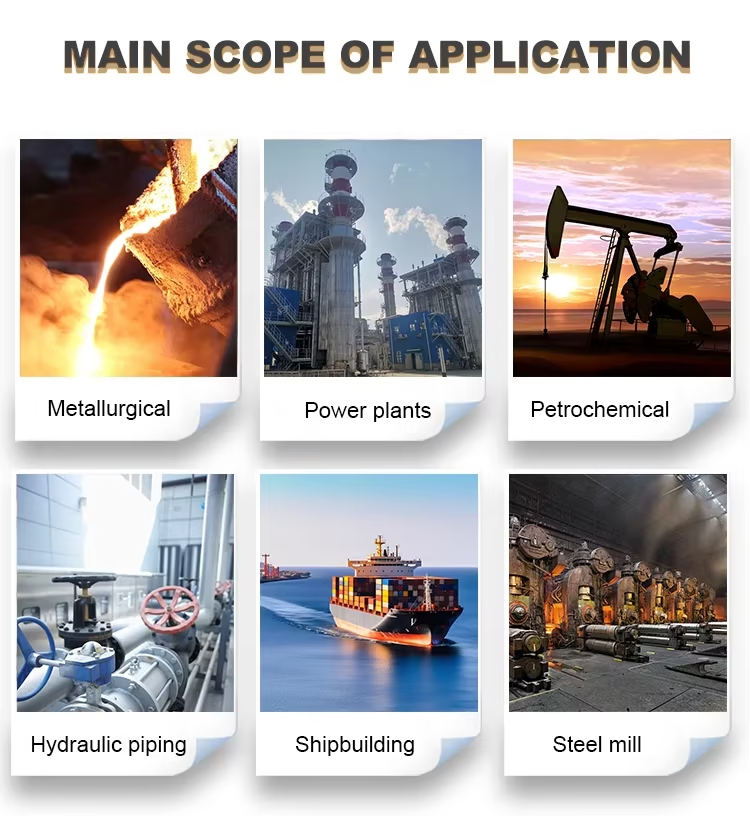
Water types of rotary Unions Applications
Water Rotary Unions are precision mechanical devices used to transfer liquids (usually water or other coolants, hydraulic fluid, and other media) between fixed pipes and rotating components. They play a key role in many industrial areas, ensuring that fluids can be transferred from a stationary system to a rotating system without leakage. Here are some typical applications of water rotary joints:
Steel industry
In steel plants, high-pressure water rotary joints are widely used in various equipment, such as continuous casting machines, rolling machines, etc., for conveying cooling water to control temperature and prevent overheating.
Paper industry
The paper-making process requires a large amount of water to treat the pulp, and also requires the use of water rotary joints to transfer steam or hot water during the drying and cooling phases.
Printing industry
On printing presses, swivel joints are used to provide coolant to heated rollers to maintain optimal operating temperature, thereby improving printing quality and efficiency.
Plastics and rubber processing
In these industries, water rotary joints are used in mold cooling systems to help cure materials quickly and reduce production cycle time.
Food processing
In food processing equipment, water rotary joints can be used for water supply during cleaning and, in some cases, for cooling systems in food processing machines.
Machine tools
Numerical control machine tools (CNC) often require coolant to cool cutting tools and workpieces, and high-speed rotating joints are used to ensure a continuous supply of coolant.
Textile industry
In dyeing machines and other textile equipment, water rotary joints are used to provide hot water or chemical solutions to facilitate the dyeing and post-treatment of fibers.
Chemical industry
Additionally, in processes involving chemical reactions or material transfer, engineers use corrosion-resistant water rotary joints to ensure the safe and reliable transfer of liquid media.
Marine and Aviation
Moreover, in these two areas, engineers employ swivel joints to ensure the efficient transfer of fuel, lubricants, or coolants to engines and other rotating components.
Agricultural irrigation
Some advanced irrigation systems may use rotary joints to achieve more flexible and efficient water distribution.
When selecting a water rotary joint suitable for a specific application, factors such as working pressure, speed, temperature range, and media type need to be considered. In addition, as different industrial environments have different requirements for materials and designs, customized solutions are becoming increasingly important. For example, for high-temperature or high-pressure applications, special seals and reinforced bearings may be required to ensure long-term stable operation. For the need for multi-channel transmission of different media, you can choose a multi-channel rotary joint to meet the needs. In summary, the design flexibility of the water rotary joint enables it to adapt to a variety of complex industrial requirements.
Installation and Maintenance Best Practices
Proper installation and maintenance ensure reliability:
Installation Guidelines
Align the union precisely to avoid stress.
Use compatible fittings and torque to manufacturer specs.
Test for leaks before full operation.
Maintenance Protocols
Inspect seals and bearings quarterly.
Lubricate bearings with FDA-approved grease if applicable.
Replace worn seals (average lifespan: 1–3 years).
Flush systems to prevent mineral buildup.
Troubleshooting Common Issues
Leaks: Check seal alignment or replace worn components.
Excessive Noise: Inspect bearings for damage.
Overheating: Ensure adequate fluid flow and clean channels.
Common Water Rotary Union Failure Problems
After years of production and repair analysis, several common failure patterns appear repeatedly.
Dry Running
Mechanical seals require lubrication from water flow.
Dry operation quickly damages sealing surfaces.
Contaminated Water
Particles inside cooling systems scratch seal faces and increase wear.
Excessive Vibration
Machine vibration transfers directly into the rotary union.
This often causes abnormal seal wear.
Incorrect Installation
Improper alignment creates side loading and unstable seal contact.
Thermal Expansion
In continuous operating systems, temperature fluctuation may affect internal clearance and sealing stability.
Why Factory Experience Matters
In industrial rotary union manufacturing, theoretical design alone is not enough.
Real operating environments often differ greatly from catalog conditions.
As a factory manufacturer, we continuously improve our products based on:
- customer feedback
- returned product analysis
- field failure investigation
- long-term operating data
- sealing performance observation
For example, in one steel mill cooling system project, repeated seal leakage occurred because contaminated cooling water damaged standard seal materials.
After redesigning the seal combination and improving bearing protection, service life improved significantly.
This type of engineering improvement comes from practical manufacturing experience rather than standard catalog data.
How to Choose the Correct Water Rotary Union
When selecting a water rotary union, industrial users should evaluate:
- rotational speed
- operating pressure
- water quality
- temperature
- operating cycle
- contamination level
- installation space
- maintenance conditions
Choosing the correct structure greatly improves reliability and reduces maintenance costs.
Future Trends in Water Rotary Union Technology
Industrial equipment continues moving toward:
- higher rotational speed
- automated operation
- compact machinery
- longer continuous operation
As a result, water rotary unions are evolving toward:
- improved sealing technology
- better corrosion resistance
- compact multi-passage structures
- lower leakage rates
- higher balancing precision
Manufacturers must continuously improve machining and testing capabilities to meet these demands.
Conclusion
Water rotary unions are critical components in industrial cooling and fluid transfer systems.
Although their basic function appears simple, long-term reliability depends heavily on machining precision, seal technology, balancing control, material selection, and practical operating experience.
As a factory manufacturer with years of production experience, we continue improving our types of water rotary unions designs based on real industrial applications and customer feedback.
For industrial users, selecting a manufacturer with genuine engineering knowledge and manufacturing capability is often the key to achieving stable performance and reducing long-term maintenance problems.