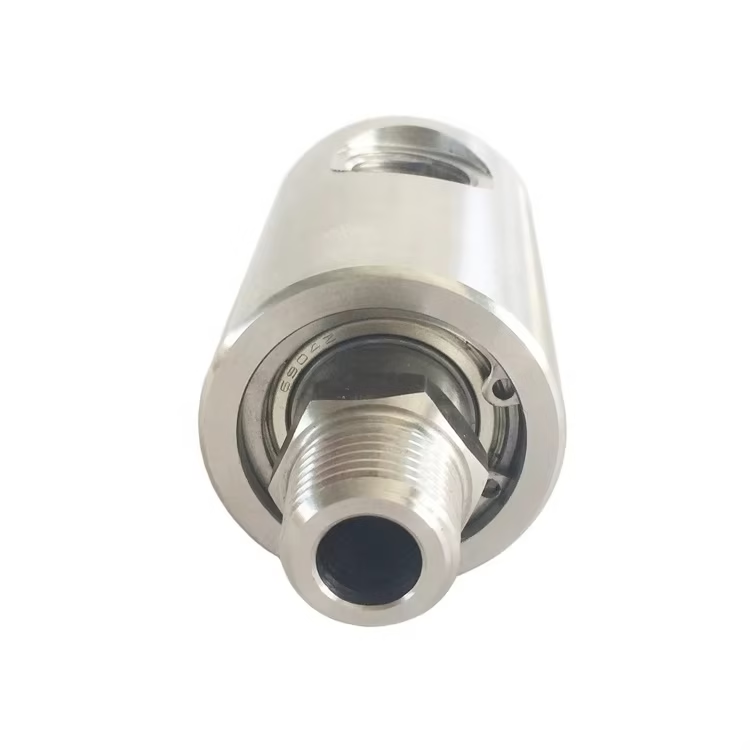

Can a Non-OEM Rotary Union Replace a Deublin or Maier Model?
In industrial fluid transfer systems, rotary unions are critical components used in CNC machine tools, paper mills, steel processing equipment, rubber machinery, printing systems, and many other rotating applications. For decades, international brands such as Deublin and Maier have been widely used across industrial markets because of their mature sealing technology and reliable product performance. However, in recent years, many industrial users have started looking for reliable Rotary Union Replacement due to:
- long delivery times
- high procurement costs
- discontinued models
- maintenance difficulties
- urgent equipment downtime
- customized operating requirements
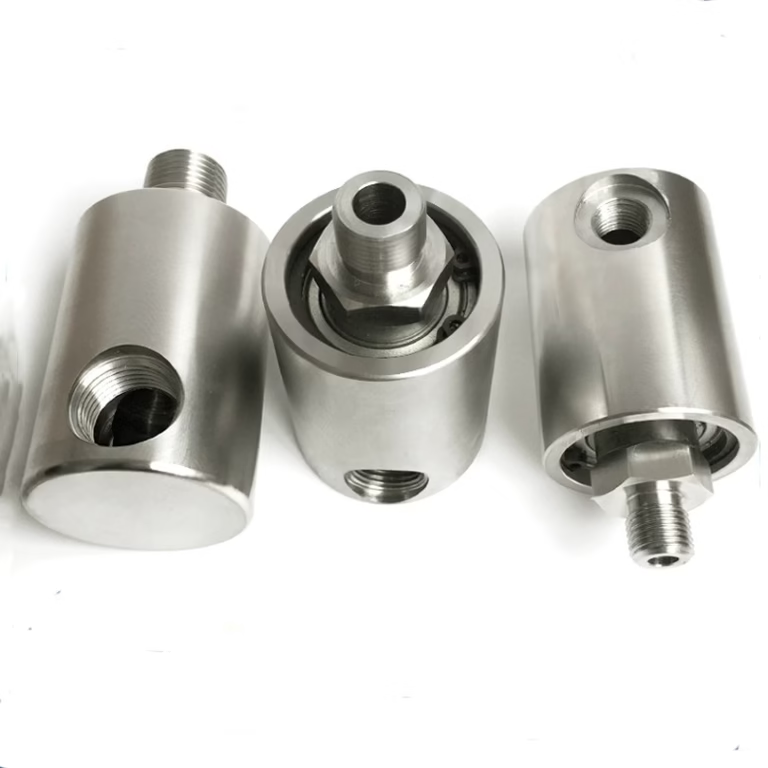
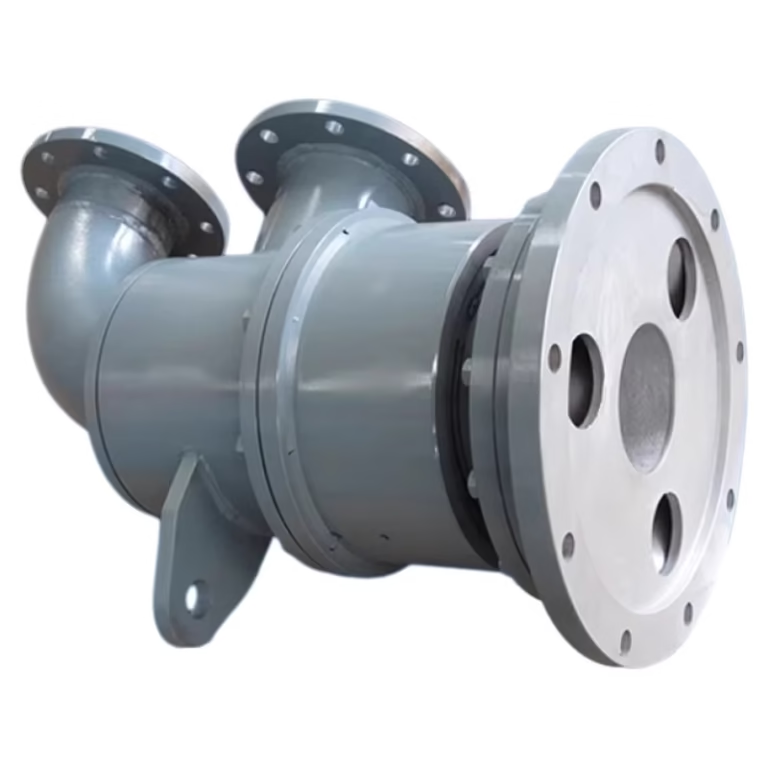
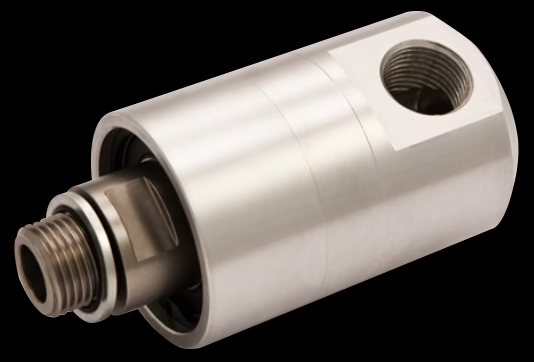
As a factory manufacturer specializing in rotary unions and rotary joints, we have produced compatible replacement rotary unions for various Deublin and Maier models used in different industries.
Through years of manufacturing and field application experience, we have learned that successful replacement is not simply copying dimensions. Real replacement capability depends on understanding sealing technology, machining precision, balancing requirements, operating conditions, and the common failure problems found in actual industrial applications.
One of the most common questions we receive from maintenance engineers and purchasing managers is:
“Can you provide a rotary union that directly replaces a Deublin or Maier model?”
The short answer is yes.
The longer answer depends on understanding the operating conditions, installation dimensions, media type, pressure, speed, and the service life expectations of the application.
As a rotary union manufacturer with years of production and replacement experience, we have supplied equivalent rotary unions for customers in the paper, steel, plastics, rubber, textile, machine tool, and packaging industries.
Many of these projects began with the same challenge: an imported rotary union had failed, spare parts were expensive, or delivery times had become unacceptable.
This article explains our practical experience in manufacturing replacement rotary unions compatible with Deublin and Maier models.
Why Many Customers Look for Deublin and Maier Replacement Rotary Unions
In many industrial facilities, imported rotary unions remain in operation for years under demanding conditions.
However, customers often face several practical problems.
Long Lead Times
For urgent maintenance projects, waiting weeks or months for imported rotary unions can stop production lines completely.
This problem is especially serious in:
- steel mills
- paper production lines
- CNC machining workshops,
- rubber manufacturing plants
Many customers contact us when equipment downtime becomes too costly.
High Replacement Cost
Imported rotary unions can become expensive, especially for large equipment operating multiple rotary joints simultaneously.
In some cases, customers seek replacement solutions to reduce long-term maintenance costs while maintaining stable performance.
Discontinued or Older Models
Some older Deublin and Maier rotary union models are difficult to source.
Customers operating older machinery often require customized replacements based on original dimensions and operating conditions.
This type of replacement work requires detailed manufacturing and engineering experience.
Custom Operating Conditions
In many real applications, original standard rotary unions may not perfectly match local operating conditions.
For example:
- coolant contamination
- unstable pressure
- excessive vibration
- elevated temperature
- poor maintenance conditions
may shorten service life significantly.
In some projects, we redesign seal combinations and bearing structures according to actual operating environments.
Replacement Is Not Simply Copying Dimensions
One of the biggest misunderstandings in the market is assuming that rotary union replacement only requires matching threads and dimensions.
In reality, dimensional compatibility is only one part of the process.
During manufacturing, we focus heavily on:
- seal structure
- rotating balance
- internal flow path
- bearing arrangement
- material selection
- leakage control
- operating pressure
- rotational speed
In high-speed spindle applications, even small dimensional errors or balancing problems may cause:
- vibration
- seal wear
- coolant leakage
- spindle damage
- bearing failure
This is why real manufacturing experience matters.
Our Experience Manufacturing Replacement Rotary Unions
As a rotary union factory manufacturer, we have supplied replacement rotary unions for customers in:
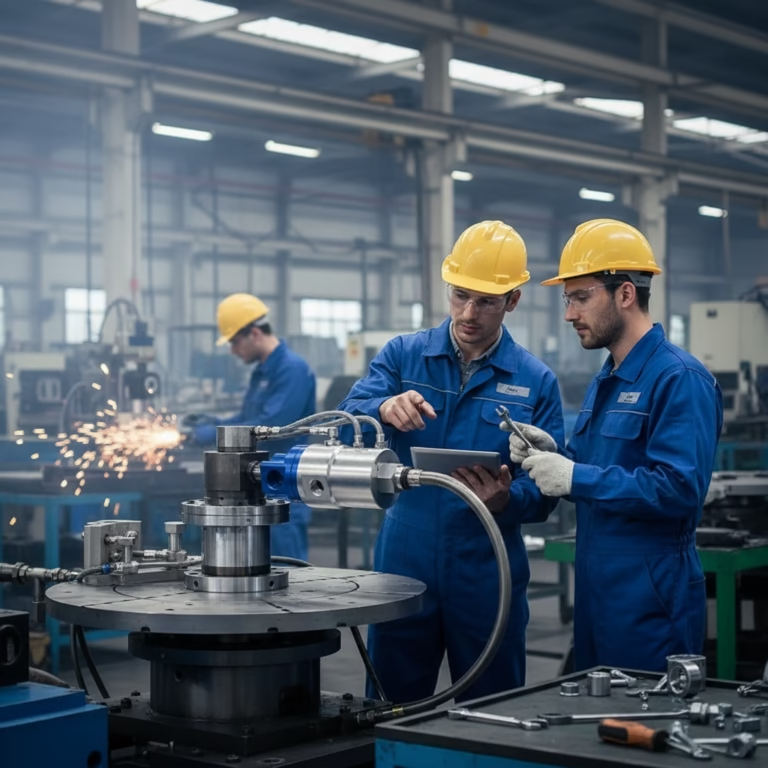
- CNC machining centers
- steel processing lines
- paper mills
- printing machinery
- textile equipment
- rotary indexing tables
- rubber and plastic machinery
Over the years, we have analyzed many failed imported rotary unions returned by customers.
These failed units helped us understand the real causes behind leakage and premature failure.
In many cases, the original rotary union itself was not defective.
The actual problems included:
- contaminated coolant
- spindle vibration
- improper installation
- pressure fluctuation
- dry running
- thermal expansion
Understanding these field problems allowed us to improve our replacement designs.
Seal Technology and Leakage Control
Seal performance is the core of every rotary union.
In our factory experience, seal selection must match the real operating environment instead of only catalog parameters.
For example:
High-Speed CNC Applications
In high-speed spindle coolant systems, balanced mechanical seals help reduce friction and heat generation.
At rotational speeds above 12,000 RPM, improper seal balancing may quickly destroy the seal faces.
We pay close attention to:
- seal face flatness
- spring pressure
- balancing structure
- concentricity tolerance
during production.
Steam and Thermal Oil Systems
Steam rotary unions face completely different challenges.
Thermal expansion often affects sealing stability.
In these applications, carbon graphite seals and heat-resistant sealing materials are commonly used.
Poor seal material selection frequently causes thermal cracking and leakage.
Contaminated Coolant Systems
In machining workshops, metal particles inside coolant systems often damage sealing surfaces.
For these environments, wear-resistant sealing combinations improve durability significantly.
Machining Precision Is Critical
Many users underestimate the importance of machining quality in replacement rotary unions.
Even when external dimensions match perfectly, poor machining precision may shorten service life dramatically.
In our production process, we focus on:
- shaft concentricity
- bearing fit tolerance
- seal cavity precision
- surface roughness
- thread accuracy
For high-speed rotary unions, dynamic balancing is especially important.
Without proper balancing, vibration damages both seals and spindle bearings.
Dynamic Balancing Experience
Dynamic balancing is one of the most overlooked areas in low-cost replacement rotary unions.
In spindle applications, imbalance directly affects:
- rotational stability
- seal wear
- bearing life
- spindle accuracy
We perform balancing tests for high-speed rotating components to improve operating stability.
In some customer projects, balancing optimization significantly increased rotary union service life compared with previously used products.
Pressure and Leakage Testing
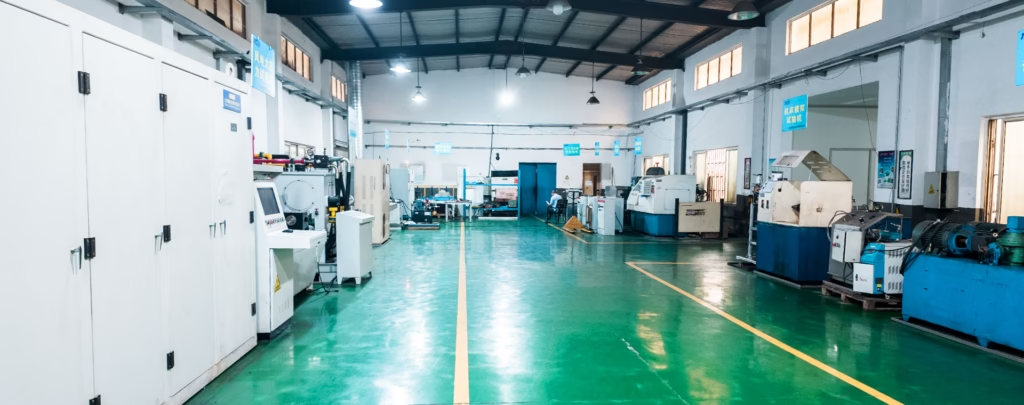
Every replacement rotary union manufactured in our factory undergoes testing before shipment.
Typical inspection procedures include:
- hydrostatic pressure testing
- air leakage testing
- rotational testing
- passage isolation inspection
- visual seal inspection
For some export projects, customers also request simulated operating tests under actual pressure and speed conditions.
These tests help identify instability before field installation.
How We Develop a Replacement Rotary Union
A successful replacement is not simply a matter of copying dimensions.
Our engineering process includes several steps.
Step 1: Original Model Identification
Customers provide:
- Nameplate photos
- Drawings
- Product codes
- Installation photos
We then identify the original design.
Examples include:
- Deublin 1109 Series
- Deublin 1115 Series
- Deublin 57 Series
- Deublin 902 Series
- Maier DX Series
- Maier H Series
Step 2: Operating Condition Analysis
We verify:
- Media type
- Pressure
- Temperature
- RPM
- Connection size
This ensures the replacement is suitable for actual working conditions.
Step 3: Internal Structure Evaluation
Two rotary unions may look identical externally while using completely different internal seal designs.
Our engineers evaluate:
- Mechanical seal structure
- Bearing arrangement
- Balance ratio
- Leakage control system
Step 4: Manufacturing and Testing
Each replacement rotary union undergoes:
- CNC machining inspection
- Pressure testing
- Dynamic balancing
- Leak testing
before shipment.
Practical Replacement Experience from Different Industries
Paper Mill Steam Rotary Union Replacement
A paper manufacturer experienced recurring leakage from imported steam rotary unions installed on dryer cylinders.
The original units had been operating for several years.
The plant faced long lead times for replacements.
After reviewing the dimensions and operating conditions, we supplied equivalent steam rotary unions using:
- Carbon graphite seal faces
- High-temperature bearings
- Stainless steel spring components
The installation required no modification to the existing machine.
The customer subsequently replaced additional units throughout the production line.
Steel Processing Line Application
A steel service center used rotary unions for roll cooling.
The original imported models suffered from contamination caused by poor water quality.
Our engineering team modified the seal arrangement and introduced additional protection features.
The result was improved service life and reduced maintenance frequency.
CNC Machine Tool Application
Several machine tool builders required replacements for through-spindle coolant rotary unions.
Critical requirements included:
- High speed
- Low leakage
- Compact design
Through optimization of seal geometry and bearing preload, the replacement units achieved stable operation at high rotational speeds.
Manufacturing Capabilities Behind Reliable Replacement Rotary Unions
Many suppliers claim they can replace imported rotary unions.
The difference lies in manufacturing capability.
Precision CNC Machining
Dimensional accuracy directly affects sealing performance.
Critical sealing surfaces are machined using precision CNC equipment and inspected throughout production.
Material Selection
Different applications require different materials.
Typical options include:
- Stainless steel
- Brass
- Carbon steel
- Aluminum alloys
Seal faces may utilize:
- Carbon graphite
- Silicon carbide
- Tungsten carbide
depending on operating conditions.
Bearing Selection
High-speed applications require careful bearing selection.
We use angular contact bearing configurations where operating conditions demand increased stability and load capacity.
Quality Control
Every batch undergoes:
- Dimensional inspection
- Pressure testing
- Rotation testing
- Leakage verification
before release.
Direct Replacement vs Customized Upgrade
In some cases, customers request a direct one-to-one replacement.
In others, a design upgrade provides better long-term performance.
Examples include:
- Improved seal materials
- Enhanced corrosion resistance
- Higher RPM capability
- Increased pressure rating
- Extended service intervals
Rather than simply copying an existing design, the goal is to solve the underlying operating problem.
Information Needed for Replacement Evaluation
To identify a suitable replacement quickly, customers should provide:
- Original brand and model number
- Working medium
- Operating pressure
- Temperature
- Rotational speed
- Connection dimensions
- Installation photos
The more information available, the more accurately the replacement can be engineered.
Why Many Customers Choose Factory Manufacturers Instead of Trading Companies
Many customers today prefer working directly with factory manufacturers because real production capability matters in industrial applications.
As a manufacturer, we can provide:
- customized dimensions
- seal material modification
- thread adaptation
- OEM replacement production
- short lead times
- technical support
- flexible production quantities
Most importantly, factory manufacturers understand actual machining and sealing problems.
This helps customers solve application issues more efficiently.
OEM Replacement Capability
We manufacture replacement rotary unions compatible with various international brands according to customer requirements.
For many projects, customers provide:
- drawings
- photos
- sample products
- machine specifications
Based on this information, we analyze:
- sealing structure
- material configuration
- bearing arrangement
- operating conditions
before starting production.
In some cases, we also improve the original structure according to customer feedback from actual operation.
What Actually Determines Rotary Union Performance
When evaluating a non-OEM replacement, engineers should focus on the following internal performance factors.
Seal Face Flatness and Balance Design
Seal face flatness is measured in microns, yet it directly determines:
-
Leakage rate
-
Heat generation
-
Seal wear pattern
Balanced seal designs reduce contact force at high pressure, improving:
-
High-speed stability
-
Seal life
-
Energy efficiency
A visually identical seal may perform drastically worse if flatness or balance is poorly controlled.
Bearing Preload and Alignment Tolerance
Proper bearing preload ensures:
-
Axial stability
-
Minimal runout
-
Consistent seal face contact
Poor preload control leads to:
-
Shaft wobble
-
Uneven seal wear
-
Noise and vibration
High-quality replacement rotary unions control bearing preload during assembly—not after installation.
Internal Flow Path Optimization
Internal flow paths influence:
-
Pressure loss
-
Turbulence
-
Localized heat buildup
Optimized flow paths reduce:
-
Seal face temperature
-
Media cavitation risk
-
Long-term erosion
This is especially critical in high-pressure coolant and high-speed CNC spindle applications.
Deublin ↔ Alternative Rotary Union Comparison Table
The following comparison table is intended to support engineering-level evaluation when replacing Deublin rotary unions with technically equivalent alternatives. Final selection should always be based on actual operating conditions.
| Technical Parameter | Deublin OEM Rotary Union | Qualified Alternative Rotary Union | Evaluation Focus |
|---|---|---|---|
| Functional Design | Monoflow / Duoflow | Monoflow / Duoflow | Must be identical |
| Application Type | CNC spindle, rotary table, ball screw cooling | Same applications | Application match is critical |
| Seal Technology | Mechanical seal (carbon / SiC / TC) | Same seal principle | Not just material name |
| Seal Face Flatness | OEM controlled (micron-level) | Verified machining tolerance | Directly affects leakage |
| Seal Balance Design | Balanced or pressure-compensated | Equivalent balance structure | High-speed stability |
| Bearing Structure | Bearing-supported design | Bearing-supported design | Self-support ≠ bearing-supported |
| Bearing Preload | Factory preset | Controlled during assembly | Prevents runout |
| Max Continuous RPM | OEM rated | Equal or higher | Continuous, not peak |
| Working Pressure | OEM rated | Equal or higher | At working RPM |
| Media Compatibility | Coolant / oil / air / water | Same media range | Verify additives |
| Internal Flow Path | Optimized OEM design | Optimized equivalent | Pressure drop & heat |
| Installation Method | Shaft-mounted / housing-fixed | Same method | Avoid structural load transfer |
Professional Insight: When Cost-Effective Alternatives Perform Reliably
From real-world field experience, cost-effective non-OEM rotary unions often perform reliably when two conditions are met.
1. The Supplier Understands the Original Application
A technically competent supplier will ask questions such as:
-
What machine is the rotary union installed on?
-
What is the continuous operating RPM?
-
What media and coolant type are used?
-
Is the system monoflow or duoflow?
Suppliers who only reference a model number without an application context introduce risk.
2. Operating Conditions Are Transparently Communicated
Accurate replacement depends on honest and complete information, including:
-
Actual working pressure (not just nominal)
-
Continuous vs intermittent operation
-
Installation orientation
-
Maintenance expectations
Trustworthiness principle:
Rotary union replacement is a technical collaboration, not a transactional purchase.
FAQ
Can a non-OEM rotary union really replace a Deublin model?
Yes. A non-OEM rotary union can replace a Deublin model if functional design, seal technology, bearing structure, and pressure–speed limits are technically equivalent. Visual similarity alone is not sufficient.
Is replacing a Deublin or Maier rotary union risky?
Replacement becomes risky only when selection is based on price or appearance instead of application data. When engineering parameters are verified correctly, replacement is a proven and widely used practice.
What is the biggest mistake when replacing a rotary union?
The most common mistake is assuming that identical thread size and port configuration guarantee identical performance. Internal seal balance, bearing preload, and flow design matter far more.
Do alternative rotary unions have a shorter service life?
Not necessarily. Service life depends on operating conditions, seal quality, and bearing stability—not brand name. Many alternatives perform reliably when operated within safe margins.
What information should I provide to ensure a safe rotary union replacement?
You should provide:
-
Machine type and application
-
Continuous RPM
-
Working pressure
-
Media type and temperature
-
Installation orientation
Transparent communication significantly reduces replacement risk.
Future Trends in Replacement Rotary Unions
Industrial users increasingly focus on:
- lower maintenance cost
- faster delivery
- customized solutions
- localized technical support
As a result, demand for reliable replacement rotary unions continues to grow.
However, industrial customers now care more about actual manufacturing capability rather than simply a low price.
Manufacturers must improve:
- machining precision
- sealing technology
- balancing capability
- testing standards
- engineering support
to remain competitive.
Conclusion
Replacing a Deublin or Maier rotary union requires far more than copying dimensions.
Reliable replacement performance depends on practical engineering experience, machining precision, seal technology, balancing control, and understanding real industrial operating conditions.
As a factory manufacturer specializing in rotary unions and rotary joints, we continue improving our manufacturing process and engineering knowledge based on real customer applications and field experience.
For industrial users, choosing a replacement rotary union supplier with genuine production capability and practical experience is often the key to reducing downtime, controlling maintenance costs, and improving long-term equipment reliability.