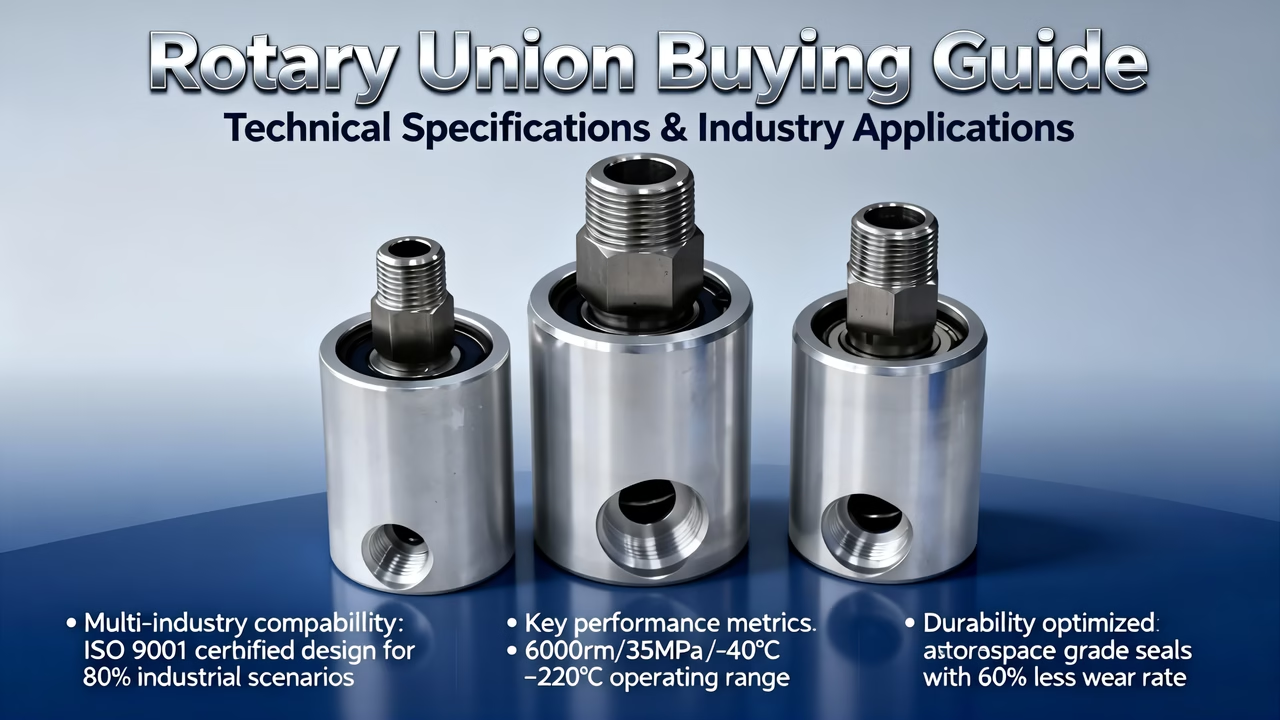
The Complete Rotary Union Buying Guide: How Engineers and Buyers Choose the Right Rotary Union in 2026
Choosing a rotary union is rarely as simple as matching a part number. While catalogs list specifications such as pressure, temperature, thread size, and rotational speed, these values only tell part of the story. In real industrial applications, a rotary union must perform reliably under changing operating conditions, contaminated environments, varying maintenance practices, and continuous production schedules. Over the years, our engineering team has spoken with hundreds of Rotary Union Buying Guide, maintenance managers, purchasing specialists, OEM designers, and equipment manufacturers. One pattern appears repeatedly: the rotary union that failed was not always poorly manufactured—it was often the wrong design for the application.
For example, two paper mills may use the same drying cylinder but operate with different steam pressures and condensate recovery systems. Two CNC machining centers may have identical spindle speeds but use different coolant filtration systems. Even something as simple as poor shaft alignment or pressure fluctuation can dramatically shorten the life of a rotary union.
That is why buying a rotary union should never begin with a catalog page alone. It should begin with understanding the operating environment, production goals, maintenance capabilities, and long-term ownership costs.
This guide is based not only on engineering principles but also on our experience as a rotary union manufacturer supplying OEM equipment builders, industrial distributors, and maintenance contractors worldwide. Rather than focusing only on technical specifications, we will explain the practical questions buyers should ask before placing an order, common mistakes to avoid, and the manufacturing details that often determine whether a rotary union lasts six months or several years.
Whether you are replacing an existing rotary union, designing a new machine, or evaluating suppliers for a large procurement project, this guide will help you make a more informed decision.
Why Buying the Right Rotary Union Matters
A rotary union is a relatively small component compared with the overall cost of industrial equipment, yet its performance can influence production efficiency, maintenance costs, product quality, and machine availability.
When a rotary union fails unexpectedly, the consequences extend beyond replacing a single component.
A leaking rotary union may cause:
- Production downtime
- Product contamination
- Hydraulic pressure loss
- Cooling system failure
- Steam leakage
- Increased energy consumption
- Premature bearing damage
- Higher maintenance costs
In continuous production industries such as steel manufacturing, paper production, plastic processing, or automated machining, even one hour of unexpected downtime may cost significantly more than the rotary union itself.
For this reason, experienced engineers increasingly evaluate rotary unions based on total lifecycle value rather than initial purchase price.
What We Have Learned from Manufacturing Rotary Unions
As a manufacturer, we inspect not only new products but also failed rotary unions returned by customers for analysis. These returned units provide valuable information about how rotary unions perform under real operating conditions.
One of the most important lessons is that failures are often caused by system conditions rather than defects in the rotary union itself.
Some of the most common issues we observe include:
Incorrect Media Selection
Customers occasionally install a rotary union designed for clean cooling water into systems carrying abrasive coolant or contaminated hydraulic oil.
Although the pressure rating may be correct, abrasive particles gradually damage the seal faces and bearings.
The result is premature leakage.
Excessive Shaft Runout
Many users replace the rotary union several times before discovering that the rotating shaft itself is worn.
Even a high-quality mechanical seal cannot compensate for excessive shaft movement.
During technical evaluations, checking shaft runout often reveals the true source of repeated failures.
Pressure Spikes
Hydraulic systems rarely operate at perfectly stable pressure.
Rapid pressure fluctuations create additional loads on seal faces and bearings.
In these applications, selecting a rotary union with an adequate safety margin often provides substantially longer service life.
Poor Installation Practices
One surprisingly common issue is pipe stress.
Rigid piping connected directly to the rotary union can introduce unwanted radial loads during operation.
Over time, these loads damage bearings and accelerate seal wear.
Simple piping improvements frequently solve recurring leakage problems without changing the rotary union itself.
Rotary Union Is More Than a Standard Replacement Part
Many buyers begin their search with an existing part number.
For example:
- “We need a replacement for a Deublin rotary union.”
- “Can you supply an equivalent model?”
- “Do you have the same dimensions?”
While dimensional compatibility is important, experienced manufacturers ask additional questions before recommending a replacement.
These questions typically include:
- What media is flowing through the rotary union?
- Has the operating pressure changed?
- Has machine speed increased?
- Is leakage occurring at the seal or bearing?
- Has the equipment been upgraded?
- Are there contamination issues?
- How long did the previous rotary union last?
The answers often reveal opportunities to improve performance rather than simply duplicate the original design.
For example, we have worked with customers replacing imported rotary unions that originally lasted less than one year in highly contaminated environments. Instead of manufacturing an exact copy, we modified the sealing arrangement, upgraded the bearing configuration, and selected more wear-resistant materials. The replacement solution achieved a significantly longer service interval without requiring changes to the customer’s equipment.
This application-focused approach is one of the biggest differences between purchasing from a manufacturer with engineering capability and buying solely from a catalog distributor.
The First Step Before Buying: Understand Your Application
Every rotary union application can be described using five fundamental operating conditions.
Before requesting a quotation, buyers should gather the following information.
1. Working Media
The type of media determines much of the rotary union’s internal design.
Common examples include:
- Hydraulic oil
- Cooling water
- Steam
- Thermal oil
- Compressed air
- Vacuum
- Cutting coolant
- Nitrogen
- Chemical fluids
Each medium has different lubrication characteristics, corrosion potential, and sealing requirements.
2. Operating Pressure
Pressure affects:
- Seal loading
- Housing strength
- Bearing selection
- Mechanical seal design
Buyers should specify:
- Normal operating pressure
- Maximum pressure
- Pressure spikes
- Safety factor requirements
3. Rotational Speed
Higher rotational speed generates:
- More friction
- Higher operating temperatures
- Increased balancing requirements
- Greater bearing loads
Providing the maximum RPM allows manufacturers to recommend an appropriate sealing configuration.
4. Operating Temperature
Temperature influences material selection throughout the rotary union.
Different seal materials perform differently under:
- Low-temperature outdoor environments
- Hot water systems
- Steam applications
- Thermal oil circulation
Ignoring temperature is one of the leading causes of shortened seal life.
5. Installation Environment
Finally, consider the surrounding operating environment.
Questions include:
- Is dust present?
- Is the machine outdoors?
- Is corrosion likely?
- Does vibration occur?
- Is the rotary union exposed to washdown procedures?
- Is maintenance performed regularly?
These practical details often determine which bearing protection and sealing arrangements are most appropriate.
Factory Insight: Why Two “Identical” Rotary Unions Can Perform Very Differently
One misconception we encounter is the belief that all rotary unions with the same dimensions offer the same performance. In reality, two externally identical units may have completely different internal designs.
During manufacturing, several factors influence reliability:
- Seal Face Materials: Carbon graphite, silicon carbide, and tungsten carbide each have distinct wear characteristics. The best choice depends on the media, pressure, and operating temperature—not simply cost.
- Bearing Quality: Bearing precision affects rotational stability, heat generation, and service life, particularly in high-speed applications. Premium bearings may significantly extend maintenance intervals.
- Machining Accuracy: Even minor deviations in concentricity or surface finish can increase seal wear over time. Precision CNC machining and strict dimensional control are essential for stable operation.
- Assembly Procedures: Proper preload adjustment, torque control, and cleanliness during assembly directly influence sealing performance. Small assembly errors can lead to early leakage despite using high-quality components.
This is why experienced manufacturers focus on the complete engineering process rather than individual parts. A reliable rotary union is the result of careful design, material selection, precision manufacturing, and thorough testing working together.
What You’ll Learn in This Buying Guide
In the following sections, we’ll move beyond basic specifications and examine the questions that experienced engineers ask before selecting a rotary union.
We’ll cover:
- How to select the correct rotary union step by step
- How pressure, speed, temperature, and media affect performance
- Which seal materials are suitable for different industries
- How to evaluate a rotary union manufacturer instead of comparing prices alone
- The quality control processes that distinguish reliable suppliers
- Common purchasing mistakes that increase maintenance costs
- Real examples from factory production and customer applications
- Practical advice for OEM replacement projects, including alternatives to premium international brands
By the end of this guide, you’ll have a structured framework for selecting rotary unions that deliver reliable performance, lower lifecycle costs, and fewer unexpected failures—whether you’re sourcing a single replacement unit or planning procurement for an entire production line.
How to Choose the Right Rotary Union: An Engineer’s Step-by-Step Selection Process
Selecting a rotary union should never rely on a single specification. In our factory, every quotation begins with an engineering review because no two applications are the same. A rotary union that performs perfectly on one production line may fail quickly in another if the operating conditions differ.
Over the years, we have developed a practical evaluation process that helps customers avoid costly mistakes. Whether the project involves replacing an existing rotary union or designing a new machine, the same engineering principles apply.
Step 1 – Identify the Working Media
The first and most important question is:
What media will pass through the rotary union?
Many buyers assume pressure or rotational speed is the primary concern, but the working media often determines the sealing technology, internal materials, lubrication requirements, and overall service life.
Common media include:
- Hydraulic oil
- Cooling water
- Steam
- Thermal oil
- Compressed air
- Vacuum
- Cutting coolant
- Lubricating oil
- Nitrogen
- Chemical liquids
Each medium behaves differently during operation.
For example, clean hydraulic oil naturally lubricates seal faces, while dry compressed air provides almost no lubrication. Steam introduces thermal expansion and condensate, whereas abrasive cutting coolant continuously challenges the sealing surfaces.
Factory Example
A customer operating several CNC machining centers reported that their imported rotary unions were leaking after only eight months. The pressure and RPM were within specification, so the products initially appeared suitable.
After discussing the application, we learned that the coolant filtration system had been modified. Fine metal particles were circulating through the coolant and gradually damaging the mechanical seal faces.
Instead of supplying the same design, we recommended a more wear-resistant seal combination and improved contamination protection. The replacement units remained in service for substantially longer under the same operating conditions.
The lesson was clear:
Always evaluate the media—not just the specifications.
Step 2 – Determine the Actual Operating Pressure
Pressure ratings listed in catalogs usually indicate the maximum allowable operating pressure.
However, actual systems rarely operate under perfectly stable conditions.
Engineers should identify:
- Normal operating pressure
- Maximum pressure
- Pressure spikes
- Frequency of pressure changes
- Safety margin requirements
For example:
| Application | Typical Pressure |
|---|---|
| Cooling Water | 5–20 bar |
| Compressed Air | 6–10 bar |
| Hydraulic Systems | 70–350 bar |
| High-Pressure Hydraulic Equipment | 400 bar and above |
| Steam Systems | Depends on temperature and process requirements |
One of the most common mistakes is selecting a rotary union based only on average operating pressure while ignoring short-term pressure surges.
Repeated pressure spikes significantly increase seal loading and accelerate fatigue.
Our engineers typically recommend selecting a rotary union with sufficient operating margin rather than matching the minimum required specification.
Step 3 – Evaluate Rotational Speed (RPM)
Rotational speed influences nearly every internal component.
As speed increases:
- Friction increases.
- Bearing loads increase.
- Seal temperatures rise.
- Dynamic balancing becomes more critical.
- Machining accuracy becomes increasingly important.
Typical operating ranges include:
| Speed | Typical Equipment |
|---|---|
| Below 300 RPM | Steel mills, heavy machinery |
| 300–1,500 RPM | General industrial equipment |
| 1,500–5,000 RPM | Machine tools |
| Above 5,000 RPM | CNC spindles, precision automation |
Many buyers focus only on maximum RPM.
Our engineers also ask:
- Is the operation continuous or intermittent?
- Does acceleration occur frequently?
- Are there sudden speed changes?
- Does the machine frequently stop and restart?
These details affect bearing selection and seal configuration.
Step 4 – Understand Operating Temperature
Temperature affects almost every material inside a rotary union.
As the temperature rises:
- Seal materials become softer or harder.
- Bearings experience lubrication changes.
- Components expand.
- Mechanical clearances change.
Typical operating environments include:
| Media | Typical Temperature |
|---|---|
| Cooling Water | 10–80°C |
| Hydraulic Oil | 30–90°C |
| Hot Water | Up to 120°C |
| Steam | Up to 220°C or higher |
| Thermal Oil | Up to 300°C (depending on system design) |
High-temperature applications require specialized seal materials capable of maintaining stable contact pressure throughout continuous operation.
In steam applications, managing condensate is often just as important as selecting the rotary union itself.
Step 5 – Determine the Number of Passages
Modern automation equipment often transfers more than one medium simultaneously.
Instead of installing multiple rotary unions, many machines use multi-passage designs.
Examples include:
- Hydraulic oil + compressed air
- Cooling water + electrical slip ring
- Vacuum + air
- Coolant + lubrication oil
Selecting the proper passage configuration improves:
- Installation efficiency
- Machine reliability
- Space utilization
- Maintenance accessibility
Our engineering team frequently customizes passage arrangements for OEM equipment builders with limited installation space.
Step 6 – Evaluate Installation Conditions
Even the best rotary union performs poorly when installed incorrectly.
Before recommending a model, we normally ask customers about:
- Shaft diameter
- Connection type
- Available installation space
- Pipe support
- Alignment condition
- Mounting orientation
One frequently overlooked issue is unsupported piping.
Heavy piping connected directly to the rotary union creates continuous radial loading.
Over time, this causes:
- Bearing wear
- Shaft deflection
- Seal face damage
- Leakage
Adding proper pipe supports often extends service life without changing the rotary union.
Step 7 – Consider Maintenance Strategy
Different factories maintain equipment differently.
Some facilities perform scheduled preventive maintenance every month.
Others operate continuously for six months or longer.
Maintenance planning influences product selection.
If shutdown opportunities are limited, investing in premium seal materials and higher-grade bearings usually reduces total maintenance costs.
A lower purchase price does not always produce the lowest operating cost.
Choosing the Right Seal Material
Seal faces determine the long-term reliability of a rotary union.
Material selection depends on:
- Media
- Pressure
- Speed
- Temperature
- Wear conditions
The combinations we commonly recommend include:
| Seal Material | Advantages | Typical Applications |
|---|---|---|
| Carbon Graphite | Self-lubricating, economical | Water, air |
| Silicon Carbide | Excellent wear resistance | High-speed coolant systems |
| Tungsten Carbide | Outstanding hardness | Hydraulic applications |
| Ceramic | Corrosion resistance | Water systems |
| Stainless Steel Components | Corrosion protection | Food processing, marine equipment |
There is no universal “best” seal material.
The correct choice depends entirely on the operating environment.
Selecting the Right Bearing Configuration
Many buyers concentrate on seals while overlooking bearings.
In reality, bearing performance directly influences:
- Rotational stability
- Vibration
- Heat generation
- Seal alignment
- Overall service life
High-speed applications require:
- Precision bearings
- Better balancing
- Lower internal friction
Heavy-duty hydraulic systems often require:
- Higher load capacity
- Greater rigidity
- Enhanced contamination protection
From our manufacturing experience, bearing failures frequently begin outside the bearing itself.
Contaminated lubrication, shaft misalignment, or excessive external loading often damage bearings long before they reach their theoretical design life.
Should You Choose a Standard or Custom Rotary Union?
Many industrial applications can use standard catalog models.
However, OEM manufacturers frequently require custom solutions.
Typical customization includes:
- Special thread sizes
- Flange mounting
- Extended rotors
- Larger internal flow passages
- Multi-passage designs
- Non-standard housing dimensions
- Special materials
- Surface treatments
One of the advantages of working directly with a manufacturer is the ability to optimize the design rather than adapting the machine to fit a standard product.
For customers developing new equipment, custom engineering often improves reliability while simplifying future maintenance.
Factory Insight: Every Quotation Begins with Engineering
At Dann Hydraulic, our quotation process is not limited to checking inventory or matching a part number. Before recommending a rotary union, our engineers review the application’s operating conditions and compare them with previous projects in similar industries.
This approach has helped customers avoid common problems such as undersized flow passages, incorrect seal materials, inadequate pressure margins, and unsuitable bearing configurations. In many cases, small design adjustments—made before production begins—have resulted in longer service life and fewer maintenance interventions.
How to Evaluate a Rotary Union Manufacturer: Beyond Price and Catalog Specifications
For many buyers, the purchasing process begins by comparing prices from several suppliers. While cost is an important factor, our experience shows that the lowest quotation often results in the highest long-term operating cost.
A rotary union is not a commodity product. It is a precision sealing component that operates under pressure, rotation, and often high temperature. Its reliability depends on engineering design, manufacturing accuracy, material selection, and quality control—not simply on its external dimensions.
Over the years, we have worked with OEM equipment manufacturers, maintenance contractors, industrial distributors, and end users from more than 40 countries. One lesson has remained consistent: the best supplier is not necessarily the one with the largest catalog, but the one that understands the customer’s application.
This section explains how experienced buyers evaluate rotary union manufacturers before placing an order.
Question 1 – Does the Manufacturer Understand Your Application?
The first conversation with a supplier often reveals how much engineering support you can expect.
If a supplier immediately sends a quotation after receiving only a part number, they may simply be acting as a reseller.
A manufacturer with real engineering capability usually asks additional questions such as:
- What media is being transferred?
- What is the operating pressure?
- What is the maximum RPM?
- What is the operating temperature?
- How many hours per day does the equipment run?
- What is the expected service life?
- Has the previous rotary union failed? If so, how?
These questions are not intended to delay the quotation.
They are intended to prevent incorrect product selection.
Factory Example
A customer requested a replacement for an imported rotary union used on a steel processing line.
The original request included only:
- Model number
- Thread size
- Quantity
During our technical discussion, we discovered that the production line had recently increased its operating speed by nearly 40%.
Although the original dimensions remained unchanged, the higher RPM required upgraded bearings and a modified seal arrangement.
Had we simply duplicated the original product, the new rotary union would likely have experienced the same premature wear.
Question 2 – Does the Factory Actually Manufacture Rotary Unions?
Not every supplier advertising rotary unions is a manufacturer.
Some companies:
- Purchase finished products.
- Assemble components from different sources.
- Operate purely as trading companies.
A true manufacturer should be able to explain:
- CNC machining capabilities
- Material selection
- Heat treatment processes
- Seal manufacturing
- Assembly procedures
- Testing methods
- Engineering modifications
Working directly with a manufacturer generally provides:
- Faster technical support
- Greater customization capability
- Better production control
- More consistent quality
- Shorter communication channels
Question 3 – What Materials Are Used?
Material selection affects far more than corrosion resistance.
It influences:
- Wear resistance
- Mechanical strength
- Thermal stability
- Seal life
- Bearing performance
Typical housing materials include:
| Material | Typical Applications |
|---|---|
| Aluminum Alloy | Pneumatic systems |
| Carbon Steel | General industrial equipment |
| Stainless Steel | Food, marine, chemical processing |
| Hardened Alloy Steel | High-pressure hydraulic systems |
Mechanical seal faces may include:
- Carbon graphite
- Silicon carbide
- Tungsten carbide
- Ceramic
- Special composite materials
Each combination is designed for specific operating conditions.
There is no universal material suitable for every application.
Question 4 – How Is Quality Controlled?
One of the biggest differences between manufacturers lies in their inspection process.
At our factory, quality control begins long before final assembly.
Raw Material Inspection
Incoming materials are inspected for:
- Material certification
- Hardness
- Dimensions
- Surface quality
Material consistency is essential because variations can affect machining accuracy and long-term durability.
Precision CNC Machining
Rotary unions require high concentricity.
Precision machining minimizes:
- Shaft runout
- Seal instability
- Bearing misalignment
- Vibration
Maintaining tight machining tolerances becomes increasingly important in high-speed applications.
Dimensional Inspection
Critical dimensions are verified throughout production.
These include:
- Thread accuracy
- Rotor diameter
- Seal face flatness
- Bearing fits
- Assembly clearances
Consistent dimensional control reduces installation problems and improves interchangeability.
Assembly Inspection
Assembly technicians verify:
- Seal preload
- Bearing positioning
- Spring installation
- Torque values
Clean assembly conditions help prevent contamination inside the rotary union before shipment.
Pressure Testing
Every pressure-rated rotary union should undergo leak testing before shipment.
Depending on the application, testing may include:
- Hydraulic pressure testing
- Pneumatic leak testing
- Static sealing verification
Testing under controlled conditions helps identify assembly issues before the product reaches the customer.
Factory Experience: The Most Valuable Quality Test Happens After Delivery
Laboratory testing is important, but real industrial environments provide the most meaningful feedback.
One advantage of manufacturing rotary unions for a wide range of industries is that every application teaches something new.
For example:
Customers operating in steel mills often report contamination challenges.
Paper manufacturers focus on steam efficiency and condensate removal.
CNC machine builders prioritize rotational accuracy.
Automation companies require compact multi-passage designs.
This field feedback allows continuous improvements that cannot be achieved through laboratory testing alone.
Every returned product becomes an opportunity to improve future designs.
OEM Replacement: More Than Copying a Part Number
One of our primary business areas involves replacing rotary unions originally supplied by premium international brands.
Many customers initially ask:
“Can you make an exact replacement?”
Our answer is usually:
“Yes—but first let’s understand why the original unit is being replaced.”
Sometimes the customer simply needs a lower-cost alternative.
However, in many cases, the original rotary union failed repeatedly.
Copying the original design would only reproduce the same problem.
Instead, our engineering team evaluates:
- Actual operating conditions
- Failure history
- Maintenance records
- Equipment modifications
Only then do we determine whether improvements can be incorporated into the replacement design.
Examples of common upgrades include:
- Improved seal materials
- Larger bearing capacity
- Enhanced corrosion resistance
- Better contamination protection
- Modified flow passages
- Increased pressure margin
This engineering approach often produces a longer service life than the original product.
How We Support Deublin Replacement Projects
A significant number of inquiries involve replacing Deublin rotary unions that are no longer available locally, have long lead times, or exceed project budgets.
Our approach is not to create a simple visual copy. Instead, we first identify the critical performance requirements of the original unit:
- Working media
- Pressure rating
- Maximum rotational speed
- Mounting dimensions
- Flow capacity
- Seal technology
Once these parameters are confirmed, our engineers review whether the customer’s current operating conditions have changed since the original equipment was installed. Production upgrades, increased machine speeds, different coolants, or changes in maintenance practices may require modifications to the replacement design.
This process allows us to provide compatible replacement solutions while also identifying opportunities to improve reliability or extend maintenance intervals.
Delivery Capability Is Part of Product Quality
A technically excellent rotary union has limited value if it cannot be delivered when production requires it.
Industrial buyers increasingly evaluate suppliers based on:
- Manufacturing capacity
- Inventory planning
- Production scheduling
- Engineering response time
- Export experience
For OEM customers, consistent lead times are often just as important as technical performance.
Our factory maintains standardized production processes for frequently ordered models while also supporting customized manufacturing for specialized applications. This combination helps reduce delivery uncertainty without sacrificing engineering flexibility.
Technical Support Should Continue After Delivery
One difference between a manufacturer and a trading company is the level of post-sales engineering support.
Our technical team regularly assists customers with:
- Installation guidance
- Failure analysis
- Seal selection
- Operating parameter review
- Replacement recommendations
- Product upgrades
In many cases, resolving the root cause of leakage requires adjustments to the equipment rather than replacing the rotary union itself.
Helping customers identify these issues reduces downtime while strengthening long-term equipment reliability.
Factory Insight: Long-Term Partnerships Produce Better Rotary Union Designs
One of the most rewarding aspects of manufacturing rotary unions is working with customers over many years. Long-term partnerships allow both sides to accumulate practical operating data rather than relying solely on catalog specifications.
For example, an OEM machine builder may initially order a standard rotary union for a new production line. After several months of field operation, feedback may indicate opportunities to improve seal life, reduce installation time, or simplify maintenance. By incorporating these observations into future production batches, both the equipment manufacturer and the end user benefit from continuous product refinement.
This collaborative process is difficult to achieve through one-time transactions. It reflects the advantage of working directly with a manufacturer that combines production capability with engineering support.
The Most Common Rotary Union Buying Mistakes: Lessons from Real Manufacturing Projects
After manufacturing rotary unions for customers in steel production, paper converting, CNC machining, hydraulic equipment, marine systems, and industrial automation, we have learned that product failures often begin long before installation.
Many problems originate during the purchasing stage, when critical application details are overlooked or suppliers are selected solely on price. The consequences may not appear immediately, but they often become evident after several months of operation through leakage, unplanned downtime, or repeated replacement costs.
This section summarizes the most common purchasing mistakes we have encountered and the practical lessons we have learned from supporting customers around the world.
Mistake 1 – Choosing Only by Price
Price is always part of a purchasing decision, but it should never be the only criterion.
We occasionally receive inquiries that simply ask:
“What is your lowest price for this rotary union?”
While understandable, this question rarely leads to the best long-term outcome.
Two rotary unions may look almost identical while differing significantly in:
- Seal face materials
- Bearing grade
- Machining accuracy
- Pressure testing procedures
- Expected service life
A product that costs 20% less but requires replacement every six months is usually more expensive than a higher-quality rotary union that operates reliably for several years.
Factory Example
A distributor supplying hydraulic equipment switched to a lower-cost rotary union from another supplier to reduce procurement expenses.
Within one year, several customers reported oil leakage.
After reviewing the returned products, the primary issues included:
- Lower-grade bearings
- Rougher seal face finish
- Reduced machining accuracy
The distributor ultimately replaced the products under warranty, resulting in transportation costs, labor expenses, and customer dissatisfaction that far exceeded the original purchase savings.
Mistake 2 – Replacing by Part Number Alone
Many buyers assume that matching the original model number guarantees successful replacement.
However, industrial equipment often changes during its service life.
Examples include:
- Higher production speeds
- Different cooling systems
- Increased hydraulic pressure
- New maintenance schedules
- Alternative process media
A replacement should match the current operating conditions, not simply the original specification.
Mistake 3 – Ignoring Installation Conditions
Even a perfectly manufactured rotary union cannot compensate for poor installation.
Some of the most common issues we encounter include:
- Unsupported piping
- Shaft misalignment
- Excessive radial load
- Incorrect tightening torque
- Dirty installation environment
These factors frequently damage bearings long before the seal itself begins to wear.
Mistake 4 – Underestimating Media Quality
Many buyers specify only:
Cooling water
or
Hydraulic oil
In practice, the condition of the media is equally important.
Examples include:
Clean cooling water.
Hard water with mineral deposits.
Water containing rust particles.
Hydraulic oil contaminated with metal debris.
Cutting coolant carries abrasive machining particles.
These differences significantly influence seal material selection.
Factory Example
A customer operating several machining centers experienced recurring seal failures.
The coolant pressure remained within specification.
The real issue was contamination.
After improving coolant filtration and upgrading the seal faces, average service life increased substantially without changing machine operating conditions.
Mistake 5 – Selecting the Wrong Seal Material
Different sealing materials perform well under different operating conditions.
There is no universal solution.
For example:
Carbon graphite performs well in many water applications.
Silicon carbide provides excellent wear resistance for abrasive environments.
Tungsten carbide offers outstanding durability in demanding hydraulic systems.
Material selection should always be based on the application rather than product cost alone.
Mistake 6 – Overlooking Future Maintenance
Many purchasing decisions focus on initial installation.
Few consider maintenance five years later.
Questions worth asking include:
- Can seals be replaced?
- Are spare parts readily available?
- Will the supplier continue manufacturing this model?
- Is technical support available?
- Can dimensions remain consistent across future orders?
Planning for maintenance during procurement reduces long-term operating costs.
Mistake 7 – Choosing a Supplier Without Engineering Support
A quotation should be the beginning of a technical discussion—not the end.
Experienced manufacturers usually ask questions before recommending a rotary union.
If a supplier immediately confirms compatibility without understanding the application, there is a greater risk of selecting an unsuitable product.
Engineering support often prevents failures that would otherwise appear months after installation.
Mistake 8 – Ignoring Total Cost of Ownership (TCO)
Industrial purchasing departments increasingly evaluate products using Total Cost of Ownership (TCO) rather than purchase price alone.
For a rotary union, TCO includes:
- Purchase price
- Installation labor
- Production downtime
- Maintenance labor
- Spare parts
- Energy losses from leakage
- Product quality impact
- Equipment reliability
The purchase price often represents only a small percentage of the total lifetime cost.
Example: Comparing Total Cost of Ownership
| Item | Lower-Cost Rotary Union | Engineered Rotary Union |
|---|---|---|
| Initial Purchase Price | Lower | Higher |
| Average Service Life | Shorter | Longer |
| Planned Maintenance | More Frequent | Less Frequent |
| Downtime Risk | Higher | Lower |
| Warranty Claims | More Likely | Less Likely |
| Total Five-Year Cost | Often Higher | Often Lower |
For continuous production industries such as paper mills, steel plants, and automated manufacturing lines, reducing unplanned downtime frequently produces greater financial savings than reducing the initial purchase price.
Case Study 1 – Extending Service Life in a Steel Mill
A customer operating a continuous steel processing line contacted us after replacing rotary unions every seven to nine months.
The original supplier had already increased seal hardness, but the improvement was minimal.
Our engineering team requested additional information, including:
- Cooling water quality
- Shaft runout measurements
- Pipe support arrangement
- Operating temperature
- Maintenance records
The investigation revealed two contributing factors:
- Unsupported piping introduced continuous radial loading on the bearings.
- Scale particles in the cooling water accelerated seal wear.
Instead of simply manufacturing a replacement, we recommended:
- Improved pipe support
- Corrosion-resistant internal materials
- Enhanced seal face combination
- Additional contamination protection
After implementation, the maintenance interval increased significantly, reducing both spare part consumption and production interruptions.
Case Study 2 – Supporting an OEM Machine Builder
An equipment manufacturer developing a new rotary indexing system required a compact multi-passage rotary union.
The available installation space was extremely limited.
Instead of adapting an existing catalog product, our engineers worked directly with the customer’s design team.
The final solution included:
- Four independent media passages
- Customized mounting flange
- Reduced installation length
- Optimized internal flow channels
The new design simplified machine assembly while reducing external piping.
The customer later standardized this rotary union across multiple machine models.
Case Study 3 – Replacing an Imported Rotary Union
A distributor serving the packaging industry needed an alternative to an imported rotary union that had become difficult to source because of long lead times.
Rather than duplicating the original unit without review, we compared:
- Operating pressure
- RPM
- Connection dimensions
- Media type
- Installation environment
The replacement maintained full dimensional compatibility while incorporating upgraded bearing protection and a revised seal arrangement.
The distributor reduced procurement costs while maintaining consistent equipment performance for end users.
Why Factory Experience Matters
Catalog specifications describe what a rotary union is designed to do.
Factory experience explains how it performs after thousands of hours in real industrial environments.
Over many years of production, we have learned that successful rotary union design depends on balancing multiple factors rather than maximizing a single specification.
For example:
Increasing seal preload may improve leakage resistance but also increase friction.
Larger bearings improve load capacity but require careful attention to lubrication and housing design.
Higher-pressure capability may reduce flow area if internal geometry is not optimized.
These engineering trade-offs are difficult to appreciate from catalog data alone. They are developed through manufacturing, testing, customer feedback, and continuous product refinement.
Every returned product provides an opportunity to improve future designs, and every application contributes a new operating experience.
Every customer project expands our understanding of how rotary unions perform under different industrial conditions.
This continuous learning process is one of the greatest advantages of working directly with an experienced manufacturer.
Procurement Checklist Before Placing an Order
Before confirming your rotary union purchase, review the following checklist:
- Confirm the working media.
- Verify normal and maximum operating pressure.
- Record maximum RPM and duty cycle.
- Identify operating temperature.
- Measure installation dimensions carefully.
- Evaluate media cleanliness.
- Check shaft alignment and runout.
- Confirm the number of required passages.
- Discuss expected service life with the supplier.
- Request pressure testing information.
- Ask about available spare parts and technical support.
- Review lead time for future repeat orders.
Completing these steps before procurement significantly reduces the likelihood of selecting an unsuitable rotary union.
Our goal is not simply to supply a rotary union that fits the machine, but to provide one that performs reliably throughout its expected operating life.
Frequently Asked Questions About Buying Rotary Unions
The following questions are based on discussions our engineering team has had with OEM manufacturers, maintenance engineers, industrial distributors, and purchasing managers. These are the issues customers ask most frequently before selecting a rotary union.
1. What is the difference between a rotary union and a rotary joint?
In most industrial applications, the terms rotary union and rotary joint refer to the same type of mechanical device—a precision component that transfers fluid or gas between stationary piping and rotating equipment.
However, terminology varies by region and industry.
In North America, “rotary union” is generally the preferred term.
In Europe and many Asian markets, “rotary joint” is also widely used.
Regardless of terminology, the selection principles remain the same.
2. How do I know which rotary union I need?
Start by collecting the following information:
- Working media
- Operating pressure
- Maximum RPM
- Operating temperature
- Connection type
- Number of passages
- Installation dimensions
- Application description
Providing this information allows manufacturers to recommend the most suitable design instead of simply matching an existing model number.
3. Can I replace an imported rotary union with a Chinese alternative?
Yes.
Many industrial users now purchase replacement rotary unions from experienced Chinese manufacturers for reasons including:
- Lower procurement costs
- Shorter lead times
- Better customization
- Local inventory availability
- OEM support
However, the replacement should be evaluated according to operating conditions rather than copied solely by appearance.
A qualified manufacturer should verify all critical engineering parameters before production.
4. How long should a rotary union last?
There is no universal answer.
Service life depends on factors such as:
- Operating pressure
- RPM
- Media cleanliness
- Temperature
- Installation quality
- Maintenance practices
In clean, properly maintained systems, rotary unions often operate reliably for several years.
In contaminated or high-temperature environments, maintenance intervals may be significantly shorter.
The goal should be maximizing predictable service life rather than simply extending operation until failure.
5. Why does my rotary union keep leaking?
Leakage rarely has a single cause.
Common reasons include:
- Worn seal faces
- Shaft misalignment
- Excessive pressure
- Dry running
- Media contamination
- Bearing wear
- Incorrect installation
Replacing the rotary union without identifying the root cause often results in repeated failures.
6. Should I repair or replace a rotary union?
The answer depends on:
- Product design
- Availability of spare parts
- Overall wear condition
- Downtime costs
For premium or customized rotary unions, replacing seals and bearings may be economical.
For heavily worn products, complete replacement is often more cost-effective.
7. Are all rotary unions with the same dimensions interchangeable?
No.
Externally identical rotary unions may differ in:
- Seal materials
- Bearing quality
- Internal flow design
- Pressure capability
- Temperature rating
- Manufacturing tolerances
Dimensions alone should never determine compatibility.
8. What information should I send when requesting a quotation?
The most helpful information includes:
- Technical drawings
- Photos
- Existing model number
- Pressure
- RPM
- Temperature
- Working media
- Equipment type
- Quantity required
The more complete the information, the more accurate the engineering recommendation.
9. Can one rotary union transfer multiple media?
Yes.
Multi-passage rotary unions can simultaneously transfer combinations such as:
- Hydraulic oil + compressed air
- Water + air
- Coolant + vacuum
- Multiple hydraulic circuits
Custom passage arrangements are common in automation equipment and robotics.
10. Which industries use rotary unions most frequently?
Rotary unions are widely used in:
- Steel production
- Paper manufacturing
- CNC machining
- Injection molding
- Packaging automation
- Food processing
- Textile production
- Wind energy
- Marine equipment
- Hydraulic machinery
- Chemical processing
Each industry requires different engineering priorities.
11. How important is pressure testing before shipment?
Pressure testing verifies sealing integrity before installation.
A manufacturer that performs pressure testing reduces the likelihood of shipping products with assembly defects.
Buyers should ask suppliers:
- Is every rotary union tested?
- What pressure is used?
- How long is the test performed?
- Are testing records available?
12. What is the biggest mistake buyers make?
In our experience, the biggest mistake is assuming every rotary union with similar dimensions performs identically.
Successful selection depends on matching the internal design to the application—not simply matching external dimensions.
13. How can I evaluate a rotary union supplier?
Look beyond price.
Consider whether the supplier can provide:
- Engineering consultation
- Material recommendations
- Manufacturing capability
- Pressure testing
- Customization
- OEM support
- Failure analysis
- Long-term technical service
A reliable supplier should function as an engineering partner rather than merely a product vendor.
14. Does a more expensive rotary union always perform better?
Not necessarily.
A higher price does not automatically indicate better quality.
Instead, evaluate:
- Manufacturing consistency
- Material selection
- Engineering support
- Testing procedures
- Customer experience
- Technical capability
The best value is achieved when product performance matches application requirements.
15. Can a rotary union be customized?
Absolutely.
Many OEM projects require:
- Special threads
- Flange mounting
- Multi-passage configurations
- Custom rotor lengths
- Larger flow passages
- Stainless steel construction
- High-speed balancing
- Special seal materials
Working directly with a manufacturer makes these modifications much easier than purchasing from a standard catalog.
Final Thoughts: Buying a Rotary Union Is an Engineering Decision
Throughout this Rotary Union Buying Guide, one principle has remained consistent:
A rotary union should be selected according to the application—not simply the catalog specification.
Pressure, speed, temperature, media, installation conditions, and maintenance strategy all influence long-term performance.
The most successful purchasing projects begin with technical discussion rather than price comparison alone.
As a manufacturer, we have found that the best results come from understanding how the equipment operates in the real world.
Every production line is different, and every operating environment presents unique challenges.
Every customer teaches us something new about improving rotary union performance.
That continuous feedback has shaped the way we design, manufacture, test, and support our products today.
Whether supporting a machine builder developing new equipment, a distributor looking for a dependable OEM replacement, or a maintenance engineer troubleshooting recurring leakage, our objective remains the same:
Provide a Rotary Union Buying Guide that improves reliability, reduces downtime, and lowers the total cost of ownership throughout the equipment lifecycle.
Why Choose Dann Hydraulic as Your Rotary Union Manufacturing Partner
At Dann Hydraulic, we are more than a supplier of rotary unions—we are a manufacturing partner focused on solving real engineering challenges.
What We Offer
- More than a decade of rotary union manufacturing experience
- OEM and ODM engineering support
- Direct factory pricing
- Precision CNC machining
- Dynamic pressure and leak testing
- Customized solutions for demanding applications
- Fast production for standard models
- Technical support from experienced engineers
- Replacement solutions compatible with many international brands
- Worldwide export experience
From single replacement units to large OEM production runs, our team works closely with customers to recommend practical solutions based on operating conditions rather than assumptions.
