
Rotary Union for Steel Industry Applications: Engineering Reliability in the Most Demanding Environments
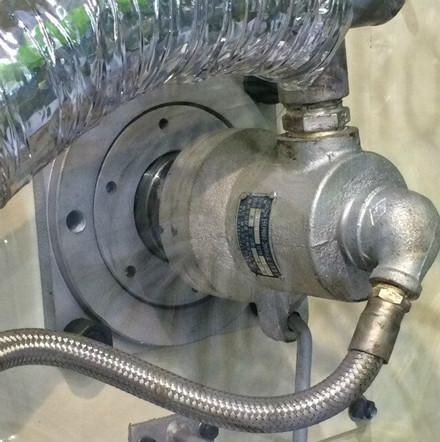
Steel manufacturing is one of the harshest industrial environments for rotating equipment. High temperatures, abrasive particles, cooling water contamination, hydraulic pressure fluctuations, and continuous production schedules place enormous demands on every component installed in the process line. Among these components, the Rotary Union for the Steel Industry plays a critical role in transferring cooling water, hydraulic oil, compressed air, steam, and other media between stationary piping and rotating equipment.
In a continuous casting or hot rolling facility, equipment failure is measured in tens of thousands of dollars per hour. There is no margin for fragile components. When metallurgical plants specify a Rotary Union for Steel Industry applications, they are not buying a standard plumbing fixture; they are procuring a critical thermal and hydraulic isolation barrier that must survive one of the most destructive manufacturing environments on the planet.
Steel mill rotary joints face a brutal combination of radiant heat, heavy shock loads, abrasive iron oxide scale, and notoriously poor water quality. A standard catalog rotary union designed for a clean CNC machine or a textile plant will violently self-destruct within weeks if bolted to a slab caster.
When a rotary union fails in a steel mill, the consequences can be significant:
- Production interruptions
- Roll damage
- Bearing failures
- Cooling system inefficiency
- Increased maintenance costs
- Safety risks
As a direct Chinese manufacturer with extensive experience in engineering heavy-duty fluid transmission systems, we have spent over a decade conducting failure analysis on rotary joints pulled directly from steel mills. We have reverse-engineered, upgraded, and manufactured direct replacements for major European and American OEM brands.
This article explores how rotary unions are used throughout steel production, the common operational challenges they face, and what engineers should consider when selecting reliable rotary unions for steel industry applications.
Why Rotary Unions Are Critical in Steel Manufacturing
Steel production involves numerous rotating systems requiring continuous fluid transfer.
Without a rotary union, it would be impossible to deliver cooling media, lubrication, or hydraulic power into rotating rolls and drums.
Typical functions include:
| Function | Media |
|---|---|
| Roll Cooling | Water |
| Roll Lubrication | Oil |
| Hydraulic Control | Hydraulic Fluid |
| Coil Processing | Water & Air |
| Heat Transfer | Steam |
| Bearing Cooling | Water-Glycol |
Because steel production often runs 24/7, rotary unions are expected to operate continuously for thousands of hours with minimal maintenance.
Even a small leakage can become a major operational issue over time.
The Brutal Reality of the Steel Mill Environment
To understand why a specialized Rotary Union for Steel Industry deployment looks and behaves differently from standard joints, you must understand the tribological battlefield it operates within.
When we inspect failed third-party rotary joints returned from steel plants, the root causes of failure almost always stem from three environmental factors:
- Abrasive Contamination (Scale & Slag): As red-hot steel is rolled or cast, it oxidizes, creating abrasive flakes known as scale. This scale mixes with water and grease, forming a grinding paste. If this paste breaches the rotary union’s bearings, the joint seizes instantly.
- Terrible Water Quality: Steel mills consume massive volumes of cooling water. This water is often drawn from rivers or recycled through open cooling towers, meaning it is loaded with silt, calcium, rust, and treatment chemicals. This “dirty water” destroys standard soft mechanical seals.
- Extreme Thermal and Mechanical Shock: A rotary joint mounted to a segment roller on a continuous caster sits inches away from a 1,200°C slab of solidifying steel. It absorbs massive radiant heat while continuously cycling cold water, all while enduring heavy low-frequency vibrations as the slab moves.
Standard aluminum housings, standard ball bearings, and carbon-graphite seals cannot survive here. Steel mill unions require forged steel, severe-duty bearings, and tungsten carbide sealing faces.
Main Steel Industry Applications for Rotary Unions
1. Hot Rolling Mills
Hot rolling mills process steel slabs at temperatures exceeding 1000°C.
Large work rolls rotate continuously while cooling water circulates through internal passages.
Rotary Union Requirements
- High-temperature resistance
- Continuous water flow
- High rotational stability
- Corrosion resistance
- Long seal life
Typical Challenges
- Scale contamination
- Thermal expansion
- Water hammer
- Misalignment
In many hot rolling installations, we have observed cooling water carrying iron oxide particles entering the rotary union. Poor filtration often causes premature seal wear.
To address this issue, our engineering team typically recommends:
- Multi-stage filtration
- Balanced mechanical seals
- Hard-faced sealing surfaces
- Enhanced bearing protection
2. Cold Rolling Mills
Cold rolling requires exceptional dimensional accuracy.
Any cooling inconsistency can affect:
- Surface finish
- Strip flatness
- Product quality
Rotary unions in cold rolling mills must provide precise and uninterrupted cooling.
Key Design Features
- Precision bearings
- Low-friction seals
- High concentricity
- Leak-free operation
Because cold rolling equipment often runs at higher rotational speeds than hot rolling systems, seal balance becomes extremely important.
The Rolling Mill Engineering Challenge
-
Pressure: Extreme hydraulic pressures, frequently exceeding 150 Bar (2,100 PSI) up to 250 Bar.
-
Passages: Multiple independent fluid channels (usually 2 or 3 passages for hydraulic extension, retraction, and sometimes water cooling).
-
Speed: Medium to high speed (up to 500 RPM), depending on the line speed.
The Factory-Engineered Solution
Designing a multi-passage hydraulic Rotary Union for Steel Industry coilers requires exact machining tolerances to prevent high-pressure cross-contamination between ports.
-
Hydrostatic Balance: At 150 Bar, the internal hydraulic force is trying to blow the rotary union apart. If you use standard seals, the pressure clamps the seal faces together so tightly that the friction melts the joint within minutes. Our engineers utilize hydrostatically balanced sealing technology. We calculate the exact hydraulic surface area so that the fluid pressure itself offsets the mechanical closing force, allowing the joint to rotate freely even under maximum pressure.
-
Elastomeric Compound Selection: Standard NBR (Nitrile) O-rings degrade rapidly under high heat and high-shear hydraulic conditions. We equip our coiler rotary unions with proprietary Viton™ (FKM) or advanced polyurethane dynamic seals backed by Teflon (PTFE) anti-extrusion rings.
-
Leakage Drain Ports: In the event of a microscopic bypass, our multi-passage designs feature dedicated atmospheric drain ports. This ensures that hydraulic fluid safely vents to a collection tank rather than blowing past a bearing and causing catastrophic mechanical failure.
3. Continuous Casting Machines
Continuous casting machines represent another critical application. These systems depend on reliable cooling throughout the casting process. The Continuous Casting Machine (CCM) is the heart of a modern steel plant, turning molten metal into solid billets, blooms, or slabs. The semi-solid steel is pulled through a curved track of segment rollers.
These rollers must be continuously cooled from the inside to prevent them from warping, cracking, or melting. This is where the rotary union comes in, injecting high volumes of cooling water through the journal of the rotating roller. Rotary unions are commonly installed on Segment rolls, Guide rolls, and Cooling systems
Operating Conditions
| Parameter | Typical Range |
|---|---|
| Temperature | 80°C – 250°C |
| Pressure | 6 – 20 Bar |
| Speed | 10 – 500 RPM |
| Media | Water |
Failure in a cooling circuit can result in:
- Surface defects
- Cracking
- Production loss
For this reason, steel producers increasingly prioritize reliability over initial purchase cost.
The CCM Engineering Challenge
-
Speed: Very slow (often 1 to 10 RPM).
-
Media: Untreated or poorly filtered cooling water.
-
Temperature: Ambient water inside, extreme radiant heat outside.
-
Location: Buried deep inside the caster segments, making maintenance incredibly difficult.
The Factory-Engineered Solution
For CCM applications, our factory engineers have designed rotary unions specifically to ignore poor water quality.
-
Silicon Carbide vs. Tungsten Carbide Faces: We utilize balanced mechanical seals where both the rotating and stationary faces are made from micro-lapped Tungsten Carbide or Silicon Carbide. If a piece of rust or sand enters the joint from the mill’s water supply, these ultra-hard faces will literally crush the particulate rather than allowing it to score the seal face.
-
Bearing-less Designs: Because CCM rollers rotate so slowly and are subjected to such extreme heat, standard ball bearings often fail due to grease baking or washing out. We manufacture specialized bearing-less rotary joints for continuous casters. These rely on high-clearance graphite or composite bushing guides, eliminating the failure point of a seized metallic bearing.
-
Heavy-Duty Brass and Forged Steel: We machine our CCM housings from solid blocks of brass or forged steel to resist exterior corrosion from the steam-filled casting environment.
4. Coil Processing Lines
Steel coil processing involves:
- Pickling
- Galvanizing
- Annealing
- Coating
Rotary unions supply cooling water and air to rotating drums and reels.
These environments often contain:
- Acid vapors
- Humidity
- Chemical contamination
Special stainless steel rotary unions are commonly required.
5. Galvanizing Lines
Galvanizing operations expose equipment to:
- Zinc particles
- High temperatures
- Corrosive atmospheres
Standard rotary unions often fail prematurely in these conditions.
Our engineering experience shows that stainless steel housings combined with carbide seal faces significantly improve service life in galvanizing environments.
Engineering Challenges in Steel Mill Rotary Union Applications
Steel mills create conditions far more demanding than most industrial facilities.
Extreme Heat
Radiant heat from furnaces and hot steel can dramatically increase seal temperatures.
Challenges include:
- Elastomer degradation
- Thermal distortion
- Lubricant breakdown
Recommended solutions:
- High-temperature seals
- Heat-resistant materials
- External cooling designs
Water Contamination
Cooling water frequently contains:
- Scale
- Rust
- Sand
- Metallic particles
These contaminants accelerate wear on:
- Seal faces
- Bearings
- Internal passages
Our factory often recommends filtration systems below 100 microns for critical rolling applications.
Pressure Fluctuation
Pressure spikes occur during:
- Pump startup
- Valve switching
- Emergency shutdowns
Sudden pressure changes can damage mechanical seals.
Balanced seal technology significantly improves performance under fluctuating pressure conditions.
Misalignment
Steel mill equipment experiences:
- Thermal growth
- Structural movement
- Roll replacement variations
Misalignment is among the leading causes of rotary union failures.
Solutions include:
- Self-supporting designs
- Flexible hose connections
- Precision installation procedures
How to Select the Right Rotary Union for Steel Industry Applications
Selecting a rotary union involves much more than matching thread size.
Engineers should evaluate the entire operating environment.
Step 1: Identify the Media
Common media include:
- Water
- Steam
- Hydraulic oil
- Air
- Water-glycol mixtures
Each medium requires different seal materials.
Step 2: Determine Operating Temperature
Temperature affects:
- Seal life
- Lubrication
- Material expansion
Typical ranges:
| Media | Temperature |
|---|---|
| Cooling Water | 20°C–120°C |
| Steam | 120°C–300°C |
| Hydraulic Oil | 40°C–100°C |
Step 3: Verify Rotational Speed
Higher speeds require:
- Better bearing support
- Improved balance
- Lower friction seals
A rotary union designed for 50 RPM may fail rapidly at 1000 RPM.
Step 4: Evaluate Pressure
Pressure determines:
- Seal loading
- Housing strength
- Bearing design
Always consider maximum pressure spikes, not only normal operating pressure.
Step 5: Assess Environmental Conditions
Questions engineers should ask:
- Is scale present?
- Is corrosion likely?
- Are chemicals involved?
- Is high ambient heat expected?
The answers influence material selection.
Common Rotary Union Failures in Steel Mills
Understanding failure modes helps reduce downtime.
Seal Face Wear
Symptoms:
- Leakage
- Reduced cooling efficiency
Causes:
- Dirty water
- Incorrect pressure
- Dry running
Bearing Failure
Symptoms:
- Vibration
- Noise
- Excessive temperature
Causes:
- Water ingress
- Misalignment
- Overloading
Housing Cracks
Symptoms:
- External leakage
Causes:
- Water hammer
- Excessive pressure
O-Ring Degradation
Symptoms:
- Slow leakage
Causes:
- Chemical attack
- Excessive heat
Real-World Example: Rotary Union Upgrade in a Rolling Mill
A steel rolling mill experienced recurring failures every three to four months.
Initial Situation
Problems included:
- Cooling water leakage
- Bearing damage
- Frequent maintenance shutdowns
Root Cause Analysis
Our engineering team identified:
- Contaminated cooling water
- Inadequate seal materials
- Poor bearing protection
Implemented Solution
We supplied:
- Tungsten carbide seal faces
- Reinforced bearing systems
- Improved drainage structure
- Enhanced contamination protection
Results
The customer increased service life from approximately 4 months to over 18 months.
Maintenance costs were reduced significantly while production uptime improved.
Our Manufacturing Expertise in the Steel Industry: Rotary Unions
As a Chinese rotary union manufacturer serving global industrial customers, we understand that steel applications demand far more than standard catalog products.
Engineering Experience
Our engineering team works closely with:
- Steel mills
- Rolling equipment OEMs
- Maintenance contractors
- Industrial distributors
This practical experience enables us to recommend application-specific solutions rather than generic products.
Advanced CNC Manufacturing
Our production facility utilizes:
- Multi-axis CNC machining centers
- Precision grinding equipment
- Coordinate measuring systems
- Dynamic balancing equipment
Critical dimensions are tightly controlled to ensure:
- Seal alignment
- Bearing accuracy
- Rotational stability
Material Selection Expertise
We manufacture rotary unions using:
- Stainless steel
- Alloy steel
- Brass
- Tungsten carbide
- Silicon carbide
Material selection is tailored to the customer’s operating environment.
Quality Control Process
Every rotary union undergoes:
- Dimensional inspection
- Pressure testing
- Rotation testing
- Leak testing
This quality verification process helps ensure reliable field performance.
Replacement Solutions for Major Brands
Many steel manufacturers seek cost-effective alternatives to premium rotary union brands.
We provide replacement solutions compatible with numerous internationally recognized rotary union designs while meeting the performance requirements of demanding steel industry applications.
Future Trends in Steel Industry Rotary Unions
Steel manufacturers increasingly demand:
Longer Service Life
Maintenance intervals continue to expand.
Higher Operating Speeds
Modern mills operate faster than previous generations.
Smart Monitoring
Condition monitoring systems help predict failures before downtime occurs.
Energy Efficiency
Improved sealing technology reduces fluid losses and energy consumption.
Manufacturers capable of integrating these technologies will be better positioned to support the next generation of steel production facilities.
Frequently Asked Questions
What is the primary function of a rotary union in steel mills?
A rotary union transfers fluids from stationary piping into rotating equipment such as rolls, drums, and reels.
What media are commonly used?
Typical media include water, hydraulic oil, steam, compressed air, and water-glycol mixtures.
Why do rotary unions fail in steel mills?
The most common causes are contamination, excessive heat, pressure fluctuations, misalignment, and improper installation.
How long should a steel mill rotary union last?
Service life varies significantly depending on operating conditions, water quality, and maintenance practices. Well-designed rotary unions operating in controlled conditions often achieve several years of service.
Can rotary unions be customized for steel applications?
Yes. Custom configurations may include special seals, materials, connections, mounting arrangements, and multi-passage designs.
Conclusion
The performance of a Rotary Union for the Steel Industry directly influences production efficiency, equipment reliability, and maintenance costs throughout the steel manufacturing process.
From hot rolling mills and continuous casting lines to galvanizing and coil processing operations, rotary unions operate under some of the most demanding industrial conditions imaginable.
Selecting the right rotary union requires careful evaluation of temperature, pressure, speed, media, contamination levels, and installation conditions. Manufacturers with genuine engineering experience and proven production capabilities can provide solutions that significantly improve equipment uptime and reduce lifecycle costs.
For steel producers seeking long-term reliability, the focus should not be on the lowest purchase price but on total operating performance, service life, and technical support. A properly engineered rotary union can become a critical contributor to stable production, improved product quality, and lower maintenance expenses across the entire steel manufacturing operation.