
Rotary Unions for Power Generation and Power Plant Equipment
Power generation equipment often requires steam, cooling water, hydraulic oil, thermal oil, compressed air, or other fluids to pass between stationary piping and rotating machinery.
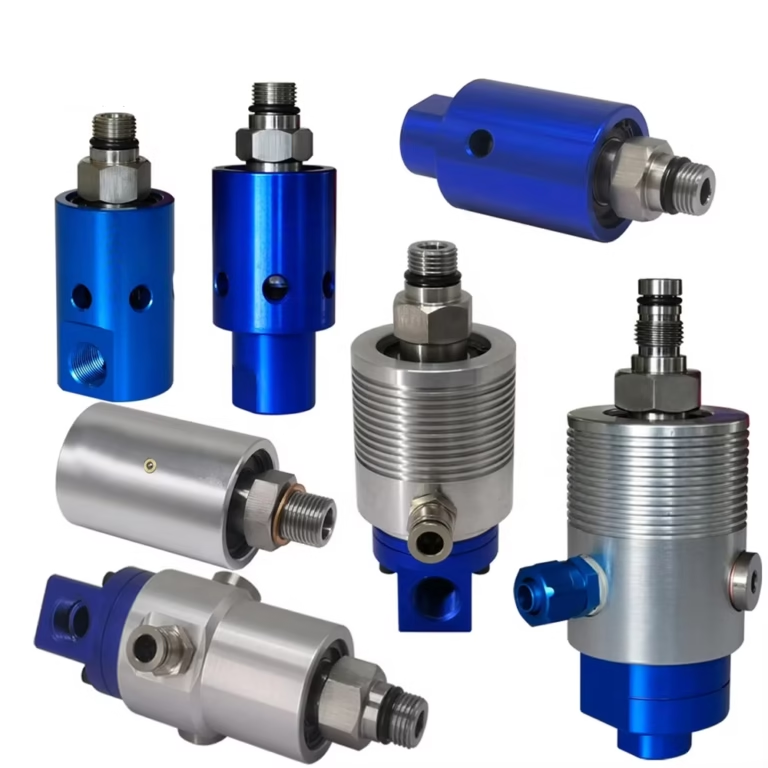
Rotary unions for power generation provide a sealed connection that allows these media to flow continuously while the connected shaft, drum, reel, turbine component, or other equipment rotates.
Dann Hydraulic manufactures industrial rotary unions and replacement rotary joints for demanding power generation applications. We provide standard and customized solutions according to operating pressure, temperature, rotational speed, media, connection size, and installation requirements.
Our rotary unions can support applications in thermal power plants, hydropower equipment, renewable energy systems, auxiliary power equipment, and industrial energy facilities.
Where Are Rotary Unions Used in Power Generation?
A power plant contains many different rotating systems, and the requirements for each rotary union can vary significantly.
Typical applications include:
- Steam and condensate transfer
- Cooling water circulation
- Hydraulic oil transfer
- Thermal oil systems
- Lubrication systems
- Turbine auxiliary equipment
- Hydroelectric turbine hydraulic systems
- Cable and hose reels
- Rotating heat-transfer equipment
- Wind energy hydraulic and cooling systems
For this reason, there is no single rotary union design suitable for every power generation application.
Correct product selection depends on the actual working conditions.
Steam Rotary Unions for Power Plant Equipment
Steam remains an important heating and energy-transfer medium in many industrial and power generation systems.
A steam rotary union must maintain reliable sealing while operating under elevated temperature and continuous rotation.
Important factors include:
- Steam pressure
- Operating temperature
- Rotation speed
- Condensate removal
- Seal material
- Installation alignment
High temperature can affect seal faces, bearings, lubricants, and other internal components. Therefore, steam rotary joints require materials and sealing structures specifically selected for thermal applications.
Dann Hydraulic provides steam rotary union solutions for rotating heating equipment and related power generation applications.
Customers requiring a dedicated steam design can also view our steam rotary unions:
Cooling Water Rotary Unions
Cooling systems are another important application for rotary unions in energy equipment.
Cool water may need to enter rotating machinery continuously to control temperature and remove heat.
A reliable water rotary union should provide:
- Stable flow capacity
- Low leakage
- Corrosion resistance
- Reliable mechanical sealing
- Long-term rotational stability
Water quality is also important.
Scale, suspended particles, corrosion products, and other contamination can damage seal surfaces or restrict internal flow passages.
For cooling water applications, our engineers evaluate water quality, pressure, temperature, flow requirements, and rotational speed before recommending a configuration.
Customers requiring a dedicated steam design can also view our water rotary unions
Hydraulic Rotary Unions for Turbine and Auxiliary Systems
Many power generation systems use hydraulic pressure to control rotating or moving equipment.
Hydraulic rotary unions allow pressurized hydraulic oil to pass through a rotating interface without twisting hoses or interrupting oil supply.
Typical requirements may include:
- High working pressure
- Multiple hydraulic passages
- Compact installation
- Stable sealing
- Low rotational torque
- Resistance to pressure fluctuations
For more complex systems, several independent hydraulic circuits may need to pass through one rotating assembly.
In these applications, a multi-passage rotary union can provide separate channels for different hydraulic circuits.
Rotary Unions for Hydroelectric Power Equipment
Hydroelectric systems can require rotary unions for hydraulic control, lubrication, cooling, and other rotating fluid-transfer applications.
Some turbine systems require multiple independent fluid passages.
Depending on the equipment design, a rotary union may need to transfer:
- Hydraulic oil
- Lubrication oil
- Cooling water
- Compressed air
Because these systems are often large and project-specific, dimensions and interface requirements may differ considerably from standard industrial rotary unions.
Dann Hydraulic can manufacture customized rotary unions according to drawings, original samples, installation dimensions, or existing model information.
Rotary Unions for Wind Energy Equipment
Wind energy equipment also contains hydraulic, lubrication, and cooling systems where fluid transfer may be required between stationary and rotating components.
Outdoor operation creates additional challenges including:
- Temperature variation
- Moisture
- Dust
- Corrosion
- Continuous vibration
Material selection and sealing design therefore need to consider both the transferred medium and the external operating environment.
Stainless steel, corrosion-resistant surface treatments, and application-specific seals can be selected according to project requirements.
What Media Can Power Generation Rotary Unions Handle?
Depending on the rotary union design and selected sealing materials, power generation applications may involve:
Steam and condensate
Used in high-temperature heating and thermal systems.
Cooling water
Used for equipment temperature control and heat removal.
Hydraulic oil
Used for hydraulic control and actuation systems.
Thermal oil
Used for indirect heating and high-temperature heat-transfer systems.
Lubricating oil
Used for rotating equipment lubrication.
Compressed air
Used in pneumatic control and auxiliary equipment.
Different media require different seal materials, internal structures, and housing materials.
Always provide the actual medium when requesting a quotation.
How to Select a Rotary Union for Power Generation Equipment
Selecting a rotary union only according to thread size or outside dimensions can result in premature failure.
Before recommending a model, we normally evaluate the following operating parameters.
1. Fluid Medium
Please specify whether the system uses:
- Steam
- Water
- Hydraulic oil
- Thermal oil
- Lubricating oil
- Air
- Other process media
Chemical compatibility directly affects seal and housing material selection.
2. Working Pressure
Provide both:
Normal operating pressure
and
Maximum system pressure
Pressure fluctuations should also be considered.
3. Operating Temperature
High temperature can significantly affect sealing materials and bearing life.
Steam and thermal oil applications require particular attention to temperature.
4. Rotational Speed
Rotational speed affects:
- Seal friction
- Heat generation
- Bearing load
- Service life
Higher speed does not necessarily require the same sealing design as a low-speed heavy-duty application.
5. Passage Quantity
Some systems require only one medium.
Other equipment may require multiple independent channels for hydraulic oil, cooling water, air, or other media.
6. Installation Dimensions
Provide:
- Thread size
- Shaft dimensions
- Mounting dimensions
- Rotation direction
- Available installation space
A technical drawing or photo of the existing rotary union is extremely helpful.
Common Causes of Rotary Union Failure in Power Generation Equipment
Power generation equipment often operates continuously, making reliability particularly important.
Several conditions can shorten rotary union service life.
Seal Wear
Mechanical seal faces gradually wear during operation.
Incorrect seal materials, excessive temperature, contamination, or unsuitable operating conditions can accelerate this process.
Pipe Stress and Misalignment
The rotary union should not be used as a structural support for connected piping.
Excessive side load or misalignment can affect bearings and seal contact.
Contaminated Media
Particles in water or hydraulic oil can damage precision sealing surfaces.
Proper filtration can significantly improve reliability.
Excessive Pressure or Temperature
Operating beyond the selected model’s design conditions can reduce service life or cause leakage.
Improper Condensate Handling
Steam systems require appropriate condensate management.
Poor condensate removal can reduce heat-transfer efficiency and create unstable operating conditions.
Replacement Rotary Unions for Imported Power Generation Equipment
Many power plants and industrial energy facilities use imported rotary unions installed on older equipment.
Over time, customers may encounter:
- Long replacement lead times
- High spare-part costs
- Discontinued models
- Difficulty obtaining customized dimensions
Dann Hydraulic manufactures replacement rotary unions according to original model information, samples, drawings, and operating parameters.
We can evaluate replacement requirements for internationally used rotary union designs while adapting dimensions and materials to specific customer applications.
Our goal is not simply to copy the appearance of an existing rotary union.
We confirm the actual:
- Medium
- Pressure
- Temperature
- Speed
- Connection
- Installation arrangement
before recommending a replacement configuration.
Custom Power Generation Rotary Union Manufacturer in China
Dann Hydraulic manufactures rotary unions for industrial customers requiring standard and customized fluid-transfer solutions.
Our production and inspection capabilities include:
- CNC machining
- Precision component machining
- Seal surface processing
- Assembly inspection
- Pressure testing
- Leakage testing
- Dimensional inspection
Depending on the application, we can customize:
- Housing material
- Rotor material
- Seal materials
- Passage quantity
- Thread standard
- Flange design
- Installation dimensions
- Pressure rating
- Temperature capability
OEM and drawing-based production are available.
Information Required for a Power Generation Rotary Union Quotation
To recommend the correct rotary union, please provide:
1. Application:
What equipment will the rotary union be installed on?
2. Medium:
Steam, water, hydraulic oil, thermal oil, air, or another fluid?
3. Working pressure:
Normal and maximum pressure.
4. Temperature:
Normal and maximum operating temperature.
5. Rotational speed:
RPM.
6. Connection size:
BSP, NPT, metric thread, flange, or custom connection.
7. Passage quantity:
Single passage or multi-passage.
8. Existing information:
Original model number, drawing, photos, or sample if available.
Providing these details allows our engineering team to evaluate the application more accurately.
Frequently Asked Questions About Power Generation Rotary Unions
What is a rotary union used for in a power plant?
A rotary union transfers steam, water, hydraulic oil, thermal oil, air, or other compatible media between stationary piping and rotating equipment while maintaining a sealed fluid path.
Can rotary unions handle steam?
Yes. Steam requires a rotary union designed for the relevant pressure, temperature, rotation speed, and condensate conditions.
Can you manufacture multi-passage rotary unions for hydraulic systems?
Yes. Multi-passage rotary unions can incorporate several independent fluid channels according to equipment requirements.
Can Dann Hydraulic replace an imported rotary union?
We can evaluate replacement requirements based on the original model, drawing, dimensions, sample, and operating conditions. Final compatibility should be confirmed before production.
What information do you need before recommending a rotary union?
The most important information includes medium, pressure, temperature, rotational speed, passage quantity, connection dimensions, and equipment application.
Contact Dann Hydraulic
If you need a rotary union for power generation equipment, send us your operating parameters, drawings, original model number, or product photos.
Our engineering team can evaluate the application and recommend a suitable standard or customized rotary union.
Dann Hydraulic — Rotary Union Manufacturer & Replacement Solution Supplier in China