
Deublin 902 Series Rotary Union Alternative: The Complete OEM Replacement Guide
When engineers search for a Deublin 902 Series Rotary Union, they are usually looking for one of two things.
The first is an original replacement for equipment that has been operating reliably for years. The second—and increasingly common—is a cost-effective alternative that delivers the same performance while reducing procurement costs and lead time.
For many industrial manufacturers, maintenance companies, and OEM equipment builders, purchasing an original rotary union is no longer the only option. Rising costs, extended delivery schedules, and global supply chain uncertainty have encouraged buyers to evaluate compatible replacements from experienced rotary union manufacturers.
At Dann Hydraulic, we specialize in manufacturing OEM-compatible rotary unions designed to replace many well-known international brands, including the Deublin 902 Series. Rather than simply copying external dimensions, we focus on engineering compatibility, sealing reliability, material quality, and long-term operational stability.
As a factory with years of experience producing rotary unions for customers in Europe, North America, Southeast Asia, and the Middle East, we understand that industrial buyers are not looking for the cheapest component—they are looking for a reliable supplier that delivers consistent quality.
This guide explains how the Deublin 902 Series works, where it is commonly used, why many customers are seeking alternatives, and how to evaluate whether an OEM-compatible replacement is the right choice for your equipment.
What Is the Deublin 902 Series Rotary Union?
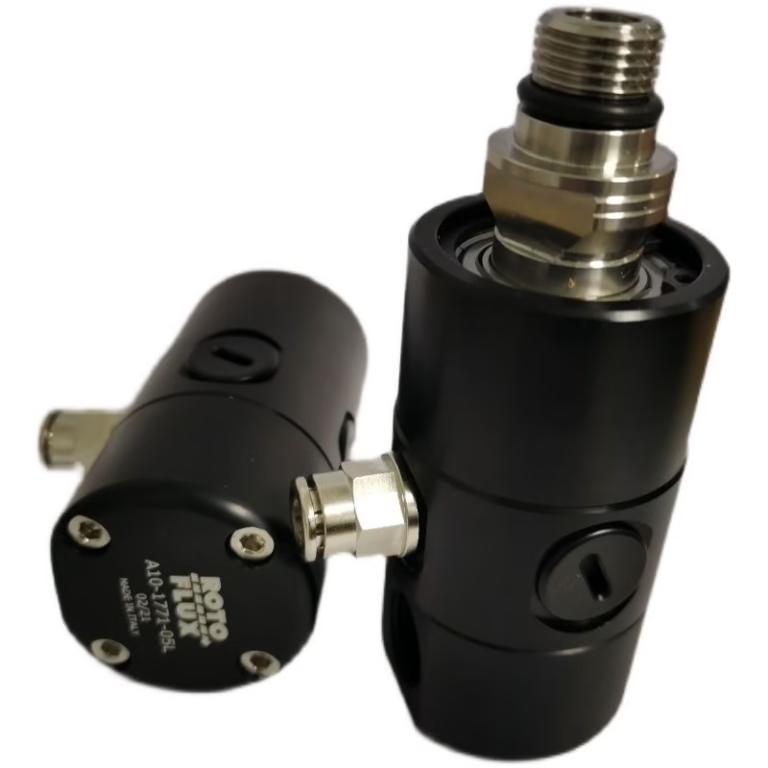
The Deublin 902 Series is a single-passage rotary union widely used for transferring coolant, water, hydraulic oil, and other industrial media between stationary piping and rotating equipment.
Its compact structure, dependable sealing system, and ease of installation have made it a common choice for machine tool builders and industrial machinery manufacturers worldwide.
Typical design characteristics include:
- Single-passage fluid transfer
- Balanced mechanical seal design
- High-speed operation
- Low-friction torque
- Long bearing life
- Compact aluminum or stainless steel housing
- Threaded shaft connection
- Easy maintenance
The rotary union creates a leak-free fluid path while allowing the shaft to rotate continuously. Proper sealing minimizes coolant loss, prevents contamination, and protects machine bearings from premature failure.
For production equipment operating around the clock, rotary union reliability directly affects machine uptime, maintenance costs, and production efficiency.
Even a minor coolant leak can result in machine downtime, reduced machining accuracy, bearing contamination, and unnecessary maintenance expenses.
This is why selecting the right replacement is far more important than simply matching thread sizes.
Typical Applications of the Deublin 902 Series Rotary Union
One reason the 902 Series has remained popular is its versatility across multiple industrial sectors.
It is commonly found in:
CNC Machining Centers
Modern machining centers rely on continuous coolant delivery to improve tool life, remove heat, and achieve better surface finishes.
The rotary union allows coolant to pass through rotating spindles without leakage, supporting high-speed machining operations.
Metal Cutting Equipment
Lathes, milling machines, drilling centers, and tapping machines often require rotating coolant connections that can withstand continuous operation.
Stable coolant flow improves machining precision while reducing thermal expansion of cutting tools.
Automatic Production Lines
Many automated manufacturing systems include rotating fixtures that require hydraulic oil or coolant transmission.
Reliable rotary unions minimize maintenance interruptions and improve production efficiency.
Packaging Machinery
Some packaging equipment incorporates rotating drums that require cooling water or compressed air.
Compact rotary unions help reduce installation space while maintaining dependable sealing performance.
Special Industrial Equipment
Customized production machinery frequently integrates rotary unions for hydraulic oil, coolant, or low-pressure fluid transfer.
Because equipment designs vary significantly, OEM compatibility and engineering flexibility become especially important.
Unlike standardized catalog products, many industrial applications require modifications to mounting dimensions, threads, shaft lengths, or sealing materials. This is one area where experienced OEM manufacturers provide greater value than off-the-shelf components.
Why More Industrial Buyers Are Looking for Deublin 902 Series Alternatives
Over the past several years, we have received an increasing number of inquiries from distributors, maintenance contractors, and equipment manufacturers specifically requesting compatible replacements for the Deublin 902 Series.
The reasons are practical rather than promotional.
1. Rising Procurement Costs
For companies operating dozens—or even hundreds—of CNC machines, replacing rotary unions with original branded components can represent a significant maintenance expense.
A high-quality OEM-compatible replacement can substantially reduce procurement costs while maintaining equivalent operational performance when properly engineered and tested.
For distributors and maintenance service providers managing inventory across multiple facilities, these savings can meaningfully impact annual maintenance budgets.
2. Long Lead Times
Original spare parts may require several weeks—or even months—to arrive, depending on regional inventory and production schedules.
Unexpected machine downtime rarely allows that kind of waiting period.
Many customers therefore seek alternative suppliers capable of delivering compatible rotary unions within much shorter lead times, helping restore production more quickly.
3. OEM Equipment Manufacturing
Machine builders often require rotary unions that meet the same functional requirements as established brands but allow greater flexibility in branding, customization, and purchasing costs.
An experienced OEM manufacturer can provide customized dimensions, logo engraving, packaging, and technical support while maintaining interchangeability with existing equipment.
4. Supply Chain Diversification
Industrial purchasing departments increasingly aim to reduce dependence on a single supplier.
Qualifying multiple compatible sources helps improve supply security, especially during periods of global logistics disruption or component shortages.
For many buyers, adding a trusted OEM manufacturer as an approved supplier is a practical risk-management strategy rather than simply a cost-saving measure.
Common Problems with Aging Deublin 902 Series Rotary Union
Even a well-designed rotary union is a wear component. After thousands of operating hours, sealing surfaces, bearings, and internal components gradually deteriorate. In our factory, we inspect hundreds of returned rotary unions every year from customers around the world. Although operating conditions differ, the failure patterns are remarkably similar.
Understanding these common issues helps maintenance engineers determine whether a rotary union should be repaired or replaced.
1. Coolant Leakage
Leakage is by far the most common reason for replacement.
A rotary union depends on precision mechanical seal faces that rotate against each other while maintaining a microscopic lubricating film. Over time, abrasive particles in coolant, insufficient filtration, dry running, or thermal shock can damage these sealing faces.
Typical symptoms include:
- Coolant dripping from the housing
- Internal leakage reduces coolant pressure
- Increased coolant consumption
- Wet spindle surfaces
- Frequent coolant refilling
Many users initially suspect damaged O-rings. However, in our experience, the majority of leaks originate from worn mechanical seal faces rather than simple elastomer failure.
2. Bearing Wear
The bearing system supports the rotating shaft while maintaining seal alignment.
When bearings begin to wear, several secondary problems appear:
- Increased vibration
- Excessive radial movement
- Abnormal operating noise
- Higher seal wear
- Reduced machining accuracy
One common mistake is continuing production after bearing noise becomes noticeable. Once bearing clearance exceeds acceptable limits, the seal faces can no longer maintain proper contact, leading to rapid leakage.
Replacing the rotary union early often prevents more expensive spindle repairs.
3. Incorrect Operating Conditions
Another issue we frequently encounter is application mismatch rather than product quality.
For example:
- Operating above the recommended speed
- Excessive pressure spikes
- Using incompatible media
- Dry running without fluid
- Frequent start-stop cycles
- Poor shaft alignment
Even a premium rotary union cannot achieve its expected service life when operated outside its design limits.
Before selecting any replacement, engineers should verify:
- Maximum working pressure
- Operating temperature
- Rotational speed (RPM)
- Fluid type
- Duty cycle
- Installation dimensions
Compatibility means much more than matching the thread size.
4. Seal Face Damage Caused by Contaminated Coolant
Many machine shops overlook coolant cleanliness.
Metal chips, abrasive particles, rust, and machining debris circulate continuously through the coolant system. Without proper filtration, these contaminants gradually scratch precision seal faces.
In our own testing, clean coolant can increase seal life several times compared with heavily contaminated systems.
For customers operating centralized coolant systems, we always recommend improving filtration together with replacing the rotary union.
The result is lower maintenance costs—not only for the rotary union but also for pumps, valves, and machine tools.
What Makes a High-Quality Deublin 902 Series Compatible Replacement?
Not every “replacement” available in the market deserves to be called a true alternative.
Some suppliers simply copy the external appearance while ignoring the engineering details that determine long-term reliability.
At Dann Hydraulic, we define a qualified replacement using four engineering principles.
1. Dimensional Compatibility
The first requirement is complete installation compatibility.
A replacement rotary union should fit directly onto the existing machine without requiring modifications.
This includes:
- Mounting dimensions
- Thread specifications
- Shaft diameter
- Overall length
- Bolt pattern
- Port locations
- Connection standards
Our engineering team verifies every critical dimension against customer drawings or original samples before production begins.
For OEM customers, we can also customize dimensions to match specific equipment requirements.
2. Equivalent or Better Sealing Performance
The mechanical seal is the heart of every rotary union.
Instead of focusing only on appearance, we select seal materials according to the customer’s application.
Depending on operating conditions, available seal face combinations include:
- Carbon graphite
- Silicon carbide
- Tungsten carbide
- Ceramic
- Special wear-resistant composites
Different applications require different material combinations.
For example:
- Clean water systems prioritize corrosion resistance.
- Coolant applications require excellent wear resistance.
- Hydraulic oil applications benefit from low-friction seal designs.
- High-speed spindles demand excellent thermal stability.
Selecting the correct seal material often has a greater impact on service life than choosing a more expensive brand.
3. Reliable Bearing System
A precision bearing system directly influences operating stability.
We use internationally recognized bearing brands or equivalent premium-grade bearings depending on customer requirements.
Every bearing is selected according to:
- Maximum speed
- Radial load
- Axial load
- Lubrication method
- Expected operating life
Proper bearing selection reduces vibration, lowers operating temperature, and extends seal life.
4. Stable Manufacturing Quality
Consistency matters more than isolated performance.
A rotary union should perform the same whether the customer purchases one unit or one thousand.
To ensure repeatable quality, our manufacturing process includes:
- CNC precision machining
- Coordinate dimensional inspection
- Dynamic balancing when required
- Surface roughness inspection
- Pressure testing
- Leakage testing
- Rotation testing
- Final visual inspection before shipment
Every production batch follows documented inspection procedures rather than random sampling alone.
This consistency is especially important for distributors and OEM machine builders who require identical performance across multiple production batches.
Why OEM-Compatible Rotary Unions Make Business Sense
Many industrial buyers initially assume that choosing an OEM-compatible rotary union means sacrificing quality.
Our experience suggests otherwise.
Today’s leading Chinese manufacturers are no longer competing solely on price. They invest heavily in precision machining, advanced testing equipment, engineering expertise, and process control.
For many customers, the decision is based on overall value rather than brand recognition alone.
Lower Total Procurement Cost
An OEM-compatible replacement can significantly reduce purchasing costs while delivering comparable performance for the intended application.
For companies operating multiple production lines, these savings accumulate quickly over annual maintenance cycles.
Faster Lead Times
Production downtime is expensive.
Unlike suppliers relying solely on centralized inventory, we maintain flexible manufacturing schedules that allow us to respond quickly to urgent replacement requests.
Standard models are typically available with much shorter lead times than many imported alternatives, while customized OEM projects can also be completed efficiently through our in-house production system.
Flexible OEM and Private Label Services
Many distributors and equipment manufacturers require more than a standard replacement.
We provide comprehensive OEM support, including:
- Customer logo engraving
- Private-label packaging
- Customized product labels
- Special thread configurations
- Modified shaft dimensions
- Custom port orientations
- Material upgrades for demanding environments
This flexibility allows our partners to strengthen their own brands while offering rotary unions that are fully compatible with existing equipment.
Stable Global Supply
Recent disruptions in global logistics have highlighted the importance of supplier diversification.
Many of our long-term customers now qualify us as a secondary or primary supplier to ensure the continuous availability of critical spare parts.
Rather than relying on a single source, they establish a more resilient procurement strategy—reducing the risk of extended downtime caused by supply chain interruptions.
By combining engineering compatibility, competitive pricing, reliable quality, and responsive manufacturing, a well-designed Deublin 902 Series alternative can deliver long-term value that extends far beyond the initial purchase price.
Why Customers Around the World Choose Dann Hydraulic as Their Deublin 902 Series Rotary Union Alternative Supplier
Finding a compatible rotary union is relatively easy. Finding a manufacturing partner that can consistently deliver the same quality across hundreds or thousands of units is much more challenging.
At Dann Hydraulic, we believe that long-term partnerships are built on engineering capability, manufacturing consistency, and transparent communication—not simply on offering the lowest price.
For more than a decade, we have focused exclusively on the design and production of rotary unions and rotary joints for industrial equipment. Our products are exported to customers across Europe, North America, South America, Southeast Asia, and the Middle East, serving OEM machine builders, industrial distributors, maintenance contractors, and end users.
Many of our customers first approached us looking for an economical replacement for premium brands. They continued working with us because our products consistently met their expectations in terms of reliability, compatibility, and technical support.
Rather than marketing ourselves as a low-cost supplier, we position ourselves as a dependable manufacturing partner capable of delivering OEM-quality rotary unions with competitive pricing and shorter lead times.
Inside Our Factory: How We Manufacture Compatible Rotary Unions
One of the biggest concerns buyers have when sourcing alternatives is consistency.
Can every production batch maintain the same dimensions?
Will sealing performance remain stable?
Can replacement units be installed without additional machining?
These are valid questions, and they are exactly why we have invested in standardized manufacturing processes.
Precision CNC Machining
Every housing, shaft, and internal component is machined using CNC equipment to maintain tight dimensional tolerances.
Critical sealing surfaces receive additional finishing processes to ensure smooth contact between the rotating and stationary seal faces.
Dimensional consistency is essential because even a slight deviation may affect bearing alignment or seal performance.
Material Selection Based on Application
Different industries require different material combinations.
Instead of offering a one-material-fits-all solution, we recommend materials according to the customer’s working conditions.
Typical housing materials include:
- Aluminum alloy for lightweight, high-speed applications
- Brass for corrosion resistance
- Stainless steel 304
- Stainless steel 316 for aggressive environments
Mechanical seal combinations may include:
- Carbon Graphite vs Silicon Carbide
- Silicon Carbide vs Silicon Carbide
- Tungsten Carbide vs Tungsten Carbide
- Carbon Graphite vs Ceramic
O-ring materials are selected according to fluid compatibility, including:
- NBR
- FKM (Viton)
- EPDM
- PTFE
Choosing the appropriate materials often extends service life more effectively than simply selecting a higher-priced product.
Assembly by Experienced Technicians
Rotary unions are precision mechanical assemblies.
Proper installation of bearings, springs, seals, and retaining components directly affects performance.
Our assembly technicians follow standardized work instructions to ensure:
- Correct bearing preload
- Accurate seal face alignment
- Proper spring compression
- Correct torque values
- Clean assembly environment
Each assembly step is documented as part of our quality management process.
Quality Control That Goes Beyond Visual Inspection
Industrial buyers expect more than an attractive appearance.
Every rotary union must prove its performance before shipment.
For this reason, each production batch undergoes multiple inspection stages.
Dimensional Inspection
Critical dimensions are measured using calibrated inspection equipment.
Inspection items include:
- Shaft diameter
- Thread accuracy
- Housing dimensions
- Port location
- Overall length
- Seal cavity dimensions
This ensures complete interchangeability with compatible equipment.
Pressure Testing
Each rotary union is pressure tested according to its intended operating range.
The purpose is to verify:
- Housing integrity
- Seal performance
- Thread sealing
- Internal leakage
- External leakage
Pressure testing allows us to identify assembly issues before products leave the factory.
Rotation Testing
Static pressure testing alone is not sufficient.
Rotary unions operate under dynamic conditions.
Therefore, representative production samples also undergo rotational testing to evaluate:
- Running stability
- Bearing performance
- Friction torque
- Temperature rise
- Dynamic sealing
Only products that pass all inspection procedures proceed to packaging.
Final Inspection
Before shipment, every rotary union receives a final inspection covering:
- Product identification
- Surface finish
- Packaging
- Thread protection
- Accessories
- Documentation
This final step helps ensure customers receive products ready for immediate installation.
Real Customer Experience: From High Maintenance Costs to Reliable Performance
One of our European distributor customers previously sourced only original branded rotary unions for servicing CNC machining centers.
Although the products performed well, customers frequently complained about high replacement costs and extended delivery times for urgent maintenance.
After reviewing the equipment drawings and operating parameters, we developed an OEM-compatible rotary union matching the installation dimensions and performance requirements.
Following several months of field testing, the customer gradually transitioned a significant portion of their maintenance inventory to our compatible products.
The feedback highlighted several measurable improvements:
- Reduced procurement costs
- Faster inventory replenishment
- Simplified spare parts management
- Stable sealing performance
- Positive acceptance from maintenance technicians
Perhaps the most valuable outcome was not simply the cost savings, but the increased confidence that replacement parts would be available whenever customers needed them.
Deublin 902 Series vs OEM-Compatible Alternative
When evaluating alternatives, purchasing decisions should be based on technical requirements rather than brand recognition alone.
| Comparison Item | Original Deublin 902 Series | Dann Hydraulic Compatible Alternative |
|---|---|---|
| Installation Dimensions | Original Standard | Fully Compatible |
| Mounting Threads | Standard | Matching Specifications |
| Media Compatibility | Water, Coolant, Oil | Water, Coolant, Oil, Customized Media |
| Seal Materials | Standard Options | Multiple Premium Material Choices |
| OEM Customization | Limited | Full OEM & Private Label Support |
| Lead Time | Often Several Weeks | Significantly Shorter Production Cycle |
| Cost | Premium Brand Pricing | More Competitive Factory Pricing |
| Technical Support | Regional Distributor | Direct Factory Engineering Support |
| Custom Design | Limited | Available |
| Spare Parts Availability | Region Dependent | Stable Manufacturing Supply |
For most industrial users, compatibility, reliability, and responsive support are often more important than the logo engraved on the housing.
How to Select the Right Deublin 902 Series Replacement
Before ordering a replacement, verify the following technical information.
1. Confirm the Original Model Number
The original part number provides the fastest way to identify a compatible replacement.
If the model number is no longer visible, engineering drawings or equipment manuals can also be used.
2. Identify the Working Medium
Different media require different sealing materials.
Examples include:
- Water
- Coolant
- Hydraulic oil
- Air
- Vacuum
- Thermal oil
- Chemical fluids
Incorrect material selection can significantly shorten seal life.
3. Determine Operating Parameters
Important specifications include:
- Working pressure
- Operating temperature
- Maximum RPM
- Rotation direction
- Duty cycle
Providing complete operating conditions enables more accurate engineering recommendations.
4. Verify Installation Dimensions
Please confirm:
- Thread size
- Shaft dimensions
- Overall length
- Port size
- Mounting configuration
Even small dimensional differences may affect installation.
Whenever possible, supplying photographs or engineering drawings helps speed up compatibility verification.
5. Choose a Manufacturer with Real Engineering Experience
A reliable supplier should be able to provide more than a quotation.
They should also assist with:
- Model identification
- Material recommendations
- Technical drawings
- Installation guidance
- After-sales support
- OEM customization
This level of engineering support often distinguishes an experienced manufacturer from a trading company.
Frequently Asked Questions
Is your rotary union an exact replacement for the Deublin 902 Series?
Our rotary unions are designed as OEM-compatible replacements with matching installation dimensions and equivalent functional performance. They are not original Deublin products but are engineered for interchangeability in suitable applications.
Can you manufacture according to our drawings?
Yes. We regularly produce customized rotary unions based on customer drawings, samples, or specific technical requirements.
What is your typical lead time?
Standard compatible models are generally available much faster than many imported alternatives. Custom OEM projects depend on design complexity and production quantities.
Do you provide private labeling?
Yes. We offer OEM manufacturing, laser logo engraving, customized packaging, and private-label solutions for distributors and equipment manufacturers.
How do you ensure product quality?
Our quality process includes CNC machining, dimensional inspection, pressure testing, leakage testing, rotational testing, and final inspection before shipment.
Conclusion
The Deublin 902 Series Rotary Union has earned its reputation through dependable performance across a wide range of industrial applications. However, today’s maintenance and procurement teams are increasingly focused on achieving the best overall value rather than relying solely on a single brand.
A well-engineered OEM-compatible replacement should provide the same installation compatibility, reliable sealing performance, and long service life while offering meaningful advantages in cost, lead time, customization, and supply flexibility.
At Dann Hydraulic, we combine precision manufacturing, application-focused engineering, and rigorous quality control to produce rotary unions that meet the practical needs of modern industry. Whether you are replacing a single worn rotary union, supporting ongoing maintenance operations, or sourcing components for OEM equipment production, our team is committed to delivering dependable solutions backed by real manufacturing experience.
If you are looking for a trusted Deublin 902 Series Rotary Union alternative, we welcome the opportunity to review your drawings, evaluate your application, and recommend a compatible solution that balances performance, reliability, and long-term value. Our goal is not only to replace a component—but to become a reliable manufacturing partner for your rotary union requirements.