
Deublin 1109 Series Rotary Union Replacement Guide from a Chinese OEM Manufacturer
For decades, the Deublin 1109 Series Rotary Union has been one of the most widely used rotary unions for machine tools, CNC machining centers, and industrial automation equipment. Its compact design, dependable sealing performance, and long service life have made it a preferred choice for OEM machine builders and maintenance engineers worldwide.
However, today’s industrial market looks very different from what it was when many of these machines were first installed. Procurement teams are under constant pressure to reduce maintenance costs, shorten equipment downtime, and secure stable supply chains. Long lead times, increasing replacement prices, and limited inventory have encouraged many companies to search for a reliable alternative rather than insisting on purchasing the original brand every time a rotary union reaches the end of its service life.
A high-quality replacement is no longer simply a lower-cost option. Modern OEM manufacturers have invested heavily in CNC machining, precision grinding, sealing technology, and quality inspection systems. When engineered correctly, a replacement rotary union can match the original in dimensions, installation, pressure rating, and operating performance while offering significant savings in procurement cost and delivery time.
This guide explains everything buyers, maintenance engineers, and machine manufacturers should know before replacing a Deublin 1109 Series Rotary Union. Instead of repeating catalog specifications, we will discuss the subject from the perspective of a manufacturer that machines, assembles, tests, and exports rotary unions every day. The insights throughout this article come directly from production experience, customer feedback, and field applications across multiple industries.
Whether you are purchasing replacement parts for CNC machining centers, designing new equipment, or looking for a dependable OEM supplier, this guide will help you make a more informed decision.
What Is the Deublin 1109 Series Rotary Union?
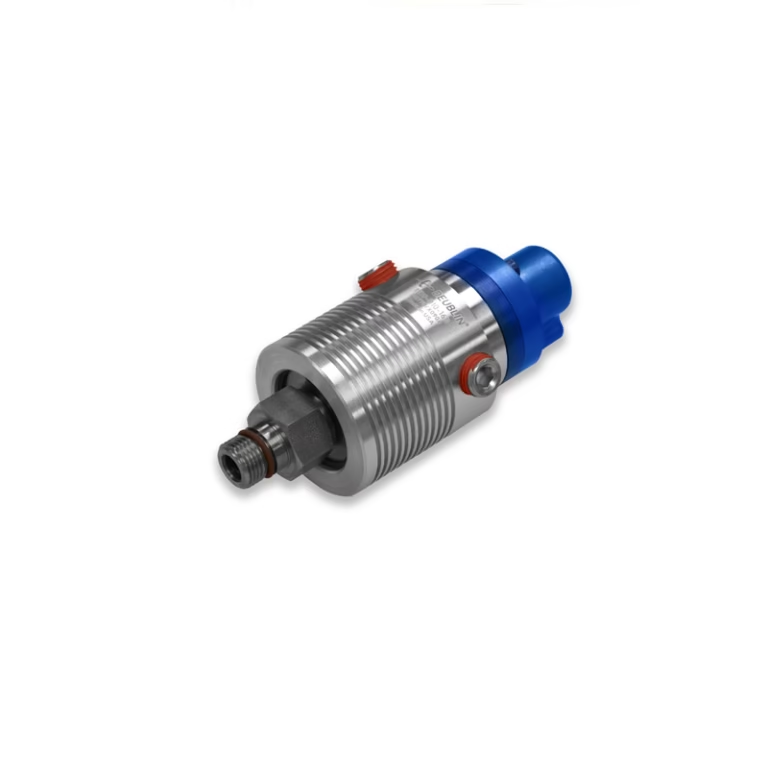
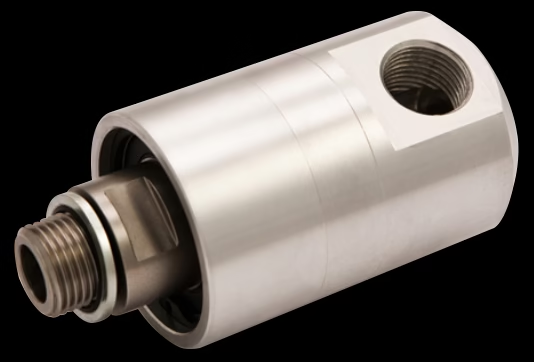
The Deublin 1109 Series Rotary Union is a single-passage rotary union primarily designed for transferring coolant, hydraulic oil, or other industrial fluids from a stationary supply line into a rotating spindle or shaft.
The series is commonly installed on:
- CNC machining centers
- Turning centers
- Milling machines
- Drilling machines
- Automatic production equipment
- Rotary indexing tables
- Transfer machines
Its primary purpose is to maintain a reliable fluid seal while allowing continuous shaft rotation. By delivering coolant directly through the spindle, the rotary union improves machining efficiency, extends cutting tool life, and enhances workpiece quality.
Typical operating media include:
- Water-based coolant
- Oil-based coolant
- Hydraulic oil
- Lubricating oil
- Compressed air (selected configurations)
Although individual models differ slightly, most 1109 Series rotary unions share several core characteristics:
- Compact aluminum housing
- Precision-machined rotating shaft
- High-quality mechanical seals
- Long-life bearings
- Easy installation
- Low maintenance requirements
Because these units are frequently installed inside expensive machine tool spindles, dimensional accuracy and sealing reliability are critical. Even a slight deviation in concentricity or bearing preload can shorten spindle bearing life or lead to coolant leakage.
This is one of the main reasons professional OEM replacement manufacturers pay close attention not only to external dimensions but also to internal engineering details.
Why Is the 1109 Series Still Widely Used?
Although many newer rotary union designs have entered the market, the 1109 Series remains one of the most common replacement models worldwide.
There are several reasons for its continued popularity.
Proven Reliability
Machine tool manufacturers tend to avoid changing proven designs unless there is a clear performance advantage. The 1109 Series has accumulated decades of successful operation across thousands of production lines.
Many machining centers built 10–20 years ago are still running efficiently today, and they continue to require compatible replacement rotary unions during routine maintenance.
Rather than replacing an entire spindle assembly, maintenance teams usually prefer installing a direct replacement rotary union that fits without modifications.
Excellent Compatibility
One reason the series has remained popular is its standardized installation dimensions.
Most maintenance engineers are looking for a component that can simply be removed and replaced during scheduled downtime.
A compatible replacement should provide:
- Identical mounting dimensions
- Matching thread specifications
- Equivalent pressure capability
- Comparable rotational speed
- Similar sealing performance
- No modification to the original machine
For maintenance departments, reducing installation complexity often matters as much as the purchase price.
Suitable for High-Volume Production
Modern manufacturing environments demand continuous production with minimal downtime.
Industries such as automotive, aerospace, mold manufacturing, electronics, and precision machining often operate machining centers around the clock.
Any unexpected coolant leakage can interrupt production, damage cutting tools, contaminate workpieces, and increase maintenance costs.
Because the 1109 Series has demonstrated stable long-term performance, it remains a preferred choice for preventive maintenance programs.
Typical Applications of the Deublin 1109 Series Rotary Union
Although originally developed for machine tools, the 1109 Series is now used in many different types of rotating equipment.
CNC Machining Centers
This is the most common application.
The rotary union supplies coolant through the spindle directly to the cutting tool, allowing efficient heat removal during drilling, milling, tapping, and boring operations.
Through-spindle coolant significantly improves chip evacuation, particularly when machining deep holes or difficult materials such as stainless steel, titanium, and high-strength alloys.
Automatic Production Lines
Many automated manufacturing systems rely on rotating fixtures that require continuous coolant or lubrication.
A reliable rotary union helps maintain stable production while minimizing maintenance interruptions.
Transfer Machines
Transfer machines often perform multiple machining operations simultaneously.
Stable coolant delivery helps maintain consistent machining quality across every station.
Rotary Indexing Tables
Rotary indexing tables frequently require hydraulic oil or compressed air to actuate fixtures during rotation.
The compact dimensions of the 1109 Series make it suitable for installations where available space is limited.
Special OEM Equipment
Many equipment manufacturers integrate rotary unions into custom-designed automation systems.
Examples include:
- Automated drilling machines
- Robot-assisted machining cells
- Packaging equipment
- Precision assembly machines
- Custom manufacturing systems
Because these machines are often produced in relatively small batches, OEM manufacturers value replacement suppliers capable of providing flexible production quantities and fast engineering support.
Our Manufacturing Experience with 1109 Series Replacements
At Dann Hydraulic, manufacturing rotary unions is not simply an assembly operation. Every replacement for the Deublin 1109 Series Rotary Union begins with a detailed engineering review based on actual industrial applications rather than only catalog drawings.
Over the years, we have supplied compatible rotary unions to distributors, machine rebuilders, CNC maintenance companies, and OEM equipment manufacturers across Europe, North America, Southeast Asia, and the Middle East. These customers expect more than dimensional compatibility—they require consistent sealing performance, stable bearing life, and reliable operation under demanding production schedules.
From our production experience, the most common causes of premature rotary union failure are not incorrect dimensions. Instead, they include:
- Seal face materials that are poorly matched to the coolant.
- Inadequate machining tolerances that increase shaft runout.
- Inferior bearings that lose preload during continuous high-speed operation.
- Insufficient pressure testing before shipment.
- Poor cleanliness during assembly allows microscopic particles to damage sealing faces during initial startup.
To avoid these issues, every production batch in our factory follows a controlled manufacturing process that includes:
- CNC machining with tight dimensional control.
- Precision inspection of critical sealing surfaces.
- Dynamic balance checks were required.
- Assembly in a clean production environment.
- Pressure and leakage testing before packaging.
- Final visual and dimensional inspection before shipment.
This manufacturing approach has allowed many customers to replace original 1109 Series rotary unions without modifying their machines while achieving dependable service life and reducing maintenance costs.
Why More Companies Are Choosing Deublin 1109 Series Rotary Union Replacements
The Market Has Changed: Procurement Priorities Are Different Today
Ten years ago, many maintenance departments automatically ordered the original replacement part whenever a rotary union failed. Today, purchasing decisions are driven by a broader set of business considerations.
Production managers want to reduce machine downtime. Procurement teams are expected to lower maintenance costs without sacrificing reliability. Machine builders need dependable suppliers that can support OEM projects with stable quality and predictable delivery schedules.
For these reasons, high-quality Deublin 1109 Series Rotary Union replacements have become an accepted solution across many industries.
A replacement should never be selected simply because it is less expensive. The right supplier should demonstrate that its product is engineered to the same functional standards, manufactured under strict quality control, and thoroughly tested before shipment.
At Dann Hydraulic, we often receive inquiries from customers who initially contacted us because of pricing. After reviewing their application requirements, most conversations quickly shift toward engineering compatibility, delivery reliability, and long-term performance. In many cases, those factors become more important than the initial purchase price.
Why Customers Replace the Original Deublin 1109 Series
After working with distributors, machine rebuilders, and OEM equipment manufacturers in more than 40 countries, we have found that replacement decisions usually fall into one or more of the following categories.
1. Rising Procurement Costs
Original branded spare parts continue to increase in price due to higher manufacturing costs, global logistics, and regional distribution expenses.
For companies operating dozens or even hundreds of CNC machining centers, the annual maintenance budget can become substantial.
Consider a factory with 120 machining centers. If each machine requires one rotary union replacement every three to five years, even a modest reduction in unit cost can translate into significant annual savings.
Rather than paying a premium for branding, many purchasing managers now focus on overall value:
- Does the replacement fit correctly?
- Does it perform reliably?
- Will it provide comparable service life?
- Can the supplier support future orders consistently?
When the answer to these questions is yes, the economic advantages become obvious.
2. Long Lead Times
Another common challenge is delivery.
Original rotary unions may require several weeks—or even months—to arrive, depending on regional inventory and distribution channels.
For production facilities running around the clock, waiting six to eight weeks for a replacement part is rarely acceptable.
Unexpected downtime affects far more than the maintenance budget. It can delay customer deliveries, reduce equipment utilization, and interrupt production schedules.
This is where an experienced OEM manufacturer offers a practical advantage.
Because we specialize in replacement rotary unions, we maintain production capacity for many popular models, including the 1109 Series. Standard models are often available from stock or can be manufactured within a much shorter production cycle than traditional branded supply chains.
For emergency maintenance projects, saving even one week can prevent costly production losses.
3. OEM Machine Builders Need Flexible Supply
Machine manufacturers face different challenges than end users.
Instead of purchasing one replacement every few years, OEM builders may require hundreds of rotary unions every month.
They also expect:
- Stable product quality
- Batch consistency
- Technical support
- Custom labeling
- Flexible packaging
- Engineering modifications
- Long-term production continuity
Large international brands typically prioritize standardized products.
By contrast, an experienced OEM manufacturer can provide customized solutions while maintaining dimensional compatibility with existing equipment.
This flexibility is especially valuable for machine builders exporting equipment under their own brands.
Cost Comparison: Original vs. High-Quality Replacement
Price alone should never determine purchasing decisions.
Instead, buyers should evaluate the total cost of ownership, including purchase price, delivery time, installation efficiency, operating reliability, and future maintenance.
The comparison below reflects what many industrial buyers consider during supplier evaluations.
| Evaluation Item | Original Brand | Quality OEM Replacement |
|---|---|---|
| Initial Purchase Cost | Higher | Typically 30–60% lower |
| Delivery Time | Often several weeks | Frequently available within days or a few weeks |
| Installation Dimensions | Original | Fully compatible when properly engineered |
| Machine Modification | Not required | Not required |
| Spare Parts Availability | Distributor dependent | Direct factory support |
| Engineering Communication | Through distributors | Direct communication with factory engineers |
| OEM Customization | Limited | Flexible |
| Private Label Service | Rare | Available |
| Long-Term Supply Planning | Distributor based | Factory production scheduling |
The objective is not to replace a premium product with an inferior copy. The goal is to obtain equivalent functional performance while reducing procurement costs and improving supply chain flexibility.
OEM Compatibility: What Does It Really Mean?
The phrase “OEM compatible” is often used in industrial marketing, but it is frequently misunderstood.
True compatibility extends well beyond matching external dimensions.
A professionally engineered replacement should also consider:
Mechanical Compatibility
The housing dimensions, shaft geometry, mounting interfaces, threads, and sealing locations must align precisely with the original design to ensure straightforward installation.
Hydraulic Compatibility
Internal flow passages should maintain efficient coolant or hydraulic fluid transfer without introducing unnecessary pressure losses.
Poor internal design may reduce coolant flow even if the exterior dimensions appear identical.
Operating Compatibility
The replacement should be capable of handling the same operating conditions, including:
- Working pressure
- Rotational speed
- Temperature range
- Media type
- Duty cycle
These factors directly affect long-term sealing performance.
Material Compatibility
Material selection plays a critical role in durability.
Depending on the application, different seal face combinations may be more suitable for:
- Water-soluble coolant
- Hydraulic oil
- Synthetic coolant
- Emulsion
- Light lubricating oil
Selecting the wrong seal materials can shorten service life even if every dimension matches perfectly.
Reverse Engineering Is More Than Copying
Some buyers assume replacement manufacturers simply duplicate an existing product.
Professional engineering is much more sophisticated.
When developing a replacement for the Deublin 1109 Series Rotary Union, experienced manufacturers typically evaluate:
- Internal fluid flow paths
- Bearing arrangement
- Seal face geometry
- Spring loading
- Surface finish
- Material hardness
- Dynamic balance
- Concentricity
- Thermal expansion during operation
In many cases, modern manufacturing equipment allows tighter machining tolerances than were common decades ago.
This creates opportunities to improve manufacturing consistency while maintaining full interchangeability with the original product.
How We Ensure Interchangeability
At Dann Hydraulic, compatibility verification begins long before production.
Our engineering team compares each replacement model against original specifications and real application requirements. The objective is to ensure that customers can install the replacement with confidence, without modifying their equipment.
Our verification process typically includes:
- Dimensional measurement using precision inspection equipment.
- Verification of mounting threads and connection interfaces.
- Inspection of shaft concentricity and critical tolerances.
- Evaluation of seal material selection based on the intended working medium.
- Pressure and leakage testing under simulated operating conditions.
- Functional rotation testing before shipment.
For repeat OEM customers, we also maintain controlled production records to ensure that every batch remains consistent over time. This level of traceability is especially important for machine builders who require interchangeable components across multiple production runs.
From our experience, dimensional compatibility is only the starting point. Consistent manufacturing quality is what allows a replacement rotary union to deliver dependable performance year after year.
Beyond Price: Reducing the Total Cost of Ownership
When evaluating a replacement supplier, experienced buyers rarely focus on the invoice price alone.
Instead, they ask questions such as:
- Will this rotary union install without additional machining?
- Can it maintain stable sealing performance under continuous production?
- Is technical support available if installation questions arise?
- Can the supplier deliver repeat orders quickly?
- Will spare parts remain available several years from now?
- Does the manufacturer understand my application rather than simply selling a catalog item?
These considerations determine the total cost of ownership, which often has a greater impact on profitability than the initial purchase price.
Engineering Behind a Reliable Deublin 1109 Series Rotary Union Replacement
Many rotary unions may look almost identical from the outside. The housing dimensions, thread size, and mounting flange can often be copied with modern CNC equipment. However, experienced maintenance engineers know that the real difference lies inside the product.
In our factory, we occasionally receive failed rotary unions from customers for analysis. Externally, many appear nearly new. Once disassembled, however, the causes of failure become clear: worn seal faces, damaged bearings, poor machining accuracy, contaminated internal components, or incorrect material selection.
This is why we believe a reliable Deublin 1109 Series Rotary Union replacement is built through engineering discipline—not simply by reproducing dimensions.
Below, we explain the key factors that determine long-term performance from a manufacturer’s perspective.
Precision Machining: The Foundation of Reliable Performance
Every rotary union begins as a collection of machined components. Even the highest-quality seals cannot compensate for poor machining.
Critical features include:
- Shaft concentricity
- Bearing seat accuracy
- Seal face flatness
- Thread precision
- Surface roughness
- Housing alignment
A deviation of only a few microns may not be visible to the naked eye, but it can significantly affect sealing stability at high rotational speeds.
At Dann Hydraulic, critical components are produced on CNC turning and machining centers with strict process controls. Key dimensions are verified throughout production rather than only during final inspection.
Our machining team follows documented inspection procedures because maintaining consistent tolerances across hundreds or thousands of parts is more challenging than producing a single accurate sample.
This manufacturing consistency is especially important for OEM customers who require interchangeable components across multiple production batches.
Seal Technology: The Heart of Every Rotary Union
If machining provides the foundation, the sealing system determines whether the rotary union will perform reliably over thousands of operating hours.
Mechanical seal faces operate under continuous contact while the shaft rotates at high speed. They must maintain an effective seal while minimizing friction and wear.
Selecting the correct seal combination depends on several operating conditions:
- Working medium
- Operating pressure
- Rotational speed
- Temperature
- Coolant chemistry
- Expected service life
There is no universal seal material suitable for every application.
Common Seal Face Materials
Depending on customer requirements, we typically recommend combinations such as:
Carbon Graphite
Advantages:
- Excellent self-lubricating properties
- Stable operation with water-based coolants
- Low friction
- Suitable for many general industrial applications
Silicon Carbide
Advantages:
- Outstanding wear resistance
- Excellent corrosion resistance
- High hardness
- Suitable for demanding coolant systems
Silicon carbide performs particularly well in applications involving abrasive particles or extended operating cycles.
Tungsten Carbide
Advantages:
- Extremely high hardness
- Excellent mechanical strength
- Long service life
- Ideal for high-pressure applications
For demanding CNC machining centers operating under continuous production schedules, tungsten carbide seal faces often provide excellent durability.
The appropriate material should always be selected according to the actual operating environment rather than simply choosing the most expensive option.
Bearing Selection Makes a Bigger Difference Than Many Buyers Realize
Many rotary union failures that appear to be seal problems actually begin with bearing deterioration.
As bearing clearance increases, shaft runout also increases. Even a slight increase in runout can prevent the mechanical seal faces from maintaining uniform contact.
The result may include:
- Coolant leakage
- Increased vibration
- Higher operating temperature
- Seal wear
- Premature failure
For this reason, bearing quality directly affects seal life.
In our production process, bearing selection is never based solely on price.
Instead, we evaluate:
- Dynamic load capacity
- Rotational speed
- Fatigue life
- Lubrication performance
- Dimensional consistency
- Long-term stability
Depending on customer requirements and application conditions, we use internationally recognized bearing brands or equivalent premium-grade bearings that meet the required performance standards.
Material Selection: Matching the Application
Different industries expose rotary unions to very different operating environments.
For example:
A machining center using synthetic coolant requires different corrosion resistance than a steel mill transferring hydraulic oil.
Likewise, food-processing equipment may require stainless steel components to satisfy hygiene requirements.
Typical housing materials include:
- Aluminum alloy
- Brass
- Carbon steel
- Stainless steel 304
- Stainless steel 316
Internal components may also receive specialized surface treatments to improve wear resistance and corrosion protection.
Rather than using one material for every application, we recommend selecting the most appropriate material according to actual operating conditions.
This approach often improves both performance and cost efficiency.
Factory Testing: Every Rotary Union Should Prove Its Performance Before Shipment
One of the biggest differences between a professional manufacturer and a low-cost supplier is the testing process.
A rotary union should never leave the factory based solely on dimensional inspection.
Functional testing is equally important.
At Dann Hydraulic, production testing typically includes several stages.
Pressure Testing
Each rotary union is tested under controlled pressure conditions to verify sealing performance.
The objective is to ensure that internal sealing components remain stable under operating pressure without leakage.
Rotation Testing
The assembled rotary union is rotated under simulated operating conditions.
This allows technicians to evaluate:
- Smooth rotation
- Bearing performance
- Seal stability
- Abnormal vibration
- Operating noise
Minor assembly issues that cannot be detected visually often become apparent during rotation testing.
Leakage Inspection
Leakage testing verifies that sealing performance meets production requirements before shipment.
Any unit failing inspection is immediately removed for further analysis rather than repaired and mixed back into production.
Dimensional Verification
Critical dimensions are measured again after assembly to confirm installation compatibility.
This step helps prevent installation issues at the customer’s facility.
Quality Control Begins Before Production Starts
Many people assume quality inspection occurs only after manufacturing is complete.
In reality, quality control begins with incoming raw materials.
Our production workflow includes multiple inspection stages:
Incoming Material Inspection
Raw materials are verified for:
- Chemical composition
- Hardness
- Surface condition
- Dimensional accuracy
Only approved materials enter production.
In-Process Inspection
Operators inspect critical dimensions throughout machining.
Rather than waiting until every component is completed, measurements are performed continuously during production.
This reduces variation and improves batch consistency.
Assembly Inspection
Before final assembly, technicians inspect:
- Seal faces
- Bearing installation
- Component cleanliness
- Surface finish
Dust particles or machining residue can significantly shorten seal life, so cleanliness is treated as a critical quality factor.
Final Inspection
Before packaging, each rotary union undergoes a final review covering:
- Appearance
- Dimensions
- Functional testing results
- Product identification
- Packaging integrity
Only products that pass every inspection stage are approved for shipment.
Lessons We’ve Learned from Manufacturing Thousands of Rotary Unions
Over the years, our engineering team has analyzed numerous rotary unions returned from the field. These analyses have revealed consistent patterns that influence product reliability.
One recurring issue is application mismatch. In several cases, customers initially selected a replacement based only on thread size and overall dimensions. After reviewing the failed units, we found that the working pressure, rotational speed, or coolant type exceeded the product’s intended operating range. Once the correct seal materials and bearing configuration were specified, the replacement operated reliably for much longer service intervals.
Another lesson involves installation practices. Even a well-manufactured rotary union can fail prematurely if shaft alignment is poor, pipe connections place excessive stress on the housing, or contamination enters the system during installation. For this reason, our technical team routinely asks customers about spindle speed, media type, pressure, and machine model before recommending a replacement.
Finally, we have learned that consistency matters more than isolated performance. Producing one excellent sample is relatively straightforward; delivering thousands of interchangeable rotary unions with stable quality requires disciplined manufacturing processes, documented inspections, and continuous process improvement. That philosophy guides our production every day.
How to Choose the Correct Deublin 1109 Series Replacement
Many buyers believe that matching the part number is enough. In reality, selecting the correct replacement requires confirming several operating parameters.
Before ordering, we recommend verifying the following information:
1. Original Part Number
The easiest starting point is the original Deublin model number.
Examples may include different variants within the 1109 Series that have unique thread sizes, mounting configurations, or seal arrangements.
Providing the original nameplate or product photo allows engineers to identify the correct replacement more accurately.
2. Working Medium
The sealing materials should be compatible with the fluid passing through the rotary union.
Typical media include:
- Water-soluble coolant
- Synthetic coolant
- Hydraulic oil
- Lubricating oil
- Compressed air
Different media require different seal face combinations.
Selecting the proper material can significantly extend service life.
3. Operating Pressure
Pressure directly influences seal loading.
Always verify:
- Maximum working pressure
- Normal operating pressure
- Pressure fluctuations
- Pressure spikes
A rotary union designed for moderate pressure may fail prematurely in systems experiencing frequent pressure surges.
4. Rotational Speed
Higher spindle speeds generate additional heat and place greater demands on both bearings and seal faces.
Important information includes:
- Maximum RPM
- Continuous operating RPM
- Intermittent duty cycle
Providing accurate speed data enables manufacturers to recommend the most appropriate bearing and seal configuration.
5. Temperature Range
Temperature affects:
- Seal elasticity
- Lubrication
- Bearing life
- Thermal expansion
For applications involving elevated coolant temperatures, suitable seal materials become even more important.
6. Machine Model
Knowing the machine manufacturer and model often helps verify compatibility.
For example:
- CNC machining center
- Horizontal machining center
- Vertical machining center
- Turning center
- Rotary transfer machine
Many machine builders use standardized rotary union configurations that simplify replacement selection.
OEM Compatibility Checklist
Before purchasing a replacement, professional buyers typically confirm the following items:
- Overall dimensions
- Mounting interface
- Thread specifications
- Shaft dimensions
- Flow direction
- Working pressure
- Maximum speed
- Temperature range
- Seal material
- Bearing configuration
- Installation method
- Fluid compatibility
- Maintenance requirements
A qualified OEM supplier should be able to confirm these specifications before production begins.
Installation Best Practices
Many rotary union failures originate during installation rather than during manufacturing.
Following proper installation procedures can significantly improve reliability.
Inspect the Machine Before Installation
Before installing the new rotary union:
Check for:
- Spindle runout
- Damaged threads
- Surface scratches
- Dirt or metal chips
- Worn bearings
Installing a new rotary union onto a damaged spindle rarely solves the underlying problem.
Clean All Connections
One small metal particle trapped between sealing surfaces may lead to leakage shortly after startup.
Before installation:
- Clean threaded connections.
- Remove old sealing compound.
- Flush coolant passages.
- Inspect O-rings.
- Ensure mounting surfaces are free of burrs.
Clean assembly conditions are just as important in the customer’s workshop as they are during factory assembly.
Avoid Excessive Pipe Stress
Rigid piping should never force the rotary union into position.
Pipe misalignment can create unnecessary radial loads on the bearings, reducing service life.
Whenever possible:
- Use flexible hose connections.
- Support heavy piping independently.
- Eliminate unnecessary side loads.
Tighten According to Specifications
Over-tightening is surprisingly common.
Excessive torque may:
- Damage threads
- Distort sealing components
- Affect bearing preload
Always follow the recommended tightening torque provided by the equipment manufacturer or supplier.
Perform a Low-Speed Trial Run
Before returning the machine to full production:
Operate at reduced speed.
Monitor:
- Leakage
- Noise
- Vibration
- Temperature
If everything remains stable, gradually increase to normal operating conditions.
This simple procedure often prevents avoidable failures.
The Most Common Causes of Rotary Union Failure
Through field analysis and returned product inspections, we have identified several recurring failure modes.
Understanding these issues helps maintenance teams prevent repeat failures.
1. Seal Face Wear
Symptoms:
- Coolant leakage
- Reduced sealing performance
- Fluid dripping during operation
Possible causes:
- Abrasive particles
- Dry running
- Incorrect seal materials
- Excessive operating pressure
Solution:
Replace worn seals and verify media compatibility.
2. Bearing Failure
Symptoms:
- Vibration
- Noise
- Shaft movement
- Rapid seal wear
Possible causes:
- Poor lubrication
- Excessive speed
- Pipe stress
- Contamination
Solution:
Replace bearings and identify the source of abnormal loading.
3. Coolant Contamination
Contaminated coolant is one of the most underestimated causes of rotary union failure.
Metal chips and abrasive particles gradually damage seal faces.
Preventive measures include:
- Coolant filtration
- Regular coolant replacement
- Cleaning coolant tanks
- Monitoring contamination levels
4. Incorrect Installation
Typical installation errors include:
- Misalignment
- Incorrect tightening torque
- Improper hose routing
- Damaged threads
- Failure to clean mounting surfaces
Even the highest-quality rotary union cannot compensate for poor installation practices.
5. Application Mismatch
Sometimes the rotary union itself is functioning correctly, but the selected model is not suitable for the operating conditions.
Examples include:
- Pressure exceeding design limits
- Excessive spindle speed
- Incompatible coolant chemistry
- Temperature outside the recommended range
Selecting the correct model from the beginning is the most effective way to avoid these problems.
Preventive Maintenance Recommendations
A rotary union is a wear component, but regular maintenance can significantly extend its service life.
Based on our experience, we recommend the following preventive maintenance schedule:
| Maintenance Item | Recommended Interval |
|---|---|
| Inspect for external leakage | Weekly |
| Check coolant quality | Monthly |
| Inspect hose connections | Monthly |
| Monitor spindle vibration | Monthly |
| Verify operating pressure | Every 3 months |
| Inspect rotary union mounting bolts | Every 6 months |
| Replace worn seals if necessary | During scheduled maintenance |
| Replace the rotary union based on service condition, not only on failure | According to the equipment maintenance plan |
A preventive maintenance strategy reduces unplanned downtime and often lowers the overall maintenance cost of the machine.
Frequently Asked Questions
Can a replacement rotary union perform as well as the original?
Yes, provided it is manufactured with appropriate materials, precision machining, and comprehensive testing. The key factor is selecting a supplier with proven engineering and manufacturing capabilities rather than choosing solely on price.
Will a compatible replacement require machine modifications?
A properly engineered replacement should install directly in place of the original without altering the machine. Before production, we verify mounting dimensions, thread specifications, and operating parameters to ensure interchangeability.
How long does a rotary union typically last?
Service life depends on many variables, including spindle speed, operating pressure, coolant cleanliness, maintenance practices, and installation quality. Under appropriate operating conditions and routine maintenance, a quality rotary union can provide reliable service for many years.
What information should I provide when requesting a quotation?
The most helpful information includes:
- Original Deublin part number
- Machine manufacturer and model
- Working medium
- Operating pressure
- Maximum rotational speed
- Temperature range
- Photos or technical drawings, if available
Providing these details enables engineers to recommend the most suitable replacement with greater accuracy.
Can OEM manufacturers customize rotary unions?
Yes. Beyond standard interchangeable models, experienced OEM manufacturers can often provide customized thread connections, special seal materials, modified housings, private labeling, laser marking, and tailored packaging for distributors and machine builders.
From Replacement Supplier to Long-Term Engineering Partner
For many industrial companies, purchasing a Deublin 1109 Series Rotary Union replacement begins as a search for a lower-cost spare part. However, long-term success depends on more than price. Reliable technical support, consistent manufacturing quality, stable lead times, and a clear understanding of real-world applications are equally important.
The strongest supplier relationships are built when manufacturers contribute engineering knowledge throughout the product lifecycle—from model selection and production to testing and after-sales support.
Why Global Buyers Are Choosing Chinese Manufacturers
China has become one of the world’s largest manufacturing centers for industrial components. This is not simply because of labor costs, but because the country’s manufacturing ecosystem provides access to advanced CNC equipment, high-quality raw materials, skilled engineers, and efficient logistics.
For rotary unions, these advantages translate into practical benefits.
1. Lower Total Procurement Cost
Choosing a Chinese OEM manufacturer does not mean compromising on quality. When production is managed correctly, buyers can achieve substantial savings while maintaining dependable performance.
Compared with purchasing original branded spare parts, many customers reduce procurement costs by 30–60%, depending on the model and order quantity.
These savings become especially meaningful for:
- CNC machine tool manufacturers
- Industrial maintenance companies
- Spare parts distributors
- Large manufacturing plants with multiple machining centers
Reducing the cost of a single rotary union may seem modest, but across hundreds of machines and years of operation, the financial impact is significant.
2. Faster Lead Times
Production downtime is often more expensive than the replacement part itself.
For this reason, delivery speed is one of the most common reasons customers contact us.
As a dedicated rotary union manufacturer, we maintain production capacity for many standard replacement models, including the Deublin 1109 Series Rotary Union.
Depending on order volume, standard models can often be:
- Shipped directly from inventory
- Produced within a short manufacturing cycle
- Delivered through international express or air freight for urgent maintenance projects
For machine builders, shorter lead times also simplify production planning and inventory management.
3. Flexible OEM and Private Label Services
Unlike standardized catalog suppliers, OEM manufacturers can adapt products and services to meet customer requirements.
Our OEM services include:
- Custom laser marking
- Private label branding
- Customized packaging
- User manuals
- Product labels
- Thread modifications
- Material upgrades
- Special seal configurations
- Small-batch production
- Long-term supply agreements
This flexibility is particularly valuable for distributors and machine builders developing their own product lines.
What Makes Dann Hydraulic Different?
There are many factories capable of machining metal components. Fewer companies specialize in rotary unions, and even fewer focus on producing high-quality replacements for internationally recognized brands.
At Dann Hydraulic, our objective is not to manufacture the lowest-cost product. Instead, we aim to deliver rotary unions that provide reliable performance while helping customers reduce procurement costs and shorten delivery times.
Our manufacturing philosophy is built on four principles:
Engineering Before Production
Every quotation begins with an engineering review.
Our technical team verifies:
- Operating pressure
- Rotational speed
- Working medium
- Mounting dimensions
- Seal material selection
- Application requirements
This process helps ensure that the proposed replacement is suitable for the customer’s equipment rather than simply matching a part number.
Precision Manufacturing
We manufacture rotary union components using modern CNC machining equipment and controlled production processes.
Critical dimensions are inspected throughout production to maintain consistency across every batch.
Particular attention is given to:
- Shaft concentricity
- Seal contact surfaces
- Bearing fits
- Thread accuracy
- Surface finish
Stable machining quality contributes directly to long-term sealing performance.
Comprehensive Quality Testing
Every rotary union should demonstrate its performance before it reaches the customer.
Our inspection process includes:
- Incoming material inspection
- Dimensional verification
- Assembly inspection
- Pressure testing
- Leakage testing
- Rotation testing
- Final appearance inspection
Products that do not meet our quality standards are rejected before shipment.
Technical Support That Continues After Delivery
A reliable supplier should remain available after the product is installed.
Our engineers regularly assist customers with:
- Product selection
- Installation recommendations
- Failure analysis
- Replacement identification
- OEM development projects
- Drawing evaluation
- Reverse engineering support
Many of our long-term customers view us as an extension of their engineering team rather than simply a component supplier.
A Real Example from Our Manufacturing Experience
One of our European distributor customers supports maintenance companies serving CNC machining centers from several different machine tool brands.
Previously, they relied almost exclusively on original spare parts. However, increasing lead times and fluctuating availability made it difficult to respond quickly to customer maintenance requests.
After evaluating our Deublin 1109 Series replacement, they conducted a structured trial on multiple machines operating under typical production conditions.
The evaluation focused on:
- Installation compatibility
- Coolant sealing performance
- Operating stability
- Bearing performance
- Delivery consistency
Following several months of successful operation, the distributor gradually expanded the use of our replacement rotary unions across additional customer projects.
Today, they maintain lower inventory costs, shorter delivery times, and greater supply flexibility while continuing to meet the performance expectations of their end users.
While every application is unique, this experience reflects a broader trend we have observed in recent years: industrial buyers increasingly prioritize dependable manufacturing partners who combine engineering expertise with responsive support.
Our Commitment to Continuous Improvement
Manufacturing industrial components is not a one-time achievement. Customer requirements, machining technology, and operating conditions continue to evolve.
For this reason, we regularly invest in:
- New CNC equipment
- Improved inspection instruments
- Advanced seal materials
- Process optimization
- Employee technical training
- Production documentation
- Quality management improvements
Continuous improvement enables us to deliver consistent products while responding to changing customer needs.
Why a Reliable Replacement Is About More Than Price
Selecting a replacement for the Deublin 1109 Series Rotary Union is as much an engineering decision as a purchasing decision.
A dependable replacement should provide:
- Full installation compatibility
- Stable sealing performance
- Reliable bearing life
- Appropriate material selection
- Consistent manufacturing quality
- Fast delivery
- Responsive technical support
- Long-term supply stability
When these elements come together, the result is lower maintenance costs, reduced downtime, and greater confidence in your equipment.
Conclusion
The Deublin 1109 Series Rotary Union has earned its reputation through decades of dependable service in CNC machining centers and industrial equipment. As these machines continue to operate worldwide, the demand for high-quality replacement rotary unions continues to grow.
A professional OEM replacement is not simply an alternative—it is a practical solution for companies seeking to optimize maintenance budgets, improve supply chain resilience, and maintain reliable machine performance.
At Dann Hydraulic, we combine precision manufacturing, rigorous quality control, and real-world engineering experience to produce rotary unions that are fully compatible with many Deublin models. Our focus is on helping customers achieve reliable performance, shorter lead times, and lower total ownership costs without compromising quality.
Whether you are a machine builder, distributor, maintenance provider, or manufacturing plant, choosing the right rotary union supplier can have a lasting impact on equipment reliability and operational efficiency.
If you are looking for a dependable Deublin 1109 Series Rotary Union replacement, our engineering team is ready to review your application, verify compatibility, and recommend the most appropriate solution for your equipment.