

Corrosion-Resistant Stainless Steel Rotary Joint for Industrial Applications
Original price was: $50.00.$35.00Current price is: $35.00.
- Material: China 316 stainless steel rotary joint
- Maximum speed of use: 100RPM
- Maximum temperature : 5MPA
- Media: Water, AIR, Oxygen, Hydrogen,etc
- Maximum temperature: 200℃
Description
Modern industrial equipment operates under increasingly demanding conditions. High temperatures, corrosive media, frequent washdowns, and continuous production cycles require rotary joints that can maintain reliable sealing performance while resisting corrosion and mechanical wear. A standard carbon steel rotary joint may perform well in general industrial environments, but industries such as food processing, pharmaceuticals, chemicals, marine engineering, and high-humidity manufacturing often require a more durable solution. A Stainless Steel Rotary Joint is specifically designed for these challenging applications. Manufactured from high-quality stainless steel materials, it provides excellent corrosion resistance, longer service life, and reliable fluid transfer between stationary piping and rotating equipment.
At Dann Hydraulic, we manufacture stainless steel rotary joints for customers worldwide. Our products are engineered to handle steam, water, thermal oil, compressed air, vacuum, hydraulic oil, and other industrial media while maintaining stable performance under continuous operation. Whether you need a replacement for an existing rotary joint or a customized solution for new equipment, our engineering team can recommend the most suitable design based on your operating conditions.
Unlike trading companies that simply resell standard products, we manufacture rotary joints in-house, allowing us to control machining quality, material selection, pressure testing, and final inspection. This manufacturing capability enables us to deliver reliable products, flexible customization, and responsive engineering support for OEMs, distributors, and end users.
Why Choose a Stainless Steel Rotary Joint?
Rotary joints are critical components in rotating machinery. They allow fluids or gases to pass from a stationary supply line into rotating equipment without leakage.
When operating environments involve moisture, aggressive chemicals, saltwater, cleaning agents, or food-grade requirements, stainless steel offers significant advantages over conventional carbon steel.
Our stainless steel rotary joints provide:
- Excellent corrosion resistance
- Long service life in harsh environments
- Stable sealing performance
- High mechanical strength
- Reduced maintenance frequency
- Improved hygiene for sanitary applications
- Compatibility with multiple industrial media
- Reliable operation during continuous production
These advantages make stainless steel rotary joints the preferred choice for industries where equipment reliability directly affects productivity and product quality.

What Is a Stainless Steel Rotary Joint?
A stainless steel rotary joint is a precision-engineered mechanical device that transfers fluids from a stationary source into rotating equipment while maintaining a leak-free seal.
During operation, one part of the rotary joint remains stationary while the rotating shaft turns continuously. Precision mechanical seals inside the assembly prevent leakage while allowing smooth rotation under pressure and temperature.
Depending on the application, stainless steel rotary joints can transfer:
- Steam
- Condensate
- Cooling water
- Hot water
- Thermal oil
- Hydraulic oil
- Compressed air
- Vacuum
- Nitrogen
- Process fluids
The combination of precision machining, optimized sealing technology, and corrosion-resistant materials allows these rotary joints to operate reliably in demanding industrial environments.

Why Material Selection Matters
One of the most overlooked factors in rotary joint performance is material selection.
Many failures that appear to be caused by seal wear are actually the result of corrosion damaging the sealing surfaces or weakening structural components.
Choosing the correct stainless steel grade significantly extends equipment life and reduces maintenance costs.
304 Stainless Steel
304 stainless steel is widely used in general industrial applications because it provides:
- Good corrosion resistance
- High mechanical strength
- Excellent machinability
- Competitive cost
Typical applications include:
- Textile machinery
- Packaging equipment
- General manufacturing
- Cooling water systems
316 Stainless Steel
316 stainless steel contains molybdenum, providing improved resistance to chlorides and aggressive chemicals.
It is commonly selected for:
- Food processing
- Beverage production
- Pharmaceutical equipment
- Marine applications
- Chemical processing
- Saltwater environments
For customers operating in corrosive conditions, our engineers often recommend 316 stainless steel to maximize equipment reliability.
316L Stainless Steel
316L offers the corrosion resistance of 316 while reducing the risk of intergranular corrosion after welding.
It is frequently used in:
- Hygienic processing equipment
- Clean-in-place (CIP) systems
- Pharmaceutical production
- Biotechnology equipment
- High-purity fluid handling
Common Rotary Joint Problems and Practical Solutions
Even high-quality rotary joints eventually require maintenance. However, understanding the causes of failure can significantly reduce downtime and extend equipment life.
Below are the issues our engineers encounter most frequently when supporting industrial customers.
Problem 1: External Leakage
External leakage is usually the first visible sign that maintenance is required.
Possible causes include:
- Mechanical seal wear
- Damaged O-rings
- Improper installation
- Shaft vibration
- Excessive pressure
- Surface corrosion
Before replacing the rotary joint, we recommend inspecting shaft alignment and verifying that operating conditions remain within the product’s design limits.
In many cases, correcting installation issues prevents repeated failures.
Problem 2: Internal Corrosion
Although stainless steel offers excellent corrosion resistance, selecting the wrong material grade may still lead to corrosion under aggressive operating conditions.
For example:
304 stainless steel performs well in general industrial environments but may experience localized corrosion when exposed to chloride-rich solutions.
In these applications, 316 or 316L stainless steel generally provides superior long-term performance.
Selecting the correct material during the design stage is often far less expensive than replacing equipment later.
Problem 3: Bearing Damage
Bearing failures usually develop gradually.
Common warning signs include:
- Abnormal noise
- Increased vibration
- Rising operating temperature
- Shaft instability
Our engineers recommend replacing worn bearings before they damage the sealing surfaces, helping avoid more extensive repairs.
Problem 4: Seal Face Wear
Mechanical seals are precision components designed to operate under carefully controlled contact pressure.
Seal wear may increase due to:
- Contaminated working media
- Dry running
- Excessive shaft movement
- Incorrect spring loading
- Thermal shock
To improve seal life, we optimize seal face geometry and carefully match seal materials to each application.
Problem 5: Excessive Vibration
Vibration affects nearly every rotating component.
Possible causes include:
- Shaft misalignment
- Bearing wear
- Poor machining accuracy
- Pipe stress
- Dynamic imbalance
Reducing vibration improves both seal life and overall equipment reliability.

Industry Applications: Where Stainless Steel Rotary Joints Deliver the Greatest Value
Although stainless steel rotary joints are often associated with food and pharmaceutical equipment, their corrosion resistance and long service life make them suitable for a much broader range of industrial applications. Over the years, our engineering team has supplied rotary joints for customers working in harsh environments where standard carbon steel products could not provide the required durability.
The following industries represent some of the most common applications.
Marine and Offshore Equipment
Marine environments present one of the toughest operating conditions for rotating sealing systems.
Equipment is continuously exposed to:
- Saltwater
- High humidity
- Salt spray
- Corrosive air
- Temperature fluctuations
These conditions accelerate corrosion on conventional steel components and can significantly reduce the service life of rotary joints.
Our stainless steel rotary joints are commonly used on:
- Cable reels
- Winches
- Offshore cranes
- Deck machinery
- Cooling systems
- Hydraulic equipment
- Shipbuilding machinery
For applications involving seawater or highly corrosive environments, our engineers typically recommend 316 or 316L stainless steel to maximize corrosion resistance and reduce maintenance frequency.
Paper and Pulp Industry
Paper mills operate under demanding conditions involving steam, condensate, hot water, and continuous rotation.
Rotary joints are installed on:
- Dryer cylinders
- Paper machine rolls
- Calenders
- Coating equipment
- Finishing machinery
Because paper mills often operate continuously for weeks, equipment reliability directly influences production efficiency.
Our stainless steel rotary joints provide:
- Reliable steam transfer
- Efficient condensate removal
- Stable sealing performance
- Reduced maintenance intervals
By minimizing steam leakage and improving heat transfer efficiency, customers can reduce energy consumption while maintaining consistent paper quality.
Textile Manufacturing
Textile factories frequently operate in environments with high humidity, airborne fibers, and elevated temperatures.
Typical applications include:
- Sizing machines
- Drying cylinders
- Stenter machines
- Dyeing equipment
- Printing machines
- Laminating equipment
- Fabric finishing systems
Although many textile applications can use carbon steel rotary joints, stainless steel offers additional protection against corrosion caused by moisture and chemical cleaning agents.
For export-oriented textile manufacturers seeking longer equipment life and lower maintenance costs, stainless steel has become an increasingly popular choice.
Battery and New Energy Manufacturing
The rapid growth of lithium battery production has increased demand for highly reliable rotating fluid transfer systems.
Battery manufacturing equipment often requires:
- Cooling water circulation
- Temperature control
- Chemical resistance
- Continuous production capability
Equipment reliability is especially important because production interruptions can affect product consistency and manufacturing efficiency.
Our stainless steel rotary joints provide dependable fluid transfer while resisting corrosion caused by humid production environments.
Semiconductor Manufacturing
Semiconductor production requires precision temperature control and clean operating conditions.
Rotary joints may be installed on:
- Wafer processing equipment
- Cooling systems
- Vacuum equipment
- Automated production machinery
For these applications, dimensional accuracy, sealing performance, and material cleanliness are particularly important.
Our precision machining process helps ensure consistent performance in demanding manufacturing environments.
Rubber and Tire Manufacturing
Rubber processing equipment often operates with:
- Steam
- Cooling water
- Thermal oil
- High temperatures
- Continuous production cycles
Applications include:
- Tire curing presses
- Mixing equipment
- Calenders
- Extrusion systems
Our stainless steel rotary joints help maintain stable fluid transfer while resisting corrosion caused by humid production environments and process chemicals.


Engineering Lessons Learned from Customer Projects
One of the advantages of manufacturing rotary joints rather than simply distributing them is the opportunity to continuously improve products based on real operating feedback.
A customer from the chemical industry contacted us after replacing several rotary joints within a single year. The original units suffered repeated leakage despite multiple seal replacements.
Instead of immediately recommending another replacement, our engineers reviewed the complete operating conditions.
We discovered that the cleaning process involved aggressive chemical solutions during scheduled maintenance. While the operating medium itself was compatible with the original seal material, the cleaning chemicals gradually attacked the elastomer components, causing premature seal degradation.
After reviewing the complete cleaning procedure, we recommended:
- Upgrading to 316L stainless steel.
- Selecting chemically compatible seal materials.
- Adjusting the maintenance procedure to reduce unnecessary thermal shock.
- Inspecting shaft alignment during scheduled shutdowns.
Following these changes, maintenance frequency was significantly reduced, and equipment availability improved.
Projects like this demonstrate why application engineering is just as important as manufacturing quality.
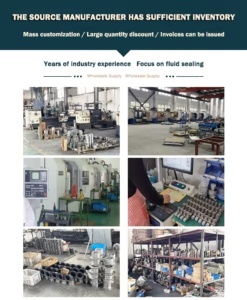
Engineering Experience from Our Factory
As a rotary joint manufacturer, we have learned that successful applications depend on understanding the customer’s process rather than simply supplying a component.
One project involved a food processing customer who experienced recurring corrosion on carbon steel rotary joints installed on steam-heated drying equipment. Although the mechanical seals remained functional, corrosion gradually affected the housing and sealing surfaces, leading to leakage and frequent maintenance.
After reviewing the operating environment, our engineers recommended replacing the original carbon steel units with 316 stainless steel rotary joints featuring upgraded seal materials designed for high-temperature steam service.
Following installation, the customer reported significantly improved corrosion resistance, fewer maintenance interventions, and more stable production during continuous operation.
Experiences like this continue to shape our product development. Instead of treating every application the same, we evaluate the complete operating environment—including fluid type, cleaning chemicals, ambient humidity, pressure, temperature, rotational speed, and maintenance practices—to recommend the most suitable rotary joint configuration.
This engineering-first approach allows us to provide practical solutions that perform reliably in real industrial environments, not just under laboratory test conditions.
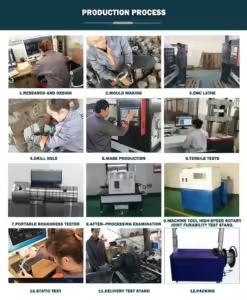
Manufacturing Quality Begins Before Assembly
Every stainless steel rotary joint starts with carefully selected raw materials.
Our production process includes:
- Material verification
- CNC machining
- Precision grinding
- Dimensional inspection
- Mechanical seal fitting
- Bearing installation
- Assembly inspection
- Pressure testing
- Leakage testing
- Final quality inspection
Rather than relying solely on final inspection, we monitor quality throughout the manufacturing process to ensure consistency from one production batch to the next.

Designed for Long-Term Reliability
Many industrial customers evaluate rotary joints based solely on initial purchase price.
However, the true cost of ownership includes:
- Service life
- Maintenance frequency
- Production downtime
- Energy efficiency
- Spare parts consumption
- Labor costs
A well-designed stainless steel rotary joint often delivers lower total operating costs by reducing unexpected failures and extending maintenance intervals.
For this reason, our engineering philosophy focuses on maximizing long-term reliability rather than simply minimizing manufacturing cost. Every improvement in machining accuracy, material selection, seal design, and quality inspection contributes to more dependable performance in real industrial applications.

How We Manufacture Stainless Steel Rotary Joints
A stainless steel rotary joint is only as reliable as the manufacturing process behind it. While many products on the market appear similar from the outside, long-term performance depends on machining accuracy, material consistency, seal quality, and assembly precision.
At Dann Hydraulic, we manufacture rotary joints in-house, allowing us to monitor every critical production stage—from raw material inspection to final pressure testing. This manufacturing control helps ensure consistent quality while giving our engineers the flexibility to customize products for specific customer requirements.
Step 1 – Raw Material Inspection
Product reliability begins with selecting the correct material.
Depending on the customer’s application, we manufacture rotary joints using:
- 304 Stainless Steel
- 316 Stainless Steel
- 316L Stainless Steel
- Hardened Stainless Steel Components
- Carbon Graphite
- Silicon Carbide
- Tungsten Carbide
- High-performance Elastomers
Before production begins, incoming materials are inspected to verify:
- Material grade
- Surface quality
- Dimensional consistency
- Mechanical properties
- Traceability
Using the correct material is especially important for applications involving corrosive chemicals, food processing, marine environments, and pharmaceutical production.
Step 2 – Precision CNC Machining
The sealing performance of a rotary joint depends heavily on machining accuracy.
Our production workshop uses CNC machining centers to manufacture critical components with high dimensional consistency.
Key machining operations include:
- Shaft turning
- Housing machining
- Thread machining
- Seal cavity machining
- Bearing seat finishing
- Internal flow passage machining
High machining accuracy improves:
- Shaft concentricity
- Seal alignment
- Bearing stability
- Dynamic balance
- Product consistency
These factors directly influence the service life of both bearings and mechanical seals.
Step 3 – Mechanical Seal Manufacturing
The mechanical seal is the heart of every rotary joint.
Instead of selecting a single seal design for every application, we match seal materials to the customer’s operating conditions.
Factors considered include:
- Working medium
- Operating pressure
- Temperature
- Rotational speed
- Chemical compatibility
- Continuous or intermittent operation
For demanding applications, we frequently recommend combinations such as:
- Carbon Graphite + Silicon Carbide
- Silicon Carbide + Silicon Carbide
- Tungsten Carbide + Carbon Graphite
Selecting the appropriate seal combination helps reduce wear while maintaining stable sealing performance over long operating periods.
Step 4 – Precision Assembly
Assembly requires careful attention to cleanliness and alignment.
Before assembly, every component undergoes dimensional inspection.
Our technicians then install:
- Bearings
- Mechanical seals
- Springs
- O-rings
- Retaining components
Special attention is given to seal face cleanliness because even microscopic particles can affect sealing performance.
Every assembled rotary joint is rotated manually before testing to verify smooth operation.
Step 5 – Testing and Quality Verification
Quality inspection does not end with assembly.
Each completed rotary joint undergoes functional verification before shipment.
Depending on the product, testing may include:
- Hydrostatic pressure testing
- Pneumatic leakage testing
- Rotation testing
- Appearance inspection
- Dimensional verification
- Connection inspection
Only products meeting our internal quality standards proceed to packaging and shipment.
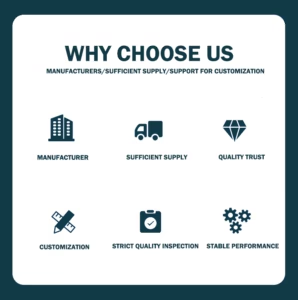
Why Engineers Worldwide Choose Dann Hydraulic
Industrial customers evaluate more than product specifications. They also consider the manufacturer’s engineering capability, production consistency, technical support, and long-term reliability.
At Dann Hydraulic, we focus on solving customer problems through manufacturing expertise and application engineering.
Manufacturing Rather Than Trading
Unlike companies that purchase finished products from multiple suppliers, we manufacture rotary joints in our own production facility.
This enables us to control:
- Raw material selection
- CNC machining
- Component inspection
- Assembly quality
- Pressure testing
- Leak testing
- Final quality verification
Maintaining control over the manufacturing process helps us deliver consistent quality and respond quickly to custom requirements.
Practical Engineering Experience
Every year, we work with customers from industries including:
- Food processing
- Beverage production
- Pharmaceutical manufacturing
- Chemical processing
- Marine engineering
- Paper production
- Textile manufacturing
- Steel processing
- Rubber and tire manufacturing
- Battery production
Each project provides valuable operating data that helps us continuously improve product performance.
Rather than relying only on theoretical calculations, we refine our designs based on real-world applications.
Continuous Product Improvement
Every returned product becomes an opportunity to improve future designs.
Our engineering team analyzes:
- Seal wear patterns
- Bearing performance
- Corrosion conditions
- Installation methods
- Operating temperatures
- Pressure fluctuations
- Customer maintenance records
These investigations have led to continuous improvements in:
- Mechanical seal geometry
- Bearing arrangements
- Internal flow channel design
- Material selection
- Machining accuracy
- Quality inspection procedures
This continuous improvement process enables us to supply products that evolve alongside customer requirements.
Supporting OEM Manufacturers
Many of our customers are original equipment manufacturers producing industrial machinery for international markets.
We support OEM projects by providing:
- Customized dimensions
- Customer-specific connections
- Private label manufacturing
- Technical drawings
- Material recommendations
- Prototype production
- Batch manufacturing
- Stable long-term supply
Our flexible manufacturing capability allows OEM partners to shorten development cycles while maintaining consistent product quality.

Frequently Asked Questions
1. What is the advantage of a stainless steel rotary joint compared with carbon steel?
Stainless steel provides significantly better corrosion resistance, making it ideal for humid environments, chemical processing, marine applications, food production, and pharmaceutical manufacturing. It also helps reduce maintenance and extends service life in demanding operating conditions.
2. Which stainless steel material should I choose?
The appropriate material depends on the application.
- 304 Stainless Steel – General industrial use
- 316 Stainless Steel – Better resistance to chlorides and chemicals
- 316L Stainless Steel – Preferred for sanitary, pharmaceutical, and welded applications
Our engineers can recommend the most suitable material after reviewing your operating conditions.
3. Which working media can your rotary joints handle?
Our stainless steel rotary joints are suitable for:
- Steam
- Condensate
- Cooling water
- Hot water
- Thermal oil
- Hydraulic oil
- Compressed air
- Vacuum
- Nitrogen
- Various process fluids
4. Can your products replace Deublin rotary joints?
Yes.
We manufacture compatible replacement rotary joints for many commonly used Deublin models.
If you provide:
- Part number
- Technical drawing
- Product photographs
- Equipment information
Our engineering team can recommend a compatible replacement solution.
5. Do you provide customized rotary joints?
Absolutely.
We manufacture customized rotary joints based on:
- Pressure
- Temperature
- Speed
- Connection type
- Material
- Mounting method
- Working medium
- Available installation space
6. How long does a stainless steel rotary joint last?
Service life depends on operating conditions, maintenance, installation quality, and media compatibility.
When properly selected and maintained, stainless steel rotary joints generally provide a significantly longer operating life than standard carbon steel models in corrosive environments.
7. What causes seal leakage?
Common causes include:
- Worn mechanical seals
- Improper installation
- Shaft misalignment
- Contaminated media
- Excessive pressure
- Thermal shock
- Bearing wear
Our engineers recommend identifying the root cause before replacing the rotary joint.
8. Which industries use stainless steel rotary joints?
Typical industries include:
- Food processing
- Beverage production
- Pharmaceutical manufacturing
- Chemical processing
- Marine engineering
- Textile production
- Paper mills
- Battery manufacturing
- Semiconductor production
- Rubber processing
9. Can stainless steel rotary joints operate continuously?
Yes.
Our rotary joints are designed for continuous-duty industrial applications operating multiple shifts or 24-hour production schedules.
10. Do you provide technical support?
Yes.
Our engineering team assists customers with:
- Product selection
- Installation guidance
- Troubleshooting
- Replacement recommendations
- OEM development
- Technical documentation
11. How do I request a quotation?
Provide the following information:
- Working medium
- Operating pressure
- Temperature
- Rotational speed
- Connection size
- Equipment model
- Quantity required
Our engineers will recommend a suitable solution and prepare a quotation.
12. Why choose Dann Hydraulic?
Customers choose Dann Hydraulic because we combine manufacturing capability, engineering expertise, and responsive technical support.
Our goal is not simply to sell rotary joints—it is to help customers improve equipment reliability, reduce maintenance costs, and increase production efficiency through well-engineered rotary sealing solutions.
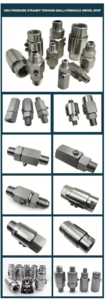
Partner with an Experienced Stainless Steel Rotary Joint Manufacturer
Choosing the right stainless steel rotary joint is more than selecting a component—it is choosing a long-term solution for reliable fluid transfer, reduced maintenance, and stable production.
At Dann Hydraulic, we combine precision CNC machining, carefully selected stainless steel materials, optimized mechanical seal technology, and rigorous quality control to manufacture rotary joints that perform reliably in demanding industrial environments.
Whether your application involves steam, cooling water, thermal oil, compressed air, vacuum, or corrosive chemical media, our engineering team can recommend a solution tailored to your operating conditions. From standard models to fully customized OEM designs and compatible replacements for leading international brands, we are committed to delivering products that meet the practical needs of modern industry.
Why Work with Dann Hydraulic?
- Manufacturer with in-house CNC machining and assembly
- Corrosion-resistant 304, 316, and 316L stainless steel options
- OEM and custom-engineered rotary joint solutions
- Strict pressure, leakage, and quality testing before shipment
- Fast technical support from experienced application engineers
- Competitive alternative to premium international rotary joint brands
- Reliable global supply for distributors, OEMs, and end users
If you are looking for a dependable Stainless Steel Rotary Joint for your next project or need assistance replacing an existing model, our engineering team is ready to help.
Contact Dann Hydraulic today to discuss your application, request technical recommendations, or receive a customized quotation. We look forward to helping you improve equipment reliability and reduce total operating costs with high-performance rotary joint solutions built for demanding industrial environments.

Related products
-
Sale!


360 Degree Tower Crane Rotary Joint for Spray Systems | Heavy Duty Swivel Union
Original price was: $35.00.$32.00Current price is: $32.00. -
Sale!
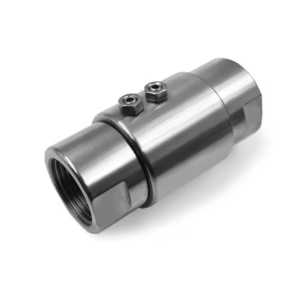
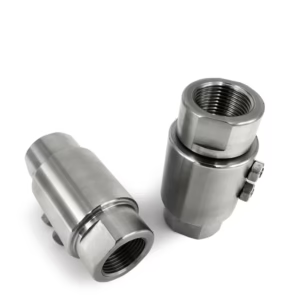
High Pressure Rotary Union for Reliable Fluid Transfer in Demanding Industrial Applications
Original price was: $70.00.$60.00Current price is: $60.00. -
Sale!


Hydraulic Rotary Joint for Tower Crane: Reliable Hydraulic Fluid Transfer
Original price was: $25.00.$20.50Current price is: $20.50. -
Sale!

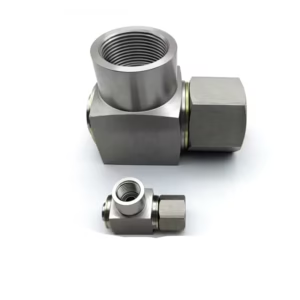
Stainless Steel High Pressure Hydraulic Right Angle Joint
Original price was: $20.00.$15.00Current price is: $15.00.