Industrial Rotating Water Joint: Applications, Failure Analysis and Factory Manufacturing Guide
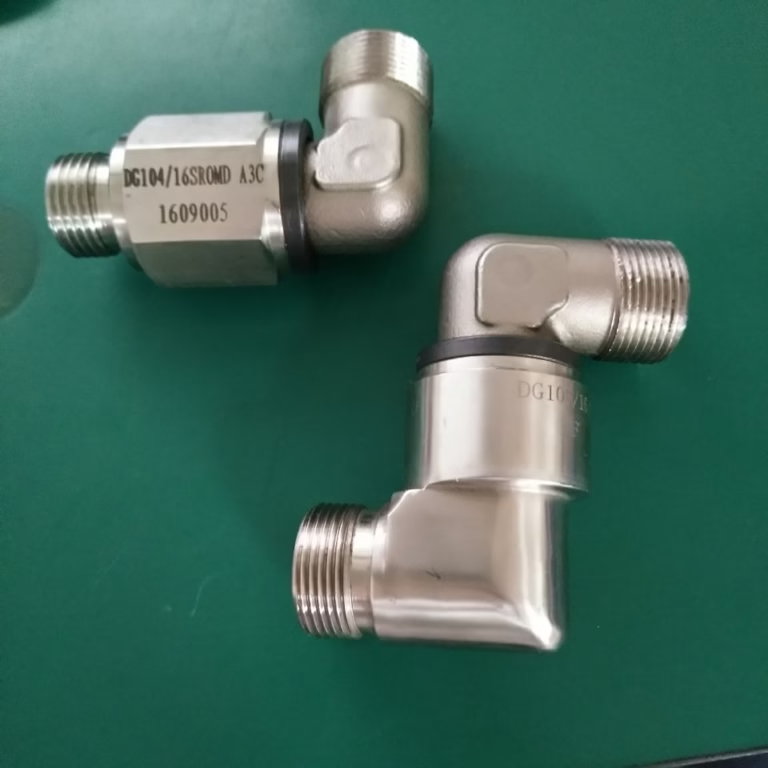
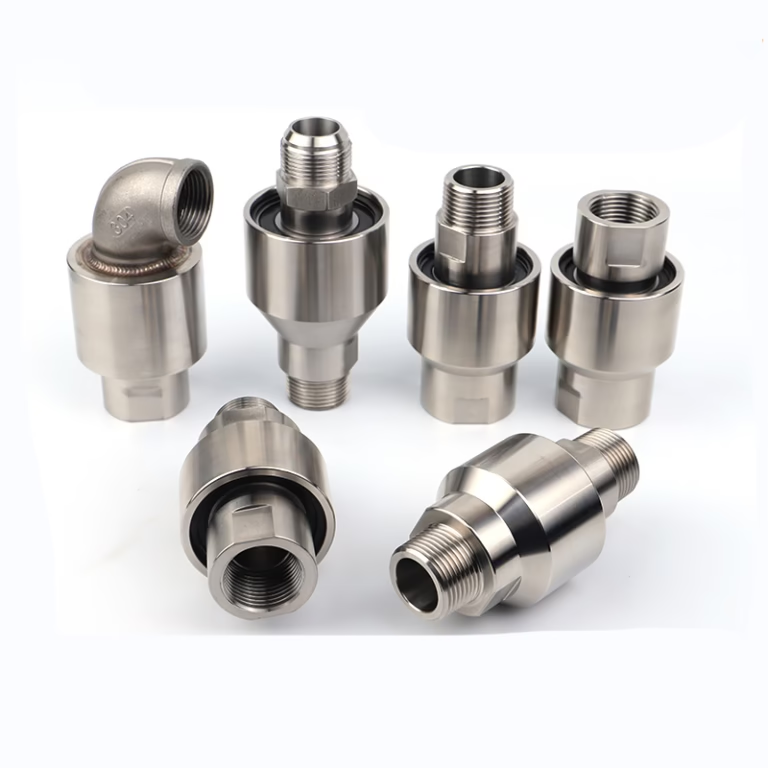
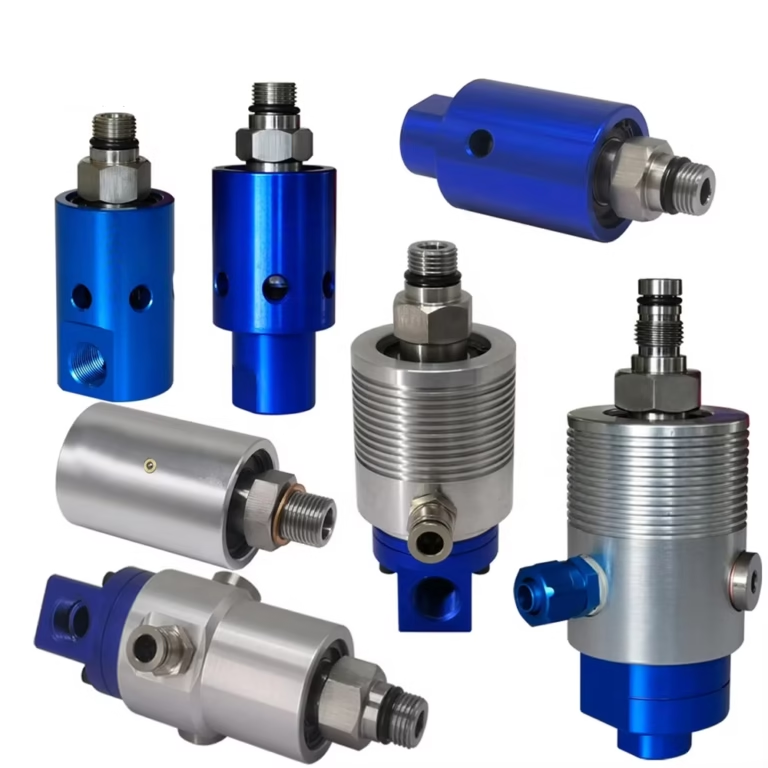
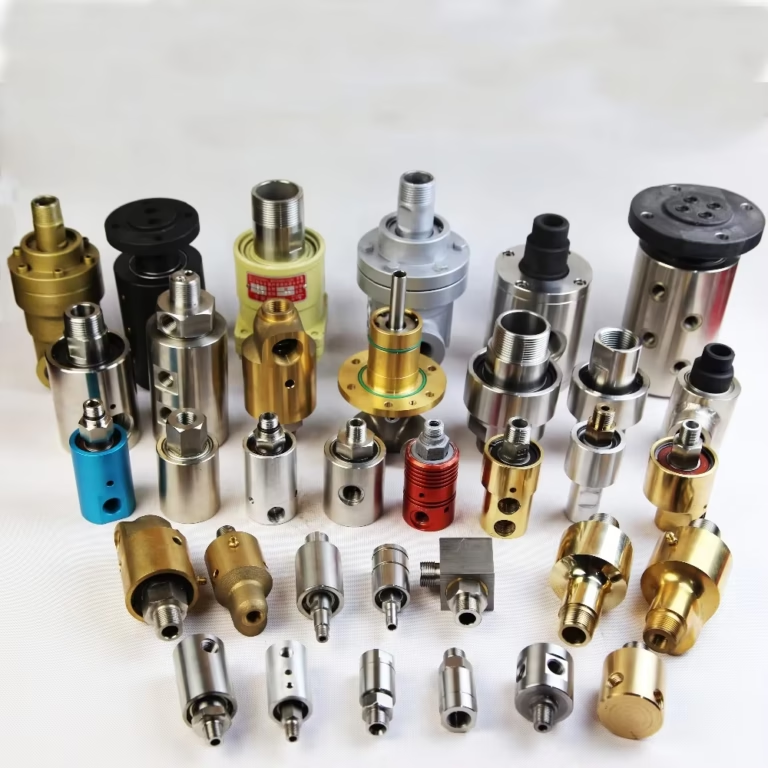
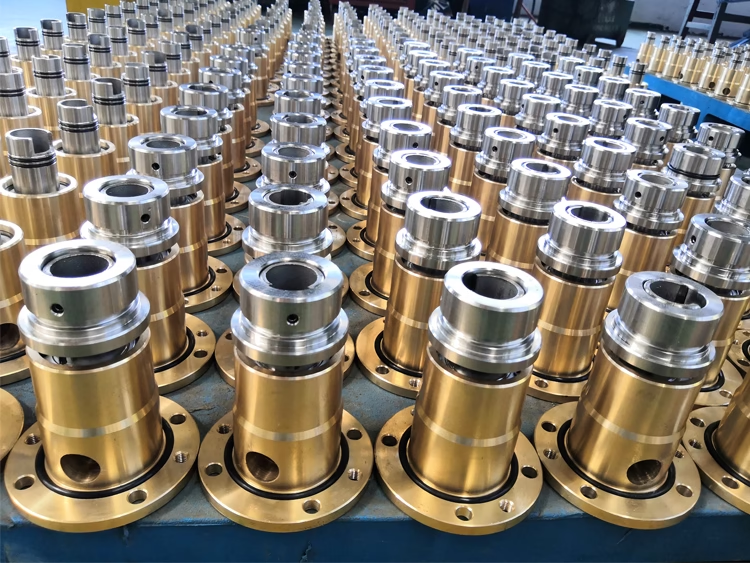
A rotating water joint, also known as a water rotary union or rotary joint for water, is a critical component in industrial equipment where cooling water must be transferred from a stationary pipeline to a continuously rotating shaft, drum, roll, or spindle. Although it is relatively small compared to the entire machine, its performance directly affects production efficiency, equipment reliability, product quality, and maintenance costs.
In our factory, we have been manufacturing rotary unions for industrial customers for many years. Our products are supplied to machine builders, maintenance contractors, distributors, and OEM replacement markets across Europe, North America, Southeast Asia, and the Middle East. During technical discussions with customers, we have found that many rotating water joint failures are not caused by poor product quality alone. Incorrect model selection, unsuitable sealing materials, installation errors, contaminated cooling water, and operating beyond the recommended pressure or speed limits are often the real reasons behind leakage or premature failure.
This guide summarizes both engineering principles and practical manufacturing experience. Instead of simply introducing product specifications, we explain how rotating water joints work in real industrial environments, where they are commonly used, what problems users frequently encounter, and how experienced manufacturers design reliable solutions for demanding applications.
Whether you are an equipment designer, maintenance engineer, purchasing manager, or distributor looking for an OEM replacement for premium brands, this guide will help you select a reliable rotating water joint for long-term industrial operation.
What Is a Rotating Water Joint?
A rotating water joint is a mechanical sealing device that transfers cooling water between stationary piping and rotating equipment without leakage.
Unlike ordinary pipe fittings, a rotating water joint must maintain a reliable seal while operating under continuous rotation. Depending on the application, it may rotate at speeds ranging from a few revolutions per minute on large steel mill rolls to several thousand RPM on CNC machining centers.
Its primary functions include:
- Delivering cooling water to rotating rolls or spindles
- Maintaining stable water pressure during rotation
- Preventing leakage between stationary and rotating components
- Reducing equipment downtime
- Protecting bearings and mechanical seals from contamination
- Extending the service life of rotating machinery
Because cooling systems operate continuously in many production lines, even a small leakage can gradually lead to bearing damage, corrosion, water waste, and unexpected production shutdowns.
For this reason, selecting a properly engineered rotating water joint is just as important as choosing pumps, bearings, or seals for the cooling system.
How Does a Rotating Water Joint Work?
Although the structure appears simple, the sealing principle requires precise engineering.
A rotating water joint generally consists of:
- Housing
- Rotor
- Mechanical seal faces
- Bearings
- Springs
- O-rings
- Shaft sealing components
- Threaded or flanged connections
When cooling water enters the stationary housing, it flows through internal passages into the rotating shaft while the shaft continues to rotate.
The most challenging part of this process is maintaining a stable seal between the stationary housing and the rotating rotor.
Instead of relying solely on rubber seals, industrial rotating water joints typically use precision mechanical seal faces. These sealing surfaces are manufactured with extremely fine flatness to create a controlled sealing interface. A spring mechanism maintains constant contact pressure while allowing slight axial movement caused by thermal expansion or shaft vibration.
During production, the accuracy of these sealing surfaces is critical. Even microscopic imperfections can significantly reduce sealing performance at high speed or under elevated pressure.
At our manufacturing facility, every seal face is carefully inspected before assembly. Depending on the application, we use different material combinations, including:
- Carbon graphite
- Silicon carbide
- Tungsten carbide
- Ceramic
- Stainless steel
Each material offers different advantages depending on operating pressure, cooling water quality, rotational speed, and service life requirements.
Why Rotating Water Joints Are Essential in Modern Manufacturing
Many industrial machines rely on precise temperature control.
Without effective cooling, excessive heat can cause:
- Dimensional inaccuracies
- Bearing failure
- Thermal expansion
- Reduced machining precision
- Shortened equipment life
- Product quality defects
Rotating water joints allow cooling water to circulate continuously while the machine remains in operation.
Compared with traditional hose connections, they offer several advantages:
Continuous Cooling
Water can circulate continuously without interrupting machine rotation.
Reduced Leakage Risk
Mechanical sealing systems provide much better sealing performance than flexible hose arrangements.
Lower Maintenance Costs
Properly designed rotary unions require less maintenance and reduce unexpected shutdowns.
Higher Production Efficiency
Stable cooling improves machining accuracy and minimizes thermal deformation.
Longer Equipment Life
Maintaining proper operating temperature protects bearings, seals, and rotating shafts from excessive wear.
Typical Industrial Applications
One reason rotating water joints have so many designs is that cooling requirements vary greatly across industries. A solution that performs well in a paper mill may not be suitable for a high-speed machining center or a continuous casting line.
Below are some of the most common applications we support.
Steel Rolling Mills
Steel production is one of the most demanding environments for rotating water joints.
Rolling mills generate enormous heat during continuous operation. Cooling water is circulated through work rolls and backup rolls to control temperature and maintain dimensional accuracy.
Typical operating conditions include:
- Continuous operation
- High water flow
- Heavy vibration
- Scale contamination
- High ambient temperatures
For these applications, durability is more important than appearance. Seal materials, bearing selection, and housing strength all play a significant role in determining service life.
Many customers replacing imported rotary unions are primarily looking to reduce maintenance frequency rather than simply lower purchase costs.
Continuous Casting Equipment
Continuous casting rollers are exposed to elevated temperatures while operating around the clock.
Water rotary joints used in these systems must provide stable sealing under fluctuating thermal conditions.
From our experience, one common issue is thermal expansion. If the rotary union is not designed with sufficient compensation for temperature changes, excessive axial load may damage the seal faces.
This is why selecting the correct seal structure is often more important than selecting a stronger spring.
CNC Machining Centers
High-speed machining centers use rotating water joints to cool motorized spindles and cutting tools.
Compared with steel mills, CNC applications require:
- Higher rotational speed
- Lower vibration
- Better balance
- Cleaner cooling water
- Compact dimensions
Because spindle accuracy directly affects machining quality, rotary unions for CNC machines must achieve excellent dynamic balance while maintaining minimal leakage.
In our factory, high-speed models undergo additional rotational testing before shipment to verify sealing performance under simulated operating conditions.
Plastic Injection Molding Machines
Injection molding relies heavily on accurate mold temperature control.
Cooling water circulates through rotating platens or indexing tables using rotating water joints.
Customers in this industry generally focus on:
- Long service life
- Minimal maintenance
- Stable sealing performance
- Easy installation
- Fast replacement during scheduled maintenance
Because production cycles are continuous, reducing unexpected downtime often provides greater cost savings than purchasing the lowest-priced rotary union.
Paper and Pulp Industry
Paper manufacturing uses rotating water joints to cool rolls and maintain consistent operating temperatures throughout the production process.
Although steam rotary unions are common in paper drying sections, many cooling rolls depend on reliable water rotary unions.
The humid operating environment requires excellent corrosion resistance.
For customers working with treated or recycled cooling water, we often recommend stainless steel housings combined with corrosion-resistant sealing materials to improve long-term reliability.
Rubber, Tire, and Composite Manufacturing
Mixing mills, calenders, laminating equipment, and cooling drums all require continuous water circulation.
These applications often experience:
- Frequent start-stop cycles
- Heavy mechanical shock
- Dust contamination
- Variable water pressure
Over the years, we have found that bearing protection is just as important as seal design in these environments. Dust entering the bearing chamber can shorten bearing life even when the mechanical seal remains intact.
For this reason, our engineering team pays close attention to bearing isolation and sealing structure during product development, helping customers achieve longer maintenance intervals in demanding production environments.
How to Choose the Right Rotating Water Joint
Selecting a rotating water joint is not simply a matter of matching thread sizes or comparing prices. In our experience, many premature failures occur because the rotary union was selected based on only one parameter—usually the connection size—while other operating conditions were overlooked.
When we review failed products returned by customers, we often find that the original rotary union was operating beyond its design limits. Excessive pressure, higher-than-expected rotational speed, contaminated cooling water, or improper installation can all shorten service life significantly.
Before selecting a rotating water joint, we recommend collecting the following operating data.
1. Cooling Medium
Although most applications use clean water, not all water systems are the same.
Examples include:
- Industrial cooling water
- Deionized water
- Softened water
- Filtered water
- Recycled process water
- Water mixed with corrosion inhibitors
- Water-glycol coolant
Different media require different seal materials. For example, deionized water has lower lubricity than ordinary cooling water, which places greater demands on the mechanical seal faces.
2. Working Pressure
Operating pressure is one of the first specifications engineers should verify.
Higher pressure increases the contact force between seal faces and places greater loads on bearings and springs.
Choosing a rotary union with a suitable pressure rating helps ensure stable sealing performance while extending component life.
3. Rotational Speed
Speed directly affects heat generation, bearing loads, and seal wear.
A rotary union designed for 300 RPM should never be expected to operate continuously at 3,000 RPM.
For high-speed applications, dynamic balancing, bearing precision, and rotor concentricity become increasingly important.
At our factory, high-speed rotary unions are assembled under stricter dimensional tolerances and undergo additional rotational testing before shipment.
4. Operating Temperature
Cooling water itself may not be extremely hot, but surrounding equipment often is.
For example:
- Steel mills
- Continuous casting equipment
- Rubber processing lines
- Aluminum extrusion plants
Ambient temperatures can accelerate seal aging and reduce lubricant life.
Selecting suitable elastomers and seal materials for the actual operating environment is essential.
5. Installation Space
Some equipment provides very limited installation clearance.
In these situations, engineers should evaluate:
- Overall length
- Housing diameter
- Connection orientation
- Hose routing
- Maintenance accessibility
Compact designs can simplify maintenance without sacrificing performance.
Common Problems with Rotating Water Joints
No rotary union lasts forever. Every mechanical seal experiences wear over time. However, understanding the causes of failure can significantly reduce maintenance costs and improve equipment reliability.
Based on our factory’s repair records and customer feedback, the following problems account for the majority of rotating water joint failures.
Problem 1: Water Leakage
Leakage is the most common issue reported by maintenance engineers.
However, leakage itself is only a symptom. The real challenge is identifying its root cause.
Typical causes include:
- Worn mechanical seal faces
- Damaged O-rings
- Excessive shaft runout
- Incorrect installation
- High vibration
- Excessive operating pressure
- Contaminated cooling water
In many cases, customers initially believe the seal has failed. After inspection, we often discover that the equipment shaft has excessive radial movement, causing uneven contact between the seal faces.
Replacing the rotary union alone does not solve the problem.
Practical Factory Experience
One customer operating a steel processing line experienced repeated seal failures every three months.
Initially, several rotary unions from different suppliers were installed with similar results.
After reviewing the application data, we requested shaft runout measurements.
The shaft deviation exceeded the recommended tolerance several times.
Once the shaft alignment was corrected, the replacement rotary union continued operating reliably for more than a year without leakage.
This experience reinforced an important lesson:
A rotary union cannot compensate for mechanical problems elsewhere in the system.
Problem 2: Bearing Failure
Although seals receive most of the attention, bearings often determine the overall service life of a rotating water joint.
Common causes include:
- Lack of lubrication
- Water contamination
- Excessive radial load
- Misalignment
- Overspeed operation
- Poor installation
When bearings begin to fail, operators may notice:
- Increased vibration
- Abnormal noise
- Elevated housing temperature
- Seal instability
- Water leakage
For this reason, we recommend replacing bearings before severe wear damages the rotor or housing.
Problem 3: Seal Face Wear
Mechanical seals rely on two precision-machined surfaces sliding against each other.
Over time, these surfaces gradually wear.
Normal wear occurs slowly.
Abnormal wear usually results from:
- Dry running
- Dirty cooling water
- Abrasive particles
- Excessive spring load
- Thermal shock
In our production facility, seal materials are selected according to customer operating conditions rather than using a single material combination for every application.
For demanding environments, silicon carbide provides excellent wear resistance.
For general industrial cooling systems, carbon graphite paired with silicon carbide often offers an excellent balance between performance and cost.
Problem 4: Overheating
A rotating water joint should never become excessively hot during normal operation.
Possible causes include:
- Bearing damage
- Insufficient lubrication
- Excessive rotational speed
- Dry mechanical seal operation
- Improper installation
Ignoring overheating often results in accelerated seal wear and bearing failure.
Maintenance personnel should investigate abnormal temperature increases before visible leakage develops.
Problem 5: Corrosion
Water quality varies significantly between industries.
Some cooling systems contain:
- Chlorides
- Minerals
- Rust particles
- Chemical additives
These contaminants may attack standard materials over time.
For aggressive cooling media, stainless steel housings provide significantly better corrosion resistance than ordinary carbon steel components.
Installation Mistakes That Shorten Service Life
Many rotary union failures occur shortly after installation.
From years of technical support, we have identified several recurring mistakes.
Installing Without Cleaning the Pipeline
Metal chips, welding slag, rust, and sand frequently remain inside new piping systems.
These particles can immediately damage seal faces during startup.
Before installation, pipelines should always be flushed thoroughly.
Applying Excessive Pipe Force
Rigid piping should never force the rotary union into position.
External loads increase housing stress and bearing loads.
Flexible hose connections or properly aligned piping help reduce unnecessary stress.
Incorrect Shaft Alignment
Even high-quality rotary unions cannot compensate for severe shaft misalignment.
Poor alignment leads to:
- Uneven seal loading
- Bearing overload
- Increased vibration
- Reduced service life
Checking shaft concentricity before installation is one of the simplest ways to prevent premature failure.
Running Without Cooling Water
Mechanical seals rely on the cooling medium for lubrication and heat removal.
Operating without water—even for a short period—can permanently damage seal faces.
This mistake is particularly common during equipment commissioning.
Maintenance Recommendations from Our Engineering Team
Routine maintenance does not require complex procedures, but consistent inspections can prevent expensive downtime.
We generally recommend the following practices:
- Inspect the rotary union regularly for signs of leakage.
- Monitor bearing noise and vibration.
- Check housing temperature during operation.
- Verify that cooling water remains clean.
- Replace worn hoses and fittings before they fail.
- Inspect shaft alignment during scheduled maintenance.
- Follow the manufacturer’s recommended operating limits.
- Replace worn seals before leakage becomes severe.
In facilities operating around the clock, preventive maintenance almost always costs less than emergency repairs.
Can a Rotating Water Joint Be Repaired?
This depends on the condition of the unit.
If only normal wear components have reached the end of their service life, replacing mechanical seals, O-rings, bearings, and springs may restore performance.
However, repair is not recommended if the housing or rotor has suffered:
- Deep corrosion
- Severe wear
- Cracking
- Excessive shaft damage
- Distortion from overheating
For many OEM replacement projects, customers choose complete replacement units because installation is faster and overall maintenance costs are lower than rebuilding heavily worn assemblies.
When evaluating repair versus replacement, engineers should consider not only component cost but also machine downtime, labor expenses, and production losses. In many industrial environments, restoring reliable operation quickly provides greater value than attempting to extend the life of a severely worn rotary union.
Factory Experience: How We Manufacture Reliable Rotating Water Joints
A rotating water joint may appear to be a simple mechanical component, but achieving reliable performance over thousands of operating hours requires far more than assembling standard parts. Every stage—from raw material selection to precision machining, seal lapping, assembly, and final testing—affects the service life of the finished product.
As a manufacturer specializing in rotary unions and rotary joint replacements, we have worked with OEM machine builders, industrial distributors, and maintenance companies across a wide range of industries. These projects have shown us that customers value consistent quality and dependable technical support far more than the lowest purchase price.
Our manufacturing philosophy is straightforward: every rotary union should perform reliably in real production environments, not just meet drawing dimensions.
From Engineering Drawings to Finished Products
Every project begins with understanding the customer’s application rather than immediately recommending an existing model.
Our engineering team first evaluates key operating conditions, including:
- Cooling medium
- Working pressure
- Rotational speed
- Operating temperature
- Shaft dimensions
- Installation space
- Connection standards
- Expected service life
Only after confirming these details do we determine the most appropriate sealing structure, bearing arrangement, and material combination.
This engineering-first approach helps reduce the risk of premature failures caused by selecting an unsuitable rotary union.
Precision CNC Machining Makes the Difference
The reliability of a rotating water joint starts with machining accuracy.
Even small dimensional deviations can lead to:
- Seal face instability
- Bearing misalignment
- Rotor imbalance
- Increased vibration
- Premature leakage
Our production workshop uses modern CNC machining centers to manufacture key components under strict dimensional control.
Critical features include:
- Bearing seats
- Seal mounting surfaces
- Rotor diameters
- Threaded connections
- Concentric bores
- Assembly reference surfaces
Throughout production, dimensional inspections are performed at multiple stages rather than only after final machining. This process helps identify deviations early and minimizes variation between production batches.
For customers requiring OEM replacements, maintaining interchangeability with the original equipment is particularly important. We verify all critical installation dimensions to ensure that replacement rotary unions can be installed without modifying existing machinery.
Selecting the Right Materials for Different Applications
No single material is suitable for every operating condition.
Choosing materials based on actual application requirements significantly improves reliability and extends service life.
Depending on customer needs, we manufacture rotary unions using materials such as:
Stainless Steel
Ideal for:
- Corrosive cooling water
- Food processing equipment
- Chemical plants
- Marine environments
Stainless steel provides excellent corrosion resistance and long-term durability in demanding conditions.
Aluminum Alloy
Suitable for:
- High-speed applications
- Lightweight equipment
- CNC machining centers
Its lower weight helps reduce rotational inertia while maintaining sufficient mechanical strength.
Brass
Commonly used for:
- General industrial cooling
- Moderate operating pressures
- Cost-sensitive applications
Brass offers good machinability and reliable performance for many standard cooling systems.
Seal material selection is equally important. Depending on pressure, water quality, speed, and operating temperature, we recommend combinations such as carbon graphite, silicon carbide, tungsten carbide, or ceramic to achieve the best balance between wear resistance, friction, and service life.
Why Seal Quality Determines Long-Term Performance
The mechanical seal is the heart of every rotating water joint.
Although bearings support rotation, the seal is responsible for preventing leakage while allowing continuous movement between stationary and rotating components.
In our experience, many inexpensive rotary unions fail because the seal faces are manufactured with inconsistent flatness or poor surface finish.
To achieve stable sealing performance, seal faces must be:
- Precisely machined
- Carefully lapped
- Thoroughly cleaned before assembly
- Protected from contamination during handling
Each sealing pair is inspected before installation to ensure proper contact between the rotating and stationary faces.
This attention to detail reduces leakage and improves long-term reliability, particularly in continuous-duty industrial applications.
Bearing Selection Is About Reliability, Not Cost
Bearings operate continuously whenever the rotary union is in service.
A low-quality bearing may function normally during initial operation but can quickly develop vibration, noise, or excessive heat under industrial working conditions.
For demanding applications, we use internationally recognized bearing brands or equivalent high-quality alternatives based on customer requirements.
More importantly, bearing selection is matched to the application’s operating speed and load rather than relying on a single standard configuration.
Proper bearing arrangement helps:
- Improve rotational stability
- Reduce vibration
- Maintain seal alignment
- Extend service life
Every Rotary Union Is Tested Before Shipment
One of the biggest differences between an experienced manufacturer and a simple assembly supplier is the testing process.
Every rotating water joint should be verified before leaving the factory.
Depending on the product type, our inspection procedures may include:
- Dimensional inspection
- Visual inspection
- Assembly verification
- Air leakage testing
- Hydrostatic pressure testing
- Rotation testing
- Seal performance inspection
- Connection thread inspection
For high-speed models, additional running tests help verify smooth rotation and stable sealing under simulated operating conditions.
Testing every unit before shipment reduces the risk of installation problems and provides customers with greater confidence during equipment commissioning.
Lessons Learned from Real Customer Projects
Over the years, we have supported customers in steel production, CNC machining, injection molding, paper manufacturing, rubber processing, and other industries. While every application is different, certain patterns appear repeatedly.
One common example involves customers replacing only the rotary union after experiencing leakage, without inspecting the condition of the equipment shaft. After installation, the new unit leaks again within a short period.
In several cases, the root cause was excessive shaft runout caused by worn bearings in the machine itself. Once the machine bearings were replaced and shaft alignment restored, the rotary union operated normally.
Another frequent issue is poor cooling water quality. Some factories use recycled process water containing rust particles, welding debris, or scale. Even a well-designed mechanical seal cannot withstand continuous abrasion from contaminated water.
For these applications, we often recommend installing filtration systems or selecting more wear-resistant seal materials. Small improvements in the cooling circuit can significantly extend rotary union service life and reduce maintenance costs.
These real-world experiences have influenced how we advise customers. Rather than focusing solely on product specifications, we aim to understand the entire operating environment so that the recommended solution performs reliably over the long term.
OEM Replacement Solutions for Global Brands
Many industrial users continue to operate equipment originally fitted with rotary unions from well-known international manufacturers. As maintenance costs increase or lead times become longer, they often look for reliable replacement solutions.
Our engineering team has extensive experience developing interchangeable rotary unions for a wide range of industrial equipment. When designing replacement models, we pay particular attention to:
- Installation dimensions
- Mounting interfaces
- Thread standards
- Flow capacity
- Pressure ratings
- Seal configurations
- Bearing arrangements
The objective is not simply to copy an existing product but to provide a replacement that installs easily while delivering dependable performance in the customer’s actual operating conditions.
In many projects, customers have also requested material upgrades, improved sealing combinations, or design modifications to better suit their production environment. These engineering improvements often result in longer maintenance intervals compared with the original configuration.
Continuous Improvement Through Manufacturing Experience
Manufacturing rotary unions is an ongoing process of refinement. Every customer application provides valuable feedback that helps us improve future designs.
Our engineering, machining, assembly, and quality control teams work closely together to evaluate field performance, identify recurring issues, and optimize product designs where appropriate.
Whether it is improving seal geometry, refining machining tolerances, selecting more suitable materials, or enhancing inspection procedures, continuous improvement remains an important part of our manufacturing philosophy.
We believe that reliable rotary unions are not created by marketing claims—they are built through precision manufacturing, practical engineering experience, rigorous testing, and a commitment to solving real industrial challenges.
Frequently Asked Questions About Rotating Water Joints
The following questions address common concerns from engineers, maintenance technicians, and purchasing managers when selecting or operating rotating water joints in industrial cooling systems.
What is a rotating water joint?
A rotating water joint is a rotary union designed to transfer cooling water from a stationary pipe into rotating equipment, such as rolls, spindles, drums, shafts, or indexing tables, while preventing leakage during continuous rotation.
What is the difference between a rotating water joint and a rotary union?
In many industrial applications, the terms rotating water joint and water rotary union are used interchangeably. Both refer to a device that transfers water or coolant through rotating machinery. The preferred term may vary by industry or region.
What applications commonly use rotating water joints?
Common applications include steel rolling mills, continuous casting equipment, CNC machining centers, injection molding machines, paper mills, rubber processing equipment, cable machinery, glass machinery, and other industrial cooling systems.
How do I choose the correct rotating water joint?
Selection should be based on cooling medium, working pressure, rotational speed, operating temperature, shaft size, connection standard, installation space, and expected service life. Providing these details to the manufacturer helps ensure the correct model is selected.
Why does a rotating water joint leak?
Leakage may result from worn mechanical seal faces, damaged O-rings, shaft misalignment, excessive vibration, contaminated cooling water, excessive pressure, or improper installation. Identifying the root cause is important before replacing the unit.
Can a rotating water joint run dry?
No. Mechanical seals rely on the cooling medium for lubrication and heat removal. Running dry, even briefly, can damage seal faces and lead to premature leakage.
What seal materials are commonly used?
Common seal materials include carbon graphite, silicon carbide, tungsten carbide, ceramic, and stainless steel. The best combination depends on water quality, pressure, speed, temperature, and wear requirements.
How long does a rotating water joint last?
Service life depends on operating conditions, water quality, seal materials, shaft alignment, and maintenance practices. Under proper conditions, a well-designed rotary union can operate reliably for many months or years.
What pressure can a water rotary union handle?
Pressure ratings vary by model and design. Standard industrial water rotary unions may handle moderate pressures, while heavy-duty models are designed for higher-pressure cooling systems. Always verify the manufacturer’s pressure specification.
Can rotating water joints be repaired?
Yes, many rotating water joints can be repaired by replacing worn seals, bearings, O-rings, and springs. However, repair may not be economical if the housing or rotor is severely worn, corroded, cracked, or damaged by overheating.
What causes bearing failure in rotary unions?
Bearing failure is commonly caused by water contamination, lack of lubrication, excessive radial load, shaft misalignment, overspeed operation, vibration, or poor installation practices.
What maintenance is recommended?
Recommended maintenance includes regular leakage inspection, monitoring bearing noise and vibration, checking housing temperature, maintaining clean cooling water, inspecting shaft alignment, and replacing worn components before severe failure occurs.
Can one rotary union handle both water and air?
Some multi-passage rotary unions can transfer both water and air, but the design must be specifically engineered for the required media, pressure, and sealing arrangement. A standard single-passage water rotary union is not always suitable for combined media service.
What materials are best for corrosive cooling water?
For corrosive or chemically treated cooling water, stainless steel housings combined with corrosion-resistant seal materials are often recommended to improve durability and reduce maintenance frequency.
Do you offer OEM replacement rotary unions?
Yes. Our factory can manufacture OEM replacement rotary unions with interchangeable installation dimensions and customized sealing solutions for many industrial applications, helping customers reduce lead time and maintenance costs.
Conclusion
A rotating water joint is a small component with a major impact on industrial equipment reliability. When properly selected, manufactured, installed, and maintained, it ensures continuous cooling water transfer, minimizes leakage, reduces downtime, and extends the service life of rotating machinery.
As a manufacturer with practical experience in rotary union production, we understand that reliable performance depends on more than product specifications. Precision machining, appropriate seal material selection, bearing quality, rigorous testing, and application-specific engineering all contribute to long-term operating stability. For customers seeking dependable rotating water joints or OEM replacement solutions, choosing a manufacturer with real factory experience and technical support can make a significant difference in equipment reliability and overall maintenance cost.