
Hydraulic Rotary Union Leaks: Complete Troubleshooting Guide from a Rotary Union Manufacturer
A Hydraulic Rotary Union Leaks is often treated as a simple maintenance issue. Many maintenance teams replace the seal, reinstall the union, and expect the problem to disappear. In reality, leakage is usually the final symptom of a mechanical issue that has been developing for weeks or even months.
From our experience as a rotary union manufacturer in China, we have inspected hundreds of returned rotary unions from customers in the steel industry, CNC machining, construction equipment, hydraulic test benches, and automation systems. Surprisingly, in many cases, the seal itself was still in acceptable condition. The actual causes were bearing wear, shaft runout, improper installation, contaminated hydraulic oil, or operating conditions beyond the original design limits.
This is why replacing seals alone often fails to solve the problem. Unless the root cause is identified, leakage will usually return after a short period of operation.
This guide summarizes the inspection methods, troubleshooting procedures, and manufacturing practices that our engineering team uses every day. Instead of repeating general maintenance advice, we share practical observations collected from years of designing, machining, assembling, and testing hydraulic rotary unions for industrial applications worldwide.
Understanding How a Hydraulic Rotary Union Works
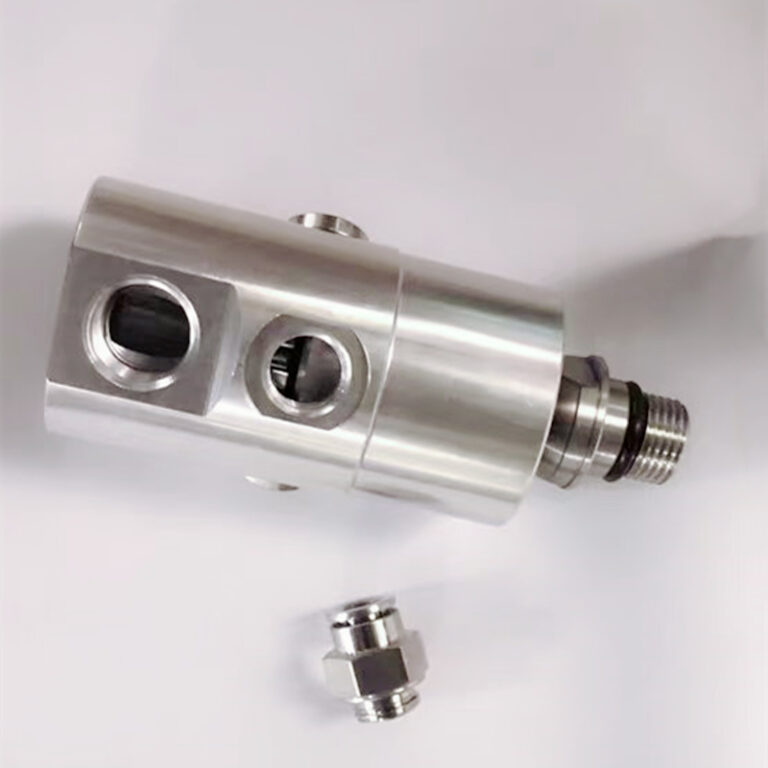
A hydraulic rotary union transfers pressurized hydraulic fluid from a stationary pipeline into a rotating shaft without allowing fluid to escape.
Although the principle appears simple, several precision components must work together perfectly:
- Mechanical seal faces
- Rotary shaft
- Bearing assembly
- Housing
- O-rings and static seals
- Springs
- Internal flow passages
When hydraulic pressure is applied, the seal faces remain in controlled contact while the shaft rotates continuously. Bearings maintain precise alignment between the rotating and stationary components, preventing vibration from separating the sealing surfaces.
If even one component begins to wear or move outside its design tolerance, sealing performance quickly deteriorates.
Unlike static hydraulic fittings, rotary unions operate under continuous dynamic motion. Every revolution creates microscopic friction, thermal expansion, and pressure fluctuations. Over millions of rotations, even very small alignment errors can gradually develop into visible leakage.
Why Hydraulic Rotary Union Leaks Is Increasing in Modern Equipment
Industrial equipment has changed significantly during the past decade.
Today’s hydraulic systems operate at:
- Higher operating pressures
- Faster rotational speeds
- Longer production cycles
- Smaller installation spaces
- Higher automation levels
These improvements increase productivity but also place much greater demands on rotary unions.
For example, many CNC machining centers now run continuously throughout multiple shifts. Hydraulic swivels installed on rotary tables may operate for thousands of hours with minimal downtime. Similarly, steel processing equipment experiences constant thermal expansion, vibration, and heavy shock loads.
Under these conditions, even a minor installation error can eventually become a significant leakage problem.
One trend we have observed in recent years is that customers often upgrade machine speed without replacing the original rotary union. While the equipment becomes faster, the rotary union may still have been designed for a lower rotational speed. This mismatch accelerates bearing wear and increases seal face temperature, eventually causing hydraulic oil leakage.
Selecting the correct rotary union for actual operating conditions is therefore just as important as maintaining it properly.
Leakage Is Usually a Process, Not a Sudden Failure
Many users believe a rotary union begins leaking unexpectedly.
In practice, leakage develops gradually.
During factory inspections of returned products, we frequently identify a progression similar to this:
Stage 1 – Microscopic Wear
Seal faces begin experiencing normal wear during operation. At this stage, no external leakage is visible.
Stage 2 – Bearing Clearance Increases
As bearings accumulate operating hours, internal clearance slowly increases. The shaft begins to experience slight radial movement.
Stage 3 – Seal Face Instability
The rotating seal can no longer maintain perfectly uniform contact pressure. Small gaps begin appearing between the seal faces.
Stage 4 – Initial Leakage
Tiny droplets of hydraulic oil appear during startup or shutdown. Many operators ignore these early warning signs.
Stage 5 – Progressive Failure
Higher temperatures, vibration, and contamination accelerate wear. Leakage becomes continuous, and hydraulic pressure may begin to fluctuate.
Stage 6 – Secondary Damage
If the operation continues, leaked hydraulic oil contaminates bearings, attracts dust, increases friction, and eventually damages additional components.
Understanding these stages allows maintenance teams to schedule repairs before catastrophic failure occurs.
Common Misconceptions About Hydraulic Rotary Union Leaks
After supporting customers from more than 40 countries, we have noticed several common misunderstandings.
Misconception 1: Every Leak Means the Seal Has Failed
The seal is only one component in the sealing system.
Many returned rotary unions show perfectly usable seal faces, while the real problem lies elsewhere:
- Excessive shaft runout
- Worn bearings
- Housing deformation
- Improper installation
- Pressure spikes
Replacing the seal without addressing these issues rarely produces a lasting repair.
Misconception 2: More Tightening Stops Leakage
Some operators attempt to eliminate leakage by tightening threaded connections excessively.
Over-tightening often creates new problems:
- Housing distortion
- O-ring damage
- Thread deformation
- Bearing preload changes
Proper installation torque should always follow the manufacturer’s specification rather than relying on additional force.
Misconception 3: Any Hydraulic Oil Can Be Used
Hydraulic fluid compatibility is frequently overlooked.
Certain seal materials perform well with mineral oil but deteriorate rapidly when exposed to synthetic fluids, phosphate esters, or high-temperature hydraulic oils.
Material compatibility should always be confirmed before changing hydraulic fluid types.
Misconception 4: Leakage Only Happens in Old Rotary Unions
New rotary unions can also leak if they are installed incorrectly.
Common installation problems include:
- Misaligned piping
- Unsupported hoses creating side loads
- Dirty hydraulic systems
- Shaft eccentricity
- Incorrect mounting dimensions
Even the highest-quality rotary union cannot compensate for poor installation conditions.
Our Factory Experience: What We Learn From Returned Rotary Unions
One advantage of being both a manufacturer and a supplier is that we have the opportunity to analyze products after years of real industrial service.
Instead of simply replacing damaged parts, our engineers disassemble returned rotary unions to understand exactly why they failed. Every component is cleaned, measured, and documented before the inspection report is completed.
Over time, these inspections have revealed several consistent patterns.
One of the most common findings is uneven wear on the mechanical seal faces. In many cases, only one side of the sealing surface shows excessive wear, while the opposite side remains almost untouched. This usually indicates shaft misalignment or bearing degradation rather than poor seal quality.
Another frequent observation is contamination damage. Fine metal particles, welding residue, or abrasive dust can enter the hydraulic system and become trapped between the seal faces. Even particles that are nearly invisible to the naked eye can create microscopic scratches, allowing hydraulic oil to escape under pressure.
We also occasionally receive rotary unions that have operated far beyond their original design limits. Some units intended for intermittent operation have been running continuously for months in demanding production environments. Others have been exposed to pressure surges well above their rated capacity. In these situations, leakage is often the result of operating conditions rather than manufacturing defects.
These real-world inspections continually improve our product designs. Feedback from failed components helps us refine machining tolerances, optimize seal material selection, and enhance testing procedures before products leave our factory.
As manufacturers, we believe every returned rotary union provides valuable engineering data. Understanding why a product fails in the field is just as important as designing it correctly in the first place.
8 Root Causes of Hydraulic Rotary Union Leaks (Based on Factory Inspection Experience)
Over the years, our engineering team has inspected returned rotary unions from machine builders, maintenance contractors, steel mills, machining workshops, and hydraulic equipment manufacturers. While every application is different, most leakage problems can be traced back to a small number of root causes.
The important point is that leakage is rarely caused by a single component. In many cases, several factors work together. For example, a slight shaft misalignment may increase bearing load, which accelerates seal wear and eventually causes oil leakage.
Below are the eight most common causes we encounter during factory inspections.
1. Mechanical Seal Face Wear
The mechanical seal is the heart of every hydraulic rotary union. It consists of two precision-lapped faces that remain in controlled contact while the shaft rotates.
During normal operation, these surfaces experience microscopic wear. Over time, the sealing faces become less flat, reducing the contact area and allowing hydraulic fluid to escape.
Typical Symptoms
- Slow oil leakage during operation
- Leakage increases as pressure rises
- Small oil droplets around the seal housing
- No obvious bearing noise
Common Causes
Seal wear is usually accelerated by:
- Continuous high-speed operation
- Dry running during startup
- Poor lubrication
- Excessive operating temperature
- Abrasive particles in hydraulic oil
Factory Observation
During returned product inspections, we often compare worn seal faces under magnification. Normal wear produces a smooth and uniform contact pattern. Premature failure, however, usually shows uneven polishing, localized scoring, or heat discoloration.
These wear patterns tell our engineers much more than simply replacing the seal. They reveal how the rotary union has been operating inside the customer’s equipment.
Prevention
- Select seal materials suitable for the operating fluid.
- Avoid dry starts whenever possible.
- Replace contaminated hydraulic oil on schedule.
- Monitor operating temperature regularly.
- Inspect sealing surfaces during preventive maintenance.
2. Bearing Wear and Shaft Movement
Many customers assume the seal is responsible for every leak. In reality, worn bearings are one of the most frequent causes we identify.
Bearings maintain the alignment between rotating and stationary components. As they wear, radial and axial movement increases. Even a very small amount of shaft movement can separate the mechanical seal faces enough to allow leakage.
Typical Symptoms
- Oil leakage becomes worse at higher speeds
- Abnormal vibration
- Increased operating temperature
- Noise from the bearing area
- Leakage appears after several hours of operation
Factory Observation
When returned rotary unions are disassembled, bearing grease often contains metallic particles. In severe cases, bearing raceways show pitting caused by long-term vibration.
The mechanical seal itself may still be in acceptable condition, but it can no longer compensate for excessive shaft movement.
This is one reason why replacing only the seal often fails to solve the problem.
Prevention
- Use high-quality bearings designed for continuous rotation.
- Avoid excessive radial loads from unsupported piping.
- Replace bearings before excessive clearance develops.
- Monitor vibration during routine maintenance.
3. Shaft Misalignment
Even the best rotary union cannot perform properly if the shaft is misaligned.
Misalignment forces the rotating shaft to wobble slightly during every revolution. Although the movement may be too small to see, it continuously changes the contact pressure between the seal faces.
Over time, one side wears much faster than the other.
Typical Symptoms
- Uneven seal wear
- Leakage concentrated on one side
- Increased bearing temperature
- Reduced seal life
Common Installation Errors
- Improper coupling alignment
- Bent shafts
- Poor machining accuracy
- Pipe stress transferred to the rotary union
- Inaccurate mounting surfaces
Factory Experience
Our inspection reports frequently show seal faces worn on only one side.
This uneven wear pattern almost always indicates alignment problems rather than defective seal materials.
For OEM customers, we often recommend checking shaft runout before replacing the rotary union. Correcting the alignment usually prevents repeated failures.
4. Hydraulic Pressure Spikes
Hydraulic systems rarely operate at perfectly stable pressure.
Rapid valve switching, sudden cylinder movement, and emergency stops can all generate pressure spikes that exceed normal operating conditions.
Repeated pressure fluctuations place additional stress on both seals and internal components.
Typical Symptoms
- Leakage occurs suddenly after the machine impacts
- Seal damage without obvious wear
- Intermittent oil leakage
- O-ring extrusion
Factory Observation
Pressure-related failures often leave very distinctive marks.
Engineers may find:
- Cracked seal edges
- Extruded elastomers
- Deformed backup rings
- Localized mechanical seal damage
These failures are very different from gradual wear caused by long-term operation.
Prevention
- Install pressure relief valves.
- Avoid rapid pressure changes where possible.
- Select rotary unions with adequate pressure ratings.
- Review the complete hydraulic circuit during troubleshooting.
5. Contaminated Hydraulic Oil
Clean hydraulic oil is essential for rotary union reliability.
Unfortunately, contamination remains one of the most underestimated causes of leakage.
Metal chips, rust particles, welding residue, dust, and degraded oil all circulate through hydraulic systems. Once trapped between mechanical seal faces, these particles act like grinding compounds.
Typical Symptoms
- Fine scratches on seal faces
- Leakage increases gradually
- Dark or dirty hydraulic oil
- Reduced service life
Factory Inspection Procedure
Every returned rotary union is cleaned before disassembly.
Our engineers carefully inspect:
- Internal flow passages
- Bearing grease
- Seal faces
- O-rings
- Oil deposits
Many failures reveal contamination embedded directly into the seal surface.
In these situations, replacing the rotary union without cleaning the hydraulic system simply repeats the failure.
Prevention
- Replace hydraulic filters regularly.
- Flush systems before installing new rotary unions.
- Maintain recommended oil cleanliness levels.
- Prevent contamination during maintenance.
6. Incorrect Seal Material Selection
Different hydraulic fluids require different sealing materials.
Selecting an incompatible seal material may initially appear successful, but chemical degradation gradually reduces sealing performance.
Common Examples
NBR works well in many mineral oil systems but may not perform well under higher temperatures or with certain synthetic fluids.
FKM offers better temperature resistance but is not the best solution for every application.
PTFE provides excellent chemical resistance but requires appropriate mechanical support.
Mechanical seal faces also vary significantly:
- Carbon graphite
- Silicon carbide
- Tungsten carbide
- Ceramic combinations
Each material performs differently depending on pressure, speed, lubrication, and operating environment.
Factory Recommendation
Rather than selecting materials based only on price, we evaluate:
- Hydraulic fluid type
- Operating pressure
- Rotation speed
- Temperature
- Duty cycle
- Expected service life
This engineering approach significantly improves long-term reliability.
7. Improper Installation Practices
Some leakage problems begin before the machine is ever started.
Improper installation places unnecessary stress on seals, bearings, and threaded connections.
Frequent Installation Mistakes
- Using excessive tightening torque
- Applying incorrect thread sealant
- Allowing hoses to pull sideways on the rotary union
- Failing to clean mounting surfaces
- Installing without checking shaft concentricity
- Damaging O-rings during assembly
Factory Experience
Technical support requests often include photographs of leaking rotary unions.
Surprisingly, many products show no manufacturing defects.
Instead, leakage is traced to installation issues that can be corrected without replacing the product.
To reduce these problems, we provide installation drawings, recommended tightening torque, and application guidance for OEM customers before shipment.
8. Operating Beyond Design Limits
Every rotary union is designed within specific operating parameters.
These include:
- Maximum pressure
- Maximum rotational speed
- Temperature range
- Fluid compatibility
- Duty cycle
Problems occur when equipment is upgraded, but the rotary union is not.
For example, increasing spindle speed by 30% may also increase seal face temperature beyond its design capability.
Similarly, replacing hydraulic oil with a higher-temperature fluid without changing seal materials may shorten service life dramatically.
Typical Symptoms
- Frequent seal replacement
- Leakage after production upgrades
- Overheating
- Accelerated bearing wear
- Reduced maintenance intervals
Factory Observation
Several customers have sent products back believing they contained manufacturing defects.
After reviewing the operating conditions, we found the rotary unions had been used well outside their original specifications.
Once the correct model was selected, leakage problems disappeared,d and service life improved significantly.
Looking Beyond the Leak
One lesson we have learned through years of manufacturing hydraulic rotary unions is that the visible leak is rarely the actual problem—it is simply the first warning sign.
A few drops of hydraulic oil may indicate:
- Bearing fatigue develops over thousands of operating hours
- Progressive shaft misalignment
- Contaminated hydraulic fluid is damaging precision seal faces
- Pressure fluctuations exceeding the system design
- An application that has gradually outgrown the original rotary union specification
Identifying these underlying issues requires more than replacing components. It requires understanding how the rotary union operates within the entire hydraulic system.
At our factory, troubleshooting always begins with measurement rather than assumption. Every returned product is inspected systematically because the failure pattern tells a story. Those lessons are then applied to improve future designs, machining tolerances, seal combinations, and testing procedures.
How We Diagnose Hydraulic Rotary Union Leaks: Factory Inspection Process and Real Industrial Case Studies
When a customer tells us, “Our hydraulic rotary union is leaking,” our first response is never to recommend a replacement seal.
Instead, we begin asking questions.
- When did the leakage first appear?
- Does it occur only during rotation or even when the machine is stopped?
- Is the leakage constant or intermittent?
- Has the machine recently been upgraded?
- Has the hydraulic oil or operating pressure changed?
- Were any bearings, pumps, or shafts replaced before the problem started?
These questions often provide more useful information than the leaking component itself.
At our factory, every returned rotary union is treated as an engineering case study. Our objective is not only to repair the product but also to understand why the failure occurred and whether design improvements or application changes can prevent the same problem in the future.
Step 1 – Collecting Operating Data Before Disassembly
Before opening the rotary union, our engineers record all available operating information.
Typical data includes:
- Working pressure
- Rotational speed
- Hydraulic fluid type
- Operating temperature
- Running hours
- Equipment model
- Installation orientation
- Application industry
This information provides valuable context.
For example, a rotary union used on a slow-speed hydraulic indexing table experiences completely different loads than one installed on a high-speed machining center spindle.
Without understanding the application, it is impossible to make an accurate diagnosis.
Step 2 – External Visual Inspection
The first physical inspection focuses on visible evidence.
Our engineers examine:
- Oil leakage locations
- Housing condition
- Thread damage
- Corrosion
- Impact marks
- Surface cracks
- Loose fittings
- Signs of overheating
The location of the leaked oil often provides the first clue.
For example:
Leakage around threaded ports
Usually indicates:
- Loose fittings
- Damaged threads
- O-ring failure
- Improper thread sealant
Leakage from the seal area
Usually suggests:
- Mechanical seal wear
- Bearing movement
- Shaft misalignment
Oil around bearing locations
May indicate:
- Bearing failure
- Internal seal damage
- Excessive internal pressure
This initial inspection helps determine which components require closer examination.
Step 3 – Measuring Shaft Runout
One of the most important inspections is measuring shaft runout.
Many customers are surprised to learn that a rotary union can leak even when every seal is in good condition.
The reason is simple.
If the rotating shaft moves off-center during operation, the seal faces cannot maintain uniform contact.
Using precision measuring equipment, we inspect:
- Radial runout
- Axial runout
- Concentricity
- Shaft straightness
Even relatively small deviations can significantly shorten seal life during continuous operation.
A Practical Example
Several months ago, a customer operating CNC machining centers reported repeated leakage after replacing mechanical seals three times within one year.
After measuring the spindle assembly, excessive shaft runout was discovered.
The rotary union itself was functioning correctly.
Once the spindle alignment was corrected, the new rotary union operated normally without recurring leakage.
This experience reinforces an important principle:
A rotary union should never be evaluated independently of the machine on which it operates.
Step 4 – Bearing Inspection
Next, we inspect the bearing assembly.
Bearings maintain the precise relationship between rotating and stationary components.
When bearings wear, vibration increases.
When vibration increases, seal faces lose stability.
The result is usually oil leakage.
During inspection, we check:
- Bearing clearance
- Surface pitting
- Lubrication condition
- Raceway wear
- Cage integrity
- Rolling element damage
Sometimes the bearing damage is obvious.
In other cases, the damage is microscopic but already sufficient to affect sealing performance.
What We Frequently Find
Returned rotary unions from heavy-duty hydraulic equipment often contain grease contaminated with extremely fine metallic particles.
Although the particles may barely be visible, they indicate progressive bearing wear that has developed over thousands of operating hours.
Replacing the mechanical seal without replacing these bearings would only provide a temporary solution.
Step 5 – Mechanical Seal Face Analysis
The seal faces tell an important story.
Rather than simply identifying whether they are worn, we study how they are worn.
Different wear patterns reveal different operating conditions.
Uniform Polishing
Usually indicates:
- Normal service life
- Proper alignment
- Stable operating conditions
Circular Scratches
Often caused by:
- Contaminated hydraulic oil
- Metal particles
- Poor filtration
Localized Burn Marks
Typically associated with:
- Dry running
- Insufficient lubrication
- Excessive heat
Uneven Contact Patterns
Usually indicate:
- Shaft misalignment
- Bearing wear
- Installation errors
Over the years, our engineering team has built a library of seal wear patterns from different industries.
Comparing new inspection results with previous cases allows us to identify recurring failure mechanisms much more quickly.
Step 6 – Dimensional Inspection
Every precision-machined component is measured after cleaning.
Inspection items include:
- Seal housing diameter
- Shaft diameter
- Bearing seats
- Seal grooves
- Thread dimensions
- Critical assembly tolerances
Wear is not always obvious.
Sometimes a shaft has worn only a few hundredths of a millimeter.
Although this seems insignificant, it may exceed the design tolerance and reduce sealing performance considerably.
Precision measurement helps distinguish between acceptable wear and components that require replacement.
Step 7 – Hydraulic Pressure Testing
Whenever possible, repaired or newly assembled rotary unions undergo pressure testing before shipment.
Testing confirms that the product performs correctly under simulated operating conditions.
Depending on customer requirements, tests may include:
- Static pressure testing
- Dynamic pressure testing
- Leakage inspection
- Pressure holding tests
- Rotational testing
- Temperature monitoring
For many hydraulic rotary unions, testing at the rated working pressure alone is not sufficient.
Our engineers also monitor how leakage changes as rotational speed increases.
This approach more closely reflects actual industrial operating conditions.
Step 8 – Cleanliness Verification Before Final Assembly
Many leakage problems originate from contamination introduced during assembly.
For this reason, cleanliness control is one of the final inspection steps before shipment.
Components are cleaned carefully before assembly to remove:
- Machining chips
- Grinding residue
- Dust
- Metal particles
- Oil contamination
Clean internal passages help protect both mechanical seals and bearings during the initial operating period.
Although cleanliness is often overlooked, it has a direct influence on long-term reliability.
Case Study 1 – Steel Processing Line
A steel manufacturer contacted us after experiencing repeated hydraulic oil leakage every four to six months.
Previous repairs focused only on replacing seal kits.
When the returned rotary union arrived at our factory, the seals showed uneven wear, but the larger issue was bearing fatigue caused by continuous vibration from the rolling equipment.
We recommended replacing both the bearings and the mechanical seal while also reviewing the alignment of the rotating shaft during scheduled maintenance.
After these changes were implemented, the maintenance interval increased significantly, reducing both downtime and spare parts consumption.
The customer later standardized the updated configuration across several production lines.
Case Study 2 – Hydraulic Test Bench
Another customer used a hydraulic rotary union on a high-pressure testing system.
The unit leaked only during pressure cycling.
Static pressure tests showed no problems.
However, dynamic testing revealed rapid pressure fluctuations far above the normal operating conditions.
These repeated pressure spikes damaged the elastomer seals long before normal wear would have occurred.
By modifying the hydraulic circuit and selecting a rotary union with seal materials better suited to the application, the leakage issue was resolved.
This case demonstrated that the hydraulic system itself—not the rotary union—was the primary source of the problem.
Case Study 3 – Construction Equipment Manufacturer
An OEM customer reported oil leakage shortly after installing a new batch of rotary unions on mobile equipment.
Initial concern focused on product quality.
After reviewing installation photographs, our engineers noticed that the connected hydraulic hoses were applying continuous side loads to the rotary union.
The hoses were repositioned, additional support brackets were installed, and the mounting geometry was adjusted.
No design changes to the rotary union were required.
The leakage disappeared because the external load on the bearings and seals had been eliminated.
This experience reinforced an important lesson: even a well-manufactured rotary union cannot achieve its expected service life if the surrounding installation places unnecessary mechanical stress on the assembly.
Why Failure Analysis Improves Future Products
Every inspection adds to our engineering knowledge.
The information gathered from returned products is shared with our design, machining, quality control, and technical support teams.
Over the years, this continuous feedback has helped us improve:
- Seal material selection for different hydraulic fluids
- Bearing configurations for demanding duty cycles
- Machining tolerances on critical sealing surfaces
- Surface finishing processes for longer seal life
- Assembly procedures to reduce contamination risks
- Factory testing methods that better simulate real operating conditions
Rather than relying solely on theoretical calculations, many of these improvements are based on practical evidence collected from equipment operating in real factories around the world.
For us, manufacturing does not end when a rotary union leaves the production line. Long-term performance in the customer’s application remains one of the most valuable sources of engineering feedback.
Preventing Hydraulic Rotary Union Leaks: Industry Applications, Preventive Maintenance, and Manufacturing Practices
One lesson we have learned after years of manufacturing hydraulic rotary unions is that there is no universal solution to leakage.
A rotary union used on a CNC machining center experiences completely different operating conditions from one installed on a steel mill, offshore equipment, or a hydraulic test bench. The fluid may be the same, but speed, pressure, vibration, temperature, contamination levels, and duty cycles vary significantly.
For this reason, selecting the right rotary union requires understanding the application—not simply matching the connection size or pressure rating.
Why Different Industries Experience Different Leakage Problems
CNC Machining Centers
High-speed machining centers require excellent rotational accuracy.
Even a small amount of spindle runout can reduce seal life.
The most common issues we observe include:
- Continuous high-speed operation
- Frequent tool changes
- Coolant contamination
- Fine metal particles entering the hydraulic system
- High spindle temperatures
For these applications, bearing precision is often just as important as seal material.
A high-quality mechanical seal cannot compensate for poor spindle alignment.
Steel Mills and Rolling Equipment
Steel plants operate under some of the harshest industrial conditions.
Typical challenges include:
- High ambient temperatures
- Scale dust
- Heavy vibration
- Continuous production
- Large pressure fluctuations
Returned rotary unions from steel mills often show contamination damage rather than simple seal wear.
Fine steel particles gradually damage both bearings and sealing surfaces.
For these applications, regular inspection intervals are usually more effective than waiting for visible leakage.
Construction Machinery
Excavators, cranes, drilling equipment, and other mobile hydraulic systems experience constant movement and shock loading.
Unlike stationary factory equipment, mobile machinery also faces:
- Mud
- Rainwater
- Dust
- Frequent vibration
- Outdoor temperature changes
Leakage often develops because external loads are transferred into the rotary union through unsupported hoses or misaligned mounting brackets.
Proper installation is therefore as important as component quality.
Marine and Offshore Equipment
Marine applications introduce another challenge—corrosion.
Saltwater environments accelerate corrosion of exposed metal components and threaded connections.
For offshore equipment, material selection becomes critical.
Depending on the application, corrosion-resistant materials such as stainless steel may provide significantly longer service life.
Regular inspection also helps identify corrosion before it affects sealing performance.
Hydraulic Test Systems
Hydraulic laboratories and pressure testing equipment often cycle rapidly between different pressure levels.
Instead of long periods of steady operation, these systems repeatedly accelerate and decelerate pressure.
Repeated pressure cycling can shorten seal life even when average operating pressure remains within specification.
For these applications, evaluating pressure fluctuations is often more important than considering maximum pressure alone.
A Preventive Maintenance Checklist That Works in Real Factories
Many maintenance programs focus on repairing leaks after they appear.
Our experience suggests that a structured inspection routine is far more effective.
Below is the checklist our engineers commonly recommend to OEM customers and industrial maintenance teams.
Daily Inspection
Operators should perform a quick visual inspection before production begins.
Look for:
- Fresh hydraulic oil around the rotary union
- Loose hydraulic connections
- Unusual operating noise
- Visible vibration
- Abnormal operating temperature
Even a few drops of oil can provide an early warning of developing problems.
Weekly Inspection
Maintenance personnel should verify:
- Hydraulic pressure stability
- Hose condition
- Mounting bolt tightness
- Bearing noise
- Rotation smoothness
Any unusual changes should be investigated before production continues.
Monthly Inspection
Recommended inspection items include:
- Hydraulic oil cleanliness
- Filter condition
- Shaft alignment
- External corrosion
- Bearing temperature
- Evidence of contamination
Machines operating in dusty environments may require more frequent inspection.
Scheduled Shutdown Inspection
Whenever equipment is removed from production for planned maintenance, inspect:
- Mechanical seal condition
- Bearing clearance
- O-rings
- Shaft wear
- Thread condition
- Housing integrity
Replacing inexpensive wear components during scheduled maintenance is usually far less costly than repairing unexpected equipment failures.
Manufacturing Practices That Reduce Leakage
Customers often ask what separates a reliable hydraulic rotary union from a lower-cost alternative.
The answer is rarely a single component.
Long service life is achieved through careful control of every manufacturing step.
At our factory, leakage prevention begins long before assembly.
Precision Machining
Critical sealing components are manufactured using CNC equipment to maintain consistent dimensional accuracy.
Particular attention is given to:
- Seal face flatness
- Shaft concentricity
- Bearing fits
- Thread accuracy
- Surface finish
Small improvements in machining precision often produce significant improvements in sealing performance.
Material Selection Based on Application
Rather than using identical materials for every product, we recommend combinations based on operating conditions.
Examples include:
Seal Face Materials
- Silicon carbide for excellent wear resistance
- Tungsten carbide for demanding hydraulic applications
- Carbon graphite for suitable lubrication conditions
Elastomer Options
- NBR for many standard hydraulic oil applications
- FKM where higher temperatures are expected
- PTFE for applications requiring excellent chemical resistance
Selecting the correct material combination is often more important than selecting the most expensive material.
Bearing Quality
Bearing performance directly affects seal life.
For applications involving continuous rotation or higher speeds, high-quality bearings provide:
- Better rotational stability
- Lower vibration
- Reduced heat generation
- Longer service life
Bearing quality is one of the areas where initial cost savings can easily result in higher maintenance costs later.
Controlled Assembly
Assembly quality has a direct influence on product reliability.
During production, attention is given to:
- Clean assembly conditions
- Correct bearing installation
- Proper seal positioning
- Controlled tightening procedures
- Lubrication where required
Preventing contamination during assembly helps protect precision sealing surfaces from the very beginning of product operation.
Functional Testing Before Shipment
Every hydraulic rotary union should be verified before it reaches the customer.
Depending on the product and application, testing may include:
- Pressure testing
- Leakage inspection
- Rotation testing
- Dimensional verification
- Visual inspection
Testing cannot guarantee that future installation conditions will be perfect, but it confirms that the product performs according to design before leaving the factory.
Working With Customers Beyond Product Supply
For many industrial users, purchasing a rotary union is only one part of the project.
Selecting the correct model, reviewing installation drawings, and evaluating operating conditions often have a greater impact on long-term performance than the purchase itself.
Our engineering team regularly assists customers by reviewing:
- Equipment drawings
- Hydraulic schematics
- Operating pressure
- Rotational speed
- Available installation space
- Fluid compatibility
- Existing rotary union dimensions
In many OEM projects, customers request a rotary union that can directly replace an existing design without modifying surrounding equipment.
To support these projects, we evaluate not only dimensional compatibility but also opportunities to improve durability by upgrading seal materials, bearing arrangements, or internal flow passage designs where appropriate.
This engineering-focused approach helps customers reduce maintenance frequency while minimizing changes to their existing machines.
Why Manufacturing Experience Still Matters
Industrial buyers today have access to thousands of hydraulic rotary unions online.
Many products appear similar in photographs and technical specifications.
However, long-term reliability depends on details that are not immediately visible.
A manufacturer with practical production experience understands how machining tolerances, seal material combinations, bearing selection, assembly cleanliness, and testing procedures interact under real operating conditions.
Just as importantly, manufacturers learn continuously from equipment operating in the field.
Every returned product, every customer report, and every technical discussion contributes to future improvements.
This cycle of manufacturing, testing, field feedback, and product refinement is difficult to replace with catalog specifications alone.
For customers seeking long service life rather than simply the lowest purchase price, engineering support and manufacturing experience often become valuable parts of the product itself.
Frequently Asked Questions About Hydraulic Rotary Union Leaks
The following questions are based on technical discussions with maintenance engineers, equipment manufacturers, distributors, and OEM customers. They reflect the issues we encounter most often when supporting hydraulic rotary union applications.
FAQ 1: Why is my hydraulic rotary union leaks even after replacing the seal?
Replacing the seal does not always solve the underlying problem.
In our factory inspections, many rotary unions returned with “failed seals” actually have other mechanical issues, including worn bearings, shaft misalignment, excessive radial runout, contaminated hydraulic oil, or pressure fluctuations beyond the product’s design limits.
Before installing another seal kit, inspect:
- Bearing condition
- Shaft alignment
- Hydraulic pressure stability
- Oil cleanliness
- Installation accuracy
Finding the root cause prevents repeated failures and reduces maintenance costs.
FAQ 2: How long should a hydraulic rotary union last?
There is no universal service life.
Actual operating life depends on several factors:
- Working pressure
- Rotational speed
- Hydraulic fluid
- Temperature
- Duty cycle
- Installation quality
- Preventive maintenance
A rotary union operating continuously on a steel production line experiences much greater stress than one used occasionally on a hydraulic positioning table.
Routine inspection and proper application selection generally have a greater influence on service life than the product itself.
FAQ 3: Can contaminated hydraulic oil cause leakage?
Yes.
Contaminated hydraulic oil is one of the leading causes of premature seal failure.
Fine metal particles, abrasive dust, and degraded oil gradually scratch mechanical seal faces and accelerate bearing wear.
For this reason, maintaining oil cleanliness is just as important as selecting a high-quality rotary union.
Replacing hydraulic filters on schedule and flushing contaminated systems before installing new components can significantly improve service life.
FAQ 4: Should bearings be replaced when replacing mechanical seals?
If the bearings show measurable wear, replacing only the seal is usually not recommended.
Worn bearings allow shaft movement that prevents the seal faces from maintaining stable contact.
Installing a new seal without correcting bearing clearance often results in another leak after only a short period of operation.
FAQ 5: Why does leakage become worse as rotational speed increases?
Higher rotational speed creates:
- More friction
- Higher operating temperature
- Greater centrifugal force
- Increased vibration
If bearings are worn or shaft alignment is poor, these effects become more severe as speed increases.
This explains why some rotary unions leak only after reaching full operating speed.
FAQ 6: Does higher hydraulic pressure always cause leakage?
Not necessarily.
A properly designed rotary union should operate reliably within its rated pressure.
However, sudden pressure spikes, rapid cycling, or water hammer effects may damage seals even when average operating pressure appears acceptable.
When troubleshooting leakage, engineers should evaluate the entire pressure profile rather than focusing only on the maximum working pressure.
FAQ 7: Can installation errors shorten service life?
Absolutely.
Some of the most common installation issues include:
- Pipe stress
- Unsupported hoses
- Incorrect tightening torque
- Shaft misalignment
- Damaged O-rings during assembly
- Poor mounting surface accuracy
Correct installation protects seals and bearings from unnecessary mechanical loads.
FAQ 8: Which seal material is best?
There is no single “best” material.
Selection depends on:
- Hydraulic fluid
- Pressure
- Temperature
- Rotational speed
- Operating environment
For example:
- Silicon carbide provides excellent wear resistance for demanding industrial applications.
- Tungsten carbide performs well under high pressure and abrasive conditions.
- Carbon graphite is widely used where stable lubrication conditions are available.
Likewise, elastomer materials such as NBR, FKM, and PTFE should be selected according to the fluid compatibility and operating temperature rather than cost alone.
FAQ 9: When should a hydraulic rotary union be replaced instead of repaired?
Repair is often practical when the housing and shaft remain within specification.
Replacement becomes the better option if inspection reveals:
- Severe shaft wear
- Cracked housing
- Excessive corrosion
- Major dimensional damage
- Long-term operation beyond the product’s design limits
A detailed inspection can determine whether repair or replacement offers the best long-term value.
FAQ 10: What information should I provide before selecting a replacement rotary union?
Providing complete operating information helps engineers recommend the correct solution.
Useful information includes:
- Working pressure
- Rotational speed
- Hydraulic fluid
- Temperature range
- Number of flow passages
- Thread or flange connection
- Installation drawing or photographs
- Existing rotary union model
- Equipment type
The more complete the application data, the more accurately a replacement can be selected.
Conclusion
A hydraulic rotary union leaks should never be viewed as an isolated seal problem. In most industrial applications, visible leakage is the final indication that changes have already occurred within the rotating system. Bearing wear, shaft misalignment, contaminated hydraulic oil, pressure fluctuations, improper installation, or unsuitable material selection often begin affecting performance long before oil appears outside the housing.
Years of manufacturing and inspecting hydraulic rotary unions have taught us that successful troubleshooting depends on understanding the complete operating environment. Looking only at the leaking component rarely identifies the true cause. Careful inspection, accurate measurement, and knowledge of the application consistently produce better results than replacing parts by trial and error.
As a rotary union manufacturer, our work extends beyond machining components and assembling products. Every returned rotary union provides valuable engineering feedback that helps improve future designs, manufacturing processes, material selection, and quality control. This continuous cycle of production, field experience, inspection, and product improvement is one of the reasons why reliable rotary unions are built through practical engineering rather than specifications alone.
Whether you are maintaining existing equipment or developing a new hydraulic system, selecting a rotary union should involve more than matching dimensions. Operating pressure, rotational speed, fluid compatibility, installation conditions, maintenance strategy, and expected service life all contribute to long-term reliability.
If your hydraulic rotary union is experiencing repeated leakage, or if you are looking for a cost-effective replacement for well-known international brands, our engineering team can assist with application review, technical recommendations, dimensional compatibility, and customized rotary union solutions based on your actual working conditions rather than generic catalog data.