What Is a Rotary Joint for Water? Factory Guide from an Industrial Rotary Union Manufacturer
Water is one of the most widely used media in industrial production. It cools high-speed machine tool spindles, regulates the temperature of steel mill rolls, transfers heat in paper machines, supports plastic extrusion processes, and removes heat from countless rotating components. However, delivering water into rotating equipment without leakage presents a significant engineering challenge. This is where a rotary joint for water—also known as a water rotary union or water swivel joint—plays a vital role.
Although it is a relatively small mechanical component, a water rotary joint directly influences equipment reliability, production efficiency, maintenance costs, and even product quality. A leaking rotary joint can stop an entire production line, contaminate finished products, damage spindle bearings, or cause expensive unplanned downtime.
At Dann Hydraulic, we have been manufacturing rotary unions for customers in Europe, North America, Southeast Asia, and the Middle East for many years. Our engineering team works with OEM machine builders, maintenance companies, steel mills, paper plants, and CNC equipment manufacturers every day. Through thousands of production drawings, repair cases, and field applications, we have learned that selecting the correct rotary joint is about much more than choosing the right thread size.
This guide shares not only the basic principles of water rotary joints but also practical engineering knowledge gained through real manufacturing and application experience. Whether you are an engineer designing new equipment or a purchasing manager searching for a reliable supplier, this article will help you understand how water rotary joints work, why they fail, and how to choose the right solution for long-term reliability.
Why Water Rotary Joints Are More Important Than Most People Realize
Many people regard a rotary joint as a simple connector between a stationary pipe and a rotating shaft. In reality, it is one of the most demanding components in a fluid transmission system.
Unlike ordinary pipe fittings, a rotary joint must continuously seal pressurized water while rotating at speeds ranging from a few revolutions per minute to several thousand RPM. It must withstand pressure fluctuations, vibration, thermal expansion, contaminated cooling water, and continuous mechanical wear—all while maintaining a leak-free seal.
When a rotary joint performs well, it is almost invisible. Operators rarely notice it because production continues without interruption. But when it fails, the consequences can be immediate:
- Coolant leaks onto machinery and the workshop floor.
- Water pressure drops, reducing cooling efficiency.
- Machine spindle bearings become contaminated.
- Production must stop for emergency maintenance.
- Expensive equipment may suffer secondary damage.
In our factory, many returned rotary joints show not only worn seal faces but also severe bearing damage caused by delayed replacement. In many cases, replacing the rotary joint at the first sign of leakage would have prevented much higher repair costs.
This is why experienced maintenance engineers treat rotary joints as preventive maintenance items rather than waiting for catastrophic failure.
What Is a Rotary Joint for Water?
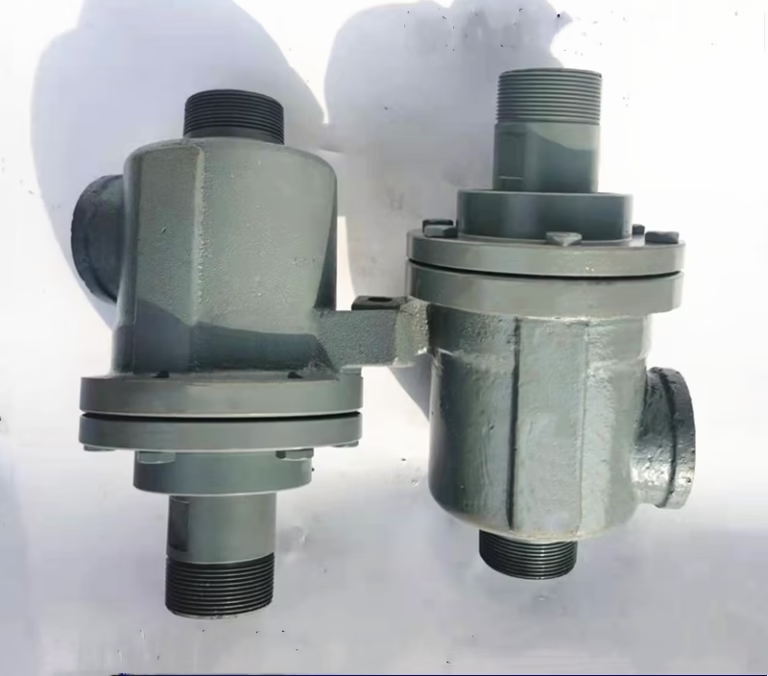
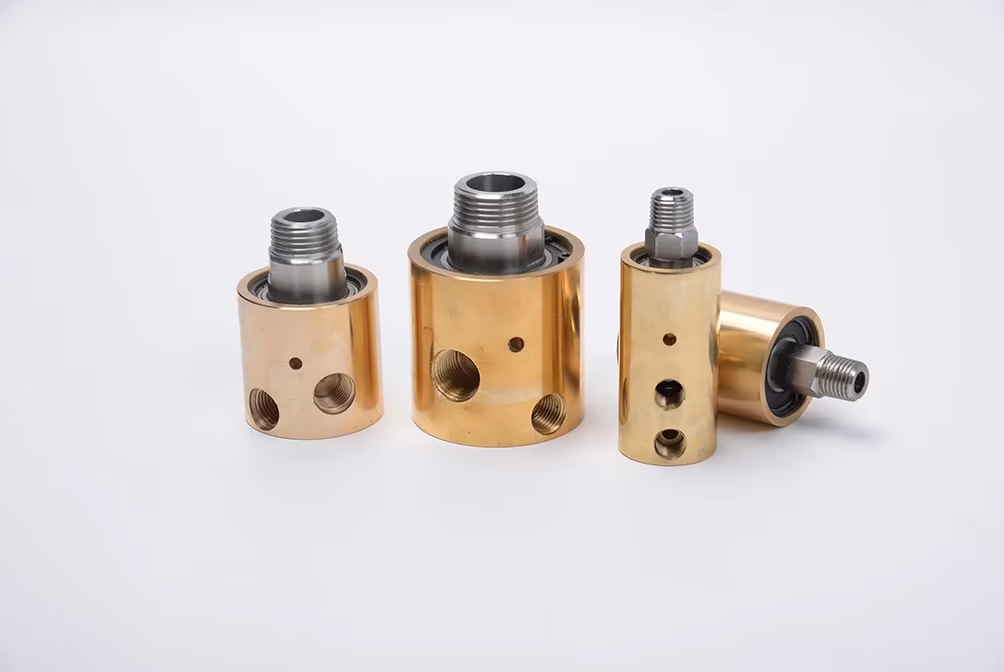
A water rotary joint is a precision-engineered mechanical device that transfers water or water-based coolant from a stationary supply line into rotating equipment while maintaining a reliable dynamic seal.
Unlike flexible hoses, which twist and fatigue during continuous rotation, a rotary joint allows unrestricted rotation while providing a stable fluid path.
The basic operating principle is straightforward:
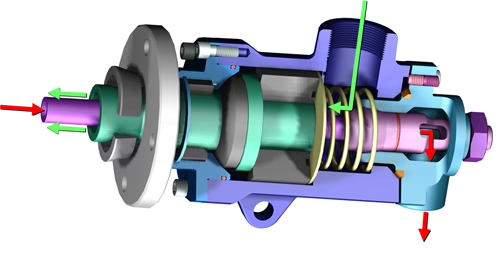
- The housing remains stationary and connects to the water supply.
- The shaft or rotor rotates together with the machine.
- Internal flow passages guide water from the stationary side to the rotating side.
- Precision mechanical seals prevent leakage between rotating and stationary components.
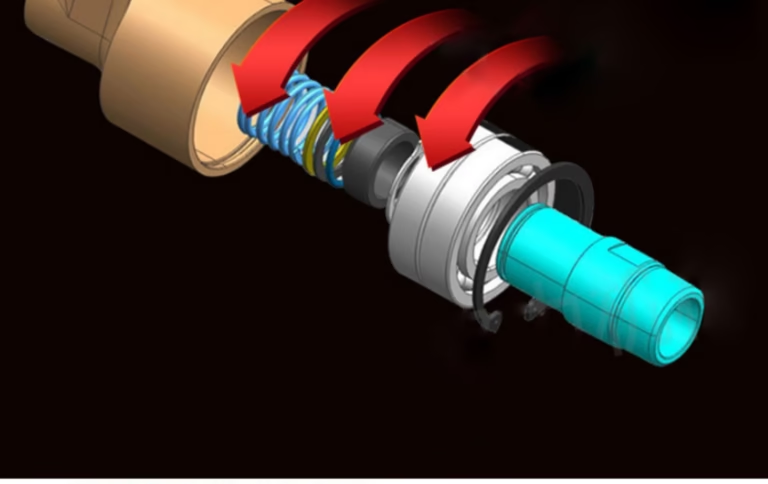
- Bearings support smooth rotation while minimizing friction and maintaining seal alignment.
Although the concept appears simple, achieving reliable sealing under real industrial conditions requires careful engineering. Even a slight error in seal face flatness, bearing alignment, or surface finish can significantly reduce service life.
For this reason, high-quality rotary joints rely on precision machining, carefully selected sealing materials, and strict quality control throughout the manufacturing process.
How Does a Water Rotary Joint Work?
The working principle of a water rotary joint combines fluid dynamics with precision mechanical sealing.
As water enters the stationary housing, it flows through specially designed internal passages toward the rotating shaft. While the shaft rotates continuously with the equipment, the stationary housing remains fixed.
The challenge lies in preventing leakage where these two components meet.
To solve this, rotary joints use mechanical seal technology. Two highly polished seal faces—one rotating and one stationary—remain in constant contact under controlled spring pressure. A microscopic fluid film between the seal faces provides lubrication, reducing friction while maintaining an effective seal.
At the same time, precision bearings keep the rotating shaft perfectly aligned. If the shaft begins to wobble due to bearing wear or improper installation, the seal faces can no longer maintain uniform contact, resulting in leakage.
This is why seal life and bearing life are closely related. In our inspection of failed rotary joints, worn bearings are often the root cause of premature seal failure.
The entire assembly must also accommodate:
- Continuous rotation
- Internal fluid pressure
- Temperature changes
- Mechanical vibration
- Axial movement
- Radial loads
Balancing all these factors is what separates a durable industrial rotary joint from a low-cost product that fails after only a short period of operation.
Where Are Water Rotary Joints Used?
One of the strengths of water rotary joints is their versatility. Almost every industry that combines rotating machinery with cooling or heating processes relies on them in some form.
CNC Machining Centers
High-speed machining generates substantial heat at the cutting edge. Through-spindle coolant systems use water rotary joints to deliver coolant directly through the rotating spindle, improving tool life, chip evacuation, and machining accuracy.
As spindle speeds continue to increase, rotary joints must maintain stable sealing while operating at increasingly demanding rotational speeds.
For these applications, precision balancing and high-quality bearings are essential.
Steel and Metallurgical Equipment
Steel production operates under extreme thermal conditions.
Continuous casting machines, rolling mills, and guide rolls require large volumes of cooling water to maintain dimensional stability and protect equipment from overheating.
Rotary joints used in these environments must withstand:
- Continuous operation
- Elevated temperatures
- Heavy vibration
- Scale-contaminated cooling water
- Harsh industrial environments
In our experience, improper material selection is one of the most common reasons for premature failure in steel plants. Corrosion-resistant materials and wear-resistant seal combinations generally provide much longer service life than standard configurations.
Paper and Pulp Mills
Paper manufacturing relies heavily on temperature control.
Large drying cylinders rotate continuously while transferring heat through steam or hot water. Rotary joints provide the critical connection between stationary piping and these rotating cylinders.
Because paper mills often operate 24 hours a day, reliability becomes more important than the initial purchase price.
Several of our customers in the paper industry evaluate rotary unions based not on unit cost but on total operating hours between maintenance shutdowns. A longer service life reduces maintenance frequency, lowers labor costs, and minimizes production interruptions.
Plastics and Rubber Processing
Temperature control directly affects product quality during rubber mixing, calendaring, and plastic extrusion.
Water rotary joints circulate cooling water through rotating rolls and drums, helping maintain stable processing temperatures.
A leaking rotary joint in these systems can disrupt production consistency and lead to defects such as uneven thickness, poor surface finish, or dimensional variations.
Because cooling systems in plastics processing often contain chemical additives, seal material compatibility should always be considered during product selection.
5 Common Water Rotary Joint Failures We See in Our Factory
After manufacturing and servicing rotary joints for customers across different industries, we have learned an important lesson: most rotary joint failures are not caused by manufacturing defects. Instead, they result from incorrect product selection, unsuitable operating conditions, poor installation, or inadequate maintenance.
Every year, customers send worn rotary joints back to our factory for inspection. By disassembling these units and examining the sealing faces, bearings, shafts, and internal components, we can often determine exactly why the product failed.
Below are the five problems we encounter most frequently.
1. Seal Face Wear Caused by Contaminated Water
Mechanical seals are the heart of every water rotary joint.
Although modern seal materials such as silicon carbide and carbon graphite are highly wear-resistant, they are not immune to abrasive particles.
In steel plants, machining centers, and paper mills, cooling water often contains:
- Rust particles
- Metal chips
- Sand
- Scale
- Mineral deposits
- Welding residue
These contaminants gradually scratch the polished seal faces, eventually creating leakage paths.
One customer operating a machining center experienced repeated seal failures every four to six months. After reviewing their coolant system, we discovered that the filter element had not been replaced for nearly a year. Once the filtration system was upgraded and the rotary joint replaced, the service life more than doubled.
This experience reinforces an important principle:
Clean water is one of the most effective ways to extend rotary joint life.
2. Bearing Failure Leading to Seal Leakage
Many operators assume that leakage always means the seal has failed.
In reality, the seal is often the final component to fail.
Precision bearings maintain concentric rotation between the shaft and housing. As bearings wear, shaft runout increases, causing uneven contact between the seal faces.
Typical warning signs include:
- Unusual operating noise
- Increased vibration
- Higher operating temperature
- Shaft movement
- Intermittent leakage during rotation
Unfortunately, many users continue operating the equipment after these symptoms appear.
Once bearing clearance exceeds acceptable limits, the mechanical seal can no longer compensate for the misalignment, resulting in rapid seal wear.
For high-speed applications, bearing quality is just as important as seal quality.
3. Incorrect Rotary Joint Selection
Another common problem is selecting a rotary joint based solely on connection size.
We frequently receive inquiries such as:
“The thread matches our machine. Will this model work?”
Thread compatibility is only one small part of the selection process.
Before recommending a rotary joint, our engineering team evaluates:
- Working pressure
- Water temperature
- Maximum RPM
- Rotation type
- Flow rate
- Shaft configuration
- Installation space
- Duty cycle
For example, a rotary joint designed for 500 RPM may perform well in low-speed applications but fail quickly if installed on a spindle operating at 5,000 RPM.
Likewise, a standard seal designed for room-temperature water may not survive continuous exposure to hot water above 120°C.
Selecting the right rotary joint requires understanding the entire operating environment—not just the mounting dimensions.
4. Installation Errors
Even a high-quality rotary joint can fail prematurely if installed incorrectly.
Some of the installation issues we encounter include:
- Misaligned shafts
- Rigid piping connections
- Excessive hose tension
- Improper tightening torque
- Lack of flexible supports
- Damaged threads during assembly
Rigid piping is particularly problematic.
When the connected piping cannot absorb machine vibration or thermal expansion, additional forces are transferred directly into the rotary joint bearings.
Over time, these extra loads accelerate bearing wear and reduce seal life.
Whenever possible, we recommend using flexible hoses or expansion joints to minimize unnecessary stress on the rotary joint.
5. Using the Wrong Seal Material
Not every water application is the same.
Some systems circulate clean cooling water.
Others use:
- Deionized water
- Water containing corrosion inhibitors
- Water mixed with glycol
- Chemical cooling solutions
- Process water with suspended particles
Each medium affects sealing materials differently.
For example:
- Carbon graphite provides excellent self-lubrication.
- Silicon carbide offers exceptional wear resistance.
- Tungsten carbide performs well under high pressure.
- PTFE resists many aggressive chemicals.
Choosing the wrong seal combination can reduce service life dramatically, even when the rotary joint is otherwise well designed.
One of our responsibilities as a manufacturer is helping customers select the most appropriate material combination before production begins.
Why Many Water Rotary Joints Fail Earlier Than Expected
Customers often ask us:
“Why did our rotary joint only last six months when the previous one operated for several years?”
After analyzing hundreds of returned products, we have identified a recurring pattern.
Premature failures are rarely caused by a single issue. Instead, several factors usually combine to shorten service life.
These include:
- Poor coolant cleanliness
- Excessive operating pressure
- High rotational speed
- Incorrect installation
- Inadequate maintenance
- Seal material incompatibility
- Bearing overload
- Continuous operation beyond design limits
In many cases, replacing the rotary joint without addressing the root cause simply repeats the same failure.
That is why we encourage customers to share complete application details before purchasing a replacement.
Understanding the operating environment allows us to recommend design improvements rather than supplying an identical component that may fail for the same reasons.
How We Select Materials for Different Water Applications
Material selection is one of the most important aspects of rotary joint design.
There is no universal solution suitable for every application.
Instead, we tailor the material combination to the customer’s operating conditions.
Housing Materials
Aluminum Alloy
Lightweight and suitable for high-speed applications where weight reduction improves dynamic balance.
Typical applications include:
- CNC machining centers
- Packaging machinery
- Printing equipment
Brass
Brass offers good corrosion resistance and economical performance for general industrial water systems operating under moderate pressure.
Stainless Steel 304
Suitable for humid environments requiring improved corrosion resistance.
Commonly used in:
- Food processing
- Pharmaceutical equipment
- General industrial cooling
Stainless Steel 316
Preferred for highly corrosive environments.
Ideal for:
- Marine equipment
- Chemical processing
- Offshore applications
- Saltwater cooling systems
Choosing the Right Mechanical Seal
The mechanical seal determines whether a rotary joint delivers years of reliable operation or requires frequent replacement.
Rather than selecting the most expensive material, our engineers focus on matching seal materials to the actual operating conditions.
Typical combinations include:
| Seal Combination | Recommended Application |
|---|---|
| Carbon Graphite + Silicon Carbide | Clean water, general industrial cooling |
| Silicon Carbide + Silicon Carbide | High-speed, abrasive water systems |
| Tungsten Carbide + Tungsten Carbide | High-pressure industrial applications |
| Carbon Graphite + Ceramic | Economical, medium-duty equipment |
This application-driven approach often provides a longer service life while keeping procurement costs under control.
Engineering Experience Makes the Difference
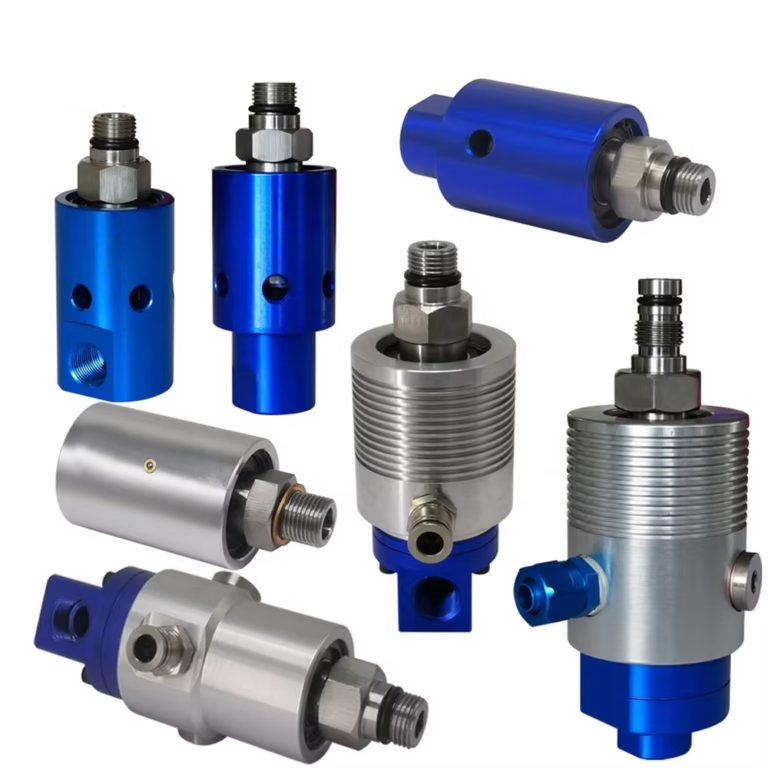
Many rotary joints available on the market appear almost identical from the outside.
The difference lies inside.
Over the years of manufacturing, we have found that long-term reliability depends on numerous engineering details that are not immediately visible, including:
- Seal face flatness is measured to extremely tight tolerances
- Bearing preload adjusted during assembly
- Surface roughness of sealing components
- Spring force matched to operating pressure
- Concentricity between shaft and housing
- Precision machining of internal flow passages
These details cannot be evaluated simply by comparing catalog photos.
They are the result of manufacturing experience, process control, and continuous improvement based on customer feedback.
For this reason, selecting an experienced manufacturer often provides greater long-term value than choosing a product based solely on price.
Inside Our Factory: How We Manufacture Reliable Water Rotary Joints
A rotary joint may appear to be a simple mechanical component, but producing one that performs reliably under continuous rotation requires much more than standard machining. At Dann Hydraulic, every production stage is designed to ensure dimensional accuracy, sealing performance, and long-term durability.
Unlike trading companies that source products from different factories, we manufacture rotary unions in-house. This allows our engineering team to control every critical process—from raw material selection to final pressure testing—and respond quickly to customer-specific requirements.
For OEM customers, this also means faster engineering support, greater customization flexibility, and more consistent product quality.
Precision Machining Starts with the Right Materials
The service life of a rotary joint begins long before assembly. It starts with selecting the correct material for the intended application.
Depending on the operating environment, we manufacture water rotary joints using:
- High-strength aluminum alloy for lightweight, high-speed machinery
- Brass for economical industrial cooling systems
- Stainless Steel 304 for general corrosion resistance
- Stainless Steel 316 for marine, chemical, and food-grade applications
Material certificates are verified before production to ensure consistency across every batch.
Each housing and shaft is then machined using CNC equipment to maintain tight dimensional tolerances. Critical sealing surfaces receive additional finishing operations because even minor machining errors can affect sealing performance.
In our experience, precision machining is one of the biggest differences between industrial-grade rotary joints and low-cost alternatives.
Mechanical Seal Manufacturing: Where Reliability Is Determined
The mechanical seal is the heart of every rotary joint.
Although it represents only a small portion of the product, it determines whether the rotary joint operates for several months or several years.
Different applications require different sealing materials.
For example:
Carbon Graphite
- Excellent self-lubrication
- Suitable for clean water systems
- Low friction
- Economical solution
Silicon Carbide
- Outstanding wear resistance
- High hardness
- Excellent for contaminated cooling water
- Ideal for high-speed equipment
Tungsten Carbide
- Exceptional pressure resistance
- Long service life
- Suitable for abrasive media
- Common in heavy industrial applications
Rather than recommending the same seal material for every customer, our engineers select combinations based on actual operating conditions.
This application-focused approach often provides a longer service life while avoiding unnecessary costs.
Bearing Selection Matters More Than Many Buyers Expect
One common misconception is that leakage is always caused by worn seals.
In reality, bearings often determine the lifespan of the entire rotary joint.
Poor bearing quality can result in:
- Shaft runout
- Increased vibration
- Higher operating temperatures
- Uneven seal wear
- Premature leakage
For this reason, we use premium-grade bearings selected according to:
- Rotational speed
- Radial load
- Axial load
- Operating temperature
- Expected service life
Our engineering team also calculates appropriate bearing arrangements for high-speed applications to minimize shaft deflection during continuous operation.
Although bearings are hidden inside the housing, they have a significant impact on long-term reliability.
Every Rotary Joint Undergoes Strict Quality Inspection
Quality cannot be inspected into a product at the final stage—it must be built into every manufacturing process.
To ensure consistency, each production batch follows standardized inspection procedures.
Dimensional Inspection
Critical dimensions are measured using calibrated inspection equipment.
Inspection items include:
- Shaft diameter
- Thread specifications
- Overall length
- Port position
- Housing concentricity
- Seal cavity dimensions
These measurements ensure that every rotary joint matches the approved engineering drawing and can be installed without modification.
Pressure Testing
Pressure testing is one of the most important quality control procedures.
Each rotary joint is tested according to its design pressure to verify:
- Internal sealing performance
- External leakage
- Housing integrity
- Thread sealing
- Assembly quality
Testing before shipment allows us to identify potential issues before products reach the customer.
Dynamic Rotation Testing
Static pressure testing alone cannot fully evaluate a rotary joint.
Representative products from each production batch also undergo dynamic testing under rotating conditions.
During testing, engineers monitor:
- Rotation stability
- Bearing noise
- Friction torque
- Temperature rise
- Dynamic leakage
This process helps confirm that the rotary joint performs reliably under real operating conditions rather than only during static inspection.
Final Inspection Before Shipment
Before packaging, every rotary joint undergoes a final inspection covering:
- Surface finish
- Laser marking
- Thread protection
- Packaging integrity
- Accessories
- Documentation
Only products that pass every inspection stage are approved for shipment.
For many OEM customers, this consistent quality is one of the primary reasons they continue working with us year after year.
OEM Manufacturing Is More Than Adding a Logo
Many people associate OEM manufacturing with simply engraving a customer’s logo onto a product.
In reality, industrial OEM projects involve much more.
Our engineering team regularly works with machine builders that require rotary joints specifically designed for their equipment.
Customization may include:
- Special shaft dimensions
- Customized mounting flanges
- Different thread standards (BSP, NPT, G, Metric)
- Modified flow passages
- Higher pressure ratings
- Special sealing materials
- Corrosion-resistant surface treatments
- Private-label packaging
- Laser engraving
- Product documentation with customer branding
Because production takes place in our own factory, engineering modifications can be completed much more efficiently than through multiple intermediaries.
This flexibility allows equipment manufacturers to reduce procurement complexity while maintaining consistent product quality.
Why More Global Customers Are Choosing Chinese Rotary Joint Manufacturers
The global rotary union market has changed significantly over the past decade.
Previously, many buyers focused exclusively on established European or American brands.
Today, purchasing priorities have shifted.
Customers increasingly evaluate suppliers based on:
- Product performance
- Engineering support
- Delivery time
- Customization capability
- Manufacturing consistency
- Total procurement cost
As manufacturing technology has advanced, experienced Chinese factories have become trusted partners for distributors and OEM equipment manufacturers worldwide.
Rather than replacing premium brands simply because of price, many customers choose compatible rotary joints because they offer a better overall balance between quality, availability, engineering support, and cost efficiency.
For maintenance departments managing hundreds of machines, reducing lead time from several weeks to a few days can have a greater financial impact than the initial purchase price.
Similarly, OEM manufacturers often require customized solutions that are difficult to obtain from standardized catalog suppliers.
Working directly with a manufacturer enables faster communication, greater design flexibility, and more responsive technical support throughout the project lifecycle.
A Practical Example from Our Manufacturing Experience
Several years ago, an overseas equipment manufacturer contacted us regarding recurring failures in the cooling system of its roll-processing equipment.
The original rotary joints had a relatively short service life under continuous operation. Leakage typically appeared after extended exposure to elevated temperatures and water containing fine abrasive particles.
Instead of producing an identical replacement, our engineering team reviewed the customer’s operating conditions in detail.
After analyzing the application, we recommended several improvements:
- Upgrading the mechanical seal material to silicon carbide for improved wear resistance.
- Optimizing the bearing arrangement to better withstand continuous operation.
- Refining internal flow passages to improve cooling efficiency.
- Improving the surface finish of critical sealing components.
After field validation, the redesigned rotary joint achieved significantly longer maintenance intervals, helping the customer reduce both replacement frequency and production downtime.
This project reinforced an important principle that guides our engineering approach today:
The best rotary joint is not necessarily the one that matches the original drawing exactly—it is the one optimized for the customer’s real operating conditions.
How to Choose the Right Water Rotary Joint for Your Application
Selecting the right water rotary joint is not simply a matter of matching thread sizes or outside dimensions. A rotary joint is a precision component that must operate continuously under pressure, temperature fluctuations, vibration, and rotation. Choosing the wrong model can result in premature seal wear, frequent maintenance, and unexpected production downtime.
Based on our experience supporting OEM machine builders, maintenance companies, and industrial end users, we recommend evaluating the following factors before making a purchasing decision.
1. Identify the Working Medium
Although this guide focuses on water rotary joints, “water” can refer to many different media, including:
- Clean cooling water
- Industrial circulating water
- Deionized water
- Water mixed with glycol
- Water containing corrosion inhibitors
- Hot water
- Process water containing suspended particles
Different media require different seal materials and housing materials. Sharing detailed information about the fluid with your supplier helps ensure the rotary joint is designed for long-term reliability.
2. Confirm the Operating Pressure
Pressure is one of the primary design parameters for any rotary joint.
Before selecting a model, determine:
- Normal operating pressure
- Maximum pressure peaks
- Pressure fluctuations during machine startup or shutdown
A safety margin should always be considered rather than selecting a rotary joint rated exactly at the system pressure.
3. Determine Maximum Rotational Speed
Rotational speed has a significant influence on bearing life and seal performance.
High-speed applications require:
- Precision bearings
- Dynamic balancing
- Low-friction mechanical seals
- Optimized spring loading
For example, a rotary joint used on a paper machine roll has very different design requirements than one used in a high-speed CNC spindle operating at several thousand RPM.
4. Consider Temperature
Temperature affects almost every internal component of a rotary joint.
Higher temperatures accelerate seal wear and influence material expansion.
Before selection, confirm:
- Minimum operating temperature
- Maximum continuous temperature
- Short-term temperature peaks
For hot water systems, special seal materials and heat-resistant elastomers are often recommended.
5. Verify Installation Dimensions
Providing accurate installation information helps avoid unnecessary modifications after delivery.
Important dimensions include:
- Thread specification
- Shaft diameter
- Mounting flange dimensions
- Port size
- Overall length
- Rotation direction
Whenever possible, we recommend supplying:
- Original part numbers
- Engineering drawings
- Equipment manuals
- Product photographs
These documents allow our engineering team to verify compatibility before production begins.
6. Choose an Experienced Manufacturer
Selecting the right supplier is just as important as selecting the right product.
A qualified rotary joint manufacturer should provide:
- Engineering consultation
- Material recommendations
- Technical drawings
- OEM customization
- Quality testing reports
- After-sales technical support
A supplier that understands your application can often recommend improvements that extend service life and reduce maintenance costs.
Why More Industrial Buyers Are Choosing OEM Water Rotary Joints
The industrial purchasing landscape has changed significantly in recent years.
Companies are no longer evaluating suppliers based only on brand recognition. Instead, procurement teams focus on overall value, supply chain reliability, engineering capability, and long-term operating costs.
This trend has created growing demand for high-quality OEM-compatible rotary joints manufactured by experienced factories.
At Dann Hydraulic, many customers initially contact us because they are searching for an alternative to a premium international brand. After evaluating our products, they often continue working with us for reasons that extend well beyond price.
Competitive Factory Pricing
Purchasing directly from the manufacturer eliminates unnecessary distribution costs.
This enables customers to achieve lower procurement costs while maintaining reliable product quality.
Shorter Lead Times
Machine downtime is expensive.
Because production is managed in our own facility, we can respond more quickly to urgent replacement requirements and OEM projects.
Shorter delivery times help maintenance teams reduce inventory costs while improving equipment availability.
Flexible OEM Manufacturing
Every machine is different.
We support:
- Custom dimensions
- Special thread standards
- Material upgrades
- Laser logo engraving
- Private-label packaging
- Customized documentation
- Small and large production quantities
This flexibility allows equipment manufacturers and distributors to build their own brands while maintaining engineering compatibility.
Stable Product Quality
Consistency is critical for industrial customers.
Every production batch follows standardized manufacturing and inspection procedures to ensure repeatable performance.
This reliability reduces unexpected maintenance and improves customer confidence in replacement parts.
Frequently Asked Questions
1. What is the difference between a water rotary joint and a rotary union?
The two terms are often used interchangeably. In most industrial applications, both describe a device that transfers fluid between stationary piping and rotating equipment while maintaining a leak-free seal.
2. How long does a water rotary joint typically last?
Service life depends on operating conditions such as pressure, speed, water quality, installation accuracy, and maintenance. Under proper operating conditions, a well-designed rotary joint can provide reliable service for many years.
3. Why is my rotary joint leaking?
The most common causes include:
- Worn mechanical seals
- Bearing damage
- Contaminated water
- Improper installation
- Excessive operating pressure
- Shaft misalignment
Identifying the root cause before replacement helps prevent repeated failures.
4. Can a water rotary joint be repaired?
In some cases, replacing seals and bearings may restore performance. However, if the shaft or housing has suffered significant wear, replacement is often the more economical solution.
5. Which seal material is best for water applications?
There is no universal answer.
The most suitable seal material depends on:
- Water quality
- Operating pressure
- Rotational speed
- Temperature
- Presence of abrasive particles
Our engineers recommend seal materials based on the customer’s specific application rather than using a standard configuration for every project.
6. Can you manufacture according to our drawings?
Yes.
We regularly manufacture OEM rotary joints based on customer drawings, samples, or technical specifications.
7. Do you offer private-label manufacturing?
Yes.
We support OEM and private-label production, including laser engraving, customized packaging, and branded documentation for distributors and equipment manufacturers.
8. How do you test product quality?
Our inspection process includes:
- CNC dimensional inspection
- Pressure testing
- Leakage testing
- Dynamic rotation testing
- Final visual inspection
These procedures help ensure every rotary joint meets design requirements before shipment.
9. Can your products replace international brands?
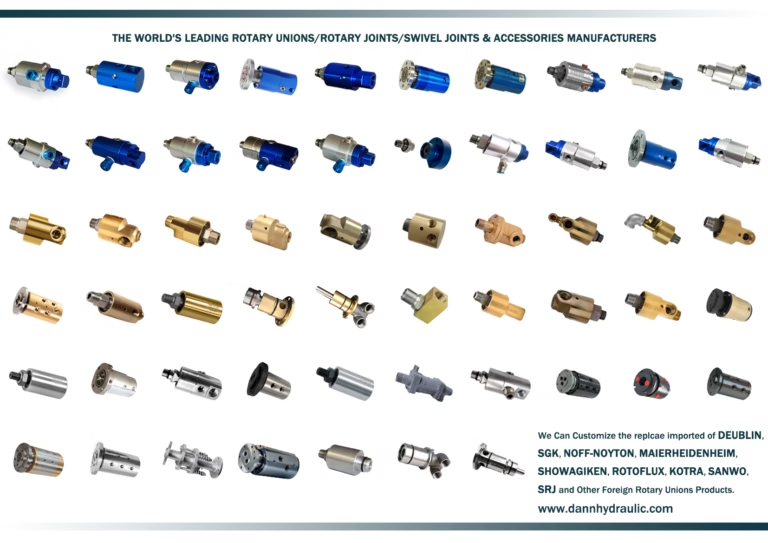
Yes. We manufacture OEM-compatible rotary joints designed to match the installation dimensions and operating requirements of many internationally recognized brands. Our engineering team reviews each application carefully to ensure compatibility before production.
10. How can I choose the correct rotary joint if I only have the old sample?
This is a common situation. Simply send us the existing rotary joint, detailed photographs, or the equipment drawings. Our engineers can identify the key dimensions, evaluate the operating conditions, and recommend a compatible replacement or develop a customized solution if required.
Conclusion
A water rotary joint is far more than a simple connector between stationary piping and rotating equipment. It is a precision-engineered component that directly influences production efficiency, equipment reliability, maintenance costs, and operational safety across industries such as CNC machining, steel manufacturing, paper production, plastics processing, food processing, and energy generation.
While many rotary joints may appear similar externally, their long-term performance depends on numerous engineering factors, including seal material selection, bearing quality, machining accuracy, assembly precision, and rigorous quality control. These details determine whether a rotary joint delivers years of reliable service or requires frequent replacement.
At Dann Hydraulic, we combine practical manufacturing experience with continuous engineering improvement to produce rotary joints that meet the demanding requirements of modern industry. From material selection and CNC machining to pressure testing and OEM customization, every stage of production is focused on delivering dependable performance and consistent quality.
Whether you need a standard water rotary joint, a customized OEM solution, or a cost-effective replacement for an existing product, our engineering team is ready to help. By understanding your operating conditions and application requirements, we can recommend a solution that balances reliability, performance, lead time, and overall cost of ownership.
When selecting your next water rotary joint, remember that the right manufacturing partner is just as important as the right product. Choosing a supplier with proven engineering expertise, real production experience, and a commitment to quality will help ensure reliable operation, reduce maintenance costs, and support the long-term success of your equipment.