
How to Select a High Speed Air Rotary Joint for Punch Press and Automation Equipment
In modern metal forming and manufacturing industries, punch presses operate at increasingly higher speeds to improve production efficiency and reduce manufacturing costs. Behind the high-speed movement of these machines, many small but critical components determine whether the equipment can maintain stable operation. One of these important components is the rotary joint for a punch press.
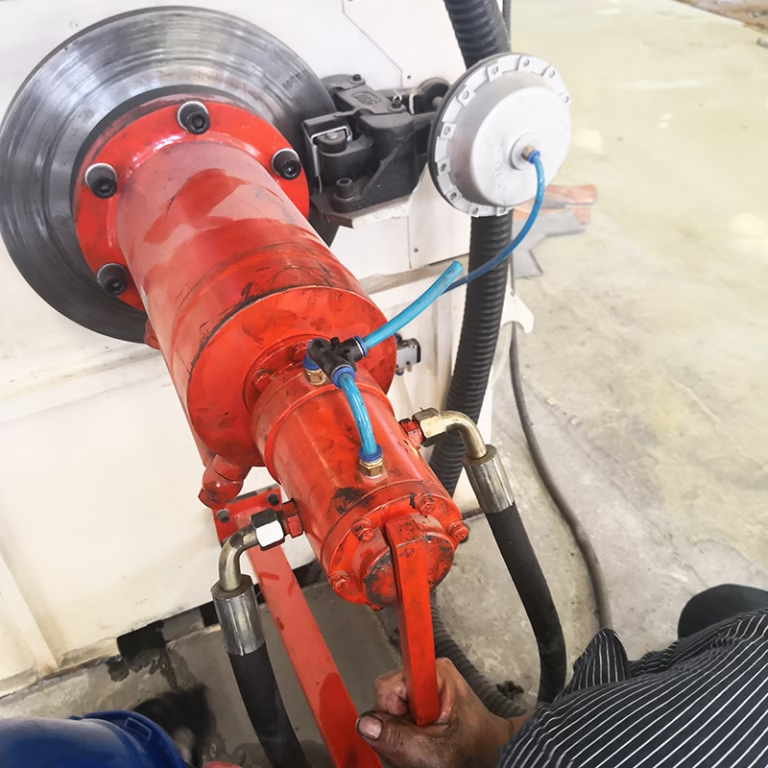
A rotary joint, also known as a rotary union or rotary coupling, provides a continuous connection between stationary supply lines and rotating machine components. In pneumatic punch press systems, the rotary joint transfers compressed air or hydraulic media while allowing continuous rotation without twisting hoses or interrupting production.
For many years, Dann Hydraulic has manufactured rotary unions and industrial rotary joints for machinery manufacturers, maintenance companies, and equipment users worldwide. Through practical experience working with different rotating systems, we have found that selecting the correct rotary joint is not simply about matching thread size or pressure rating. The real challenge is understanding the machine operating environment, rotation speed, sealing requirements, and long-term reliability expectations.
This guide explains how to select a high-speed air rotary joint for punch press and automation equipment, based on real manufacturing experience and common application requirements.
Why Punch Press Equipment Requires a Reliable Rotary Joint
Punch presses are designed for high-speed repetitive operations. Depending on the machine design, the rotating components may include:
- Pneumatic clutches
- Rotary cylinders
- Indexing mechanisms
- Rotating tooling systems
- Automatic feeding devices
During operation, these components often require a continuous supply of compressed air.
Traditional hose connections cannot handle continuous rotation because the hose may:
- Twist after repeated cycles
- Experience fatigue failure
- Restrict machine movement
- Create leakage points
- Require frequent replacement
A pneumatic rotary joint solves this problem by providing a controlled rotating connection between the stationary air supply and the rotating shaft.
A properly selected rotary joint allows:
- Continuous 360-degree rotation
- Stable compressed air transmission
- Reduced downtime
- Improved machine reliability
For high-speed punch press applications, the rotary joint becomes a key component affecting overall equipment performance.
Common Problems Caused by Incorrect Rotary Joint Selection
In our factory experience, many rotary union failures are not caused by poor manufacturing quality. They are often caused by selecting a rotary joint that does not match the actual working conditions.
Below are several common problems found in industrial applications.
1. Air Leakage During High-Speed Rotation
Air leakage is one of the most common problems in pneumatic rotary systems.
Possible causes include:
- Incorrect seal material selection
- Excessive rotation speed
- Poor alignment between rotating and stationary parts
- Incorrect operating pressure
For punch presses running thousands of cycles per day, even a small leakage can reduce machine efficiency and increase compressed air consumption.
At Dann Hydraulic, we normally evaluate:
- Working pressure
- Rotation speed
- Media cleanliness
- Temperature condition
before recommending the sealing structure.
2. Premature Seal Wear
The sealing system is the core technology of a rotary joint.
Different applications require different sealing materials.
For example:
Carbon Graphite Seal
Commonly used for:
- Air rotary unions
- High-speed rotation
- Low-friction applications
Advantages:
- Good self-lubricating performance
- Stable operation at high speed
- Reduced friction heat
Silicon Carbide Seal
Suitable for:
- Higher pressure applications
- More demanding environments
- Longer service life requirements
Advantages:
- Excellent wear resistance
- High hardness
- Good sealing stability
Choosing the correct seal combination is essential for achieving long service life.
3. Vibration and Mechanical Misalignment
Punch press equipment generates significant mechanical forces during operation.
High vibration can affect rotary joint performance by causing:
- Uneven seal contact
- Bearing damage
- Increased leakage
- Abnormal noise
A high-quality high RPM rotary union requires precise machining and proper balance control.
During production, Dann Hydraulic uses CNC machining processes to maintain critical dimensional accuracy for rotating components.
4. Incorrect Speed Rating
One of the most overlooked factors is rotation speed.
A rotary joint designed for low-speed operation may fail quickly when installed on a high-speed punch press.
Before selecting a rotary joint, engineers should confirm:
- Maximum RPM
- Continuous or intermittent rotation
- Acceleration and deceleration cycles
A high-speed air rotary joint should be selected according to the actual machine speed rather than only the pressure requirement.
Understanding the Working Principle of a Punch Press Rotary Joint
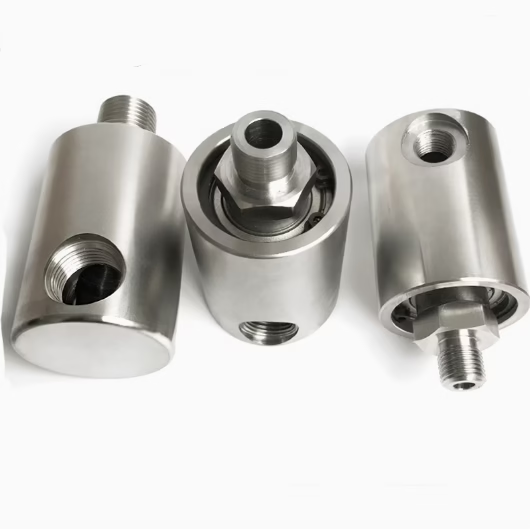
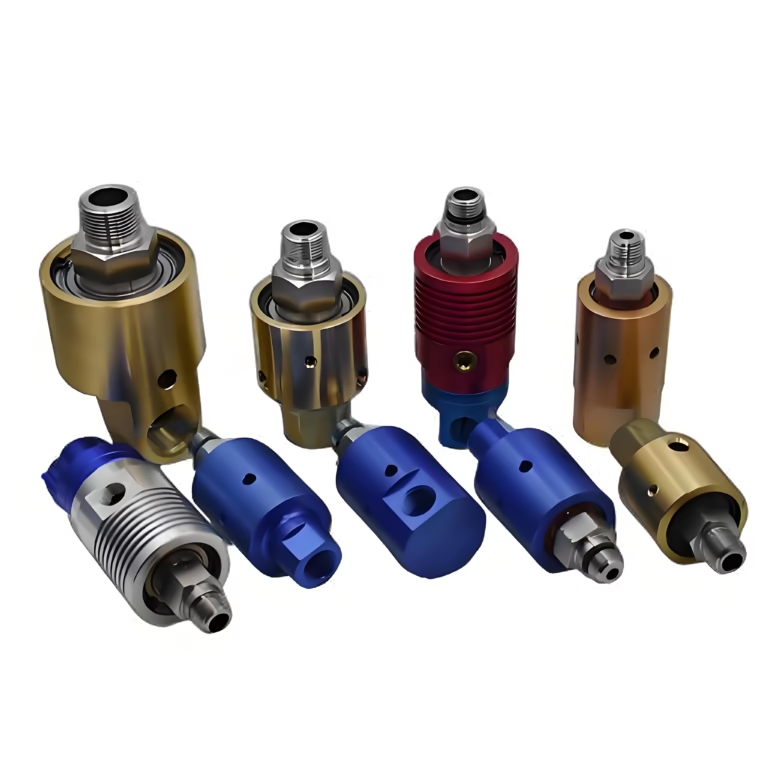
A rotary joint consists of several precision components:
- Rotating shaft
- Stationary housing
- Sealing assembly
- Bearings
- Connection ports
The stationary side connects to the external air supply, while the rotating side connects to the rotating machine component.
During operation, the internal sealing system maintains contact between rotating and stationary surfaces, allowing compressed air to pass through without leakage.
The performance of the rotary joint depends mainly on:
- Seal design
- Material selection
- Machining accuracy
- Assembly quality
- Operating condition matching
This is why rotary joint manufacturing requires both mechanical engineering knowledge and practical application experience.
How to Select the Correct Rotary Joint for Punch Press Applications
Selecting the correct rotary joint for punch press applications requires more than checking the connection size or replacing the original part with an identical model. In real industrial environments, a rotary joint must match the machine’s operating conditions, including speed, pressure, media, installation structure, and working cycle.
Based on years of manufacturing and supplying rotary unions for industrial equipment, Dann Hydraulic has found that many rotary joint failures can be avoided during the selection stage. A properly selected high-speed air rotary joint can significantly improve machine reliability, reduce maintenance frequency, and extend the service life of rotating components.
The following factors should be carefully considered when selecting a rotary joint for punch presses and automation equipment.
1. Confirm the Working Medium: Air, Vacuum, or Hydraulic Oil
The first step in selecting a rotary joint is identifying the type of media that needs to be transferred.
Different media require different internal designs and sealing structures.
Compressed Air Applications
Most pneumatic punch press systems use compressed air to control:
- Clutches
- Braking systems
- Pneumatic cylinders
- Rotary actuators
For these applications, an air rotary union must provide stable airflow while maintaining low leakage during continuous rotation.
Important factors include:
- Air pressure
- Air cleanliness
- Rotation speed
- Operating temperature
A rotary joint designed specifically for compressed air will normally use sealing materials optimized for low friction and high-speed operation.
Vacuum Applications
Some automated punch press systems and robotic equipment require vacuum transmission for:
- Material handling
- Vacuum fixtures
- Suction devices
A vacuum rotary joint requires excellent sealing performance because even small leakage can reduce vacuum efficiency.
When designing vacuum rotary joints, engineers need to consider:
- Vacuum level
- Seal structure
- Surface finish
- Rotation speed
Hydraulic Oil Applications
Some heavy-duty forming equipment uses hydraulic systems instead of pneumatic systems.
For hydraulic applications, the rotary joint must handle:
- Higher pressure
- Different fluid characteristics
- Higher sealing requirements
A hydraulic oil rotary union usually requires stronger sealing materials and more robust internal structures compared with a standard air rotary joint.
2. Check Rotation Speed Requirements
Rotation speed is one of the most important parameters for selecting a high-performance rotary joint.
A common mistake is selecting a rotary union based only on pressure while ignoring RPM requirements.
For example:
A rotary joint operating at 500 RPM and a rotary joint operating at 5,000 RPM may have completely different designs.
High-speed applications require:
- Precision-balanced rotating parts
- Low-friction bearings
- Optimized seal contact pressure
- Heat control design
A High Speed Air Rotary Joint used in punch press equipment should be evaluated according to:
- Maximum operating RPM
- Continuous rotation speed
- Acceleration frequency
- Duty cycle
At Dann Hydraulic, we often review the actual machine working conditions rather than only the technical drawing. This practical approach helps avoid premature seal wear and unexpected downtime.
3. Select the Correct Pressure Rating
Pressure rating is another critical factor.
A rotary joint must maintain reliable sealing under the actual working pressure, including pressure fluctuations during machine operation.
When selecting a rotary joint, consider:
- Normal working pressure
- Maximum pressure
- Pressure spikes
- Safety margin
For pneumatic punch press applications, common working pressures may vary depending on machine design.
A rotary joint with insufficient pressure capability may experience:
- Internal leakage
- Seal damage
- Reduced performance
However, choosing an excessively high-pressure model is not always the best solution. The internal sealing structure should match the application.
A properly designed rotary joint provides the balance between:
- Sealing reliability
- Rotation speed
- Service life
- Cost efficiency
4. Choose the Appropriate Seal Material
The sealing system determines the performance and lifespan of a rotary joint.
In industrial applications, the most common sealing combinations include:
Carbon Graphite Seal + Ceramic Seal
This combination is widely used for:
- Pneumatic rotary joints
- High-speed air applications
- Automation equipment
Advantages:
- Low friction
- Good wear resistance
- Stable high-speed performance
Silicon Carbide Seal
Silicon carbide is often selected for more demanding applications.
Advantages:
- Excellent hardness
- High wear resistance
- Strong chemical compatibility
- Long operating life
Applications include:
- High-pressure rotary unions
- Industrial machinery
- Difficult operating environments
Elastomer Selection
The auxiliary seals also influence performance.
Common materials include:
NBR
Suitable for:
- General industrial air applications
- Standard temperature conditions
FKM (Viton)
Suitable for:
- Higher temperature environments
- More aggressive fluids
Selecting the correct seal material requires understanding the complete operating environment.
5. Single Passage or Multi Passage Rotary Joint?
Another important consideration is the number of media channels required.
Single Passage Rotary Joint
A single passage rotary joint transfers one medium.
Typical applications:
- Compressed air supply
- Vacuum transfer
- Hydraulic oil circulation
Advantages:
- Simple structure
- Higher reliability
- Easier maintenance
Multi-Passage Rotary Joint
A multi-channel rotary joint transfers different media simultaneously.
Applications include:
- Automated production equipment
- Rotary indexing systems
- Complex machinery
For example:
A machine may require:
- Air channel
- Vacuum channel
- Hydraulic oil channel
- Cooling water channel
In this case, a multi-passage rotary union may be the better solution.
6. Consider Installation Dimensions and Connection Type
Even when replacing an imported rotary joint, installation compatibility is essential.
Before manufacturing a replacement rotary joint, engineers should confirm:
- Shaft diameter
- Thread specifications
- Mounting method
- Port direction
- Overall length
- Rotation direction
Many customers approach manufacturers after experiencing problems with imported rotary unions. In these cases, providing the original model number, drawings, or photos can greatly simplify the replacement process.
At Dann Hydraulic, our engineering team regularly develops replacement solutions based on:
- Deublin models
- Maier models
- Rotoflux models
- Customer drawings
- Existing samples
This allows customers to replace imported components without major machine modifications.
7. Air Quality and Filtration Requirements
Although pneumatic rotary joints are designed for compressed air applications, air quality directly affects service life.
Poor air quality may contain:
- Moisture
- Dust particles
- Oil contamination
These contaminants can accelerate seal wear.
For long-term operation, we recommend:
- Proper air filtration
- Regular maintenance of pneumatic systems
- Clean compressed air supply
A clean working environment helps maintain stable sealing performance and reduces unexpected maintenance.
Practical Selection Checklist for Rotary Joint for Punch Press
Before ordering a rotary joint, confirm the following information:
| Parameter | Required Information |
|---|---|
| Medium | Air / Vacuum / Hydraulic Oil |
| Pressure | Working and maximum pressure |
| Speed | Maximum RPM |
| Passage | Single or multi-passage |
| Connection | Thread size and mounting dimensions |
| Temperature | Operating environment |
| Rotation | Continuous or intermittent |
| Application | Punch press, automation, CNC, etc. |
Providing these details allows the manufacturer to recommend the most suitable rotary joint solution.
Manufacturing Experience Matters When Selecting a Rotary Joint
A rotary joint is a precision mechanical component. Small differences in machining accuracy, seal installation, or assembly process can directly affect performance.
At Dann Hydraulic, rotary unions are manufactured with attention to:
- CNC machining accuracy
- Component dimensional control
- Seal surface finishing
- Assembly precision
- Performance testing
Our experience in producing replacement rotary unions has shown that successful applications depend on matching the product design with the real working environment.
For punch presses and automation equipment, the right rotary joint is not simply a replacement part. It is a component that supports stable production and long-term equipment reliability.
Why Manufacturing Experience Matters for Rotary Joint Performance
A High Speed Air Rotary Joint may appear to be a simple mechanical connection, but its internal structure requires precise engineering and manufacturing control.
Unlike standard pipe fittings, a rotary joint contains rotating and sealing components that must work together under continuous movement. During high-speed operation, even a small machining deviation or improper seal selection can lead to:
- Air leakage
- Excessive friction
- Seal overheating
- Vibration
- Shortened service life
- Unexpected machine downtime
For this reason, choosing a rotary joint supplier is not only about comparing prices. The manufacturer’s experience in precision machining, sealing technology, and application engineering directly affects the final performance of the product.
At Dann Hydraulic, we specialize in manufacturing rotary unions and rotary joints for industrial applications. Through years of production experience, we have developed practical knowledge of how different machines operate and how rotary joints should be designed for real working conditions.
Precision Manufacturing Process of High-Speed Air Rotary Joint
A reliable pneumatic rotary joint starts from accurate component manufacturing.
The main components include:
- Rotary shaft
- Housing body
- Sealing assembly
- Bearings
- Connection ports
- Precision rotating surfaces
Each component requires strict dimensional control to ensure smooth operation.
1. CNC Machining for Accurate Rotating Components
The rotating shaft and housing are the foundation of rotary joint performance.
During manufacturing, CNC machining is used to control:
- Shaft diameter tolerance
- Concentricity
- Surface finish
- Thread accuracy
- Assembly dimensions
For high-speed applications, the rotating parts must maintain excellent balance and alignment.
Poor machining accuracy can cause:
- Uneven seal contact
- Increased vibration
- Bearing wear
- Reduced operating speed
Our production experience shows that many rotary joint problems are related to mechanical accuracy rather than the sealing material itself.
Therefore, precision machining is one of the most important steps in producing a reliable high-RPM rotary union.
2. Advanced Sealing Technology for Long Service Life
The sealing system is the heart of every rotary joint.
A good sealing design must achieve two goals:
- Prevent leakage
- Minimize friction during rotation
These requirements are often difficult to balance.
Higher sealing pressure can reduce leakage but may increase friction and heat generation.
Lower sealing pressure can reduce friction but may increase leakage risk.
Through practical manufacturing experience, Dann Hydraulic selects sealing structures according to:
- Media type
- Rotation speed
- Pressure requirement
- Temperature
- Operating cycle
Carbon Graphite Sealing Solution
For many compressed air rotary joint applications, carbon graphite seals are widely used.
Advantages include:
- Self-lubricating properties
- Low friction coefficient
- Stable performance at high speed
- Good wear resistance
They are especially suitable for:
- Pneumatic rotary joints
- Automation equipment
- High-speed rotating systems
Silicon Carbide Sealing Solution
For more demanding applications, silicon carbide seals provide higher durability.
Advantages:
- Extremely high hardness
- Excellent wear resistance
- Strong corrosion resistance
- Stable sealing performance
They are commonly selected for:
- Higher pressure applications
- Industrial machinery
- Continuous operation systems
3. Bearing Selection and Rotational Stability
Bearings play an important role in maintaining smooth rotation.
A high-speed rotary joint must operate with:
- Low friction
- Minimal vibration
- Stable rotation
Poor bearing selection may result in:
- Increased torque
- Abnormal noise
- Shaft movement
- Seal damage
During production, bearing selection depends on:
- Rotation speed
- Load condition
- Operating environment
For customers requiring high-speed performance, bearing quality is especially important.
Factory Testing Before Shipment
A rotary joint installed in a production machine directly affects operational efficiency. Therefore, testing is an essential part of our manufacturing process.
Before shipment, Dann Hydraulic performs inspection procedures according to product requirements.
1. Pressure Testing
Pressure testing verifies that the rotary joint can maintain sealing performance under working conditions.
Testing helps identify:
- Internal leakage
- External leakage
- Seal installation issues
2. Air Leakage Testing
For pneumatic rotary joints, leakage performance is critical.
Air leakage testing evaluates:
- Seal reliability
- Connection integrity
- Internal passage performance
This is especially important for:
- Punch press clutch systems
- Automation equipment
- Pneumatic rotary mechanisms
3. Rotation Performance Testing
High-speed rotary joints require stable rotation.
Testing focuses on:
- Smooth operation
- Abnormal vibration
- Rotational resistance
- Sealing stability
This helps ensure that the rotary joint performs correctly after installation.
4. Dimensional Inspection
Before shipment, critical dimensions are inspected, including:
- Shaft diameter
- Thread size
- Mounting dimensions
- Overall length
For replacement projects, dimensional accuracy is especially important because customers often need a solution that fits existing equipment directly.
High Speed Air Rotary Joint Replacement Experience
One of Dann Hydraulic’s key advantages is experience in manufacturing replacement rotary unions for imported brands.
Many industrial customers use imported rotary joints from brands such as:
- Deublin
- Maier
- Rotoflux
When these original components have problems such as:
- Long delivery time
- High replacement cost
- Limited technical support
Customers often look for compatible alternatives.
Dann Hydraulic provides OEM-compatible replacement solutions based on:
- Original model numbers
- Product drawings
- Samples
- Installation dimensions
- Machine requirements
Deublin Rotary Joint Replacement Solutions
Many CNC machines and industrial systems use Deublin rotary unions.
Replacement requirements usually focus on:
- Matching dimensions
- Equivalent sealing performance
- Reliable operation
- Shorter delivery time
Our engineering team evaluates the original rotary union structure and develops suitable alternatives.
Maier Rotary Joint Alternative Solutions
European industrial equipment often uses Maier rotary joints for:
- Automation systems
- Machine tools
- Special machinery
For these applications, compatibility and reliability are key considerations.
A successful replacement requires understanding:
- Application conditions
- Media requirements
- Speed limitations
Rotoflux Rotary Union Replacement Solutions
Rotoflux rotary unions are commonly used in:
- CNC machining
- Manufacturing equipment
- High-speed rotating applications
Dann Hydraulic provides replacement solutions designed according to customer application requirements.
Customized Rotary Joint Manufacturing Capability
Not every industrial application can use a standard rotary joint.
Some customers require:
- Special thread connections
- Different mounting dimensions
- Customized passages
- Special sealing materials
- Higher speed capability
In these cases, Dann Hydraulic can provide customized engineering support.
The customization process typically includes:
- Review customer drawings or samples
- Confirm operating parameters
- Select suitable materials
- Manufacture prototype or production units
- Test performance before delivery
This approach helps customers obtain a rotary joint solution that matches their equipment.
Practical Experience from Industrial Applications
Through continuous cooperation with machinery manufacturers and industrial users, we have gained practical knowledge in different applications:
- Punch presses
- CNC machines
- Automation equipment
- Rotary tables
- Packaging machinery
- Special industrial systems
Each application has different requirements.
A rotary joint used in a high-speed punch press requires different considerations compared with one used in a low-speed process machine.
Understanding these differences is what allows a manufacturer to provide a reliable solution rather than simply supplying a standard component.
Choosing the Right Rotary Joint Manufacturer
When selecting a supplier for a Rotary Union for Automation Equipment, customers should evaluate:
- Manufacturing capability
- Engineering experience
- Quality control process
- Replacement experience
- Customization ability
- Technical support capability
A reliable manufacturer should not only provide a product but also provide technical confidence throughout the application process.
Dann Hydraulic focuses on delivering dependable rotary joint solutions by combining precision manufacturing, application experience, and customer-oriented engineering support.
Industrial Applications of High Speed Air Rotary Joint
A High Speed Air Rotary Joint is widely used in industrial equipment where continuous rotation and reliable media transfer are required.
Although the structure of a rotary joint may appear simple, its application requirements can vary significantly depending on the machine type, operating environment, and production process.
Based on Dann Hydraulic’s manufacturing and application experience, the following industries commonly require pneumatic rotary joints and rotary unions.
Rotary Joint for Punch Press Applications
Reliable Air Transfer for Punch Press Clutch Systems
Punch presses are among the most demanding applications for high-speed rotary joints.
During operation, the machine performs repeated high-frequency movements, and the rotating clutch system requires a stable compressed air supply.
A suitable rotary joint for punch press helps achieve:
- Continuous air transmission
- Stable clutch operation
- Reduced hose failure
- Improved production reliability
In punch press applications, the rotary joint must handle:
- High rotation speed
- Frequent start-stop cycles
- Mechanical vibration
- Continuous operation
A poorly selected rotary joint may result in:
- Air leakage
- Reduced clutch response
- Machine downtime
- Increased maintenance costs
For this reason, selecting a rotary union based on actual working conditions is essential.
Rotary Union for Automation Equipment
Modern automation systems increasingly require compact and reliable rotating connections.
Applications include:
- Robotic rotating mechanisms
- Automatic assembly equipment
- Rotary indexing systems
- Packaging machines
- Material handling systems
A rotary union for automation equipment allows pneumatic signals and compressed air to transfer between stationary and rotating parts without limiting movement.
Key requirements include:
- Compact design
- High-speed capability
- Low maintenance
- Stable sealing performance
For automated production lines operating continuously, even small component failures can interrupt the entire process. Therefore, rotary joint reliability directly affects production efficiency.
Rotary Joint for CNC Machines and Rotary Tables
CNC equipment often uses rotary tables, fixtures, and clamping systems that require pneumatic or vacuum connections.
A pneumatic rotary joint allows:
- Air supply to rotating fixtures
- Vacuum clamping operation
- Continuous rotary movement
Typical applications include:
- CNC machining centers
- Rotary indexing tables
- Automatic tooling systems
- Precision manufacturing equipment
For CNC applications, important factors include:
- Rotation speed
- Machine accuracy requirements
- Coolant environment
- Installation space
A high-quality air rotary union helps maintain stable machining performance and reduces unexpected machine stops.
Rotary Joint Applications in Special Machinery
Beyond standard applications, industrial rotary joints are also used in customized machinery.
Examples include:
- Testing equipment
- Assembly machines
- Inspection systems
- Special-purpose automation equipment
In these applications, standard products may not always meet the requirements.
Customers may need:
- Customized dimensions
- Special connections
- Different sealing materials
- Modified mounting structures
With manufacturing experience and engineering capability, Dann Hydraulic provides customized rotary joint solutions according to actual machine requirements.
How Dann Hydraulic Supports Global Customers
Choosing a rotary joint supplier is an important decision for equipment manufacturers and maintenance teams.
A reliable supplier should provide more than a standard product catalog.
At Dann Hydraulic, our support includes:
Technical Selection Support
We help customers evaluate:
- Media requirements
- Pressure conditions
- Rotation speed
- Installation dimensions
- Operating environment
This ensures the selected rotary joint matches the actual application.
Replacement Engineering Support
For customers replacing imported rotary unions, we can analyze:
- Existing product models
- Technical drawings
- Installation conditions
- Performance requirements
and provide compatible alternatives.
This is especially valuable for customers using:
- Deublin rotary unions
- Maier rotary joints
- Rotoflux rotary unions
- Other imported rotary connection products
Frequently Asked Questions About Rotary Joint for Punch Press
1. What is a rotary joint for punch press?
A rotary joint for punch press is a mechanical device that transfers compressed air, vacuum, or hydraulic media between a stationary supply system and rotating machine components.
It allows continuous 360-degree rotation while maintaining a reliable sealed connection.
In punch press systems, rotary joints are commonly used for pneumatic clutch systems and rotating mechanisms.
2. What is the difference between a rotary joint and a rotary union?
In many industrial applications, the terms rotary joint and rotary union are used interchangeably.
Both devices provide media transfer between stationary and rotating components.
However, “rotary union” is more commonly used in industrial manufacturing applications, while “rotary joint” is often used when referring to specific mechanical connection designs.
The correct selection depends on:
- Media type
- Pressure
- Speed
- Machine requirements
3. How long does a high-speed air rotary joint last?
The service life of a rotary joint depends on:
- Rotation speed
- Working pressure
- Media cleanliness
- Installation accuracy
- Seal material
- Maintenance conditions
A properly selected and installed rotary joint can provide long-term reliable operation.
Regular inspection of leakage and operating conditions can further extend service life.
4. Can a pneumatic rotary joint transfer vacuum?
Yes.
Many pneumatic rotary joints can be designed for vacuum applications.
However, vacuum applications require special attention to:
- Seal performance
- Surface finish
- Leakage control
A rotary joint designed for compressed air may not always be suitable for vacuum systems, so the operating conditions should be confirmed before selection.
5. How do I choose a replacement rotary joint for Deublin, Maier or Rotoflux?
When replacing an imported rotary union, provide:
- Original model number
- Product drawing
- Installation dimensions
- Working pressure
- Rotation speed
- Media type
A professional rotary union manufacturer can evaluate compatibility and provide a suitable replacement solution.
6. Why does a rotary joint leak?
Common causes include:
- Incorrect model selection
- Worn sealing components
- Excessive operating speed
- Contaminated media
- Installation problems
- Misalignment
Identifying the actual cause is more effective than simply replacing the component.
Conclusion: Selecting the Right Rotary Joint Improves Machine Reliability
A Rotary Joint for Punch Press is a critical component that directly affects machine performance, production efficiency, and maintenance costs.
For high-speed applications, selecting the correct rotary joint requires careful consideration of:
- Working medium
- Rotation speed
- Pressure requirements
- Seal technology
- Installation conditions
A reliable High Speed Air Rotary Joint should not only transfer air or other media but also provide stable performance during continuous industrial operation.
With years of experience manufacturing rotary unions and supporting industrial customers, Dann Hydraulic understands the challenges faced by machinery manufacturers and maintenance teams.
From pneumatic rotary joints for punch presses to customized rotary unions for automation equipment, our goal is to provide reliable, application-focused solutions that help customers reduce downtime and improve equipment performance.
When you need a dependable rotary joint manufacturer or a compatible replacement solution for imported rotary unions, Dann Hydraulic provides the engineering support and manufacturing capability required for demanding industrial applications.