
Does a Rotary Union Have a Bearing? Bearing vs. Bearingless Rotary Union
A rotary union does not necessarily have a bearing.
This is one of the most common questions we receive when customers send us a rotary union drawing, a worn-out sample, or a photo of an existing assembly. The correct answer depends on the construction of the rotary union, its operating speed, the sealing system, how the unit is mounted, and whether the rotating shaft is supported by the rotary union itself or by the customer’s machine.
In our experience manufacturing and replacing rotary unions, we have seen both bearing-supported and bearingless designs. Some compact rotary joints are intentionally designed without an internal bearing because the machine shaft already provides the necessary support. Other rotary unions require internal bearings to maintain rotor alignment and stable rotation.
Therefore, it is not correct to assume that every rotary union contains a bearing.
The more useful question is:
Does this particular rotary union need a bearing for its application and installation arrangement?
What Is a Rotary Union?
A rotary union, also called a rotary joint or rotating union, is a mechanical device used to transfer a fluid or gas between a stationary supply line and a rotating component.
Depending on the application, the transferred media may include:
- Water
- Cooling water
- Hydraulic oil
- Thermal oil
- Steam
- Compressed air
- Vacuum
- Cutting fluid
- Coolant
- Chemical fluids
A typical rotary union consists of a stationary housing and a rotating rotor. Inside the unit, the sealing system prevents the process fluid from escaping while allowing the rotor to rotate.
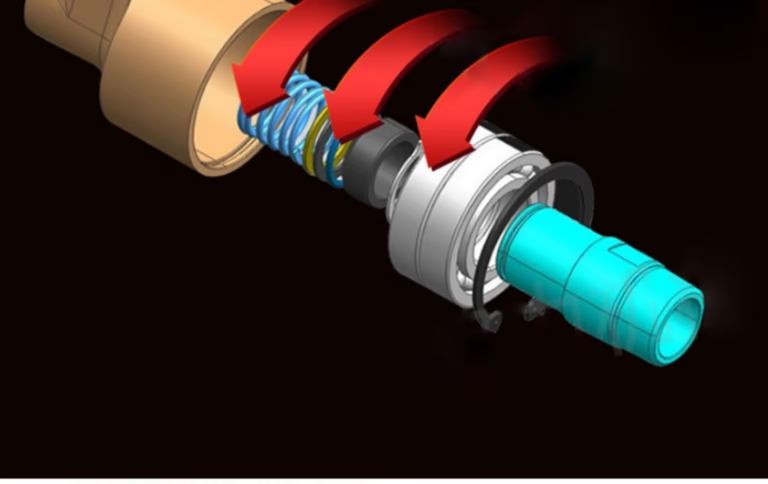
The basic components may include a housing, rotor, mechanical seal or lip seal, O-rings, springs, bearings, retaining components, and connection ports.
However, the exact construction varies considerably between different rotary union designs.
For example, a high-speed CNC spindle rotary union may use a completely different internal structure from a steam rotary joint installed on a paper machine. A hydraulic rotary union designed for high pressure may also have very different bearing and sealing requirements from a low-speed water union.
This is why the bearing question must always be considered together with the complete application.
Do All Rotary Unions Have Bearings?
No.
There are two major structural approaches:
1. Bearing-supported rotary unions
In this design, one or more bearings are incorporated into the rotary union assembly.
The bearings support the rotating rotor and help maintain its position relative to the stationary housing.
A bearing-supported rotary union may be used when the rotary union needs to maintain its own rotor alignment, particularly when the operating conditions require stable rotation over a wide speed range.
Common bearing types can include deep-groove ball bearings and, depending on the mechanical requirements, other bearing arrangements.
The bearing selection depends on factors such as:
- Rotational speed
- Radial loading
- Axial loading
- Temperature
- Lubrication
- Required service life
- Rotor weight
- Installation arrangement
- Sealing configuration
2. Bearingless rotary unions
A bearingless rotary union does not contain a conventional rolling bearing.
Instead, the rotor is supported by the machine shaft, mounting arrangement, or the internal geometry of the sealing and guiding system.
This design is common in applications where the external machine structure already provides accurate shaft support.
Bearingless construction can provide several advantages:
- Compact dimensions
- Lower rotating mass
- Reduced internal components
- Simple construction
- Lower maintenance requirements
- Potentially lower cost
- Good suitability for specific high-speed applications
However, bearingless does not mean that the rotary union can tolerate poor alignment.
In fact, alignment can become even more important because the rotary union depends more heavily on the machine’s shaft and mounting accuracy.
What Does the Bearing Do Inside a Rotary Union?
When a rotary union contains a bearing, the bearing primarily supports and guides the rotating assembly.
Its function is not simply “to make the rotary union rotate.”
The bearing can perform several important mechanical functions.
Rotor support
The rotor must remain correctly positioned relative to the housing and sealing components.
If the rotor moves excessively during operation, the sealing faces can become misaligned.
This can result in:
- Leakage
- Uneven seal wear
- Increased friction
- Abnormal temperature
- Vibration
- Premature seal failure
A properly selected bearing helps maintain the required rotor position.
Friction reduction
Rolling bearings reduce friction between rotating and stationary components.
This becomes increasingly important as rotational speed increases.
For example, a rotary union used on a CNC spindle may operate at several thousand RPM. At these speeds, small increases in friction can generate additional heat and affect seal performance.
For high-speed rotary unions, bearing selection therefore cannot be separated from seal selection.
Radial stability
The rotor may experience radial forces caused by the rotating assembly and installation conditions.
The bearing arrangement helps control radial movement and maintain rotor concentricity.
From a manufacturing perspective, this is closely related to shaft diameter tolerance, bearing seat accuracy, rotor runout, and housing alignment.
Axial positioning
Some bearing arrangements also control axial movement.
However, the exact load capacity depends on the bearing type and the complete rotary union design.
This is an important point for equipment designers:
Do not assume that an internal rotary union bearing is designed to carry all external axial or radial loads from the machine.
The machine’s main shaft bearings should normally handle the primary mechanical loads unless the rotary union manufacturer specifically states otherwise.
Should the Rotary Union Bearing Carry the Machine Load?
This is one of the most important practical issues we see in rotary union applications.
A rotary union is primarily a fluid transfer and sealing component. It should not automatically be treated as the main structural bearing for the machine.
For example, imagine a rotary union installed on a rotating drum.
The drum may have:
- Significant weight
- Belt tension
- Chain forces
- Gear forces
- Coupling forces
- Thermal expansion
- Shaft deflection
These loads are normally handled by the machine’s shaft support bearings.
If excessive external load is transferred to the rotary union rotor, several problems can occur.
The rotor may become misaligned.
The mechanical seal may develop uneven contact.
The seal faces may wear faster on one side.
The bearing may overheat.
The rotary union may begin to vibrate.
Eventually, leakage can occur.
For this reason, when selecting a rotary union, we always recommend looking at the complete installation rather than selecting the union based only on pressure, temperature, and connection size.
How We Check Rotary Union Bearing Problems During Manufacturing and Repair
As a rotary union manufacturer, we do not evaluate a bearing only by its catalog dimensions.
When a customer sends us a failed rotary union, we normally need to understand what happened to the complete assembly.
For example, if a customer reports that a rotary union is leaking after only a short operating period, replacing the mechanical seal may not solve the actual problem.
During inspection, we look for evidence such as:
- Bearing play
- Rotor runout
- Shaft wear
- Bearing seat damage
- Seal face wear
- O-ring deformation
- Housing distortion
- Corrosion
- Abnormal grease condition
- Evidence of overheating
- Incorrect assembly
- Installation damage
This is particularly important because a leaking rotary union is not always caused by a bad seal.
Excessive rotor movement can produce a secondary seal failure.
Bearing seat accuracy
During machining, the bearing seat must be manufactured within the required dimensional tolerance.
If the fit is too loose, the bearing can move relative to the housing or rotor.
If the fit is excessively tight, internal bearing clearance may be affected.
Both conditions can shorten bearing life.
For this reason, precision machining and dimensional inspection are essential parts of rotary union manufacturing.
Rotor concentricity
Rotor concentricity is also important.
A rotor that does not rotate concentrically can create additional loading and vibration.
This becomes particularly important for high-speed rotary unions used on machine tools, CNC spindles, and other rotating equipment.
Assembly
Bearing installation also requires care.
The bearing should be installed using the correct assembly method rather than transmitting excessive force through the rolling elements.
The same principle applies to seals.
Mechanical seal faces must be protected from contamination, scratches, and improper handling during assembly.
A technically correct component can still fail prematurely if it is incorrectly assembled.
Bearing or Seal: Which Component Usually Causes Leakage?
Customers sometimes assume that bearing failure directly causes fluid leakage.
In many rotary union designs, the bearing and sealing system perform different functions.
The bearing supports the rotating assembly.
The mechanical seal or lip seal controls the fluid.
A bearing may fail without immediate fluid leakage.
Conversely, a rotary union may leak while the bearing is still in acceptable condition.
However, the two systems are mechanically related.
If bearing wear causes excessive rotor movement, the resulting misalignment can accelerate seal wear.
This is why replacing only the seal may provide a temporary solution if the underlying bearing or rotor problem remains.
A proper troubleshooting process should therefore distinguish between:
seal failure, bearing failure, rotor wear, installation error, and operating-condition problems.
How Can You Tell Whether a Rotary Union Has a Bearing?
If you do not have a drawing, there are several ways to determine the construction.
Check the manufacturer’s drawing
This is the most reliable method.
A sectional drawing can show whether the rotary union contains:
- Ball bearings
- Roller bearings
- Thrust bearings
- Bushings
- Mechanical seals
- Lip seals
- Clearance seals
- Internal support components
Check the model number.
Many manufacturers use different internal structures for different series.
Two rotary unions that look almost identical externally can have completely different internal assemblies.
Therefore, do not identify the bearing structure based only on the external appearance.
Inspect a disassembled unit.
If the rotary union is already removed from the machine, the internal structure can often be identified during disassembly.
However, disassembly should be performed carefully because seal faces, springs, and precision components can be damaged during incorrect removal.
Send the old rotary union to the manufacturer
For replacement projects, this is often the most practical solution.
A manufacturer can evaluate the sample, dimensions, connection type, operating conditions, and internal structure before proposing a replacement.
For OEM replacement rotary unions, we often work from the customer’s existing part number, drawing, photographs, or physical sample.
When Is a Bearingless Rotary Union a Better Choice?
Bearingless construction can be advantageous when the machine itself already provides accurate shaft support.
For example, some compact rotary joints are mounted directly onto a supported shaft or spindle.
In such a system, adding another internal bearing may not provide a meaningful benefit.
A bearingless rotary union can reduce:
- Overall length
- Internal component count
- Rotating mass
- Maintenance requirements
It can also simplify the structure.
However, bearingless designs require the installation conditions to be suitable.
The shaft must have appropriate:
- Concentricity
- Radial support
- Axial positioning
- Surface condition
- Dimensional accuracy
If the machine shaft is already worn or misaligned, installing a bearingless rotary union may expose the problem rather than solve it.
Bearing Selection for High-Speed Rotary Unions
High-speed applications require particular attention to the relationship between the bearing, rotor, and seal.
As speed increases, bearing friction and heat generation become more important.
At the same time, mechanical seals can become sensitive to:
- Rotor runout
- Face loading
- Heat
- Lubrication
- Vibration
- Media contamination
For CNC machine tools, spindle applications and high-speed coolant systems, we therefore consider the complete operating envelope rather than simply asking, “What bearing size is inside?”
The correct engineering questions include:
- What is the maximum RPM?
- What is the continuous operating RPM?
- What fluid is being transferred?
- What is the pressure?
- What is the temperature?
- Is the fluid clean or contaminated?
- Is the rotor externally supported?
- Is there an external radial load?
- Is there an external axial load?
- What level of leakage is acceptable?
These factors determine the appropriate rotary union construction.
Common Rotary Union Bearing Problems
A bearing-supported rotary union can develop several common problems.
Excessive bearing clearance
Wear can increase internal clearance and allow excessive rotor movement.
Bearing noise
Abnormal noise can indicate bearing damage, contamination, lubrication problems, or excessive loading.
Overheating
Excessive preload, high rotational speed, insufficient lubrication or incorrect bearing selection can increase operating temperature.
Rotor runout
Runout may be caused by bearing wear, shaft damage, machining problems or incorrect installation.
Secondary seal leakage
When rotor movement becomes excessive, the sealing system can be affected even if the seal material itself is suitable.
This is why bearing inspection should be included when troubleshooting repeated rotary union leakage.
How We Test Rotary Unions Before Shipment
A rotary union should not be considered finished simply because all components have been assembled.
At our factory, the manufacturing process includes precision machining, component inspection, assembly, and performance testing according to the requirements of the particular design.
Depending on the application, testing can include:
- Dimensional inspection
- Seal inspection
- Pressure testing
- Air leakage testing
- Rotation testing
- Leakage inspection
- Temperature evaluation
- Speed testing
- Torque checking
- Cleanliness inspection
For high-speed designs, rotor balance and concentricity are particularly important.
As hydraulic rotary unions, pressure resistance and leakage performance are critical.
For steam and thermal oil rotary joints, temperature resistance and seal material compatibility become major considerations.
This application-based approach is more useful than simply selecting a rotary union because it “has a bearing.”
Bearing-Supported vs. Bearingless Rotary Union
| Feature | Bearing-Supported Rotary Union | Bearingless Rotary Union |
|---|---|---|
| Internal bearing | Yes | No conventional rolling bearing |
| Rotor support | Internal bearing arrangement | Machine shaft / internal guiding system |
| Compact design | Depends on design | Often very compact |
| External shaft support | Less dependent | More important |
| High-speed application | Possible | Possible in suitable designs |
| Maintenance | Bearing may require attention | Fewer bearing-related components |
| Alignment requirement | Important | Extremely important |
| Application suitability | Depends on load and design | Depends strongly on machine structure |
Neither construction is universally better.
The correct design is the one that matches the machine.
Final Answer: Does a Rotary Union Have a Bearing?
A rotary union may have a bearing, but it does not necessarily have one.
Bearing-supported rotary unions use bearings to support and guide the rotating assembly, maintain alignment, and reduce friction. Bearingless rotary unions rely on the machine’s shaft support or other internal guiding arrangements.
The choice depends on:
- Speed
- Pressure
- Temperature
- Fluid
- Rotor design
- External loading
- Shaft support
- Sealing system
- Installation conditions
- Required service life
From a manufacturing perspective, the bearing itself is only one part of the system.
Rotor concentricity, bearing seat tolerance, seal face condition, shaft alignment, material selection, assembly accuracy and final testing all influence the actual service life of a rotary union.
This is also why simply replacing a failed rotary union bearing or seal does not always solve the problem. If the original failure was caused by excessive shaft runout, external loading, contamination or incorrect installation, the replacement part may fail again.
If you are unsure whether your rotary union contains a bearing, send the manufacturer the model number, drawing, photos, operating pressure, temperature, speed, and fluid type. For an existing failed unit, a physical sample can provide even more information.
As a rotary union manufacturer, we can evaluate the structure and application requirements and determine whether a bearing-supported, bearingless, mechanical-seal or other rotary union design is appropriate for the equipment.
The right rotary union is not simply the one that fits the shaft.
It is the one whose bearing system, sealing system, rotor design, and operating parameters work together reliably in the actual machine.