Rotary Union vs Rotary Joint: What’s the Difference?
In industrial fluid transfer systems, the terms rotary union vs rotary joint are often used interchangeably. Engineers, purchasing managers, maintenance technicians, and OEM manufacturers frequently encounter both terms when selecting equipment for CNC machines, paper mills, steel processing lines, food machinery, hydraulic systems, and automation equipment.
If you are designing a complex hydraulic system, upgrading a CNC machining center, or maintaining a massive corrugated paper plant, you will eventually face a common terminology problem. You need a component to transfer fluid from a stationary pipe into a rotating machine part. You open an engineering catalog and see two terms: rotary union vs rotary joint.
Do they do the same thing? Are the terms interchangeable? Does specifying the wrong one risk catastrophic machine failure?
As a direct manufacturer with 10 years of specialized experience in fluid transmission engineering, we hear these questions from procurement managers and engineers every week. In short, while both devices perform the core function of transferring fluid under rotation, industry terminology and internal structural designs have evolved to separate them into distinct categories.
This comprehensive technical guide will break down the exact differences in definition, structural engineering, industry terminology, and application. By the end of this article, you will know exactly which component your system requires to eliminate leaks and reduce unplanned downtime.
The Core Definition: What Do They Actually Do?
Before we analyze the differences, we must establish the baseline. Both rotary unions and rotary joints are precision mechanical sealing devices. They create a leak-proof connection between a stationary supply pipe (providing water, steam, coolant, oil, or air) and a rotating drum, spindle, or cylinder.
Without these devices, continuous fluid transfer in rotating machinery would be physically impossible, as standard hoses would instantly twist, kink, and rupture under the rotational torque.
What Is a Rotary Union?
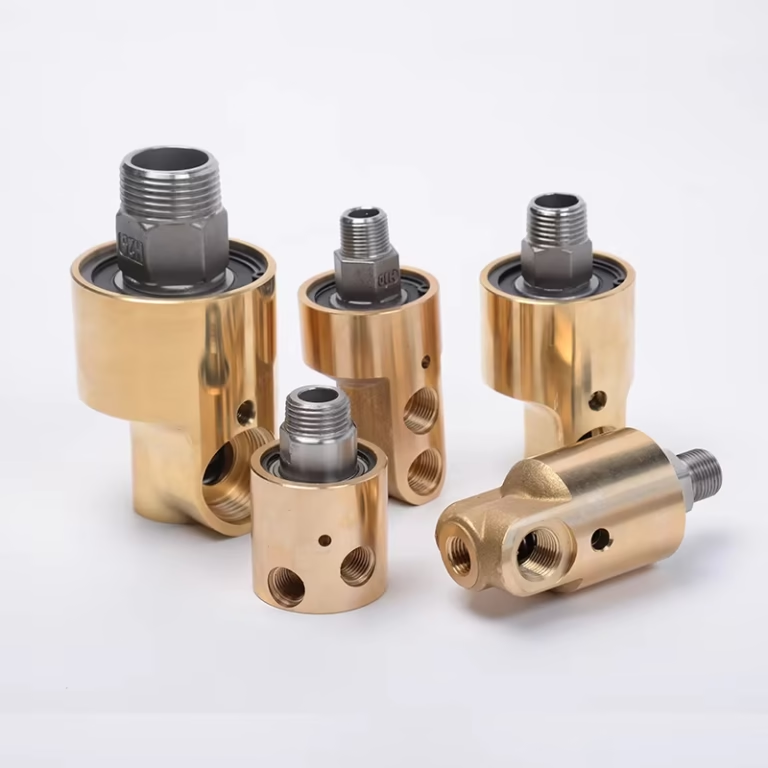
A rotary union is a mechanical device used to transfer fluid or gas from a stationary source into rotating equipment while maintaining a leak-free seal.
It allows media such as:
- Water
- Hydraulic oil
- Air
- Steam
- Vacuum
- Coolant
- Thermal oil
to flow continuously between stationary piping and rotating machine components.
Rotary unions are commonly installed in:
- CNC machine tools
- Rotary tables
- Textile machinery
- Packaging equipment
- Steel mills
- Plastic processing lines
- Printing machinery
- Food processing equipment
The core function of a rotary union is to maintain stable fluid transfer during continuous rotation.
What Is a Rotary Joint?
A rotary joint also enables the transfer of media between stationary and rotating parts. In many industries, the term “rotary joint” refers to the same product as a rotary union.
However, in some industrial sectors, especially heavy industries, “rotary joint” may imply:
- Larger sizes
- Lower rotational speed
- Higher flow capacity
- More rugged structures
- Steam or thermal oil applications
Rotary joints are commonly used in:
- Paper machines
- Corrugated board production
- Rubber processing
- Steel manufacturing
- Drying cylinders
- Tire production lines
In practical engineering discussions, rotary unions are generally associated with precision and high-speed applications, while rotary joints are often associated with heavy-duty industrial systems.
Rotary Union vs Rotary Joint: Core Difference
Although the two terms overlap significantly, the distinction usually comes down to industry usage and application characteristics rather than fundamental operating principles.
| Feature Rotary Union Rotary | ry Joint | |
|---|---|---|
| Typical Usage | Precision machinery | Heavy industrial equipment |
| Common Media | Air, coolant, hydraulic oil | Steam, thermal oil, water |
| Rotation Speed | High speed | Medium or low speed |
| Structure | Compact and precise | Rugged and durable |
| Typical Industries | CNC, automation | Paper, steel, rubber |
| Seal Design | Mechanical seals | Carbon bushings or mechanical seals |
| Multi-Passage Options | Common | Less common |
In many catalogs, manufacturers use both terms interchangeably to improve global SEO visibility because customers search using different terminology.
Industry Terminology: Why the Confusion Exists
Language evolves, and engineering terminology is no exception. Over the past few decades, localized geographic dialects and specific industry silos have blurred the lines between the two terms.
The Geographic Divide
In North America, the term “Rotary Union” has largely become a proprietary eponym (like calling all facial tissues Kleenex) popularized by major legacy brands. Many American engineers use “union” to describe everything. In Europe and Asia, however, engineers draw a strict semantic line, reserving “joint” for steam/oil and “union” for high-speed coolant.
- In North America, “Rotary union” is more commonly used in CNC machining/Automation/Hydraulic systems, and Pneumatic systems.
- In Europe, “Rotary joint” is frequently used in Paper mills, Steam systems, and heavy industrial applications.
- In Asia, Manufacturers often use both terms together for international customers. For example: Rotary Union, Rotary Joint, Rotating Union, Rotary Swivel Joint. All may describe similar products. This is why many industrial websites optimize for combined keywords such as: Rotary Union / Rotary Joint Manufacturer.
The CNC Industry
If you are speaking to a machine tool manufacturer, they will exclusively use “coolant rotary union.” If you ask them for a “coolant joint,” they might think you are asking for a static plumbing fitting.
The Paper & Steel Industry
Conversely, if you walk into a corrugated packaging plant and ask the maintenance supervisor about their “steam unions,” they will correct you and call them “steam rotary joints.”
The Manufacturer’s Perspective
When clients contact our factory, we do not focus on the words they use. Instead, our engineering team immediately asks for the operating parameters (RPM, Pressure, Temperature, and Media). The physics of the fluid transmission dictates the internal design, regardless of the label on the CAD drawing.
Structural Differences Between Rotary Unions vs Rotary Joints
The internal sealing structure is one of the most important technical distinctions.
Rotary Union Structure
High-speed rotary unions typically include:
- Precision bearings
- Mechanical seals
- Balanced seal faces
- Lightweight housing
- Multi-passage channels
These designs reduce vibration and ensure stable sealing at high RPM.
Applications include:
- CNC spindles
- High-speed automation
- Robotics
- Rotary indexing tables
Rotary Joint Structure
Heavy-duty rotary joints often include:
- Carbon graphite seals
- Larger internal passages
- Reinforced housing
- Flexible hose connections
- Self-supporting structures
These are optimized for:
- High temperature
- Steam transfer
- Large flow rates
- Harsh industrial environments
Seal Technology Comparison
Seal performance directly affects service life and leakage prevention.
Rotary Union Seals
Modern rotary unions often use:
- Silicon carbide seals
- Tungsten carbide seals
- Ceramic seal faces
- Balanced mechanical seals
Advantages:
- High-speed stability
- Low friction
- Long service life
- Minimal leakage
Rotary Joint Seals
Steam rotary joints are frequently used:
- Carbon graphite bushings
- Metal-to-metal sealing
- Spring-loaded seals
Advantages:
- High-temperature resistance
- Durability under thermal expansion
- Lower maintenance costs
At our manufacturing facility, we use CNC precision machining and dynamic balancing technology to ensure excellent seal concentricity and operational stability for high-speed rotary unions.
Application Differences
Rotary Union Applications
CNC Machine Tools
Coolant-through-spindle systems require compact high-speed rotary unions capable of stable operation at thousands of RPM.
Pneumatic Automation
Air rotary unions are used in robotic arms and automated assembly systems.
Hydraulic Systems
Hydraulic rotary unions enable oil transfer in rotating platforms and mobile machinery.
Semiconductor Equipment
Precision rotary unions are used where ultra-low leakage is critical.
Rotary Joint Applications
Paper Mills
Steam rotary joints transfer steam into drying cylinders.
Steel Processing
Rotary joints deliver cooling water and thermal fluids to rotating rollers.
Rubber and Tire Production
Heavy-duty joints manage high-temperature media under continuous operation.
Corrugated Packaging Machinery
Steam rotary joints maintain temperature stability in corrugated rollers.
Rotary Union vs Swivel Joint
Many buyers also confuse rotary unions with swivel joints.
A swivel joint primarily allows piping to move and provides directional flexibility, while a rotary union transfers media during continuous rotation.
| Component | Main Function |
|---|---|
| Rotary Union | Fluid transfer during rotation |
| Rotary Joint | Fluid transfer in rotating systems |
| Swivel Joint | Flexible pipe movement |
Although the products appear similar, their engineering purposes are different.
How to Specify the Right Component for Your System
Selecting the wrong device guarantees premature failure, fluid leakage, and severe safety hazards. Whether you call it a union or a joint, you must provide your manufacturer with the following five critical engineering parameters:
Media (The Fluid)
Is it water, steam, diathermic oil, compressed air, or MQL (Minimum Quantity Lubrication)? The media dictates the seal material. Standard NBR O-rings work for water but will melt instantly in thermal oil.
Maximum Operating Pressure
We need to know the maximum spike pressure, not just the working average. High-pressure applications require robust housing materials and anti-extrusion backup rings.
Maximum Rotational Speed (RPM)
This dictates the bearing type. Sleeve bearings are sufficient for 100 RPM steam drums, but 12,000 RPM CNC spindles require precision angular contact bearings.
Maximum Temperature
Thermal expansion changes internal clearances. If the temperature exceeds 120°C, we must machine the internal components with larger tolerances so they do not seize when the metal expands.
Number of Passages
Do you need to transfer one fluid in one direction (Single Passage), or do you need to pump coolant in and pull return fluid out simultaneously through the same shaft (Dual Passage)?
Common Problems Caused by Incorrect Selection
Improper rotary union selection can lead to:
- Seal leakage
- Bearing failure
- Excessive vibration
- Premature wear
- Pressure instability
- Machine downtime
One of the most common mistakes is using a standard water rotary union in high-temperature steam applications.
Another frequent issue is selecting low-quality rotary unions without dynamic balancing for high-speed CNC spindles.
Our Manufacturing Capabilities
The B2B industrial market is flooded with resellers, distributors, and trading companies. When a critical fluid transmission component fails, dealing with a middleman leads to extended downtime and lost production.
This is where dealing directly with a source manufacturer fundamentally changes your maintenance strategy.
As a professional industrial rotary union manufacturer with over 10 years of experience, we provide reliable replacement solutions for global customers seeking cost-effective alternatives to premium international brands. For the past 10 years, our facility in China has been at the forefront of fluid rotary transmission technology. We do not just assemble parts; we engineer solutions. Here is why global manufacturers trust our rotary unions and rotary joints:
Advanced CNC Machining
We use precision CNC equipment to ensure:
- Tight tolerances
- Excellent concentricity
- Stable sealing performance
Strict Quality Inspection
Every rotary union undergoes Pressure testing, Leakage testing, Rotation testing, and dynamic balance verification. Quality cannot be inspected into a product—it must be engineered into it and rigorously verified. Our ISO-certified facility subjects every single rotary union and joint to 100% dynamic testing. Before a unit is packaged, it is pressurized to its maximum rating and rotated on a test bench to guarantee absolutely zero leakage.
Custom Engineering Support
We provide customized solutions for:
- High-speed applications
- Multi-passage systems
- High-pressure media
- Steam systems
- Special mounting structures
Cost-Effective Replacement for Legacy Brands
We manufacture compatible replacement rotary unions for many international models while maintaining competitive pricing and fast lead times. Industrial procurement teams are under massive pressure to reduce MRO (Maintenance, Repair, and Operations) costs without sacrificing quality. Our engineered solutions provide direct, drop-in replacements for major international brands like Deublin, Maier, and Rotoflux. You receive Tier-1 European-level performance at a factory-direct Chinese price point, significantly lowering your total cost of ownership.
Why Global Customers Choose Our Rotary Unions
Customers choose our products because we combine:
- Stable quality
- Competitive pricing
- Fast delivery
- Engineering expertise
- Reliable after-sales support
Our rotary unions are widely used in:
- CNC machinery
- Steel mills
- Paper production
- Packaging machinery
- Hydraulic systems
- Textile equipment
- Automation industries
We continuously improve our seal technology and production processes to meet demanding industrial requirements.
Conclusion: Focusing on Performance, Not Just the Name
So, Rotary Union vs. Rotary Joint—what is the final verdict?
Semantically, rotary unions handle high speeds and precision fluids (coolants, air, hydraulics), while rotary joints tackle heavy loads, high temperatures, and aggressive media (steam, thermal oil).
However, operationally, the terminology is far less important than the engineering behind the product. Whether you are replacing a weeping coolant union on a high-speed milling machine or overhauling the steam joints on a massive paper corrugator, the goal remains identical: continuous, leak-free fluid transfer that maximizes your machine’s uptime.
With a decade of manufacturing expertise, strict quality control, and a deep understanding of fluid dynamics, our factory is equipped to provide the exact component your system demands. Don’t let confusing terminology or overpriced OEM parts slow down your production line.
Are you experiencing premature seal failures or looking for a cost-effective, high-performance replacement? Contact our engineering team today with your operating parameters. We will cut through the jargon and provide the exact rotary fluid solution your machinery needs.