Steam Rotary Union Leakage Causes and Solutions: Complete Troubleshooting Guide for Industrial Steam Systems
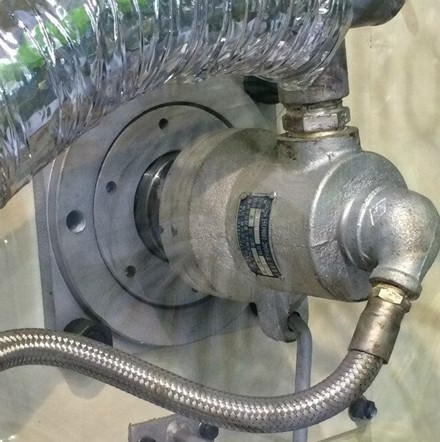
Steam rotary unions play a critical role in modern industrial production systems. They are widely used in paper manufacturing, textile machinery, rubber processing, corrugated packaging equipment, drying cylinders, tire production lines, food processing machinery, and other applications requiring continuous steam transfer between stationary piping and rotating equipment.
However, one of the most common problems faced by maintenance engineers and factory operators is steam rotary union leakage. A leaking steam rotary union not only reduces production efficiency but also increases energy consumption, causes safety hazards, damages bearings, and shortens equipment lifespan.
If a steam rotary joint leaking issue is not solved in time, it can lead to severe steam loss, unstable temperature control, excessive downtime, and costly maintenance expenses.
As a professional rotary union manufacturer in China, we have years of experience producing steam rotary unions and replacement rotary joints for global industrial customers. Based on real-world industrial applications and factory manufacturing experience, this article explains the most common causes of steam rotary union leakage, effective troubleshooting methods, maintenance recommendations, and how to select a reliable steam rotary union solution.
What Is Steam Rotary Union Leakage?
Steam rotary union leakage refers to steam escaping from sealing surfaces, housing connections, bearings, or internal rotating components during operation.
Under high-temperature and high-pressure working conditions, even a small sealing failure may rapidly worsen due to thermal expansion, friction, pressure fluctuations, and mechanical wear.
Typical leakage locations include:
- Mechanical seal faces
- Threaded pipe connections
- Rotor sealing surfaces
- Bearing areas
- O-ring sealing positions
- Housing joints
Steam leakage is especially dangerous because high-temperature steam may cause:
- Operator burns
- Energy waste
- Equipment corrosion
- Production instability
- Condensation damage
- Premature bearing failure
Therefore, identifying the root cause of steam rotary joint leaking is essential for maintaining stable industrial operations.
Common Symptoms of Steam Rotary Joint Leaking
Before diagnosing leakage causes, maintenance personnel should recognize common warning signs.
Visible Steam Escape
The most obvious symptom is visible steam escaping around the rotary union housing or seal area during machine operation.
Water Accumulation Around the Rotary Union
Steam leakage often condenses into water droplets around the equipment.
Excessive condensate accumulation usually indicates internal sealing failure.
Abnormal Noise
A damaged seal or worn bearing may produce:
- Grinding sounds
- Whistling noise
- Vibration noise
during rotation.
Increased Energy Consumption
Steam leakage causes heat loss and pressure reduction, forcing boilers and heating systems to consume more energy.
Reduced Heating Efficiency
In paper dryers or roller heating systems, leaking steam rotary unions may lead to uneven temperature distribution and unstable product quality.、
Main Causes of Steam Rotary Union Leakage
1. Seal Aging and Seal Wear
Seal aging is one of the most common causes of steam rotary union leakage.
Steam rotary unions operate under:
- High temperature
- Continuous friction
- Pressure fluctuations
- Thermal cycling
Over time, sealing materials gradually lose elasticity and wear out.
Common Seal Aging Problems
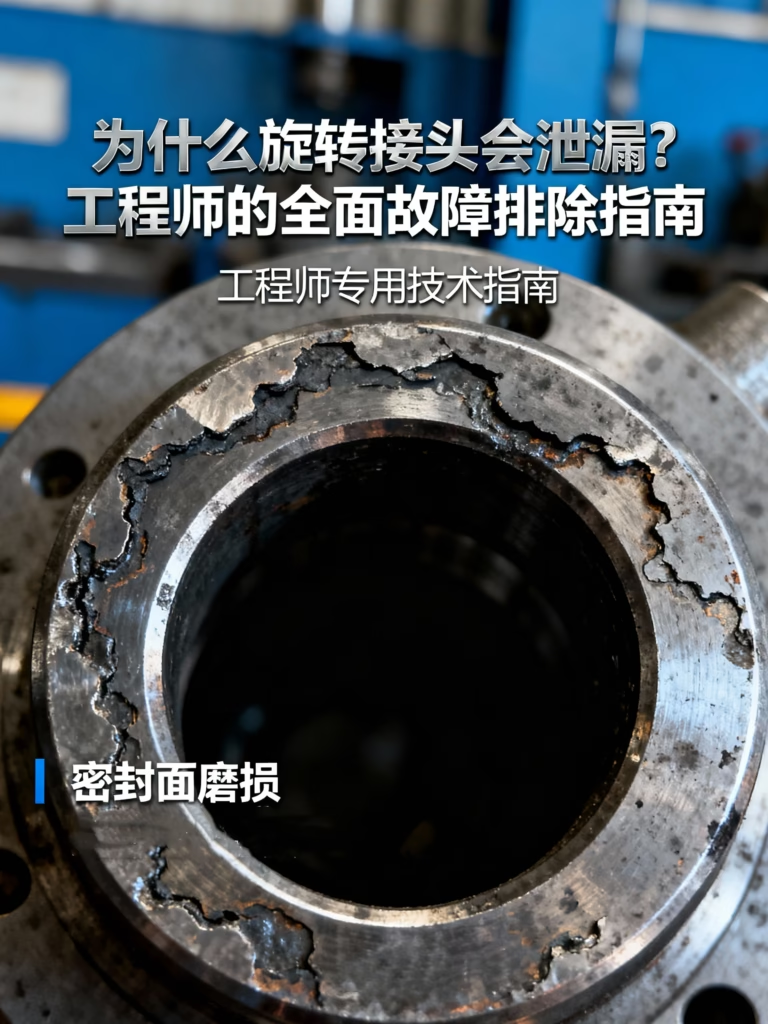
- Cracked seal faces
- Hardened O-rings
- Carbon seal wear
- PTFE deformation
- Thermal fatigue
Once sealing surfaces become uneven, steam begins escaping through microscopic gaps.
How Seal Wear Causes Leakage
Mechanical seals rely on precise contact between rotating and stationary seal faces.
When wear occurs:
- Surface flatness decreases
- Friction increases
- Steam penetrates the sealing gap
- Leakage becomes progressively worse
Prevention Methods
To reduce seal aging:
- Use high-temperature resistant seal materials
- Perform regular inspections
- Replace worn seals before failure
- Avoid dry running
- Ensure proper lubrication and condensate drainage
2. Incorrect Installation
Improper installation is another major reason for the steam rotary joint leaking.
Even high-quality rotary unions may fail quickly if installed incorrectly.
Common Installation Errors
Misaligned Pipe Connections
Improper pipe alignment creates excessive stress on the rotary union body.
This causes:
- Uneven seal pressure
- Shaft deformation
- Bearing overload
- Accelerated wear
Excessive Tightening Force
Overtightening threaded connections may damage:
- Housing threads
- O-rings
- Seal faces
resulting in leakage.
Poor Support Structure
Unsupported piping systems transfer vibration and load directly to the rotary union.
This significantly reduces sealing stability.
Improper Seal Assembly
Incorrect installation of mechanical seals may lead to:
- Uneven seal contact
- Seal cracking
- Seal face contamination
Installation Best Practices
To avoid leakage caused by installation errors:
- Ensure accurate shaft alignment
- Use flexible pipe connections
- Avoid excessive pipe stress
- Follow the manufacturer’s torque specifications
- Keep sealing surfaces clean during assembly
3. Shaft Misalignment and Shaft Deviation
Shaft deviation is one of the most overlooked causes of steam rotary union leakage.
In industrial systems, shaft misalignment may occur due to:
- Equipment vibration
- Bearing wear
- Thermal expansion
- Poor machining accuracy
- Improper assembly
How Shaft Deviation Causes Leakage
A steam rotary union requires stable concentric rotation.
When shaft deviation occurs:
- Seal faces lose uniform contact
- Mechanical seals experience uneven wear
- Bearings become overloaded
- Rotor wobbling increases leakage risk
Even slight eccentricity can significantly shorten seal life under high-speed rotation.
Common Symptoms of Shaft Misalignment
- Uneven seal wear
- Excessive vibration
- Bearing overheating
- Intermittent steam leakage
- Unusual rotational noise
Solutions for Shaft Deviation
Precision Shaft Machining
Use high-precision CNC machining to ensure accurate concentricity.
Regular Alignment Inspection
Periodically inspect:
- Shaft runout
- Bearing condition
- Coupling alignment
Use Flexible Support Systems
Proper support structures help absorb vibration and reduce stress.
4. Bearing Failure
Steam rotary unions contain bearings that support smooth rotation.
When bearings fail:
- Rotor instability increases
- Seal faces shift
- Friction rises
- Leakage develops rapidly
Causes of Bearing Damage
- Steam contamination
- Lack of lubrication
- Excessive vibration
- Overheating
- Misalignment
Signs of Bearing Failure
- Loud noise
- Excessive heat
- Rotational instability
- Increased vibration
Bearing Maintenance Recommendations
- Use high-quality bearings
- Replace worn bearings promptly
- Protect bearings from condensate contamination
- Maintain proper lubrication
5. Condensate Drainage Problems
Poor condensate removal is a major contributor to steam rotary union leakage.
When condensate accumulates inside the system:
- Water hammer occurs
- Pressure fluctuations increase
- Thermal shock damages seals
Water Hammer Damage
Water hammer creates sudden impact forces capable of:
- Cracking seal faces
- Damaging bearings
- Breaking internal components
Proper Condensate Management
Install:
- Steam traps
- Siphon systems
- Proper drainage pipelines
to ensure smooth condensate removal.
6. Excessive Operating Pressure or Temperature
Operating conditions beyond design limits significantly increase leakage risk.
Common problems include:
- Seal deformation
- Housing expansion
- Thermal cracking
- Excessive friction
Importance of Proper Rotary Union Selection
Selecting an undersized or low-quality rotary union often leads to early failure.
Always verify:
- Pressure rating
- Temperature rating
- Rotation speed
- Media compatibility
before installation.
How to Troubleshoot Steam Rotary Union Leakage
Step 1: Identify Leakage Location
Inspect whether leakage originates from:
- Seal faces
- Thread connections
- Housing
- Bearings
- Drainage ports
Step 2: Check Seal Condition
Inspect seals for:
- Wear
- Cracking
- Burn marks
- Surface scratches
Step 3: Inspect Shaft Alignment
Measure:
- Shaft runout
- Concentricity
- Coupling alignment
Step 4: Examine Bearings
Check for:
- Noise
- Looseness
- Heat generation
- Vibration
Step 5: Evaluate Steam System Conditions
Verify:
- Pressure stability
- Condensate drainage
- Steam quality
- Temperature fluctuations
How High-Quality Steam Rotary Unions Reduce Leakage
Low-quality rotary unions often fail due to poor machining precision and inferior sealing systems.
As a professional rotary union manufacturer, we focus on:
- Precision CNC machining
- Dynamic balancing
- High-temperature sealing technology
- Strict leakage testing
- Long-life bearing systems
Our steam rotary unions are designed for stable operation under demanding industrial conditions.
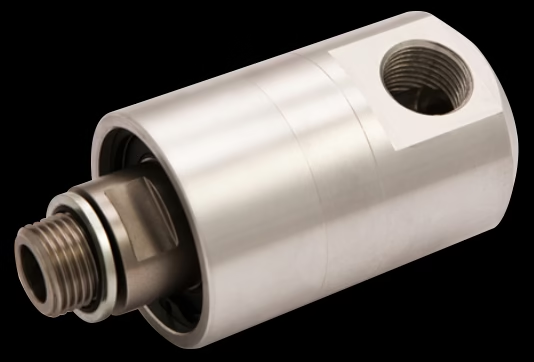
Recommended Product: 355 Series Steam Rotary Union
To address the common causes of steam rotary joint leaking, our engineering team developed the 355 Series Steam Rotary Union. This series is specifically designed for high-speed, high-temperature applications where reliability is non-negotiable.
The 355 series is designed specifically for:
- Steam transfer systems
- Drying cylinders
- Paper machinery
- Textile equipment
- Rubber processing machines
- Corrugated board production lines
| Feature | Technical Benefit |
| Balanced Mechanical Seal | Reduces contact pressure, extending seal life by 40%. |
| Antimony-Impregnated Carbon | Withstands temperatures up to 315°C without degrading. |
| Dual-Bearing Support | Minimizes shaft vibration and handles higher side-loads. |
| Stainless Steel Bellows | Provides consistent spring pressure even after years of use. |
Specifically, the 355 series utilizes a bellows-type design. Unlike traditional spring-loaded unions, the bellows provide a more uniform load on the seal face. This design is particularly effective at compensating for the thermal expansion common in corrugated paper machines and textile dryers.
Advantages of the 355 Series Steam Rotary Union
High-Temperature Resistance
Designed for continuous steam operation under high-temperature environments.
Reliable Mechanical Seal Structure
The optimized seal design minimizes steam leakage and extends service life.
Precision Bearing Support
High-quality bearings ensure rotational stability and reduce shaft deviation.
Corrosion-Resistant Materials
Manufactured using durable materials suitable for harsh industrial conditions.
Easy Maintenance
The modular structure simplifies maintenance and seal replacement.
Prevention: Best Practices for Steam System Maintenance
Preventing steam rotary union leakage is far more cost-effective than repairing a failed unit.
A. Implement a Filtration Strategy
Install a high-quality strainer upstream of every rotary union. Specifically, a 20-micron filter can prevent 80% of premature seal failures caused by scale and rust.
B. Standardize Installation Protocols
Ensure your team follows a strict installation checklist:
-
Verify Concentricity: Use a dial indicator to check the spindle runout.
-
Flexible Hoses: Ensure hoses are installed with a slight bend to allow for movement.
-
Anti-Rotation: The anti-rotation rod must be loose-fitting. It should stop the housing from spinning, but must not apply pressure to it.
C. Monitor Thermal Cycles
Steam systems undergo intense thermal stress during startup and shutdown. Specifically, we recommend a gradual warm-up period. Sudden steam injection into a cold union can cause “thermal shock” to the carbon seal, leading to immediate cracking.
Why Choose Us as Your Steam Rotary Union Manufacturer?
We are a professional rotary union source manufacturer in China specializing in industrial rotary unions and Deublin replacement rotary unions.
Unlike trading companies, we have real manufacturing capability and production experience.
Our Factory Advantages
Advanced CNC Machining Equipment
We use precision CNC machining centers to ensure:
- High concentricity
- Accurate sealing surfaces
- Stable product quality
Strict Quality Inspection
Every steam rotary union undergoes:
- Pressure testing
- Leakage testing
- Rotation testing
- Seal inspection
before shipment.
OEM and Custom Manufacturing
We support customized solutions based on:
- Drawings
- Samples
- Operating parameters
- Industrial applications
Global Export Experience
Our rotary unions are exported worldwide for industrial steam systems and rotating equipment applications.
Steam Rotary Union Maintenance Tips
Regular maintenance significantly reduces leakage risk.
Recommended Maintenance Practices
- Inspect seals periodically
- Monitor bearing condition
- Check shaft alignment
- Ensure proper condensate drainage
- Replace worn components promptly
- Use suitable operating parameters
Preventive maintenance is always more cost-effective than emergency shutdown repairs.
Future Trends in Steam Rotary Union Technology
Modern industrial systems demand:
- Higher energy efficiency
- Lower leakage rates
- Longer service life
- Reduced maintenance costs
Future steam rotary unions increasingly use:
- Advanced ceramic seals
- Improved bearing systems
- Intelligent monitoring technology
- Enhanced thermal resistance materials
Manufacturers focusing on precision engineering and industrial reliability will continue leading the market.
Conclusion
Steam rotary union leakage is a serious industrial issue that affects equipment reliability, production efficiency, and energy consumption.
The most common causes of steam rotary joint leaking include:
- Seal aging
- Incorrect installation
- Shaft deviation
- Bearing failure
- Poor condensate drainage
- Excessive operating conditions
Understanding these root causes helps maintenance engineers reduce downtime and improve equipment performance.
Choosing a high-quality steam rotary union is essential for long-term operational stability.
As a professional rotary union manufacturer in China, we provide reliable steam rotary union solutions with precision manufacturing, strict quality control, and OEM customization capability.
Our 355 Series Steam Rotary Union is specifically designed for demanding industrial steam applications requiring stable sealing performance, long service life, and reduced leakage risk.
If you are looking for reliable steam rotary union solutions or replacement rotary unions, contact our engineering team for technical support and customized recommendations.