
Chinese Rotary Union Manufacturer vs Premium Brands: Complete 2026 Guide
Chinese Rotary Union Manufacturer vs Premium Brands
For decades, premium rotary union manufacturers have dominated the global market. Companies from the United States, Germany, and Japan have built strong reputations through engineering excellence, patented sealing technologies, and decades of application experience. However, the purchasing landscape has changed dramatically over the past ten years. OEM machine builders, industrial distributors, maintenance contractors, and multinational factories are no longer asking only one question: “Which Chinese Rotary Union Manufacturer is the best?”
Instead, procurement teams increasingly ask:
- Can we reduce equipment cost without sacrificing reliability?
- Is there a qualified Chinese rotary union manufacturer capable of OEM production?
- Can Chinese rotary unions directly replace premium brands?
- How much lead time can we save?
- Are spare parts interchangeable with existing equipment?
These questions have become even more important as global supply chains continue to evolve.
Today, many industrial companies are shifting part of their sourcing strategy toward experienced Chinese manufacturers—not simply because of lower prices, but because manufacturing capability, CNC machining precision, quality control systems, and export experience have improved significantly.
This article provides an engineering-focused comparison between Chinese rotary union manufacturers and premium international brands, helping buyers make informed sourcing decisions based on application requirements rather than brand recognition alone.
Why Buyers Are Looking Beyond Premium Brands
Premium brands have earned their reputation through years of innovation.
They typically offer:
- Extensive product portfolios
- Proven sealing technologies
- Strong global distribution networks
- Long product history
- Excellent documentation
- Reliable performance in demanding applications
For critical aerospace or highly specialized industrial environments, these manufacturers remain the preferred choice.
However, many industrial applications simply do not require the most expensive solution available.
For example:
- Steel processing lines
- Paper converting equipment
- Rubber machinery
- Plastic extrusion
- Textile equipment
- Printing presses
- Food packaging machinery
- Cable manufacturing
- Tire production
- General machining centers
In these industries, buyers increasingly evaluate products based on total ownership cost rather than brand prestige.
The focus has shifted toward achieving equivalent performance with greater procurement efficiency.
The Evolution of Chinese Rotary Union Manufacturing
Twenty years ago, Chinese rotary unions were often perceived as low-cost alternatives with inconsistent quality.
That perception no longer reflects today’s leading manufacturers.
Modern Chinese rotary union factories invest heavily in:
- High-precision CNC machining centers
- Coordinate measuring machines (CMM)
- Dynamic balancing equipment
- Pressure testing systems
- Leakage testing laboratories
- Material traceability
- ERP production management
- ISO-certified quality systems
More importantly, experienced manufacturers have accumulated practical expertise through thousands of custom projects across industries worldwide.
Rather than merely copying existing products, many factories now optimize designs based on customer feedback, application conditions, and production efficiency.
The result is a generation of rotary unions that meet demanding industrial requirements while offering greater purchasing flexibility.
Cost Advantage: More Than Just a Lower Purchase Price
Price is often the first reason buyers consider a Chinese rotary union manufacturer.
But focusing solely on unit price overlooks the broader financial picture.
The real advantage lies in the overall cost structure.
Lower Manufacturing Costs
China benefits from a mature industrial ecosystem.
Within a relatively small geographic area, manufacturers have access to:
- Precision machining suppliers
- Bearing manufacturers
- Seal producers
- Surface treatment facilities
- Heat treatment partners
- Packaging suppliers
- Logistics companies
This integrated supply chain reduces production costs without necessarily reducing product quality.
Unlike manufacturers who import many components, experienced Chinese factories source most materials domestically under strict quality standards, shortening production cycles and reducing overhead.
Economies of Scale
Many Chinese factories produce rotary unions every day for customers across Europe, North America, Southeast Asia, South America, and the Middle East.
Large production volumes create economies of scale in:
- Material purchasing
- CNC programming
- Fixture development
- Inspection procedures
- Inventory management
These efficiencies enable competitive pricing while maintaining consistent manufacturing standards.
Lower Total Procurement Cost
The savings extend beyond the product itself.
Buyers often reduce costs through:
- Lower minimum order quantities
- Flexible batch production
- OEM labeling
- Consolidated shipping
- Faster replenishment
- Reduced inventory requirements
For equipment manufacturers producing hundreds or thousands of machines annually, these savings become substantial over the lifecycle of a project.
Lead Time: A Competitive Advantage in Modern Manufacturing
In today’s manufacturing environment, delays can be more expensive than the product itself.
Unexpected downtime may halt entire production lines.
Machine builders cannot afford to wait months for replacement components.
Many premium manufacturers quote delivery times ranging from 8 to 20 weeks, depending on model availability.
In contrast, experienced Chinese rotary union manufacturers often maintain flexible production scheduling and semi-finished inventory for popular product families.
Typical lead times include:
| Product Type | Typical Chinese Factory Lead Time |
|---|---|
| Standard Rotary Union | 7–15 days |
| Customized Rotary Union | 15–30 days |
| OEM Production | 20–35 days |
| Large Quantity Orders | Negotiable Production Schedule |
For emergency replacement projects, this speed can significantly reduce production downtime.
EEAT: What We Have Learned from Manufacturing Rotary Unions
As a Chinese rotary union manufacturer serving global industrial customers, we have observed that purchasing decisions are rarely driven by price alone.
Customers return because products consistently perform in real operating conditions.
Over the years, our engineering team has supplied rotary unions for applications involving:
- High-speed spindles
- Steel strip processing
- Paper drying cylinders
- Hydraulic rotary tables
- Pneumatic automation systems
- Plastic extrusion lines
- Continuous casting equipment
- Cooling water circulation
- Thermal oil transfer
- Vacuum applications
Each project presents unique challenges.
Some require higher rotational speeds.
Others demand improved sealing life under contaminated environments.
Many OEM customers request dimensional compatibility with existing premium-brand installations while optimizing production cost.
These practical engineering experiences continuously influence how we refine our product designs, machining tolerances, sealing selection, and quality inspection procedures—experience that cannot be gained through theoretical design alone.
Comparing Chinese Rotary Union Manufacturer with Premium Brands
Choosing between a Chinese rotary union manufacturer and a premium international brand is no longer a simple matter of price versus quality. The industrial market has matured. Many Chinese manufacturers now deliver products that meet demanding performance requirements while offering greater flexibility in production, customization, and supply chain management.
The key is understanding where the differences truly matter.
Comparison Overview
| Evaluation Factor | Premium Brands | Experienced Chinese Rotary Union Manufacturer |
|---|---|---|
| Initial Purchase Cost | Highest | 30–60% Lower in Most Standard Applications |
| Delivery Time | Often 8–20 Weeks | Typically 7–30 Days |
| OEM & Private Label | Limited | Highly Flexible |
| Custom Design Support | Available but Expensive | Fast Engineering Response |
| Compatibility with Existing Equipment | Excellent | Designed to Match Major International Brands |
| Spare Parts Availability | Regional Warehouses | Direct Factory Supply |
| Engineering Communication | Distributor-Based | Direct Access to Factory Engineers |
| Production Flexibility | Standardized | Small Batch to Large Volume |
| Manufacturing Experience | Decades | Rapidly Growing with Global Export Experience |
For many industrial users, the decision is no longer about replacing premium brands entirely. Instead, it is about selecting the most cost-effective solution for each application.
Compatibility: Can Chinese Rotary Unions Replace Premium Brands?
One of the biggest concerns among buyers is compatibility.
A rotary union is not an isolated component. It is part of a machine that has already been designed, installed, and has been operating for years. Replacing it should not require redesigning the shaft, housing, piping, or surrounding equipment.
Experienced Chinese manufacturers understand this requirement.
Rather than asking customers to modify their equipment, many factories design replacement models that maintain the same critical installation dimensions as widely used international products.
These dimensions typically include:
- Mounting thread specifications
- Shaft interface dimensions
- Overall installation length
- Rotor diameter
- Port locations
- Connection thread standards
- Seal chamber dimensions
- Bearing arrangement
- Rotation direction
- Flow path configuration
When these parameters are controlled correctly, installation becomes straightforward and minimizes downtime during maintenance.
Common Compatible Product Families
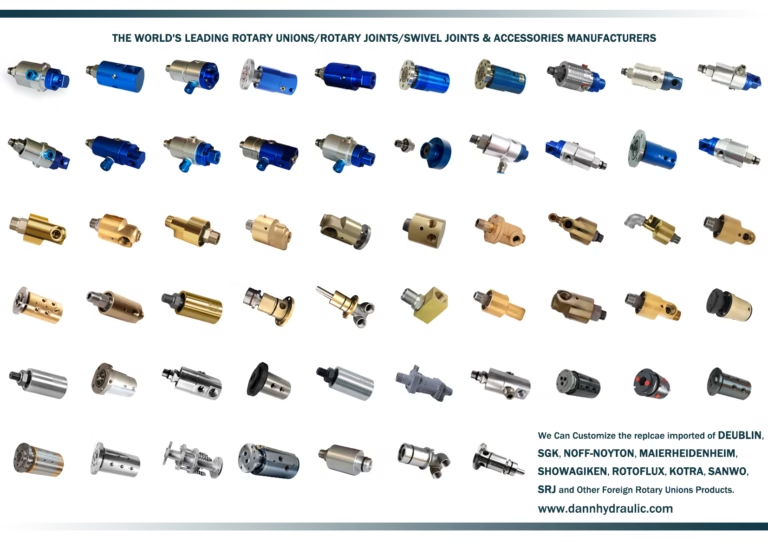
Many customers request replacements compatible with products originally supplied by well-known international manufacturers, including:
- Deublin Series rotary unions
- Johnson-Fluiten rotary unions
- Kadant rotary joints
- DSTI rotary unions
- Moog rotary unions
- Moflon multi-passage rotary joints
Compatibility should never mean simple copying. An experienced manufacturer evaluates the customer’s operating pressure, media, rotational speed, temperature, and installation environment before recommending a replacement solution.
In many cases, the internal sealing materials or bearing configuration can be optimized while maintaining external compatibility.
OEM Manufacturing: Beyond Private Label
OEM manufacturing has become one of the strongest advantages of Chinese rotary union manufacturers.
For global distributors and equipment builders, branding is only one part of the project.
Customers increasingly require suppliers that can participate in product development.
Typical OEM support includes:
Product Design Optimization
Many machine builders provide only a concept drawing or an existing sample.
Factory engineers then assist by:
- Improving manufacturability
- Reducing machining complexity
- Optimizing seal selection
- Increasing service life
- Lowering production cost
- Simplifying assembly
This engineering collaboration often significantly shortens development cycles.
Private Label Manufacturing
Distributors frequently require:
- Company logo engraving
- Customized nameplates
- Brand-specific packaging
- Product manuals
- Barcode labels
- QR code traceability
- Individual serial numbering
Professional Chinese manufacturers integrate these services into standard production rather than treating them as special requests.
Low Minimum Order Quantities
Unlike many large international suppliers, experienced Chinese factories can often support:
- Prototype production
- Small trial batches
- Medium-volume orders
- Annual blanket orders
- Scheduled deliveries
This flexibility allows OEM customers to validate products before committing to large inventories.
Engineering Collaboration
The most valuable OEM relationship extends beyond manufacturing.
Customers regularly consult factory engineers regarding:
- Seal material selection
- Bearing arrangements
- High-speed applications
- High-pressure performance
- Thermal expansion
- Lubrication methods
- Cooling circuit optimization
Direct communication with manufacturing engineers eliminates many delays associated with distributor-based support.
Manufacturing Capability: What Buyers Should Really Evaluate
Price tells only part of the story.
The manufacturing capability behind a rotary union determines whether it will perform reliably over thousands of operating hours.
When evaluating a Chinese rotary union manufacturer, buyers should examine the complete production process rather than relying solely on product photos or catalogs.
Precision CNC Machining
Every rotary union begins with machining accuracy.
Critical dimensions such as:
- Seal contact surfaces
- Bearing seats
- Thread concentricity
- Rotor runout
- Housing alignment
must remain within strict tolerances.
Even minor machining deviations can reduce seal life or increase leakage under high-speed operation.
Factories equipped with modern CNC turning centers, machining centers, and automated inspection systems generally achieve more consistent quality than workshops relying on conventional machining.
Material Selection
Different applications require different material combinations.
Experienced manufacturers typically work with:
- Carbon steel
- Stainless steel 304
- Stainless steel 316
- Hardened alloy steel
- Aluminum alloys
- Brass
- Bronze
Seal materials may include:
- Carbon graphite
- Silicon carbide
- Tungsten carbide
- PTFE
- Fluororubber (FKM)
- EPDM
- Nitrile rubber
- Ceramic sealing faces
Selecting the appropriate material combination has a greater influence on service life than simply choosing the most expensive material.
Assembly Standards
Assembly quality directly affects product reliability.
Important assembly procedures include:
- Bearing preload adjustment
- Seal face alignment
- Torque control
- Lubrication quantity
- Dynamic balancing
- Thread locking
- Leak testing
Factories with standardized assembly procedures produce more consistent performance across production batches.
Quality Control That Extends Beyond Final Inspection
Many buyers ask whether Chinese rotary unions undergo the same inspection procedures as premium brands.
The answer depends entirely on the manufacturer.
Leading factories do not rely solely on final inspection. Quality is built into every stage of production.
A comprehensive quality control process typically includes:
Incoming Material Verification
Every batch of raw material is checked for:
- Chemical composition
- Hardness
- Surface condition
- Material certificates
- Dimensional accuracy
This prevents defects from entering production.
In-Process Inspection
Machined components are inspected throughout manufacturing for:
- Concentricity
- Surface finish
- Thread accuracy
- Geometric tolerances
- Critical dimensions
Identifying deviations early reduces scrap and improves consistency.
Pressure Testing
Each finished rotary union should undergo pressure testing using the intended operating medium or a suitable test fluid to verify sealing performance under working conditions.
Leakage Testing
Leakage testing confirms that sealing interfaces perform correctly before shipment.
Depending on the application, testing may involve air, water, or hydraulic oil.
Traceability
Professional factories assign batch numbers or serial numbers that link each rotary union to:
- Material records
- Machining history
- Assembly personnel
- Inspection reports
- Test results
This traceability supports continuous improvement and provides confidence for customers operating critical equipment.
Factory Experience Matters More Than Marketing
One lesson we have learned through years of manufacturing rotary unions is that no two applications are exactly alike.
A rotary union used on a paper drying cylinder behaves very differently from one installed on a CNC machining center or a hydraulic rotary table. Differences in media, rotational speed, temperature, contamination, and maintenance practices all influence service life.
Our engineering team has worked with customers replacing imported rotary unions in industries including steel processing, paper converting, plastics extrusion, food packaging, tire manufacturing, automation equipment, and machine tools. In many of these projects, the objective was not simply to reduce cost, but to deliver a component that could be installed without modifying the existing machine while maintaining reliable long-term operation.
These projects have reinforced an important principle: successful replacement solutions depend on understanding the application first and the product second. Before recommending a compatible model, our engineers review operating pressure, rotational speed, media type, installation dimensions, and expected maintenance intervals. This practical manufacturing experience enables us to recommend solutions that balance compatibility, performance, lead time, and overall ownership cost rather than focusing on specifications alone.
Real-World Applications: Where Chinese Rotary Union Manufacturer Deliver the Greatest Value
One of the biggest misconceptions in industrial sourcing is that every application requires the highest-priced rotary union available. In reality, the optimal choice depends on operating conditions, maintenance strategy, equipment value, and total cost of ownership.
After supplying rotary unions to customers across more than 40 countries, we have found that many industrial applications benefit more from responsive engineering support, short lead times, and reliable compatibility than from premium branding alone.
Below are some of the industries where experienced Chinese rotary union manufacturers have become trusted long-term suppliers.
Steel Industry
Steel production is among the harshest environments for rotary unions.
Typical operating conditions include:
- Continuous operation
- Heavy vibration
- High ambient temperatures
- Cooling water circulation
- Hydraulic systems
- Scale contamination
- Dust exposure
Applications include:
- Continuous casting machines
- Rolling mills
- Coil processing lines
- Strip cooling systems
- Roller tables
- Tension reels
In these environments, buyers focus on durability and the availability of fast replacements.
Waiting three or four months for imported spare parts may stop an entire production line.
A qualified Chinese manufacturer can usually produce compatible replacement rotary unions within weeks instead of months, helping maintenance teams minimize costly downtime.
Paper and Tissue Industry
Paper mills remain one of the largest users of rotary unions worldwide.
Typical media include:
- Steam
- Condensate
- Thermal oil
- Cooling water
- Vacuum
Applications include:
- Dryer cylinders
- Calendar rolls
- Coating machines
- Rewinders
- Converting equipment
Steam rotary unions must maintain sealing performance despite constant thermal expansion.
Years of production experience have taught us that seal material selection often has a greater impact on service life than simply increasing material hardness.
For paper industry customers, we frequently recommend different sealing combinations depending on steam pressure, condensate recovery systems, and machine speed instead of applying one standard design across all machines.
CNC Machine Tools
Modern machining centers require stable coolant delivery under high rotational speeds.
Common applications include:
- Spindle coolant-through systems
- Rotary tables
- Multi-axis machining centers
- Tool changers
Important considerations include:
- High rotational accuracy
- Low leakage
- Stable bearing performance
- Excellent balancing
- Long seal life
Machine tool builders increasingly seek suppliers capable of maintaining dimensional compatibility while supporting OEM customization for different machine models.
Plastic and Rubber Processing
Extrusion and molding equipment rely heavily on rotary unions for cooling and temperature control.
Typical applications include:
- Extrusion dies
- Chill rolls
- Rubber calenders
- Injection molding equipment
- Film production lines
Production interruptions often result in material waste rather than simply equipment downtime.
Fast spare-part delivery therefore becomes an important purchasing consideration.
Food and Beverage Equipment
Food processing equipment requires materials that resist corrosion while supporting hygienic production environments.
Typical requirements include:
- Stainless steel construction
- Corrosion resistance
- Stable sealing
- Water cooling
- Low maintenance
Many OEM manufacturers require customized connection dimensions to integrate rotary unions into proprietary equipment designs.
Flexible manufacturing makes Chinese factories particularly competitive in these projects.
Packaging Machinery
Packaging equipment emphasizes production efficiency.
Rotary unions may operate continuously for thousands of hours while transferring:
- Compressed air
- Vacuum
- Cooling water
- Hydraulic oil
Machine builders often value:
- Consistent dimensions
- Rapid engineering response
- Stable production quality
- Competitive pricing
These factors align well with the strengths of experienced Chinese manufacturers.
Supply Chain Advantages Beyond Manufacturing
A rotary union represents only a small portion of an industrial machine’s value.
However, delays in obtaining replacement parts can stop production entirely.
Supply chain responsiveness has therefore become a major competitive advantage.
Experienced Chinese rotary union manufacturers typically offer:
Faster Quotation Response
Because engineering, sales, and production operate within the same factory, technical questions can often be answered within one business day.
This direct communication reduces misunderstandings and shortens purchasing cycles.
Flexible Production Scheduling
Production plans can usually accommodate:
- Emergency replacement orders
- Prototype development
- Small trial batches
- Annual blanket orders
- Scheduled deliveries
This flexibility is especially valuable for OEM equipment manufacturers launching new products.
Global Export Experience
Professional manufacturers regularly export to:
- North America
- Europe
- Southeast Asia
- Australia
- South America
- Middle East
Years of export experience improve:
- Packaging standards
- Customs documentation
- International logistics
- Product labeling
- Compliance with customer requirements
Reliable logistics reduce procurement risks beyond manufacturing itself.
Common Misconceptions About Chinese Rotary Union Manufacturers
Although manufacturing capability has advanced considerably, some misconceptions still influence purchasing decisions.
Let’s address several of the most common concerns.
Misconception 1: Lower Price Means Lower Quality
Lower manufacturing costs do not automatically indicate lower product quality.
China’s mature supply chain, efficient production systems, and economies of scale enable competitive pricing without compromising machining accuracy or material standards.
The critical question is not where the product is manufactured, but how it is manufactured.
Misconception 2: Chinese Factories Only Copy Existing Products
Reverse engineering may have been common decades ago, but experienced manufacturers now provide much more.
Today’s engineering teams regularly:
- Optimize seal configurations
- Improve bearing arrangements
- Redesign flow passages
- Reduce weight
- Increase service life
- Develop completely customized solutions
Many OEM projects involve original engineering rather than product duplication.
Misconception 3: Communication Is Difficult
Communication depends more on the supplier than the country.
Professional export-oriented manufacturers typically provide:
- English-speaking sales engineers
- Technical drawings
- CAD models
- Pressure calculations
- Installation guidance
- Video support
- After-sales engineering assistance
Direct communication with factory engineers often proves faster than working through multiple distributor layers.
Misconception 4: Spare Parts Are Difficult to Obtain
In reality, factory-direct purchasing often shortens replacement cycles.
Without distributor inventory limitations, manufacturers can frequently produce replacement seal kits or complete rotary unions within significantly shorter lead times.
How to Evaluate a Reliable Chinese Rotary Union Manufacturer
Selecting the right supplier requires more than comparing prices.
Professional buyers evaluate several critical factors.
Manufacturing Capability
Ask questions such as:
- Does the factory own CNC machining equipment?
- Is assembly performed in-house?
- Are pressure tests conducted on every product?
- Can the supplier provide inspection reports?
Factories that control their production process generally deliver more consistent quality.
Engineering Support
A reliable manufacturer should ask about:
- Operating pressure
- Rotational speed
- Media type
- Temperature
- Installation dimensions
- Equipment drawings
If a supplier provides a quotation without understanding the application, it may indicate limited technical expertise.
OEM Experience
Evaluate whether the factory can support:
- Custom dimensions
- Special materials
- Brand labeling
- Packaging customization
- Engineering improvements
OEM capability reflects manufacturing maturity rather than simply production capacity.
Quality Management
Look for evidence of systematic quality control, including:
- Material traceability
- Dimensional inspection
- Pressure testing
- Leak testing
- Final inspection documentation
Consistent processes are more important than isolated claims of quality.
EEAT: Lessons Learned From Thousands of Replacement Projects
Over the years, one pattern has become increasingly clear: customers rarely switch suppliers because they want the lowest possible price. They switch because they need a better balance between performance, responsiveness, and long-term procurement efficiency.
Many of the replacement projects we have supported began with a practical problem. A machine builder needed a rotary union compatible with an existing imported model, but the original supplier quoted a lead time of several months. A maintenance team needed to restore production quickly after an unexpected failure. An OEM wanted to reduce equipment cost while maintaining the same installation dimensions for customers already using established international brands.
These projects have taught us that successful replacement is not about copying a product—it is about understanding how the rotary union performs within the customer’s complete system. Our engineering process starts by reviewing the application, operating conditions, shaft dimensions, pressure, rotational speed, and maintenance requirements. Only after understanding these factors do we recommend a compatible solution or propose design improvements.
Because our engineering, machining, assembly, and testing teams work within the same factory, design adjustments can be evaluated and implemented quickly. This close collaboration has enabled us to support customers across industries ranging from steel production and paper converting to automation, plastics processing, and CNC machine tools.
The experience gained from manufacturing and refining thousands of rotary unions continues to shape how we improve sealing performance, simplify maintenance, shorten lead times, and deliver practical solutions that create measurable value for industrial users.
The Future of Chinese Rotary Union Manufacturing
Global manufacturing is entering a new phase. Instead of selecting suppliers based solely on geography or brand recognition, buyers are building supply chains that prioritize resilience, engineering collaboration, and total cost of ownership.
This trend is creating new opportunities for experienced Chinese rotary union manufacturers.
Over the last decade, Chinese factories have invested heavily in CNC automation, precision inspection equipment, ERP production systems, and digital quality management. These investments are changing how industrial components are manufactured and delivered.
Rather than competing only on price, leading manufacturers now compete through engineering capability, production flexibility, and faster response to customer requirements.
For OEM customers, this means shorter product development cycles. As distributors, it means a more stable supply. For end users, it means reliable replacement parts with significantly reduced procurement costs.
Digital Manufacturing Is Improving Product Consistency
One of the most significant changes in modern rotary union production is the adoption of digital manufacturing.
Instead of relying on manual processes, experienced factories increasingly integrate digital systems throughout production, including:
- CNC machining programs with standardized parameters
- ERP-based production scheduling
- Barcode or QR-code traceability
- Digital inspection records
- Electronic material certificates
- Real-time production monitoring
- Batch-level quality tracking
These systems improve repeatability from one production batch to the next, particularly for OEM projects where dimensional consistency is essential.
For customers placing repeat orders over several years, process stability is often just as important as the product itself.
Sustainability Is Becoming a Competitive Advantage
Industrial buyers are paying closer attention to sustainability—not only because of regulatory requirements, but also because efficient components help reduce long-term operating costs.
A well-designed rotary union contributes to sustainability by:
- Reducing media leakage
- Lowering energy consumption
- Extending maintenance intervals
- Minimizing unplanned downtime
- Increasing equipment service life
- Reducing spare-part consumption
Within our own manufacturing operations, we continuously evaluate ways to improve material utilization, optimize machining efficiency, and reduce unnecessary waste without compromising product performance.
These improvements benefit both the manufacturer and the customer by lowering production costs while maintaining consistent quality.
Why More Global OEMs Are Sourcing from Chinese Rotary Union Manufacturers
In conversations with OEM customers, we have observed that purchasing priorities have evolved considerably.
A decade ago, supplier selection focused heavily on brand recognition.
Today, engineering teams and procurement departments evaluate a much broader range of factors, including:
- Can the supplier respond quickly to engineering changes?
- Can prototypes be delivered within weeks rather than months?
- Is technical support available directly from the factory?
- Can customized dimensions be produced without excessive tooling costs?
- Is long-term supply stable?
- Can replacement parts remain available for years?
These questions highlight an important shift in industrial sourcing. Buyers are looking for manufacturing partners rather than simply product vendors.
Factories that combine engineering expertise with flexible production capabilities are increasingly becoming part of long-term global supply chains.
A Practical Buyer’s Checklist
Before selecting a Chinese rotary union manufacturer, purchasing teams should conduct a structured evaluation.
The following checklist can help reduce sourcing risks and improve supplier selection.
Manufacturing Capability
- Does the factory manufacture rotary unions rather than simply trading them?
- Are CNC machining operations performed in-house?
- Does the manufacturer assemble products internally?
- Are pressure and leakage tests conducted before shipment?
Engineering Support
- Can engineers review application conditions before recommending a model?
- Can CAD drawings or 3D models be provided?
- Does the supplier understand sealing materials, rotational speed, and media compatibility?
- Can customized solutions be developed?
Quality Assurance
- Are inspection reports available?
- Is material traceability maintained?
- Are production batches documented?
- Is each product assigned a serial or batch number?
OEM Capability
- Can logos be engraved?
- Can customized packaging be supplied?
- Are private-label projects supported?
- Can dimensional modifications be accommodated?
Supply Chain Reliability
- Are standard models kept in production?
- Can emergency replacement orders be prioritized?
- Does the supplier have regular export experience?
- Can delivery schedules support annual procurement plans?
A manufacturer capable of answering these questions confidently is far more likely to become a dependable long-term partner.
EEAT: What Our Manufacturing Experience Has Taught Us
After years of producing rotary unions for machine builders, distributors, and industrial end users, one conclusion stands out: every successful project begins with understanding the customer’s application rather than recommending a product from a catalog.
Our engineering team has supported replacement projects for paper mills, steel plants, CNC machine tools, plastics extrusion lines, tire manufacturing equipment, textile machinery, and automated production systems. Although the industries differ, the engineering approach remains the same.
We begin by collecting operating data, including pressure, rotational speed, media, temperature, shaft dimensions, installation space, and maintenance objectives. Our engineers then review whether the existing design should be replicated for compatibility or optimized for longer service life, easier maintenance, or improved sealing performance.
Because machining, assembly, testing, and quality inspection are all managed within our factory, design revisions can be evaluated quickly without relying on external suppliers. This integrated manufacturing process has enabled us to shorten lead times, improve consistency, and support both standard replacement models and fully customized OEM projects.
Many of our long-term customers first contacted us to reduce procurement costs. They continued working with us because they found value in responsive engineering support, transparent communication, stable quality, and the ability to solve practical application challenges—not simply because our products were competitively priced.
This experience reinforces an important principle: a reliable rotary union manufacturer should contribute engineering knowledge throughout the product lifecycle, from design and production to installation and after-sales support.
Frequently Asked Questions
1. Are Chinese rotary union manufacturers suitable for industrial applications?
Yes. Experienced manufacturers supply rotary unions for industries including steel, paper, plastics, machine tools, food processing, packaging, automation, and renewable energy. The key is selecting a factory with proven manufacturing and testing capabilities.
2. Can a Chinese rotary union replace premium international brands?
In many applications, yes. Manufacturers can design rotary unions with compatible installation dimensions while optimizing internal sealing materials or bearing configurations based on the customer’s operating conditions.
3. How much can buyers typically save?
Although savings vary by product and order quantity, many customers reduce procurement costs by 30% to 60% on standard industrial rotary unions while maintaining reliable performance and compatibility.
4. Can Chinese manufacturers provide OEM and private-label services?
Yes. Most experienced factories support logo engraving, customized packaging, product labeling, engineering modifications, and complete OEM manufacturing for machine builders and distributors.
5. What information should buyers provide before requesting a quotation?
The most useful information includes:
- Operating pressure
- Rotational speed
- Working medium
- Temperature
- Shaft dimensions
- Connection type
- Installation drawings or photos
- Quantity requirements
- Existing model number, if available
Providing complete technical information enables engineers to recommend the most appropriate solution.
6. What is the typical production lead time?
Standard rotary unions are often available within 7–15 days, while customized or OEM projects generally require 15–35 days, depending on design complexity and order volume.
7. How do manufacturers ensure product quality?
Leading factories implement quality control throughout production, including raw material inspection, in-process dimensional checks, assembly verification, pressure testing, leakage testing, and final inspection before shipment.
8. Is technical support available after delivery?
Professional manufacturers provide installation guidance, troubleshooting assistance, replacement part recommendations, and engineering support throughout the product lifecycle.
9. What industries benefit most from sourcing from China?
Applications requiring reliable performance, cost efficiency, OEM flexibility, and shorter lead times—such as paper, steel, plastics, packaging, machine tools, and automation—often realize the greatest value.
10. What should buyers look for when selecting a supplier?
Evaluate manufacturing capability, engineering expertise, quality management, testing procedures, export experience, responsiveness, and the ability to support long-term OEM cooperation rather than focusing solely on price.
Final Thoughts
The global rotary union market is no longer defined by a simple choice between premium brands and low-cost alternatives. Buyers today expect suppliers to combine engineering expertise, manufacturing consistency, responsive communication, and competitive pricing.
An experienced Chinese Rotary Union Manufacturer can deliver exactly that balance.
For many industrial applications, the greatest value does not come from purchasing the most expensive component—it comes from selecting a manufacturing partner capable of delivering reliable performance, short lead times, flexible OEM support, and long-term compatibility with existing equipment.
As global supply chains continue to evolve, manufacturers that combine precision machining, rigorous quality control, application-focused engineering, and customer collaboration will play an increasingly important role in the future of industrial fluid transfer technology.
Whether you are sourcing a standard replacement rotary union, developing a custom solution for a new machine, or building a private-label product line, choosing the right manufacturing partner is ultimately an investment in the reliability, efficiency, and competitiveness of your own business.